Colorado
Independent presidential contender Robert F. Kennedy Jr. holds Aurora rally as he attempts to get on Colorado’s ballot


A boisterous crowd of a thousand or so packed the Stanley Marketplace in Aurora on Sunday to hear a White House pitch from Robert F. Kennedy Jr. — a presidential candidate who isn’t yet on Colorado’s November ballot but who said he represents an opportunity for people to “vote out of hope and inspiration” rather than fear.
Kennedy started his speech by decrying his omission from two recently scheduled presidential debates, noting that independent voters are by far the largest bloc of the American electorate. Both President Joe Biden and former President Donald Trump agreed to the debates — one in June and the second in September.
“Don’t you think there should be an independent on the stage?” Kennedy said to loud applause. “I think it’s important that the American people get to see their presidential candidates debate.”
Kennedy, an environmental lawyer, announced last fall that he would run as an independent candidate for president, eschewing his and his family’s deep Democratic Party roots.
Kennedy’s campaign claims the son of U.S. Attorney General Robert F. Kennedy, who was assassinated in 1968 during his own run for the White House, has qualified for the ballot in seven states while amassing enough signatures to make the ballot in eight additional states. Clipboard-wielding volunteers on Sunday tried to hustle up signatures for access to Colorado’s ballot from attendees at the rally.
“We like Bobby, that’s for sure,” said Greg Jones, who drove with his wife from Fort Collins to attend the rally in Aurora. “We’re just glad there’s an alternative to the two existing candidates.”
His wife, Kathleen, said she likes Kennedy’s aversion to war.
“I think he’s an advocate of peace in the world,” she said. “I’m afraid we might go to war with (Russian President Vladimir) Putin and China and he can prevent that from happening.”
Kennedy questioned the wisdom of Congress’ decision late last month to send $60 billion to Ukraine to aid it in its ongoing war with Russia, asking whether “we could have used that $60 billion here in the United States?” He also decried the nation’s rising national debt — now at $34 trillion — and the role of both Trump and Biden in its escalation.
“If we give them four more years, we’re going to see more of the same, aren’t we? This is existential,” Kennedy said to the crowd, many holding Kennedy-Shanahan signs.
Kennedy chose Nicole Shanahan, a California lawyer and philanthropist, as his vice presidential running mate in March.
Kennedy had tough words for the pharmaceutical industry, in line with his long-held skepticism about vaccine safety. He also questioned how effective Trump or Biden would be in managing the emerging and powerful field of artificial intelligence.
Politics watchers are trying to figure out what role Kennedy might play in the November election if he lands on all 50 state ballots, and who he might hurt or help more — Trump or Biden. Last week, polls conducted by The New York Times and Siena College showed that in a five-way race with minor party candidates included, Kennedy drew 8% of Trump’s supporters compared to 7% of Biden’s.
But from the stage in the hangar at Stanley Marketplace, Kennedy rejected the idea that he could be a spoiler, citing the results of a recent poll conducted by John Zogby Strategies. That poll, he said, showed him handily beating Biden in a head-to-head matchup, while barely beating Trump in a one-on-one contest.
“I cannot be the spoiler because I can win the race,” he said.
Adherents to both major parties were in attendance Sunday. Denverite Jennifer Camp, 51, said she typically votes Republican but wanted to broaden her horizons this year.
“We wanted to come and see the third-party candidate because we were sick and tired of the other two,” she said.
Longtime Democrat Jill Stedronsky, 62, said she had become so disillusioned with Biden that she would vote for Trump over the president. Democrats, she said, had let her down by supporting vaccine mandates and censoring speech on social media platforms under the guise of fighting misinformation.

But her heart is first and foremost with Kennedy, who she lauded for his willingness to take on corporate power.
“I’ve been following his campaign for over a year and I love the man,” said Stedronsky, of Lakewood. “He’s the great hope for the country.”



The famed Blue Lakes on Colorado’s Western Slope will once again reopen for recreation following a closure in the summer of 2025, and lucky for hikers, there will be no permits required for day-use and overnight camping there until 2027.
Located near Ridgway and Telluride, the Blue Lakes are among the most popular places to hike in the San Juan Mountains thanks to their alluring turquoise waters, robust wildflowers and access to the roughly 14,150-foot Mount Sneffels. The three lakes are so popular, in fact, that the U.S. Forest Service is now implementing a plan to reduce foot traffic to the area in hopes of restoring the natural environment, which has suffered over the years.
In addition to requiring permits in the future, that plan included last summer’s closure, which enabled the agency to upgrade some of the visitor amenities and lay the foundation for future restoration projects in the area, said Dana Gardunio, Ouray District Ranger for the USFS. Crews focused on remediating and re-seeding human-made campsites that eroded the soils, ripping up user-made trails, clearing dead trees, and cleaning up human waste.
“We found a lot of piles of human feces and toilet paper behind almost every tree that was up there,” Gardunio said.
Reducing traffic to the area for one summer may have an impact on the wildlife there, too. Gardunio said crews saw moose at Lower Blue Lake, as well as bears, deer and elk.
As hikers and campers prepare to return this summer, there are new guidelines they should be aware of to avoid overcrowding and to enable more restoration to be done. The forest service and its partners, like the San Juan Mountains Association, will have personnel at the trailhead, along the trail and at the Lower Blue Lake to help ensure compliance, Gardunio said, “because we don’t really want to lose the investment we’ve made in the work if it’s not being respected.”
Here are five things you should know before making the trip to the Blue Lakes in the summer of 2026.
Crowds and conditions
In the past, the Blue Lakes saw about 35,000 visitors per year. Gardunio expects traffic to reach those levels in 2026, though it’s possible there may be an increase as people seek to visit prior to the permit system launch next year.
Peak hiking season runs June 1 through Sept. 30, with the most foot traffic coming through on weekends and holidays. Given the warm and dry conditions Colorado experienced this winter, it’s possible the trail may be accessible earlier than normal. However, Gardunio advised anyone who plans to visit in the spring to monitor the weather and be prepared for evolving conditions in the alpine terrain.
Parking capacity limits
In 2025, forest service crews reconstructed the trailhead parking lot to delineate specific spots for cars and added an overflow lot for oversized vehicles or those with trailers. In total, there are 45 first-come, first-served parking spots, and if they are full, visitors should be prepared to change their plan.
“Right now, the rule is that you should be parking in designated spots only, and if there aren’t spots, then you would leave,” Gardunio said.
Parking is prohibited along County Road 7 leading up to the trailhead, and agency personnel planted trees along the road’s edge to deter drivers from stationing their cars there. “We’re going to be working on trying to watch that and see where we may need to put some more signage or build some little fences, if needed, to try and discourage that use,” Gardunio added.
When nature calls, pack it out
Speaking of the trailhead, hikers will find a new bathroom with more stalls than previously available. The rest of the wilderness, however, is no longer a toilet. Visitors now must pack out their human waste. This requirement comes after unsustainable use and improper burying on the part of innumerable people. That was probably the top issue the environment faced, Gardunio said, as she and her crew found the landscape littered with “little white toilet paper flowers.”
“Typically, you’re supposed to dig a cathole at least six inches deep and bury it,” she said. “The soils up there are really challenging, there’s so many roots and rocks. I was up there trying to plant some of the trees, and it’s really hard to dig in that soil, which is why we decided to do the pack out waste. The environment’s just really not conducive for that.”
Gardunio recommends bringing a WAG Bag or some comparable product to carry and dispose of excrement. And remember, it is also poor form to pee near lakes, which can cause contamination. Leave No Trace principles advise urinating at least 200 feet away from trails, campsites, high-use areas, and water sources.
Camping changes
As people prepare to camp overnight near the Blue Lakes, there are both new and existing rules to consider.
Dispersed camping will still be available near the Lower Blue Lake this year, and while there will not be a cap on the total number of people who stay overnight, the forest service is limiting groups to a maximum of six people. Also new this year, campers are required to carry bear-resistant food storage containers, which must be approved by the Interagency Grizzly Bear Committee.
Camping has long been prohibited at the middle and upper Blue Lakes, and that restriction remains in place. Additionally, camp spots must be at least 100 feet away from both water and trails, and avoid natural areas that are being restored. Those who cannot find a compliant spot should have a secondary plan in mind, Gardunio said.
“There is still a possibility, depending on numbers, that you could get up there and find yourself without a campsite,” she said. “So visitors should still be prepared that is the case and if they don’t have anywhere to camp, they’ll need to have another plan — either not camp up there, go back down the trail or find another spot somewhere else along the trail, which I know there’s not a lot because of how steep it is.”
Another existing rule worth repeating: Campfires are prohibited in the wilderness area. Forest Service personnel dismantled numerous man-made fire rings when they remediated the area, Gardunio said. The agency plans to build fire rings at the designated campsites it has identified for future years. Until then, do not build your own.
No permit required to hike to Colorado’s Blue Lakes in 2026
What’s next on permits
The forest service is now building a digital permit system and continues to discuss proposed fees. Gardunio said to expect to hear more about the agency’s proposal around June 1, and that there will be a 60-day window to solicit public feedback. The agency’s proposal will likely include a fee that goes back to the local office that is intended to support the management of Mount Sneffels Wilderness and Blue Lakes recreation area, Gardunio said.
In response to criticism about implementing a fee for visitation, Gardunio said she believes this is a necessary strategy to protect the wilderness for future hikers and campers. She also believes it will lead to a better experience in 2027 and thereafter.
“Although it may feel restrictive, the hope is that when you are able to visit those areas, whether it’s with a permit or outside of permitted season, that your experience is a much higher quality without it and that you also have an area to enjoy that doesn’t feel like it’s overrun or degraded to the extent that we’ve seen at Blue Lakes,” she said.
Subscribe to our weekly newsletter, The Adventurist, to get outdoors news sent straight to your inbox.

Members of Colorado’s task force on the Front Range pine beetle infestation met at Chief Hosa Lodge on Wednesday morning amid worries about the expected wide-ranging damage that hangs over hundreds of thousands of acres of Colorado forests.
“This is a wicked problem,” said John Sanderson, director of the Center for Collaborative Conservation.
He outlined some of the goals for local and state leaders: “Who’s going to do what by when?”
Colorado has about 4.2 million acres of pine forest. Approximately 3.4 million acres were affected by the last pine beetle outbreak, which began in the 1990s and faded in 2013. That was primarily in lodgepole pine.
There are 800,000 acres along the Front Range at risk this time, said the Colorado Forest Service’s state entomologist, Dan West. And this time, the pine beetle is showing up in ponderosa pine.
“If you were along the Front Range in 2013, we had the 100-year rain event, or the huge rain event, along the Front Range. And that kind of stopped the beetle in its tracks and allowed these trees to be able to draw up enough resources and start to defend themselves,” said West.
That’s not the case this time, he explained. Climate change has led to warmer temperatures, and Colorado experienced a warm, dry winter.
“Given the alignment with the precipitation, temperature, everything we’re sitting at right now, we will for sure see an increase in intensity and the footprint of the mountain pine beetle moving forward,” he explained.
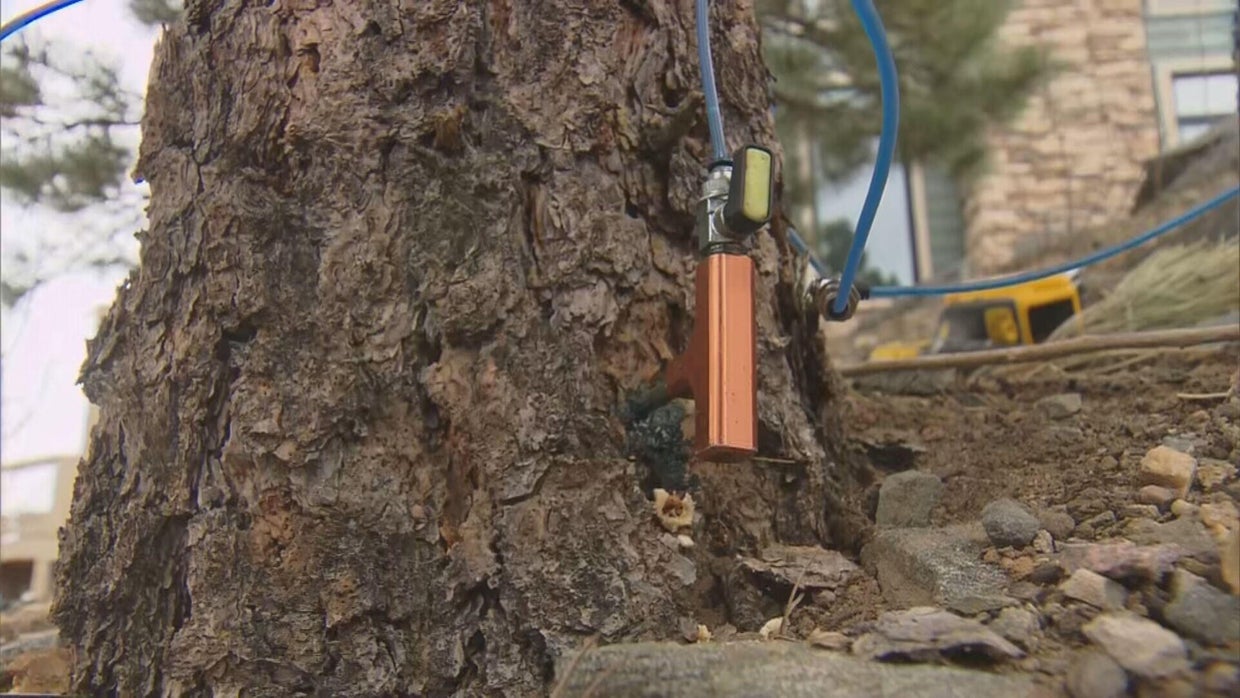
While the acreage at risk may seem smaller, there is potential for very costly damage from the current outbreak. Forests along the Front Range have faced firefighting efforts for 100 years or more, but the affected area may be at greater risk, experts say.
“We’ve got property, life, egress, all the utilities, everything we’ve got along the Front Range that we’ve been protecting. But most of the ponderosa pine in these lower elevation forests are really at-risk because they’ve been there with not much disturbance, and of course, the lack of fire, which creates the mosaic of species and age diversity. And so what we’ve really seen is this kind of ever-increasing larger fuel load and or trees that are along the Front Range, so that’s in large part why I’m more worried about this one than I was in the past,” said West.
“There’s a couple real bad infestations, one along I-70. There’s more in Pine and Conifer and a little bit in between,” explained Brad Huddleston, owner and certified arborist with Splintered Forest Tree Service of Evergreen. On Wednesday, they were working to protect trees in the Ruby Ranch area.
Injecting pesticide into trees helps it uptake into the tree’s vascular system, which can save some trees and protect them longer than an external application, Huddleston explained. He pointed out a goopy pitch on the tree’s exterior as evidence of an attempted invasion. When a tree is stronger, he says it will be better able to resist the infestation. A tree with only a few visible pitch tubes still has a chance to survive.

“That’s what the grant program is trying to address, is trying to get the currently infested trees,” he explained.
That program in Jefferson County is the Mountain Pine Beetle Landowner Assistance Program. It started only a month ago, with $500,000 set aside for homeowners who contract work to fight the pine beetle. Homeowners can apply for reimbursement of 50% of the cost of contracted mitigation services, with priority going to properties of less than 40 acres.
After one month, the program is already planning to pay out $183,000 of that money after receiving 47 applications.
Evergreen resident Scott Porter has been doing work himself after pine beetles wiped out dozens of trees on his property.
“We started having trees die this summer,” he said. “When a tree died, we’d cut it down, and we probably felled close to about 70 trees.”
He bought pheromone packs and a tree injection system for pesticides.
“We have ten acres, and I’ve probably treated over a hundred trees that have not yet been killed by the beetles,” said Porter.
There could be some rough years ahead. Porter said he hopes he’s winning the battle.
Colorado
Did you spot the ‘Doomsday’ and ‘Electronic Attack’ aircraft circling Colorado Springs this week?

COLORADO SPRINGS, Colo. (KOAA) — Social media lit up on Monday after two unique military aircraft were spotted flying laps over and around the Colorado Springs area.
The so-called “Doomsday” plane, or the E-4B “Nightwatch,” took off from Omaha and made its way to Colorado Springs airspace, making several loops before returning to Nebraska, according to its flight data from FlightAware.
The large plane is a militarized version of the four-engine Boeing 747-200, so it’s hard to miss in the sky. Its FlightAware path showed it was on a somewhat low altitude between 6,000 to 9,000 feet during its stay in Colroado Springs.

The aircraft is often referred to as the “Doomsday” plane because it helps ensure continuity of government in the event of a national emergency like a nuclear attack.
Of course, with a plane of that notoriety circling the city, some on social media sites questioned why it was in the area. Residents should rest easy as it appeared to be a typical training and operation flight.
Space Base Delta 1 at Peterson Space Force Base referred questions to the Global Strike Operations Center, which operates out of Barksdale Air Force Base in Louisiana.
“The National Airborne Operations Center has several missions, both operational and training, which require travel to a wide variety of locations, both within the United States and around the world,” said the Global Strike Operations Center in an email. “The E-4B’s visit was part of meeting both the operational and training requirements of the 95th Wing and NAOC mission.”
Around roughly the same time, another noticeable military plane was circling the Colorado Springs area.

The EA-37B took off from the Tuscon area and made its way to central and southern Colorado for laps as well.

This aircraft is known for electronic attacks that disrupt enemy communications.
Neither Space Base Delta 1 nor the Global Strike Operations Center addressed why that plane was in the region at the same time as the E-4B.
If you spotted either aircraft and took photos or video, you can submit them here.
___

This southeast Colorado reservoir completely dried out, taking away one of the best recreation spots
All that’s left of the Two Buttes Reservoir is a scattering of lifeless buoys, a rusty lawn chair, empty beer cans, and a number of fishing lures that have fallen into the water over the years.
This southeast Colorado reservoir completely dried out, taking away one of the best recreation spots
News Tips
What should KOAA5 cover? Is there a story, topic, or issue we should revisit? Have a story you believe should make the light of day? Let our newsroom know with the contact form below.
____
Watch KOAA News5 on your time, anytime with our free streaming app available for your Roku, FireTV, AppleTV and Android TV. Just search KOAA News5, download and start watching.

FIFA World Cup 2026 spurs human trafficking awareness trainings in Missouri, Kansas

Roadway in Northern Kentucky could be designated ‘Charlie Kirk Memorial Highway’

COVID variant Cicada detected in Louisiana

In Maine, officials say fuel prices jumped 41% since the war in Iran began

‘Paralyzing’ E-ZPass fines balloon into tens of thousands in debt as lawmakers push fix

Florida High School Football Rankings: Top 25 teams – Oct. 21

How old is Bo Nix? What to know about Oregon quarterback ahead of 2024 NFL Draft

Cleary's 21 help Le Moyne down Central Connecticut State 69-64 in OT

99th annual Pony Swim held in Virginia

Indiana Members Credit Union announced as new anchor tenant at Bottleworks District

GOP rails against ‘s— sandwich’ deal as all eyes turn to House to end DHS shutdown

Planning commission approves Trump’s White House ballroom plans

Trump does not have to turn over presidential records, Justice Department says

Map: 4.6-Magnitude Earthquake Shakes Northern California

What you need to know: 5 key takeaways from Trump’s Iran address
-

 South-Carolina5 days ago
South Carolina vs TCU predictions for Elite Eight game in March Madness
-

 Education1 week ago
Video: Trader Joe’s Dip Head-to-Head Taste Test
-

 Miami, FL1 week ago
Jannik Sinner’s Girlfriend Laila Hasanovic Stuns in Ab-Revealing Post Amid Miami Open
-

 Culture1 week ago
Wil Wheaton Discusses ‘Stand By Me’ and Narrating ‘The Body’ Audiobook
-

 Minneapolis, MN1 week ago
Boy who shielded classmate during school shooting receives Medal of Honor
-

 Culture1 week ago
What Happens When We Die? This Wallace Stevens Poem Has Thoughts.
-

 Vermont5 days ago
Skier dies after fall at Sugarbush Resort
-

 Politics5 days ago
Trump’s Ballroom Design Has Barely Been Scrutinized