Colorado
Fieldside Chat | Midweek check-in with Cole Bassett and Chris Armas | Colorado Rapids


On the win over Vancouver
It was another tough game for us. We came out ahead on the night against a good team, it’s nice to see the boys win in a different way, to manage the game the way they did. After halftime being up a man, I thought it was a mature performance in the second half, which is never easy just because you’re up a man. I saw some good stuff there in the second half and we had a lot of control. Yes, it’s a shutout, which is really important. It’s a victory here for us at home. The fans once again came out. Pride night is so important to our club, to so many of our fans, and to our team. So yes, even extra special on the night. We look forward to a few days from now. We know what’s coming up.
On the upcoming contest with Real Salt Lake to clinch the Rocky Mountain Cup
I wish we were hosting this one. This Rocky Mountain Cup is such an important cup to us as a team and to our fans. It would have been nice if maybe we played one on the road and then one at home, or one home and one on the road. To have the first two on the road, it’s tricky but that’s what it is. The fact that we have the slight edge at the moment is what it is, it’s an edge. We have a lot of work to do to go there and get the trophy. However, I think you can go through an entire season and not really play for a trophy, and now we are 12 games in or so. The fact that we have a chance to bring one home this early in the season, that we’ve put ourselves in that spot, is a really big positive. We know Salt Lake, they’re a really good team. We’ve played them and we’ve gotten a look at them, but they also have managed a busy week. What team do they put out? It’d be hard to predict that and then even prepare in detail without knowing exactly who they’re putting out with two days [to go]. I think the most important thing is that we went there, we had a victory, and the guys have some confidence that we can go there again. To be clear, we will be going after that. It’s important to our fans. After the match tonight, I can’t say how many were chanting “Beat Salt Lake”, so we will go after them with everything that we have. I can promise our fans that.”
On the significance of winning the Rocky Mountain Cup to Rapids Homegrowns
If you ask those guys, they’ll tell you there’s extra motivation. Every game is a game, but it means a lot to our Homegrowns in our club, it’s ingrained in their blood and what they’ve been brought up with through here. It means a lot to our club, our Unified Team is gonna go for it as well. We’re going for it. Our Homegrowns are always extra motivated for that one. We have a lot of respect for what they’re doing. But we will go there, no doubt to try to bring home the win.
On Connor Ronan, Jonathan Lewis getting back from injury, updates to Djordje Mihailovic’s condition after being subbed off against Vancouver
Always good getting guys healthy, getting guys back on the field, getting the minutes to get deeper in the roster. I trust the guys that we have. You can see that that each of them brought what we thought. [Jonathan Lewis] all of a sudden becomes a guy in transition and in spaces can make something happen, and in those moments and we need to do better. But it’s good to see him back out there. And of course, I think we can all appreciate Connor Ronan’s quality that in that very moment, that he helps control things even more in the middle of the pitch, his decision-making and we’ve missed that. It was good that we could use that on the night. With Djordje Mihailovic, I haven’t gotten all the details yet, but it looks like right after the shot he felt that heel [injury] which is what he was battling recently. I would say it’s fairly minor and we’ll have to see how that responds.



Former Colorado Buffaloes stars Sebastian Rancik and Bangot Dak announced their transfer portal decisions on Sunday with Rancik committing to Florida State and Dak committing to Vanderbilt, per On3’s Joe Tipton. They join former Buffs guard Isaiah Johnson (now at Texas) as the third former Colorado player to leave the Big 12 conference as Rancik opts for the ACC and Dak heads to the SEC.
The trio of Johnson, Rancik, and Dak make up three of Colorado’s four most productive players with rising senior guard Barrington Hargress, and the Buffs are now tasked with replacing such production with Hargress as the only returner.
Rancik’s season ended prematurely with an injury, but he averaged 12.3 points and 5.6 rebounds per game for the Buffs. Dak was Colorado’s leading rebounder with 6.5 boards per game, scoring 11.5 points per contest as well.
While each player has his respective reasons for transferring, the most expected ones are for seeking better NIL deals or more development on a better team in a better league. The Buffs finished 12th in the Big 12, and the allure of the SEC was too strong for the program to hold onto key talent like Johnson and Dak.
Still, Colorado coach Tad Boyle proved his ability to recruit and build up a solid core, one that saw its headliners of Johnson, Dak, and Rancik all depart in the portal. Can he do it again?
Colorado Buffaloes Roster Outlook
Boyle and the Buffaloes did retain Hargress as well as three freshmen guards: Jalin Holland, Ian Inman, and Josiah Sanders.
As a freshman, Holland averaged 4.9 points and 2.7 rebounds per game as one of Colorado’s key pieces coming off of the bench. Meanwhile, Sanders appeared in 33 games as a constant presence in the Buffs backcourt, averaging 4.4 points and 1.7 assists per game.
Inman played the fewest minutes of the returning trio, but he flashed with a couple of double-digit scoring performances as a true freshman.
“When I think of those three together, I think of toughness. I think of the improvement they made over the course of the season and the togetherness they have. They’re great friends and have formed a bond during their freshman year. Their toughness, energy and work ethic, when you have those attributes to go along with talent, which they all have, you get a chance to have three really good sophomores next year that will take the next step,” Boyle said in a release announcing the return of the three freshmen.
With eight outgoing transfers to replace, the Buffaloes will certainly have a new look to them for the 2026-27 season.
Colorado has landed one transfer portal prospect so far in former North Dakota State foward Noah Feddersen. On the recruiting trail, Boyle and company are bringing in four-star forward Rider Portela as well as two prospects from the NBL in Australia: forward Goc Malual and guard Alex Dickeson.
The transfer portal for men’s college basketball closes on Tuesday, April 21, meaning players have to enter their names by then. Transfer athletes do not have to commit before the portal closes, though, so Colorado is expected to continue hosting prospects on visits while building out the roster.
Sign up to our free newsletter and follow us on Facebook for the latest news.
 Add us as a preferred source on Google
Follow

ColoradoAvalanche.com is the official Web site of the Colorado Avalanche. Colorado Avalanche and ColoradoAvalanche.com are trademarks of Colorado Avalanche, LLC. NHL, the NHL Shield, the word mark and image of the Stanley Cup and NHL Conference logos are registered trademarks of the National Hockey League. All NHL logos and marks and NHL team logos and marks as well as all other proprietary materials depicted herein are the property of the NHL and the respective NHL teams and may not be reproduced without the prior written consent of NHL Enterprises, L.P. Copyright © 1999-2025 Colorado Avalanche Hockey Team, Inc. and the National Hockey League. All Rights Reserved. NHL Stadium Series name and logo are trademarks of the National Hockey League.
Colorado
Colorado faces LA in first round as Kings captain Anze Kopitar embarks on final Stanley Cup chase

DENVER — Anze Kopitar wrapped up the last regular season of his storied career. The Los Angeles Kings captain wants to prolong his final playoff run for as long as possible.
Kopitar, who announced in September his plans to retire, instantly becomes a postseason rallying point for the Kings. They have a tall task ahead of them against the Colorado Avalanche, the top team in the league, with the top goal scorer in Nathan MacKinnon and one of the best defensemen in the game in Cale Makar. Game 1 is Sunday at Ball Arena, where the Avalanche are 26-9-6.
“Playoffs,” said the 38-year-old Kopitar, a two-time Stanley Cup winner with the Kings. “I’m not going to say anything can happen, but we’ll go in and we’ll play hard and we’ll see where that takes us.”
This will be the third postseason series between the two teams and the first in 24 years. Colorado won in seven games during both the 2002 conference quarterfinals and the 2001 conference semifinals.
It’s been a record season for the Presidents’ Trophy-winning Avalanche as they amassed the most points (121) in franchise history. That broke the mark set by the 2022 team, which went on to win the Stanley Cup title. MacKinnon had a career-best 53 goals.
Goaltenders Scott Wedgewood and Mackenzie Blackwood shared the net this season and surrendered a league low in goals. They earned the William M. Jennings Trophy, which is presented to the goalies who have played a minimum of 25 games — Wedgewood suited up in 45 and Blackwood 39 — for the team with the fewest goals allowed. The other goaltender to win that honor for Colorado was Hall of Famer Patrick Roy (2001-02).
“We’re in a good spot,” Colorado forward Brock Nelson said. “The mentality of this group throughout the year, right from the start of training camp, (was) set on a mission to be the best team.”
Colorado Avalanche’s Nathan MacKinnon (29) celebrates the goal against Edmonton Oilers goalie Connor Ingram (39) during shoot-out NHL action, in Edmonton on Monday, April 13, 2026. Credit: AP/JASON FRANSON
Record against each other
The Kings went 0-3 against Colorado this season and were outscored by a 13-5 margin.
“You hear the hype. They have good players,” Kings defenseman Brandt Clarke said. “We’re a scrappy team. We keep it close with everybody. That can really frustrate them.”
Leading after two
The Avalanche were 41-0-0 when leading after two periods. They’re the first squad to have a lead after two periods on 40 or more instances and capture each one, according to team research.
“Even though we’ve been smart, we’ve been committed, we’ve been relentless at times, it’s going to have to go to a whole new level now,” Avalanche coach Jared Bednar said. “I have faith in our guys.”
Los Angeles Kings’ Anze Kopitar, who is retiring after this season, acknowledges the crowd after being recognized after losing to the Vancouver Canucks during overtime NHL hockey action in Vancouver, on Tuesday, April 14, 2026. Credit: AP/DARRYL DYCK

Remember the season opener?
Six grueling months ago, the Avalanche and Kings opened the season against each other. The Avalanche won 4-1 in Los Angeles behind a pair of goals from Martin Necas, who would go on to register his first 100-point season (38 goals, 62 assists).
The two teams join an exclusive club by becoming the fifth pair since 2015-16 to open the regular season and the playoffs against each other, according to NHL Stats. The other pairs to do so were Montreal and Toronto (2020-21); Colorado and St. Louis (2020-21); St. Louis and Winnipeg (2018-19); and Los Angeles and San Jose (2015-16).
Of those teams that won the season opener only San Jose went on to win the series. It’s a trend Kopitar and the Kings wouldn’t mind joining.
Kopitar and the playoffs
Kopitar helped the Kings to the Stanley Cup title in 2011-12 and 2013-14 along with goaltender Jonathan Quick, who now is with the New York Rangers and recently said he’s retiring. Kopitar has played in 103 postseason games with 27 goals and 62 assists.
“The intensity ramps up, everything ramps up,” Kopitar said of the postseason. “Every mistake, every little play, magnifies now.”
Familiar faces
Kings goaltender Darcy Kuemper was in net for the Avalanche when they won the Stanley Cup in 2022. In addition, Kuemper and Drew Doughty were teammates with MacKinnon, Makar and Devon Toews when Canada won silver at the Milan Cortina Olympics.
-
 Sports4 minutes ago
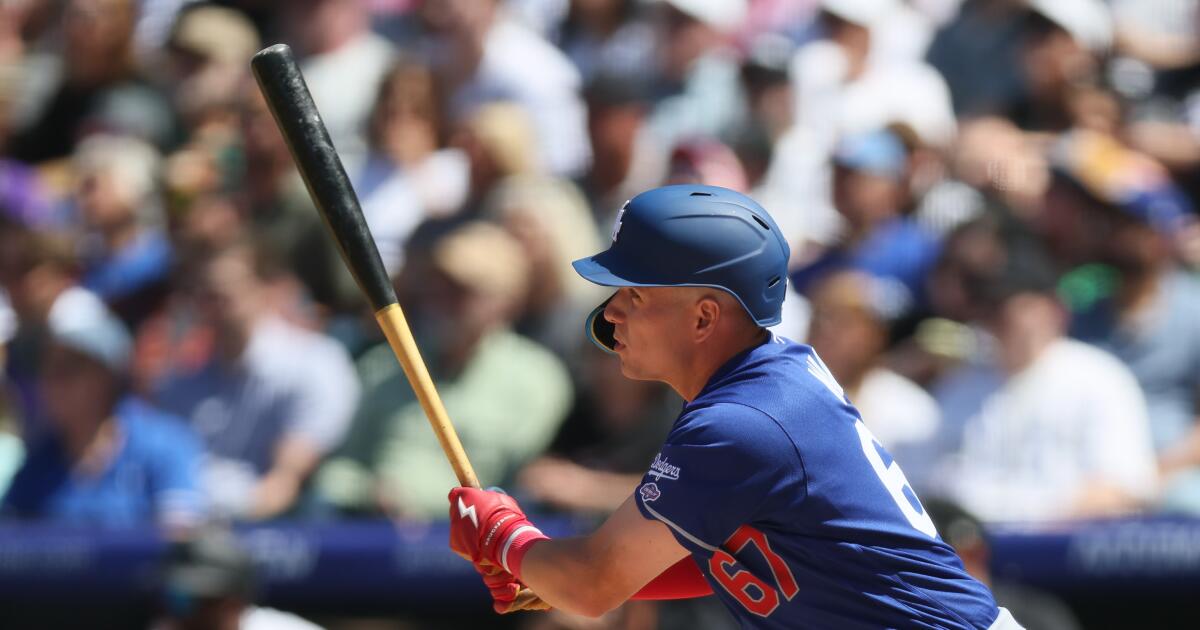
Ryan Ward has a solid debut, but bullpen blows it again as Dodgers lose to Rockies
-

 World16 minutes ago
Schools, shops shut in northern Israel to protest the Lebanon ceasefire
-
 News46 minutes ago
Communities launch cleanup after severe weather and tornadoes churn across Midwest
-

 Detroit, MI3 hours ago
Game 21: Tigers at Red Sox, Garrett Crochet battles both Detroit and the weather
-

 San Francisco, CA3 hours ago
Why do gray whales keep dying in San Francisco’s waters?
-

 Dallas, TX3 hours ago
Dallas Mavericks Owners Might Be Making Big Mistake in Search for New GM
-

 Miami, FL3 hours ago
Defense dominates, Mensah flashes in Miami’s spring game – The Miami Hurricane
-
Boston, MA3 hours ago
A crowd scientist is helping the Boston Marathon manage a growing field of 30,000-plus runners

