West
California’s politicians didn’t start the fires. They made them worse

NEWYou can now listen to Fox News articles!
Seeing homes in Malibu and the Pacific Palisades burn to the ground while fire hydrants ran dry is bad enough, but knowing the water shortage resulted from bad bureaucratic decisions makes the horrifying sights even worse.
Water is everywhere in California. The Golden State borders the Pacific Ocean, which contains countless gallons that could be desalinated to fill reservoirs and feed fire hydrants.
But California’s bureaucracy discourages desalination plants that would guarantee additional water, and no reservoirs were built with the $2.7 billion authorized in 2014.
LOS ANGELES WILDFIRES: CALIFORNIA FIREBUG ARREST CAUGHT ON VIDEO AS POLICE WARN OF ARSONISTS
Environmentalists prefer blaming climate change for wildfires, just like the ancient Greeks blaming their gods when things went wrong. It’s passing the buck rather than looking in the mirror.
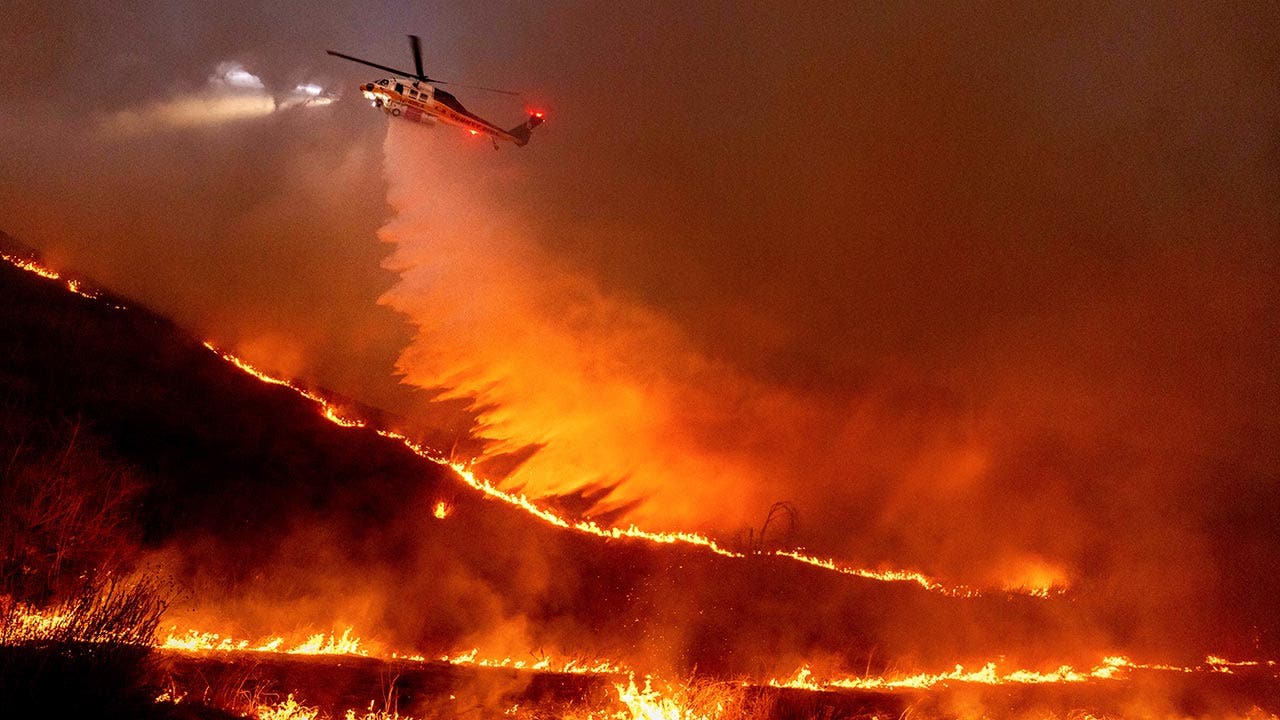
Water is dropped by helicopter on the Kenneth Fire in the West Hills section of Los Angeles, Thursday, Jan. 9, 2025. (Ethan Swope/AP)
Acres of fires burned on federal lands from 1916 to the mid-1940s, when CO2 emissions were lower, were as high as levels in the first decade of the 2000s.
In California, politicians promoted an agenda to get rid of water, energy and minerals, which increased human suffering. The question is how they retain power without people voting them out of office.
This is particularly true when considering the tragedy of the fire, which could have been prevented by water.
State agencies that must approve desalination projects include the State Water Resources Control Board, the California Coastal Commission, the California State Lands Commission, the California Department of Fish and Wildlife, Monterey Bay National Marine Sanctuary, the National Marine Fisheries Service’s West Coast Region and the six coastal regional water quality control boards. This system is designed to slow progress.
Plus, approval depends on tribal consultation, environmental justice, consideration of marine life and energy efficiency, among other factors.
California has awarded $120 million for desalination projects, compared to $1.4 billion on charging stations and $500 million for electric school buses. The California Air Resources Board has the power to fast-track clean air regulations.
Surely, if California can afford billions of dollars on electric vehicles, the state can afford to fill its reservoirs with water — especially since the wildfires are doing more harm to the air than gasoline-powered vehicles?
Countries with lower GDP than California have no trouble building desalination plants. Such plants produce over 7 million cubic meters per day in the United Arab Emirates, about 40% of the country’s drinking water. Kuwait and Oman use desalination for about 90% of their drinking water, and Saudi Arabia’s share of desalinated water is 70%.
More burned-out cars from the Eaton fire at a Brake Masters in Altadena. (Fox News Digital / Ashley Carnahan)
Bahrain has recently completed its second desalination plant, with new reverse osmosis energy-efficient technology from Veolia Water Technologies, headquartered in France. The plant produces 227,000 cubic meters a day and began operations after 22 months.
The problem is that California’s government has created water scarcity, just as it created energy scarcity and critical mineral scarcity.
CLICK HERE FOR MORE FOX NEWS OPINION
California requires 60% of its energy to be created from renewables by 2030, so it has an energy scarcity with high prices. The legislature unanimously passed the Seabed Mining Prevention Act in 2022, which prevents extracting critical offshore minerals, leaving America at the mercy of China.
The environmentalist agenda, which focuses on scarcity rather than abundance, gives power to governments to distribute those limited resources. In times of scarcity, people become dependent on government rather than depending on their own actions.
Water is everywhere in California. The Golden State borders the Pacific Ocean, which contains countless gallons that could be desalinated to fill reservoirs and feed fire hydrants.
One of the two houses on his street that survived the 2018 Wolsey Fire in Malibu was owned by Robert Kerbeck, author of “Malibu Burning: The Real Story Behind L.A.’s Most Devastating Wildfire,” who learned in advance how to spray his home with fire retardant and who cut back brush that could feed the flames.
As Kerbeck recently wrote, “We need more water to fight fires, more reservoirs to store the water, and more firefighters with the right kind of equipment to battle these massive wind-driven blazes.”
California’s policies are often based on a myth inside an enigma, to paraphrase Churchill about the Soviet Union. Californians who promoted the agenda of energy, water, and mineral scarcity for the sake of the environment should think again. Nature should not be worshiped at such cost to people.
CLICK HERE TO READ MORE BY DIANA FURCHTGOTT-ROTH
Read the full article from Here


OPINION: Alaska’s LNG future requires creative thinking
Published 1:30 am Wednesday, July 1, 2026
Many Alaskans have grown increasingly skeptical that the proposed liquefied natural gas (LNG) pipeline is not moving forward because of its escalating cost. Early estimates placed the project near $44 billion; more recent figures — though unofficial — suggest costs approaching $60 billion or more. When projects reach this scale, uncertainty alone can stall even the most ambitious development plans.
That uncertainty is reflected in the caution shown by Alaskan major energy companies such as Exxon, ConocoPhillips, and BP. Their hesitation is not surprising: projects of this magnitude carry significant capital exposure, and investors require a clear path to profitability before committing. In practical terms, that means LNG prices would need to be high enough to recover costs and provide returns, even in a global market where competing supply — including underdeveloped reserves in Russia and elsewhere — continues to exist.
This cost pressure is also evident in current negotiations with prospective project partners. Currently, one example is Glenfarne, which has reportedly emphasized that state corporate taxes would need to be waived as part of any development agreement. While tax incentives are common in large infrastructure deals, the scale of the requested waiver raises legitimate questions about long-term public benefit and fiscal sustainability.
Alaska has faced similar debates before. During the Trans-Alaska Pipeline negotiations, tax structures were part of the broader discussion, but they were not treated as a condition that undermined the project’s feasibility. More recently, companies such as Hilcorp — now a major operator in Cook Inlet following acquisitions from BP — have benefited from favorable operating conditions, as a sub chapter S Corp, and therefore tax exempt.
Yet declining natural gas production in Cook Inlet has already raised concerns about long-term energy security for the Anchorage region, underscoring the need for new reliable supply sources. The central question is: if a project is only viable with extensive tax waivers and escalating public concessions, does it truly serve Alaska’s long-term economic interests? The state relies heavily on a limited set of revenue streams to fund education, transportation, and public services, including the Alaska Highway System. At the same time, Permanent Fund Dividend levels have become increasingly constrained. Against that backdrop, LNG development is often presented as one of the few significant new revenue opportunities on the horizon.
However, waiving broad categories of taxation for a single project could set a dangerous precedent with long-term consequences. Alaska must balance the need to attract investment with the responsibility to maintain a stable and equitable revenue base.
Infrastructure costs are only part of the challenge. Alaska’s unique land ownership structure — where the federal government controls roughly two-thirds of land within the state — adds complexity to large-scale development. This makes innovative approaches to transportation and energy export even more important.
It has been suggested that the proposed LNG line from the North Slope to Kenai be built in two phases. The first would be to build the line to initially serve the Fairbanks and Anchorage metro areas. Later, the final section, including the export dock, would be constructed on the Kenai. The drawback with this approach is the first section would not distribute enough LNG to cover operating costs or debt reduction.
An interesting group that continues to research the Arctic proposal of LNG by ice-breaking tanker to Asia is Oilak, associated with Lloyd Energy Company, with estimates of nearly 40% cost savings in transportation by the Arctic tanker route suggested.
Ice-breaking LNG tanker technology is already in use in Arctic regions, including Russia. Similar approaches could allow North Slope gas to reach Asian markets more directly. This would involve specialized loading facilities and seasonal shipping strategies designed around Arctic conditions.
During the 1967-68 period I worked in state government and during that time, we maintained a State office in Tokyo, Japan. The purpose was to promote Alaska resource potential to the Asian countries. This resulted in stimulating Alaska’s timber and fisheries industry, resulting in pulp mills in Sitka and sawmills in Ketchikan, Wrangell, Haines and Metlakatla, as well as several fish processing plants throughout Alaska.
I believe there is an opportunity to consider international equity partnerships in any LNG proposal. Countries such as Japan, South Korea, the Philippines and Taiwan, as well as other major LNG importers, could potentially participate as investors in infrastructure development in exchange for long term supply agreements. Similar models have been used in Alaska’s resource history, including earlier investment in timber, pulp and sawmills and fisheries operations across Alaska. Our state’s presence in Tokyo, as I’ve indicated, helped facilitate trade relations and market development.
These kinds of partnerships are not without complexity, but they reflect a broader truth: large-scale resource development increasingly requires creative financing structures and shared risk models.
Ultimately, the most expensive component of any LNG strategy is not just production, it is transportation to market. Whether through pipelines, rail systems, or Arctic shipping corridors, the chosen infrastructure path will determine the project’s viability more than resource availability itself.
Alaska should be cautious about allowing enthusiasm for a single project structure to override broader fiscal considerations. The goal should not be development at any cost, but development that strengthens the state’s long-term economic foundation. I believe if consideration of the potential of the Alaska Arctic tanker route were given genuine support by our governor and the legislature, the Arctic route would advance far beyond the current debate over foreign tax forgiveness. The state would generate greater revenue from the cost savings on transportation alone. Let’s take a look at how they are doing it from the Russian Arctic.
Frank Murkowski is a former U.S. senator and Alaska governor.

MARANA, AZ (AZFamily) — Proposals for data centers and ICE detention facilities in Marana are dividing neighbors and turning some against their local leaders.
These are two issues that some Republicans and Democrats are finding themselves agreeing on, as people try to take charge of who and what ends up in their communities.
“Well, first I think everyone on our city council needs to be replaced. What they are doing to Marana and surrounding areas is destroying our future and our kids’ futures,” a Marana resident said.
A recent proposal by the Department of Homeland Security would create an ICE detention center about 3 miles from the community center.
The property proposed for the ICE facility was a minimum-security prison with a capacity of about 500 people. The release said that renovations will increase capacity to 775, but could expand to over 1,300.
DHS officials say the facility would include more exam rooms, a dental area, and other features.
Arizona’s Family asked DHS for some clarification on those numbers and details. DHS released a statement saying, “ICE does not discuss individual pre-decisional conversations, but when a new facility contract is finalized, information will be available on ICE.gov.”
Data center concerns
Meanwhile, a rezoning application for a data center surfaced on the Town of Marana’s website last week.
It’s the second potential data center in the area and has people itching to get to public comment to voice their concerns.
“The detention center- we don’t need that here; no one wants that here. The data center- I mean, we already don’t have water and it’s awful; we don’t need another data center. Look at the ones across the country and what they’re doing,” the Marana resident we spoke with said.
Marana Town Manager Terry Rozema said nothing is set in stone.
“There’s so many factors that could come into considering whether or not something is beneficial to a community,” Rozema said.
Supporters of these projects said they will create jobs.
See a spelling or grammatical error in our story? Please click here to report it.
Do you have a photo or video of a breaking news story? Send it to us here with a brief description.
Copyright 2026 KTVK/KPHO. All rights reserved.
California
California bill to block registered sex offenders from local office rejected by Senate committee

FRESNO, Calif. (KFSN) — California bill aimed at preventing registered sex offenders from holding local elected office was halted Tuesday after a Senate committee declined to advance the measure without changes opposed by its author.
Assembly Bill 2753, introduced by Assemblywoman Esmeralda Soria in February, would have prohibited anyone who is or has been required to register as a sex offender from running for local elective office.
“This issue is critical. We have heard loud and clear from the community that we must do something,” Soria said.
The proposal came to a stop in the Senate Elections Committee, where lawmakers argued the bill’s restrictions were too broad.
California’s sex offender registration system is divided into three tiers. Tier 1 offenders are generally required to register for 10 years, Tier 2 offenders for 20 years and Tier 3 offenders for life.
According to Soria, committee members proposed limiting the bill to Tier 3 offenders. She rejected those amendments, arguing that the legislation should apply more broadly.
“For this not to be the law today, where we’re banning people that have committed some of the most horrific crimes against children, against other people, you know, and we have survivors out there, I think it’s a disservice,” Soria said.
The bill had attracted significant support before reaching the Senate. It was backed by the Fresno City Council and passed the Assembly floor in April.
Fresno City Council President Nelson Esparza traveled to Sacramento to testify in favor of the measure and said he was disappointed by the outcome.
“I call it really a gut punch for our community, and what we had experienced here, and sort of the upheaval… I don’t think we want that to happen again here at Fresno,” Esparza said.
Esparza referenced controversy earlier this year involving registered sex offender Rene Campos, who sought a seat on the Fresno City Council but ultimately did not qualify for the ballot.
Opponents of the bill argued that candidacies should be decided by voters rather than restricted by law.
“It should be a decision made by the voters, so a person should not be barred from running for office and let the voters make the decision that makes the most sense for them,” said civil rights attorney Janice Bellucci.
With the committee declining to move the bill forward under its current language, efforts to enact the proposed restrictions have stalled for now.
Copyright © 2026 KFSN-TV. All Rights Reserved.
-

 Cleveland, OH3 minutes ago
Rangers capitalize on costly Guardians mistake, extend winning streak to six
-

 Austin, TX10 minutes ago
Apptronik opens robot training hub in Austin, Texas and debuts Apollo 2
-

 Alabama13 minutes ago
Alabama grocery bills will change as tax returns July 1
-

 Alaska18 minutes ago
OPINION: Alaska’s LNG future requires creative thinking – Homer News
-

 Arizona25 minutes ago
Proposed data centers, ICE facility create mixed emotions in rural Arizona town
-

 Arkansas27 minutes ago
Central Arkansas bike trail breaks ground in Cabot – The Arkansas Leader
-

 California33 minutes ago
California bill to block registered sex offenders from local office rejected by Senate committee
-

 Colorado40 minutes ago
Where to watch Miami Marlins vs Colorado Rockies: TV channel, start time, streaming for July 1

