California
RWE to start California offshore wind project surveys


June 16, 2024

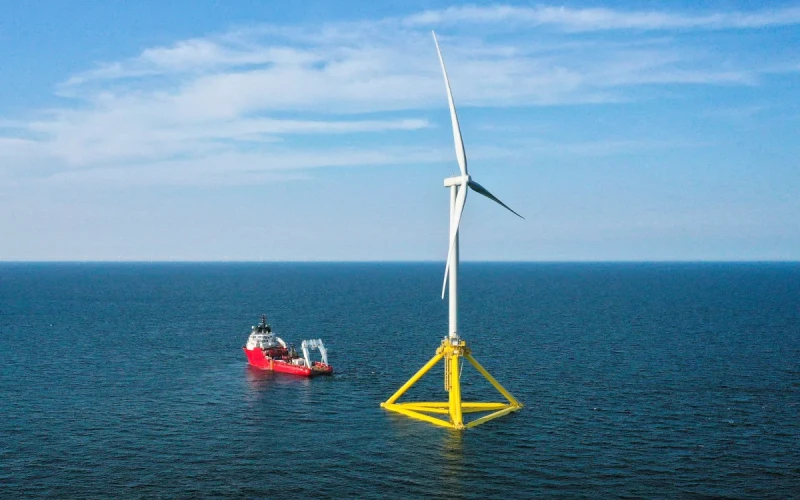
Offshore wind developer RWE announced it will start site investigation surveys for its planed 1.6-gigawatt Canopy Offshore Wind Farm off northern California.
Located 20 miles off Humboldt County, the Canopy project would anchor floating wind turbines on a 63,338-acre lease RWE obtained in a 2022 auction by the federal Bureau of Ocean Energy Management.
“Surveying is an important step on the path toward developing Canopy Offshore Wind and helping provide clean energy that meets California’s ambitious climate goals,” said Sam Eaton, CEO of RWE Offshore Wind Holdings, in a June 12 statement. “RWE is committed to responsible, inclusive development by engaging Humboldt residents, Tribal Nations, and working closely with the fishing community as we begin offshore activities on the project.”
RWE selected subsea service provider Argeo to perform the Canopy site investigation work. “Argeo is pleased to partner with RWE on their first commercial scale floating offshore wind project. We will conduct subsea surveying utilizing proven, state-of-the-art technology,” said Dave Gentle, vice president for North and South America at Argeo.
Argeo will utilize an autonomous underwater vehicle (AUV) to conduct surveys in the Humboldt lease area, where depths range from 500 to 1,100 meters (1,640 to 3,600 feet) according to BOEM.
“The use of an AUV as the survey platform during this initial site characterization effort will enable high-quality data collection close to the seafloor, including photographs of biological communities,” according to a summary by RWE.
Using the autonomous vehicle “significantly reduces the potential for entanglement of fishing gear as they are not towed equipment,” the company says. The sensors carried by the AUV operate at safe sound levels and meet California low energy equipment requirements for geophysical surveys that are in place to minimize impacts to marine mammals and other wildlife.”
Groups opposing offshore wind projects off the U.S. East Coast have worked to tie survey work to whale strandings and deaths. West Coast wind power is just entering that first phase of development, and RWE officials said they are planning to deploy protected species observers on survey vessels.
The company has engaged Geo SubSea and Coastal 35 Consulting to provide PSOs on survey vessels. Smultea Sciences will provide PSO training “to Tribal citizens and Humboldt County community members to increase the involvement and workforce opportunities for individuals who possess local and Indigenous knowledge of the area during the site investigation campaign,” according to RWE.
The first survey work is planned to start in June to map the seafloor and begin assessing best locations for turbines, anchors and cables, and charting habitat and environmental factors.
“Protected Species Observers are an essential part of ensuring site surveys occur safely in a way that avoids interactions with wildlife,” said Jeff Gardner, president of Geo SubSea, in a joint statement with RWE. “They are an important way to ensure offshore wind surveys are conducted in a manner that results in minimal disturbance to the marine ecosystem.”
“The role of the PSO is solely dedicated to monitoring for protected species,” said Jenn Klaib, owner of Coastal 35 Consulting. “PSOs work to enforce environmental regulations that protect marine wildlife and also provide valuable data for Canopy to better understand marine mammals, their habitats, behaviors, and migration routes.”
In April, Smultea Sciences trained 19 members of the local Humboldt and Tribal communities as Protected Species Observers. Several graduates of this program subsequently participated in Global Wind Organization safety training
“The Smultea Sciences team is pleased with the strong turnout of local CalPoly Humboldt and other students, local Tribal members, and community members attending and successfully completing our Marine Protected Species training,” said “It was very fulfilling to share our collective knowledge and experience in my hometown community and to open the door to work opportunities in the realms of marine biology and green energy development for Humboldt residents.”
RWE says its consultations with the northern California fishing industry “resulted in Canopy survey planning intended to avoid and minimize the potential for activity overlap, with activities sequenced in different areas during varying fishing seasons.”
The company is sending local commercial fishermen to Global Wind Organization safety training. Local fishing captains, identified by the area’s fishing industry, “will serve as an Onboard Fisheries Liaison (OFL) on the survey vessel to manage at-sea communication and coordination with the fishing fleet during survey activities,” the company says.



California
Sheriff’s lieutenant with million-pound fireworks stash led to deadly blast, prosecutors say

A former Yolo County Sheriff’s Office lieutenant is one of five people charged with murder following a fireworks warehouse explosion that killed seven workers in the rural Northern California community of Esparto last summer, authorities said.
Samuel Machado is accused of illegally having 1 million pounds of fireworks on his property at the time of the blast and using his law enforcement position to shield the illicit operation from scrutiny for years, according to the Yolo County district attorney’s office.
Machado was placed on administrative leave following the violent July 1 explosion, which was felt by residents up to 20 miles away, destroyed a family farm and sparked a 78-acre grass fire.
Devastating Pyrotechnics LLC and Blackstar Fireworks, Inc., are accused of manufacturing and storing explosives — including some too powerful to even be legally considered fireworks — on Machado’s property. On Friday, Yolo County Dist. Atty. Jeff Reisig announced a 30-count felony indictment had been filed against seven people connected to the blast, following the largest investigation he’s seen in two decades at the office. A separate five-count felony indictment was filed against an eighth defendant, Machado’s wife.
The most serious counts are seven second-degree murder charges — one for each of the warehouse workers who died.
An investigative report filed by a Yolo County civil grand jury last month stated that various top county authorities were aware of the sprawling illegal operation for at least three years prior to the lethal explosion, yet failed to take action.
A county Building Services Department official received a tip that the property was being used by two pyrotechnics businesses in June 2022, according to the report. Department officials wrote in emails that they would inspect the site, but noted they would “tread lightly” as the property was owned by “deputies that we work with.”
“Inexplicably, no code enforcement occurred, even though all dangerous fireworks had been banned by ordinance throughout rural Yolo County since 2001,” the report states. “In the absence of official oversight and enforcement, unmitigated expansion of the fireworks businesses operating at the site in Esparto led directly to death and destruction.”
In addition to Machado, the owner of Devastating Pyrotechnics, Kenneth Chee, operations manager Jack Lee and business partner Gary Chan Jr. all were charged with murder, as was Douglas Tollefsen of Blackstar Fireworks, Inc.
Machado’s wife, Tammy, was working at the Sheriff’s Office in an administrative position at the time of the blast. She also has been placed on leave and was charged in a separate indictment with child and animal endangerment for allegedly storing illegal fireworks at their property, as well as tax fraud and mortgage fraud.
The 30-count indictment alleges a decadelong conspiracy that “turned the property of a former Sheriff’s Lieutenant Sam Machado into the Northern California hub for an illegal enterprise that imports illegal explosives on the black market,” Yolo County Deputy Dist. Atty. Clara Nabity said at a Friday news conference.
Devastating Pyrotechnics is accused of expanding its footprint from 13 storage containers on Machado’s property in 2015 to more than 50 containers and a 5,000-square-foot warehouse in 2025.
During that period, the enterprise allegedly imported more than 11 million pounds of explosives and related materials onto a site located near residents and a family pool, Nabity said. None of the storage containers were licensed by the Bureau of Alcohol, Tobacco, Firearms and Explosives, and there are no licenses that permit the storage of explosives near homes and public roadways, Nabity said.
Other counts filed in the indictments include charges for having a dangerous workplace, unlawfully causing a fire, insurance fraud, child endangerment, animal cruelty, tax fraud and possession of illegal assault weapons.
Seven people charged in connection with the explosion were arrested in a sweeping operation early Thursday morning, Reisig said, including Blackstar Fireworks owner Craig Cutright. Ronald Botelho III, who worked for Blackstar, has been in custody since December on separate charges, the Associated Press reported, and on Thursday was charged for his alleged role in the explosion.
Chee, the owner of Devastating Pyrotechnics, was arrested in Orlando, Fla. Jail records obtained by Monterey Bay area news station KSBW indicate that he was apprehended at Disney World.
The defendants are scheduled to be arraigned Monday, Reisig said. Chee and another defendant who was arrested outside the county will be arraigned once they have been transferred to local custody, he added.
“This investigation has thus far involved dozens, maybe hundreds of law enforcement agencies around the state and the country,” Reisig said. “It has taken us across California, it’s taken us across the nation and it’s even taken us across our national borders.”
The seven workers killed in the explosion were identified as Christopher Goltiao Bocog, 45, and Neil Justin Li, 41, of San Francisco; Joel Jeremias Melendez, 28, of Sacramento; Carlos Javier Rodriguez-Mora, 43, of San Andreas; brothers Jesus Manaces Ramos, 18, and Jhony Ernesto Ramos, 22, of San Pablo; and Angel Mathew Voller, 18, of Stockton, according to the Yolo County coroner’s office.
The families of the victims filed a $35-million claim against the county and state fireworks regulators alleging widespread negligence for allowing the illegal operation to continue.
California
7 arrested in a Northern California fireworks warehouse blast that killed 7 and injured 2

WOODLAND, Calif. (AP) — Seven people have been arrested in connection with a fireworks warehouse explosion in Northern California that killed seven people and injured two others last July, authorities said Friday.
The deadly fireworks explosion near the small farming community of Esparto in Yolo County sparked a massive fire and led to nearby Fourth of July celebrations being called off.
The Yolo County District Attorney’s Office is expected to announce the indictments for those arrested at a news conference Friday. Several of those arrested have been booked on murder charges, according to jail records.
Those arrested include Samuel Machado and Tammy Machado, who owned the warehouse about 40 miles (64 kilometers) northwest of Sacramento. At the time, Samuel Machado was a lieutenant with the Yolo County Sheriff’s Office and his wife, Tammy Machado, was a non-sworn administrative employee. They were put on leave after the incident.
Kenneth Chee, owner of Devastating Pyrotechnics, whose illegal fireworks were being stored at the warehouse, was arrested in Florida. He appeared in a Florida courtroom Friday and was told he will be extradited to California within the week, KCRA-TV reported.
Authorities also arrested Jack Lee, the operations manager for Devastating Pyrotechnic, and Gary Chan Jr., whose name is on the company’s federal license, the television station reported.
Craig Cutright, the owner of Blackstar Fireworks, which operated at the Esparto property owned by the Machados, was also among those arrested. Cutright, was a volunteer firefighter for the Esparto Fire District and was also listed as an employee of Devastating Pyrotechnics, KCRA-TV reported.
One of Cutright’s employees, Ronald Botelho III, has been in custody since December. More than a dozen new charges were filed against him Thursday, jail records show.

(KTXL) — Northern California residents will have an opportunity to see the world’s largest steam locomotive when Union Pacific’s “Big Boy” makes numerous stops in the state over the next several days.
Big Boy No. 4014 is in the middle of a coast-to-coast tour that will take the train from California to Pennsylvania in celebration of the 250th anniversary of the United States. The train began the journey last month in Cheyenne, Wyoming, the locomotive’s home base, and arrived in Portola, California on Wednesday.
After stops in Oroville, Marysville and Lincoln Thursday, Big Boy will arrive for a multi-day stay in Roseville, California.
“We’re proud to welcome the Big Boy back to Roseville, a city that owes its founding more than a century ago to the railroad,” Roseville Mayor Krista Bernasconi said in a news release. “Big Boy’s return isn’t just a nod to our past; it brings visitors from across the region to explore the shopping, dining, events and attractions that make Roseville such a vibrant place to be.”
The train will be on public display at 375 Atlantic Street in Roseville for two days: 1-5 p.m. on April 10 and 9 a.m. to 3 p.m. on April 11.
While in the Golden State, the train will also make brief “whistle-stops” in several other area towns:
- Oroville, April 9, 2-2:30 p.m., 2181 High Street
- Marysville, April 9, 3:30-3:45 p.m., 7th Street Crossing
- Lincoln, April 9, 4:30-4:45 p.m., 7th Street Crossing
- Colfax, April 12, noon-12:45 p.m., Amtrak Depot, 99 Railroad Street
- Truckee, April 12, 4:45-5 p.m., 10065 Donner Pass Road
Admission is free, though Union Pacific warns that guests should always stay 25 feet back from the tracks and never climb on the locomotive.
U.S. Labor Secretary Lori Chavez-DeRemer, former Oregon congresswoman who now serves in President Donald Trump’s administration, will be in town to celebrate the visit. The cabinet member plans to talk with the Big Boy’s “steam team” and learn more about the locomotive, officials said.
Big Boy No. 4014 was one of 25 locomotives commissioned for Union Pacific Railroad beginning in 1941. According to the company, they were built to haul heavy equipment during World War II between Ogden, Utah and Cheyenne, Wyoming.
The locomotives are 133 feet long and weigh 1.2 million pounds. They are “hinged,” which helps the huge trains navigate curves.
The Big Boys were eventually decommissioned, including the retirement of No. 4014 in December 1961 after traveling more than a million miles, according to Union Pacific.
But in 2013, the company reacquired the locomotive from a museum in Pomona, California. And in May 2019, Big Boy No. 4014 was returned to service, celebrating the 150th anniversary of the completion of the Transcontinental Railroad.

Jazz lose by winning in the ‘Tanking Super Bowl’ — but optimism reigns as team imagines possibilities for next season
VT Lottery Mega Millions, Gimme 5 results for April 10, 2026

‘Don’t Fairfax Me’: How Virginia’s largest county became center of antiredistricting campaign – WTOP News

Report: Wisconsin transfer John Blackwell down to six schools, not two
Trump promised to cut electric costs in half. In energy-rich West Virginia, bills now top mortgages

Florida High School Football Rankings: Top 25 teams – Oct. 21

How old is Bo Nix? What to know about Oregon quarterback ahead of 2024 NFL Draft

Cleary's 21 help Le Moyne down Central Connecticut State 69-64 in OT

99th annual Pony Swim held in Virginia

Indiana Members Credit Union announced as new anchor tenant at Bottleworks District

Trump adversary running for Senate borrows his filibuster playbook

Russian propaganda unit targets Hungary’s elections

WATCH: Artemis II astronauts splash down on Earth

Swalwell’s former female staffer drops bombshell allegations of sexual assault, exposing himself: report

NASA’s Artemis II prepares for splashdown on Earth
-

 Atlanta, GA6 days ago
1 teenage girl killed, another injured in shooting at Piedmont Park, police say
-

 Education1 week ago
Video: Toy Testing with a Discerning Bodega Cat
-

 Movie Reviews1 week ago
Vaazha 2 first half review: Hashir anchors a lively, chaos-filled teen tale
-

 Georgia4 days ago
Georgia House Special Runoff Election 2026 Live Results
-

 Pennsylvania5 days ago
Parents charged after toddler injured by wolf at Pennsylvania zoo
-

 Arkansas20 hours ago
Arkansas TV meteorologist Melinda Mayo retires after nearly four decades on air
-
 Milwaukee, WI5 days ago
Potawatomi Casino Hotel evacuated after fire breaks out in rooftop HVAC system
-
 Entertainment1 week ago
Inside Ye’s first comeback show at SoFi Stadium