California
Missing house cat makes incredible trek from Yellowstone to California


At the edge of their campground in Yellowstone National Park in June, Susanne and her husband, Benjamin “Bennangy” Anguiano, gazed at the lodgepole pine tree forest. The ground was covered with piles of broken branches and dry, old trees that had fallen on top of each other.
The Anguianos felt overwhelmed and distraught: Somewhere in that forest was their small, brownish seal point Siamese cat that had run off from the Fishing Bridge RV Park.
For five days the couple searched the area, calling out for their 2-year-old cat named Rayne Beau (pronounced “rainbow”). They used cat food and toys to try and lure him back.
Benjamin and Susanne Anguiano in Yellowstone National Park.
(Benjamin and Susanne Anguiano)
But it would be weeks before they would reunite with their beloved pet, a tearful reunion that by some miracle would also take place hundreds of miles west in California.
There is no shortage of stories about pets traveling great distances to get home. In 2012, a black Labrador named Bucky walked 500 miles from Virginia to South Carolina, eventually reuniting with his owner.
Hollywood has even made movies about them — take 1993’s “Homeward Bound,” in which an American bulldog, a golden retriever and a Himalayan cat make their way through the Sierra Nevada to San Francisco to reunite with their family.
And now, there’s Rayne Beau.
Although it has been a month since the cat returned home, it wasn’t until this weekend that the Anguianos felt comfortable enough to talk about the incident, in part because they want to know if anyone helped the cat travel more than 800 miles from Yellowstone to California.
In a phone interview Friday, Susanne Anguiano said everything began June 4 when the couple arrived at the campground. She said she was trying to transfer Rayne Beau and his sister, Star, a flame point Siamese cat, from the truck to the traveling trailer.
Anguiano said she was untangling the cats’ leashes when Rayne Beau jumped out of the vehicle, slipping out of his collar before dashing toward the forest.
“I screamed,” she said. “I swear, I think the whole campground heard me.”
She ran after Rayne Beau, leaving the truck door open and the other cat behind. She said her husband shut the door to prevent the other cat from escaping.
She said Rayne Beau ran under a log, where she tried to scoop him up, but that caused him to run off again, this time deeper into the woods. Eventually, she lost sight of him.
The next day they reported the cat missing with the ranger’s office, providing a photo.
“Every morning I went out for an hour and called,” she said. “Even his sister, from the safety of the screen door of the trailer, meowed for him.”
The couple spent days searching the forest, calling out for him, trying to entice him with tuna and toys well into the night.
“But he never showed up,” she said. “Then came the day when we had to leave and that was horrible.”
“It felt like I was abandoning him,” she said.
As their truck pulled out of the campground on June 8, Anguiano looked out the window, crying, calling and scanning the road.
“I knew it was hopeless to do that but I did it anyway,” she said.
The ride home was somber. The couple didn’t talk, and Star clung to Susanne. She worried about Rayne Beau getting stuck in a tree or falling from one. Would he starve? No, she told herself, there were plenty of mice he could live off.
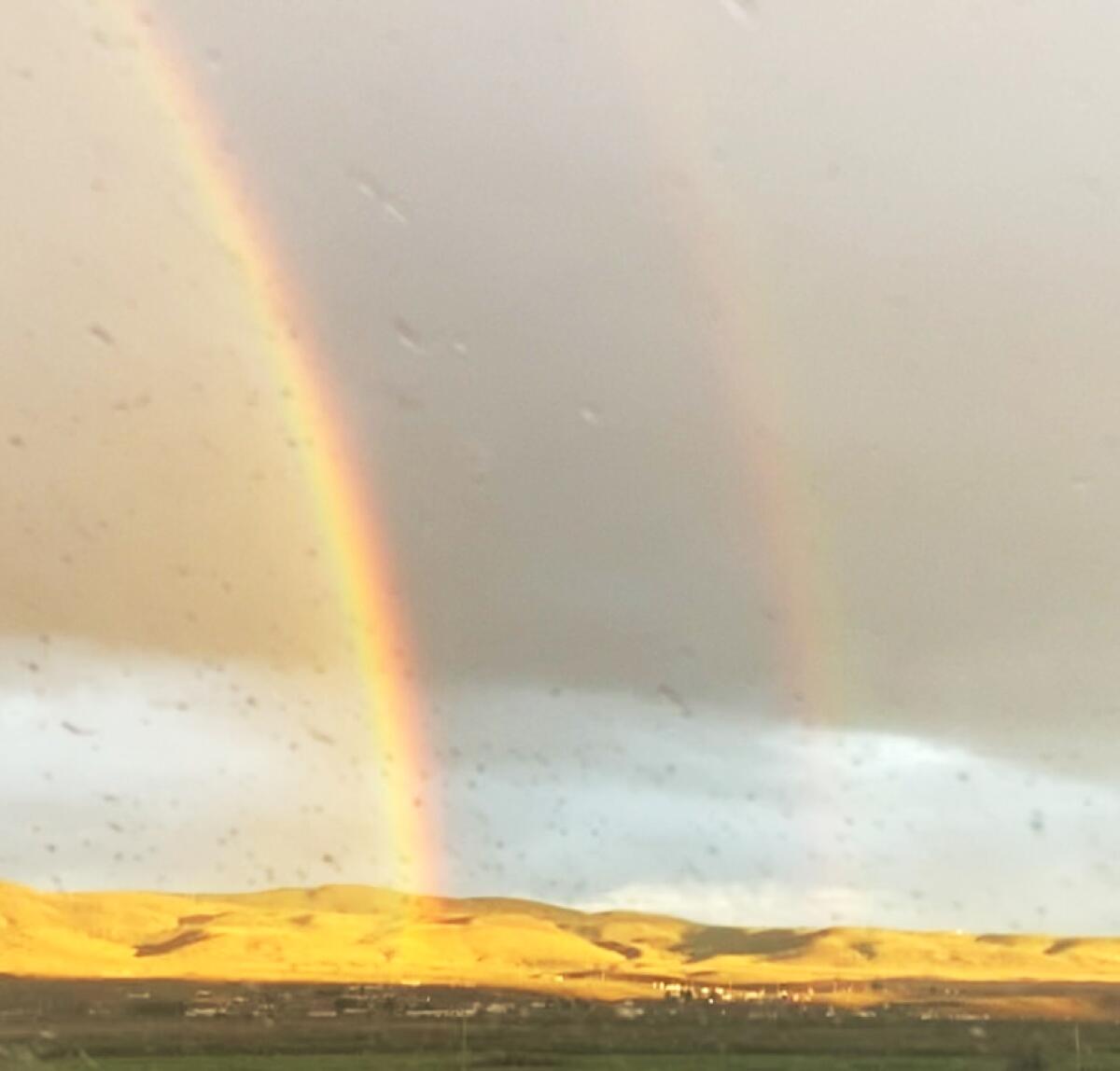
Susanne Anguiano took a sighting of a double rainbow in the Nevada desert as a sign of hope.
(Benjamin and Susanne Anguiano)
As they were entering the Nevada desert, the couple saw a double rainbow. For Anguiano, it was a sign that their cat was safe.
“I’m a Christian and I was praying the whole time,” she said. “God told me: ‘I have him safe,’ and that’s what I hung on to.”
It was July 31 and Alexandra Betts had arrived at her job at Sutter Roseville Medical Center in Roseville, Calif. It was hot and temperatures were in the triple digits, she recalled. She was making her way from the parking lot to the hospital when she heard yowling coming from some bushes.
Betts said it sounded like a cat in heat or in labor, so she walked over to take a look. There, she noticed saw a small brownish cat near a storm drain.
She stayed with it for a few minutes before going into work. Her co-workers told her the cat had been there for days and likely belonged to someone nearby. Betts didn’t buy that. A cat yowling and in the same spot for days didn’t seem right to her.
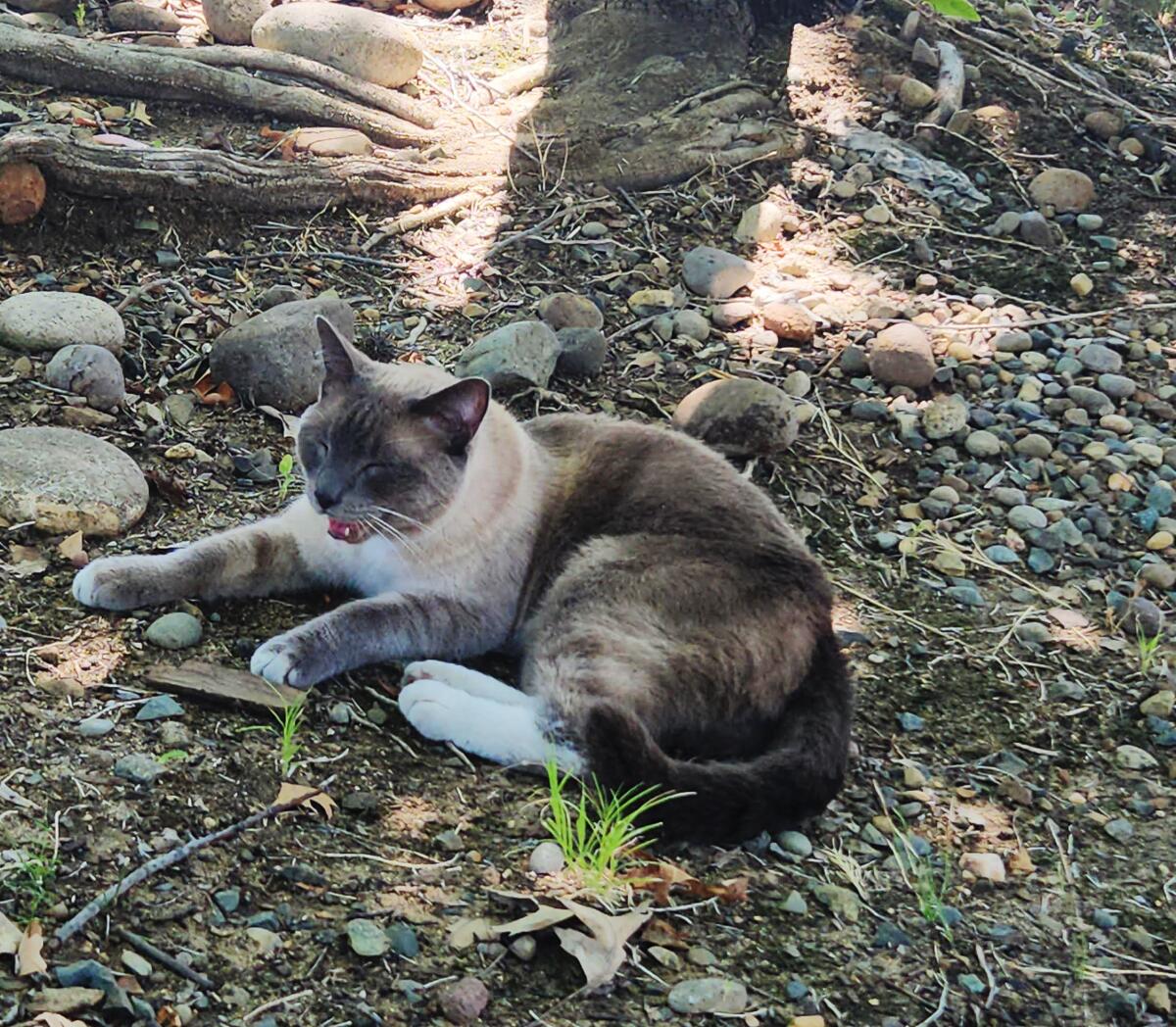
Alexandra Betts found a panting cat during triple-digit temperatures in Roseville, Calif. She took it home and posted pictures in hopes of finding the owner.
(Alexandra Betts)
She checked in with her sister, who once worked at an animal shelter, and learned that cats that yowled were either in distress, in heat or lost.
Betts ordered cat food from DoorDash. On her lunch break, she went out to feed it.
“I could tell it was a house cat of some kind because it could register what the sound of a can opening was,” she said.
But the hot weather was starting to take its toll on the cat. Betts said it was panting, and she felt she needed to bring the cat home.
Betts was no stranger to helping animals. She owned a cat herself and often fostered many felines for many years. The next day, a Thursday, she brought the cat home in a carrier.
That night, she said, she took photos and uploaded them to the Facebook account for Roseville Lost and Found Pets.
The cat stayed with the family until Saturday, snuggling and playing.
“It was just the sweetest cat,” Betts said. “My son wanted to keep him but I told him: ‘if your cat Ninja got out, how would you feel if you never got to see him again?’”
She told him they needed to do everything they could to get the cat back to its owner.
On Aug. 3, she took the cat to the Placer Society for the Prevention of Cruelty to Animals in Roseville. She updated her post on Facebook that day to let people know where she took the cat.
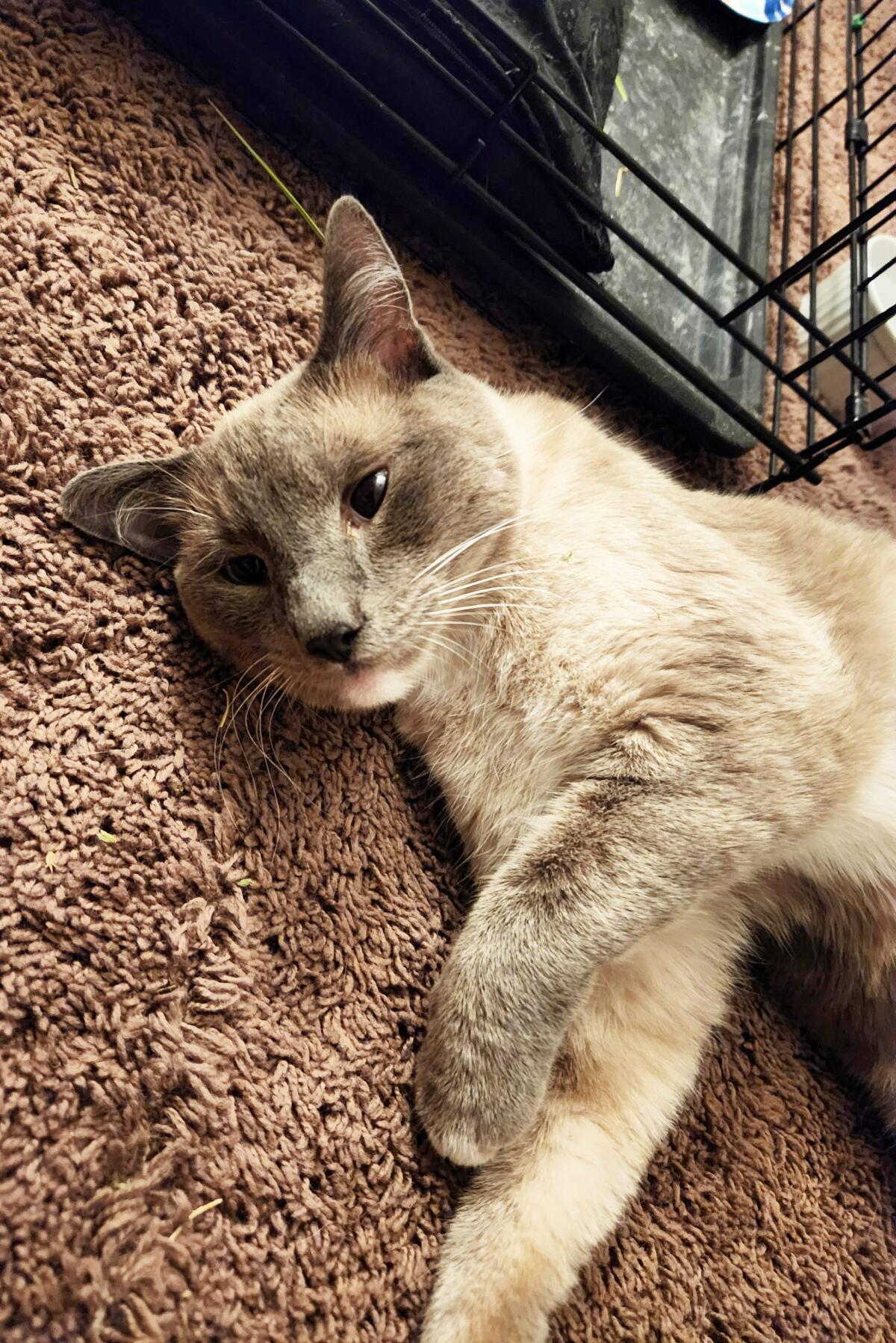
Betts took more photos of the cat after bringing it home, where she said it loved to cuddle. Her son wanted to keep it, but she took it to a shelter so it could have a chance of being reunited with its owners.
(Alexandra Betts)
Leilani Fratis, chief executive with Placer SPCA, said the cat was in fairly good condition when it arrived at the shelter. She said staff immediately scanned the pet for a microchip, and it had one.
“What’s really incredible is that we get over 1,000 cats that come through our shelter,” she said. “Only 23 are ever reunited with their owners and of that number, a teen of them are microchipped.”
“Microchipping is especially important for cats,” she added, “as it can be hard to keep a collar on them.”
She hoped the story will encourage more people to microchip their pets if they haven’t done so.
It was Saturday afternoon when Susanne Anguiano got the call, but she didn’t pick up. The number didn’t show up as Placer SPCA. In fact, the shelter had to call her daughter to inform them of the news.
Even then, Anguiano didn’t believe it. She thought it was a scam. She Googled the number to make sure it matched that of Placer SPCA in Roseville.
She called them and asked if they had Rayne Beau. They told her they did. She asked them to describe the cat and they did that too.
As she was on the phone, her husband walked in and told her he had received a text message that Rayne Beau had been found.
“Wait, is this really happening?” she recalled telling herself.
She said her husband asked the shelter to provide photos. When they received them, the couple was stunned: It was Rayne Beau.
“Eight weeks of hoping and praying just came full circle,” she said. “We were blown away, we hugged and cried, it was just so surreal.”
The next morning, they drove to Roseville, about four hours from their home in Salinas. They walked into the shelter and reunited with Rayne Beau.
Shortly after, Anguiano said she took the cat to the vet.
“He was so skinny,” she said. “He had lost 40% of his body weight.”
She said his blood work showed low protein levels, and the pads on his paws were dry, cracked and calloused, proof that he had spent a lot of time on his own.
Anguiano said they wanted to thank the person who had found their cat but for privacy reasons the shelter couldn’t release that information.
A few days later, however, her husband stumbled upon Betts’ Facebook post. They were able to thank her and provide some details of the story.
“She’s the only one who did something,” she said. “She’s our hero, our angel.”
Betts was elated to hear that the family had reunited with their pet. She was also happy that she decided to help Rayne Beau after learning about his long journey.
“I think everything lined up perfectly for it to work out the way it was supposed to work out.”

California
Mother, daughter found ‘alive and well’ after going missing on Southern California hiking trail

A mother and daughter who went missing after going for a hike on a difficult trail in San Bernardino County’s San Gorgonio Wilderness have been found “alive and well,” the sheriff’s department announced Friday.
The San Bernardino County Sheriff’s Department told KTLA they were uninjured and “walked out on their own.”
Krystal Meyers, 41, and her daughter Alexis Meyers Martinez, 21, were hiking on the Vivian Creek Trail Thursday but didn’t return, according to the San Bernardino County Sheriff’s Department.
They were last known to be at the 10,300-foot elevation mark above the High Creek switchbacks at 11 a.m., according to the San Gorgonio Search and Rescue team.
The Vivian Creek Trail is widely considered one of the more strenuous and hazardous routes in the San Gorgonio Wilderness.
The U.S. Forest Service says it’s the shortest and steepest route to the summit of Mount San Gorgonio and requires experienced mountaineering skills.
Officials did not provide any further details about the circumstances surrounding their disappearance.

BAKERSFIELD, Calif. (KBAK/KBFX) — The California Highway Patrol is urging drivers to stay focused on the road as they head out for Fourth of July celebrations.
The holiday weekend can be a dangerous time on our roads as millions of drivers are expected to travel.
CHP Officer Jorge Toro joined Eyewitness News Mornings to share how drivers can stay safe behind the wheel.
Officer Toro also highlighted the importance of sober driving over the holiday.
BE THE FIRST TO COMMENT
He says anyone hosting a party should make sure all of their guests get home safely, ensuring anyone who may be impaired doesn’t drive.

California is returning a stretch of rugged Mendocino County coast to the Indigenous nations whose ancestors once stewarded its shores.
State transportation officials recently approved the transfer of Blues Beach and the surrounding bluffs to Kai Poma, a nonprofit founded by representatives of the Sherwood Valley Band of Pomo Indians, Round Valley Indian Tribes and Coyote Valley Band of Pomo Indians.
The transfer of 136 acres just south of the community of Westport will mark the first time land managed by the California Department of Transportation has been returned to Indigenous tribes.
“This is beyond huge,” said J. Carlos Rivera, tribal chairman of the Sherwood Valley Band of Pomo Indians. “It’s enormous from our tribal perspective that we are basically obtaining the land that our people once lived on before colonization.”
California purchased the swath of rocky cliffs and windswept shoreline in the 1960s to expand the construction of Highway 1 and create a scenic viewpoint for highway travelers, according to a California Coastal Commission report.
More recently, public access has been largely unregulated, and summer weekends and holidays have drawn large groups who camp and party on the beach, at times driving through sensitive areas, damaging cultural sites and leaving behind trash, the report states.
Kai Poma plans to conduct cultural and archaeological resource studies and environmental surveys and then prepare a resource management plan for the property, according to planning documents. The nonprofit and the Coastal Commission have drafted a public access management plan that states the land will be open from sunrise to sunset.
Rivera described the entire property as a sacred site. The coastal waters are used by tribal people for seaweed and abalone gathering, and the shores host youth cultural camps, he said. “Protecting the land, it has a deeper meaning for us because we’re connected to the land,” he said.
The effort to acquire the land took years — and required a change in state law. Caltrans lacked the ability to transfer land to tribal governments until 2021, when Gov. Gavin Newsom signed a bill sponsored by state Sen. Mike McGuire (D-Healdsburg) that enabled the transfer, according to a news release issued at the time. The law also bars commercial activity on the property and requires public access be maintained.
“With 136 acres now officially transferred into tribal stewardship, one of the most spectacular stretches of the Mendocino Coast will be forever protected,” McGuire said in a statement.
“This agreement, the first of its kind in California, gives these three dynamic Native American tribes the rightful opportunity to reclaim sacred lands and cultural traditions on this special piece of earth. And it’s about damn time.”
The land transfer cleared its last regulatory hurdle June 26 with the approval by the California Transportation Commission, said Neil Thapar, an attorney who works as an advisor and legal consultant to Kai Poma. Caltrans staff will next record the deed transferring the title from the state of California to Kai Poma, which is expected to happen any day, he said.
-

 Texas2 minutes ago
Off-duty Kerrville officers recall dramatic Hill Country flood rescues one year later
-

 Utah7 minutes ago
Utah Jazz sign defensive wing to roster
-
Vermont14 minutes ago
VT Lottery Mega Millions, Gimme 5 results for July 3, 2026
-

 Virginia17 minutes ago
Virginia Lottery Mega Millions, Pick 3 Night results for July 3, 2026
-

 Washington22 minutes ago
Review: ‘Young Washington’ is an imperfect film perfect for kicking off the 4th of July
-

 Wisconsin29 minutes ago
NAVY NEWS: USS Wisconsin submarine replica on display in Madison
-

 West Virginia32 minutes ago
Iconic country music band Alabama takes stage for West Virginia’s America 250 celebration
-

 Wyoming37 minutes ago
Election Q&A: Steve Harshman for Wyoming superintendent of public instruction

