It was early in the morning when Ben Smith drove his SUV to the top of Mountain High ski resort and looked south. Miles away and across a valley, he could see the ominous red glow of the Bridge fire amid the dark green pines of the Angeles National Forest.
By Smith’s estimate, the fire wouldn’t reach the resort for at least another day.
Then, the fire exploded.
Advertisement
By 6:30 that evening, the resort’s general manager would be racing east down Highway 2 past the town of Wrightwood as flames closed in on the road from both sides.
Smith had done everything he could to save the resort. He was the last to flee after his staff activated a battery of snow cannons to douse the ski area in water.
Now, there was just one thought running through his head: “Hopefully I make it out of here,” Smith recalled as he leaned against a wooden post at the resort’s Big Pines Lodge recently.
The fact the lodge and most of the nearby resort escaped the hellish firestorm is a testament to the work of Smith’s team and firefighters.
“When I left out of here … I expected to come back to everything gone,” he said.
Advertisement
Now, roughly one month later, tree removal crews and electrical trucks crisscross the property. Mountain High operators are optimistic that the resort will open by Thanksgiving.
“Come wintertime — when the snow comes — you won’t even know there was a fire here,” said Damaris Cand, guest services manager.
The Mount Baldy ski lifts are shrouded in smoke from the Bridge fire in Mount Baldy on Sept. 12.
(Genaro Molina / Los Angeles Times)
Advertisement
The Bridge fire began Sunday, Sept. 8, in the early afternoon, 11 miles south of the resort. By Monday, the fire was on Smith’s radar as it slowly inched closer.
On Tuesday, the fire would “explode” — engulfing tens of thousands of acres in a matter of hours, increasing in size tenfold.
At the resort’s staff meeting that early Tuesday morning, the mood was calm. The sky still was clear, and painted with the pinks and oranges of sunrise.
But Smith, who is the vice president and treasurer of the Wrightwood Fire Safe Council, saw potential for calamity, as winds were forecast to pick up.
He directed the team to start placing snowmaking guns strategically along the perimeter of the resort. Some 50 employees — enlisted from a wide range of departments — moved around the resort as the skies grew increasingly dark with smoke.
Advertisement
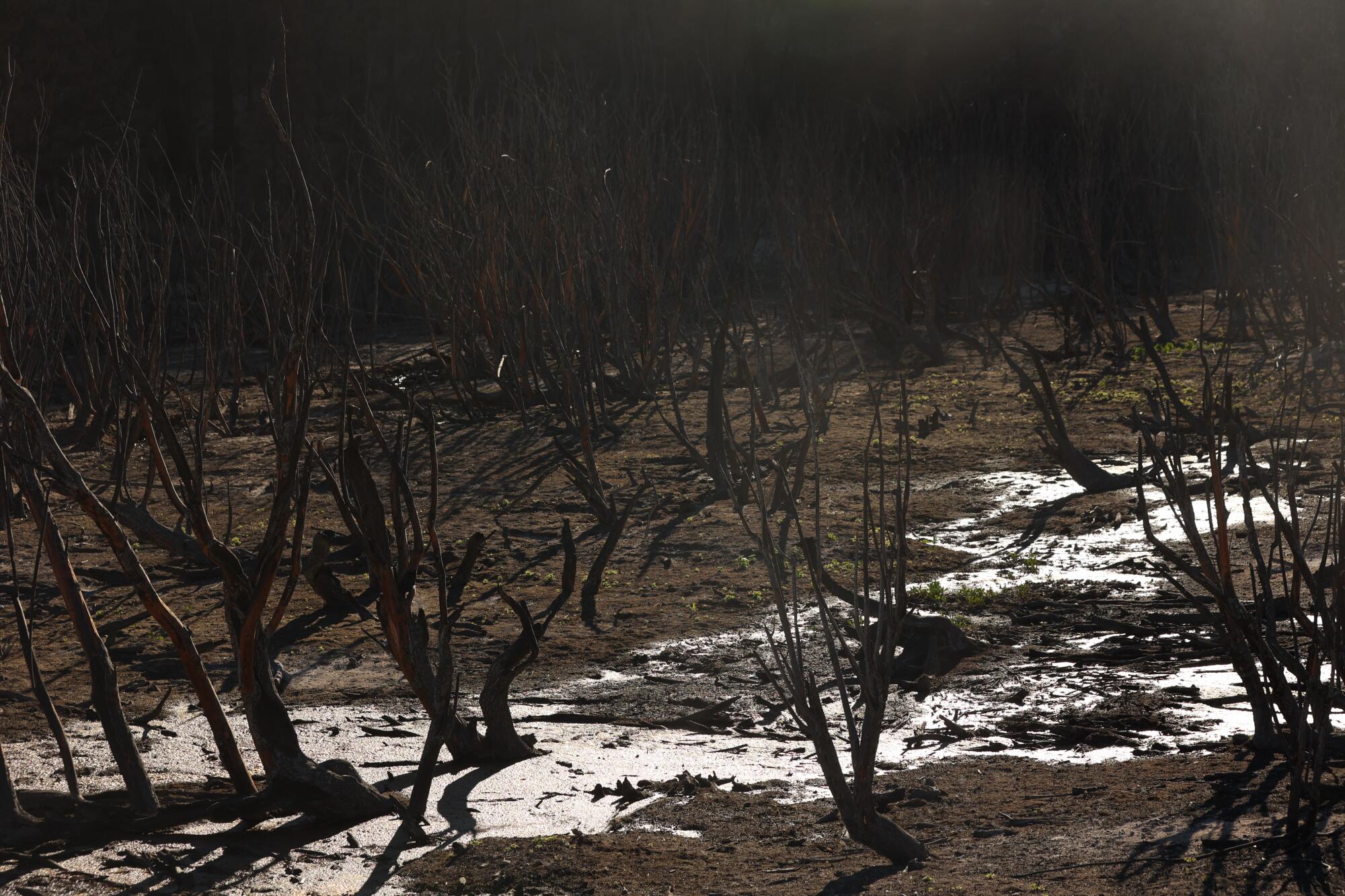
Trees around Mountain High ski resort were left scorched by the Bridge fire.
(Michael Blackshire / Los Angeles Times)
By early afternoon, Smith could no longer see more than 100 feet in front of him. There was no way to directly monitor the fire anymore.
Ash and debris — still on fire — started falling from the sky. At one point, a burning stick about a foot long hit the ground.
Employees started leaving, worried about safety and air quality.
Advertisement
“I got out of here about 2 o’clock, and the sky was black,” said John McColly, vice president of sales and marketing at the resort. “A lot of smoke was being whipped up, and it had this reddish hue to it. … Just for the sake of my lungs, I probably need to get out of here,” he recalled thinking.
Then, around 4:30 p.m., the nightmare scenario that was unfathomable just a few hours earlier became reality. A wall of flames over 300 feet tall by Smith’s estimate crested the ridge, roaring with the sound of a jet engine and blasting the resort with superheated wind and debris.
What had started as cautious fire protection preparations had suddenly became a fight for survival.
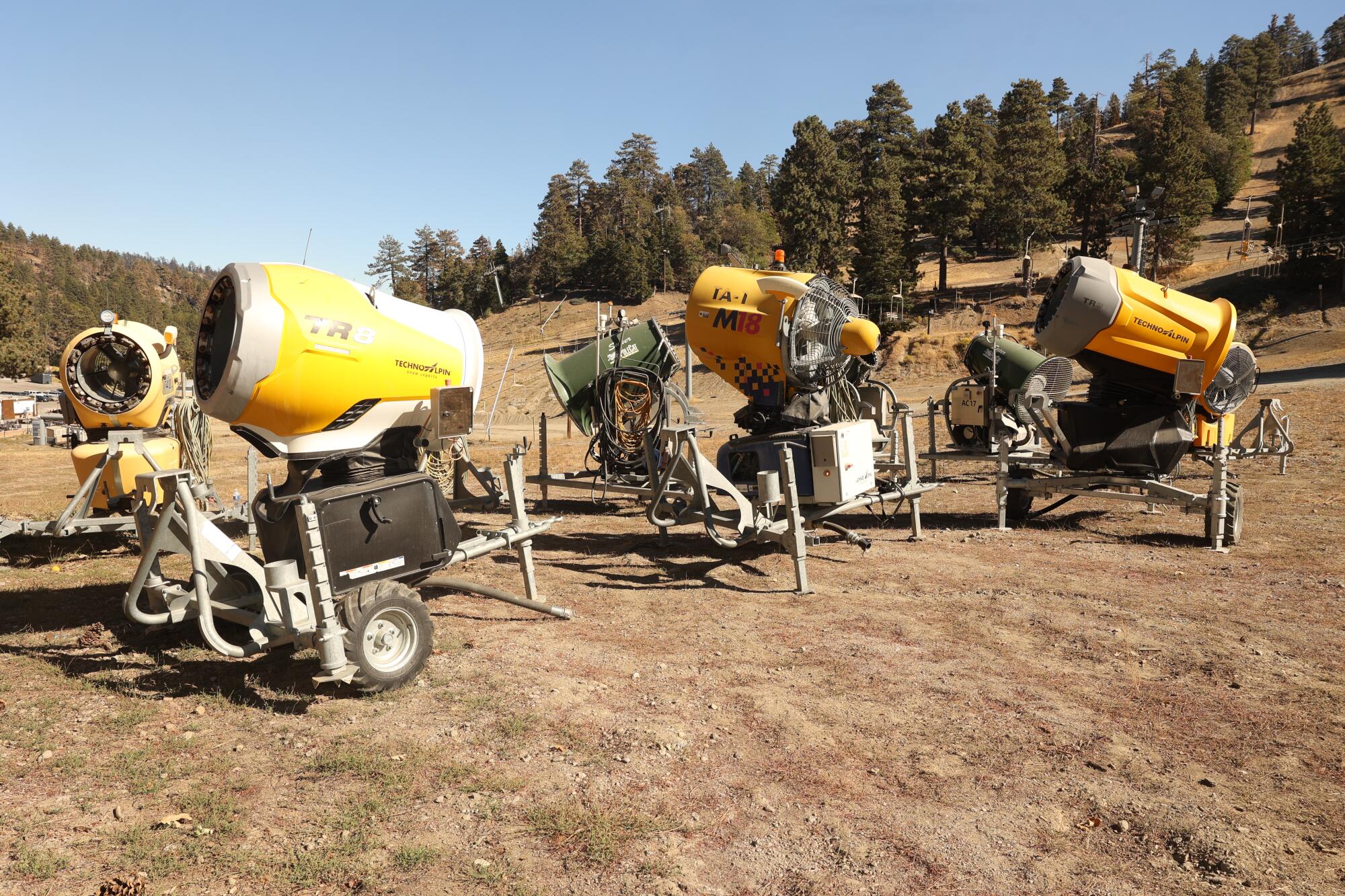
Workers at Mountain High ski resort used snow fan guns to battle the flames of the Bridge fire.
(Michael Blackshire / Los Angeles Times)
Advertisement
Smith directed staff to evacuate nearby campers. The team started pulling time sheets to make sure every employee was accounted for.
Smith sent another team member racing toward the snowmaking control center to activate the giant water system.
The team had stationed about 100 of their roughly 500 snow guns to defend the resort. While they could start about three quarters of them with the push of a button, the rest had to be turned on by hand.
As the majority of the staff evacuated, Smith and a handful of employees remained and raced around the property activating snow guns.
McColly monitored the fire’s progress via the resort’s live camera feed — which is intended to provide skiers a look at snow and weather conditions. He and countless others who had tuned in via social media beheld the flames with awe as they silhouetted a seemingly doomed ski lift terminal.
Advertisement
Smith had alerted fire crews, whom he knows personally through his role with the fire safety council and past wildfires, but they wouldn’t arrive for hours still.
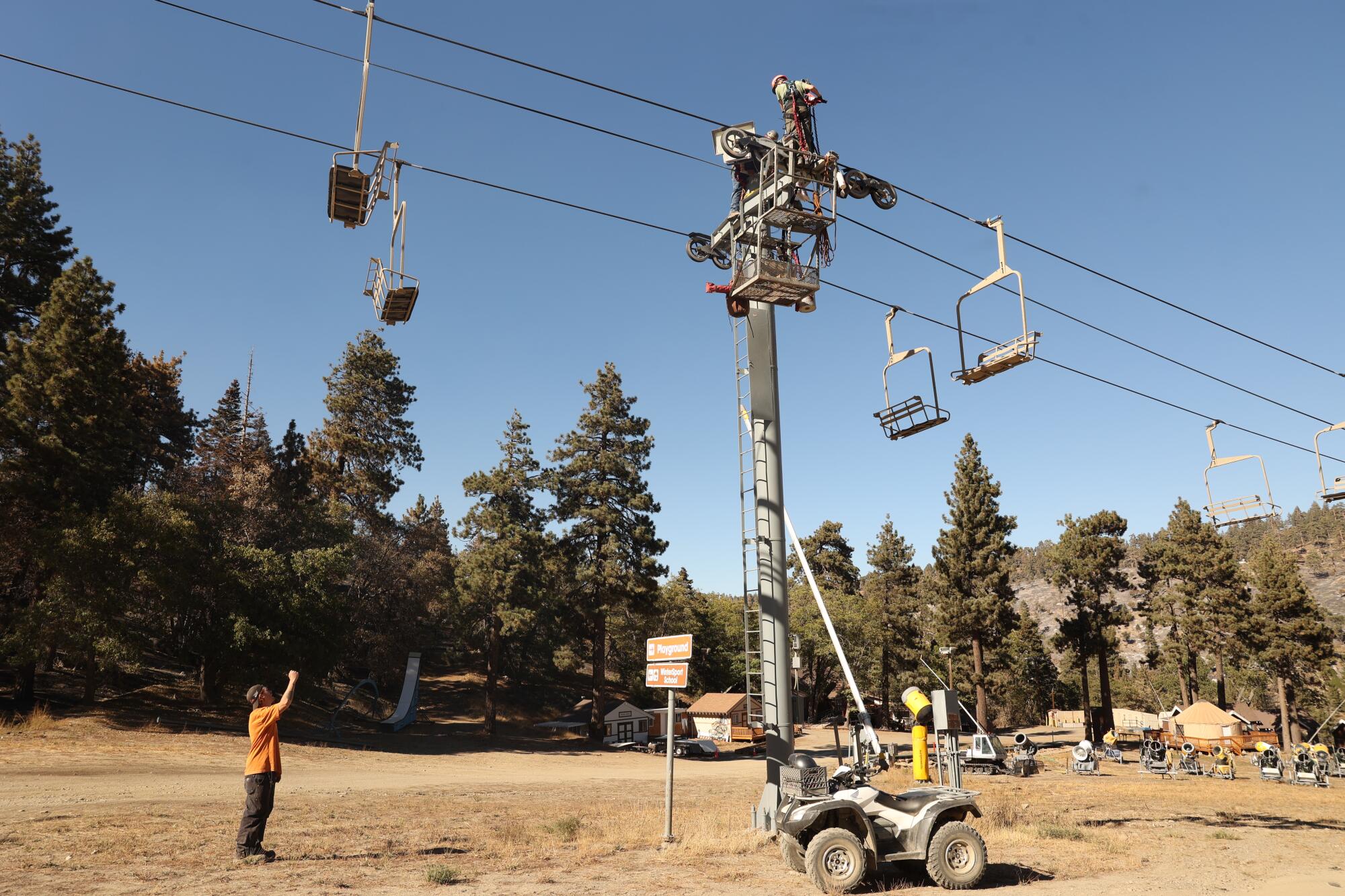
A Mountain High ski resort crew works on a chairlift recently.
(Michael Blackshire / Los Angeles Times)
At multiple points, massive explosions shook the ground, accenting the roar of the fire.
The upper elevations of the resort lost power first. By 5:30 p.m., the base area went dark as well. Without electricity, the water pumps for the snow guns fell silent. Now, the guns were powered only by gravity, which sent water rushing downhill from the 500,000-gallon reservoirs and out the guns’ nozzles.
Advertisement
As the fire burned through telephone poles, phone service went down.
The number of employees left at the resort dwindled to three. Then, two. Then, one: Smith.
At this point — 6:30 p.m. — fire flanked both sides of the resort. Realizing there was nothing left he could do, Smith made his escape.
“I wasn’t trying to be a hero,” he said. “I’ve got a wife and family.”
It wasn’t until night that firefighters were able to get to the scene.
Advertisement
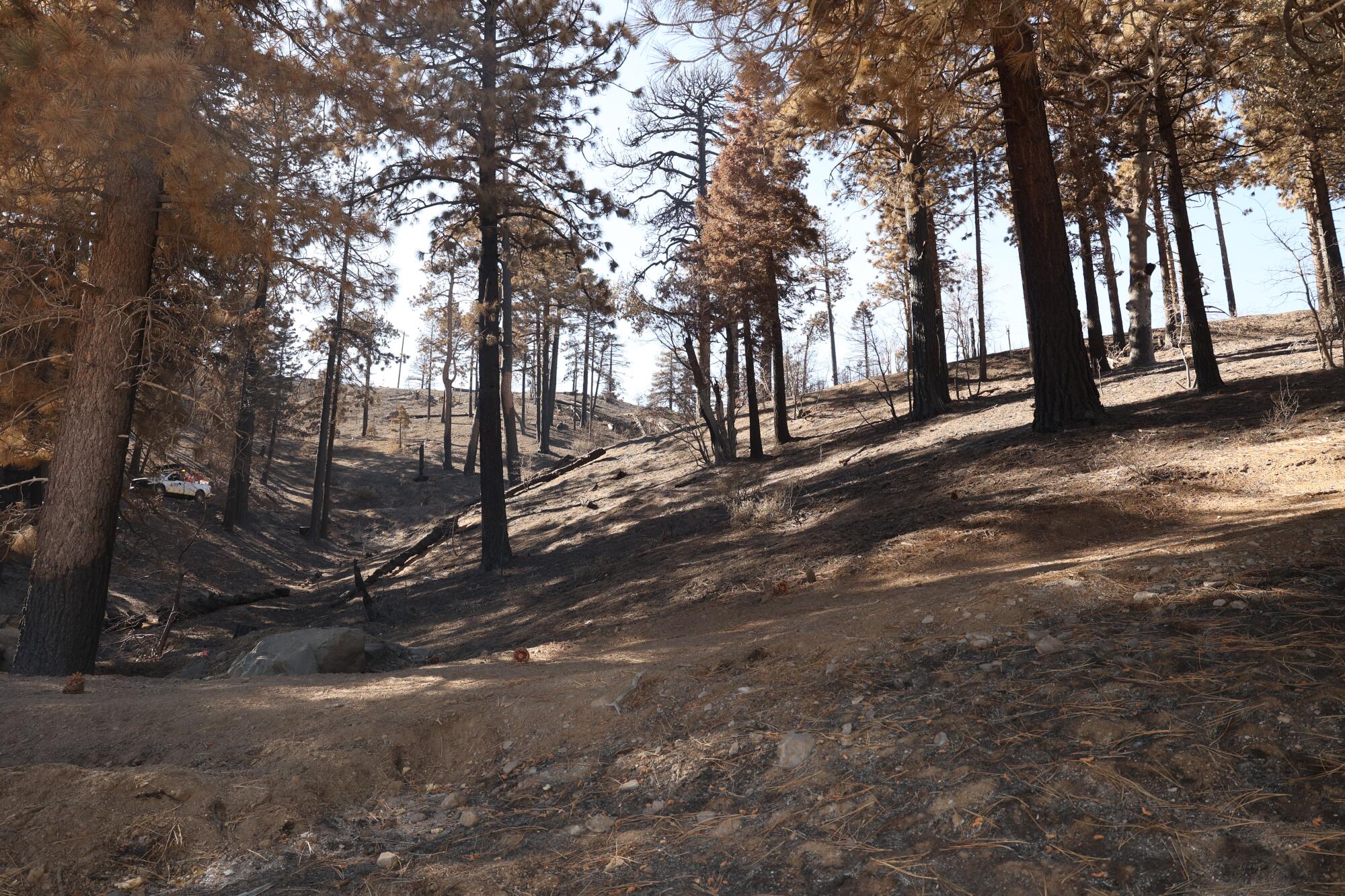
Burnt trees from the Bridge fire dot the landscape in Wrightwood.
(Michael Blackshire / Los Angeles Times)
Smith arrived back at Mountain High the next morning to assess the damage and assist firefighters. The fire continued to rage on — still with hundred-foot flames, just not fanned by violent winds.
“I came up through Wrightwood, and before you get up to our East Resort, … you’re like, ‘hey, everything’s gone,’” Smith said. “But then you hit the East Resort and start seeing green trees, and you see buildings, and you’re like, ‘Well, damn, that ain’t so bad.’”
Not only was the majority of the resort standing, but the snowmaking guns were still pouring water onto the edge of the resort.
Advertisement
In all, the resort had one, unessential ski lift damaged, while a few ski patrol and maintenance shacks burned down.
“I’m very proud of my team,” Smith said. “A lot of what’s still standing here is because of them.”
When the resort isn’t a victim of the fires in Angeles National Forest, it frequently provides firefighters with an invaluable operations hub. Its buildings serve as a command center, its parking lot becomes a helipad, and its water reservoirs are essential resupply stations.
“Through the years, through the fires, through the fire safe council — just having the partnerships with all those groups and to be able to have all those contacts at your fingertips is amazing,” said Smith.
It took nearly a month to secure the resort and restore power, allowing the full team of employees to safely return.
Advertisement
By early October, crews worked to repave Highway 2, which was left cracked and scarred from the fire and the efforts to fight it.
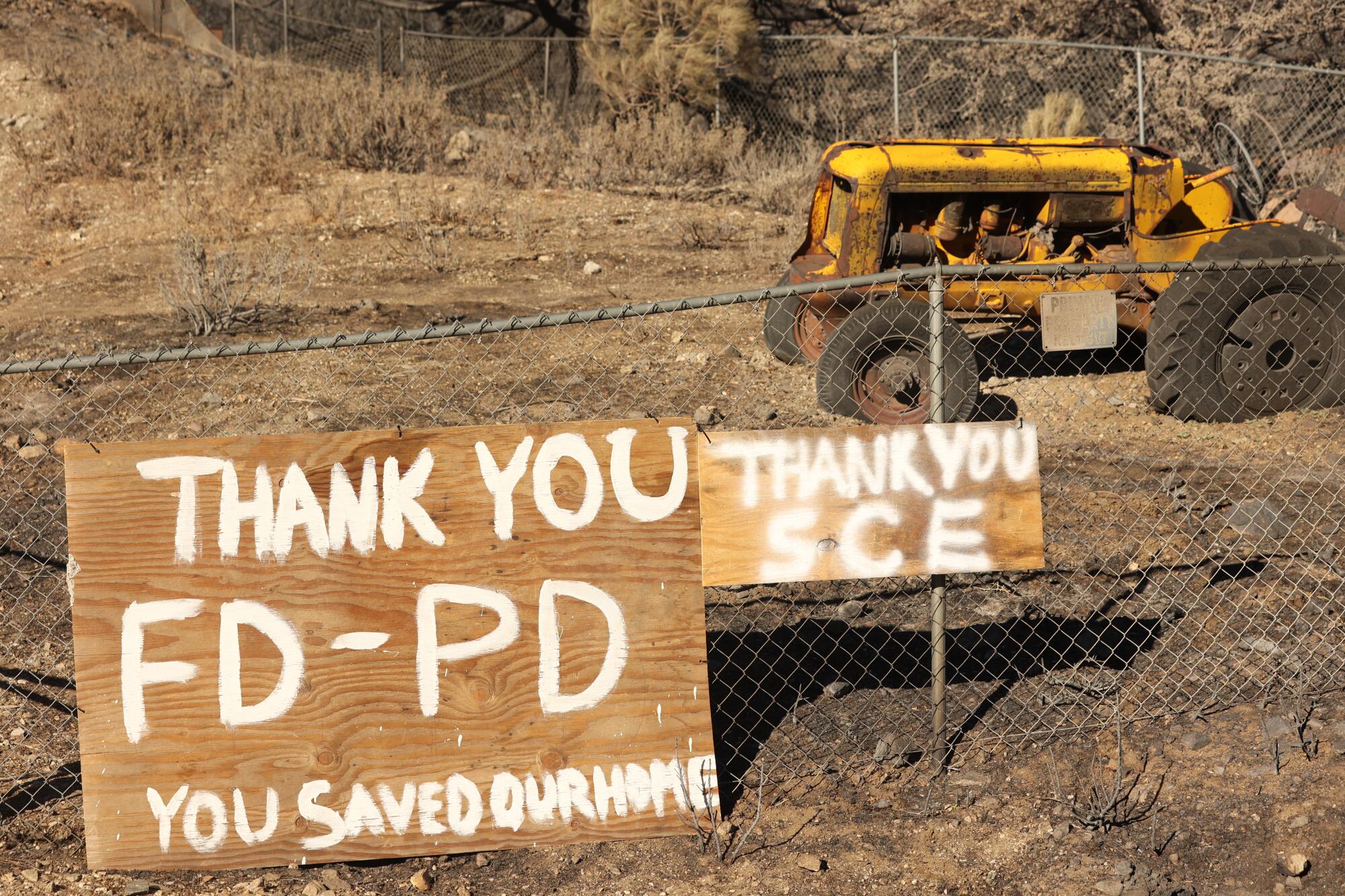
A sign in Wrightwood thanks emergency crews in the wake of the Bridge fire.
(Michael Blackshire / Los Angeles Times)
In Wrightwood, residents have adorned the city with homemade signs.
A piece of plywood, fixed to the Wrightwood city line sign, with black spray-painted letters read “Thank you for saving us.” A colorful hand-painted sign with a firetruck cartoon hung next to the fire station. “We [heart sign] you,” it read.
Advertisement
McColly had returned to his office in a historic cabin, which now smelled like wet rags and old cigarettes.
He turned his computer screen to show a season pass special offer for the resort’s 100th anniversary. Customers would receive a special hat and pin commemorating the season. And the resort would donate $25 to the American Red Cross Disaster Relief.
The Red Cross was onsite after the fire, supporting relief efforts, McColly said. Partnering with the Red Cross is a way to say thank you and pass the help forward.
“They were great to work with,” said McColly. “They really helped us out a lot.”
Donald Trump has alleged without evidence that Democrats are cheating in California’s primaries and claimed in a late-night social media post that the US attorney’s office in Los Angeles was investigating.
As counting continues in the most populous state in the US, the president’s unfounded remarks are likely to further alarm election observers, who have warned of the risk of escalating misinformation in the absence of a final result.
Trump has a history of undermining election results that don’t go in his favor. He has repeatedly alleged that Democrats “stole” the 2020 presidential election, which he lost to Joe Biden, despite privately admitting his defeat, according to aides.
At 12.48am on Thursday, Trump posted: “The Dumocrats are at it again! They are trying to STEAL THE GOVERNOR OF CALIFORNIA PRIMARY, AND THE MAYOR OF LOS ANGELES, PRIMARY, AWAY FROM TWO GREAT REPUBLICAN CANDIDATES. Here we go with the very late and massive numbers of MAIL IN BALLOTS.”
Advertisement
“There’s BIG cheating by the Dumocrats in California,” he said 17 minutes later in another post on his Truth Social platform. “Votes are all tied up. May not be in for weeks. Under investigation by the U.S. Attorney’s Office in Los Angeles. Why the vote counting DELAY??? President DJT”.
The US attorney’s office said it had no comment on Trump’s claim that his allegations of cheating are “under investigation” by US attorneys. The Department of Justice in Washington DC did not immediately respond to a request for comment.
The president presented no substantive basis for questioning the legitimacy of the election.
Mail-in ballots factor heavily in California political races – typically about 80% of votes cast – and those ballots can be counted up to a week after election day, as long as they are postmarked before election day.
California uses a “jungle” primary process, in which the two candidates with the most votes advance to a runoff – regardless of their political party – unless one candidate wins an outright majority. A huge field of 61 candidates fragmented the vote in the race for governor, but Republicans have coalesced around Steve Hilton. Together with Xavier Becerra and Tom Steyer, the three are in a contest that remains too close to call as votes are tallied.
Advertisement
Mail-in ballots tend to favor Democrats, which implies the possibility that Hilton – whom Trump has endorsed – may drop into third place by the time all the ballots are counted.
The last Republican to win the California gubernatorial race was Arnold Schwarzenegger in 2006. Republicans have polled just under 40% in each of the last four contests.
Last month Gavin Newsom sent a letter to elections officials to thank them for their work while warning that a long process invites disingenuous accusations of misconduct.
“We must acknowledge that the longer the vote count takes, the more mis- and dis-information spreads,” wrote the California governor. “That means we must do all that we can to tabulate votes quickly and accurately. Time is of the essence in preventing election lies from taking root.”
On Wednesday evening, election observers echoed those concerns. “Conducting elections with integrity and ensuring that every eligible vote is counted are fundamental to maintaining public confidence in our democracy,” said Mike DuHaime of the Democracy Defense Project, a bipartisan effort to combat election misinformation.
Advertisement
“At the same time, prolonged delays in ballot tabulation, such as those that have become increasingly common in California, can undermine public trust and create unnecessary uncertainty around election outcomes,” DuHaime added. “The longer election results remain unresolved, the greater the opportunity for misinformation and speculation to spread online, eroding confidence in our electoral process. Accuracy must always remain the highest priority, but accuracy and timeliness are not mutually exclusive.”
A California man was charged Tuesday after authorities say he brought an explosive device and other weapons through a security checkpoint at Sacramento International Airport.
Kimani Osayande Jones, who also uses the last name Jackson,attempted to bring an improvised explosive device, a knife and other bladed weapons, a torch lighter and zip ties through a TSA security checkpoint on May 30, according to court documents filed Tuesday in the Eastern District of California.
Officials believe Jones, 49, repeatedly called the FBI tip line to report he was being threatened and intimidated in the months leading up to the incident.
Sacramento County Sheriff’s Office bomb technicians safely removed the explosive device and tested its powder and fuse, both of which were determined to be “viable and energetic,”officials say.
Advertisement
Investigators said the device had the potential to damage an aircraft and cause a loss of cabin pressure.
Jones’ other luggage, which had already been through security and loaded onto an American Airlines flight to Charlotte, North Carolina, was hand-searched and examined by a canine unit upon arrival, and investigators said nothing “illegal or concerning” was found.
Jones has been chargedin federal courtwith unlawful possession of explosive material at an airport. He faces up to five years in prison and a $250,000 fine if convicted.
His attorney, Meghan McLoughlin, told CNN in a statement: “There is often more to these cases than the government’s allegations, and that the criminal process will reveal Mr. Jones’ story as well.”
Multiple cell phones and repeated FBI tip line calls
The Sacramento resident went through security on May 30 wearing a face covering and blue latex gloves, court documents say.
Advertisement
When officers found the explosive device and other items in Jones’ carry-on bag, he told them he was unaware the items were in his possession and said “he would be okay with just discarding them.”When authorities informed him that explosive material could not simply be thrown away, he denied ownership of the backpack.
Jones also had five mobile phones in his possession. The cameras on each phone had been covered with painter’s tape, which authorities believe was intended to prevent his surroundings from being recorded.
One phone contained a 15-minute timer ready to start and another had a message from an unknown number on the screen stating, “we will be awaiting your call,” according to court documents.
An individual police believe to be Jones made approximately 13 calls to the FBI tip line leading up to the incident,beginning in March.
On May 24, the caller reported being followed to and from a doctor’s appointment and described what he said were threats and intimidation by another individual.
Advertisement
He said he was “being coerced in sleep to say certain phrases through digital media” and described “hearing sounds coming through walls, window panes, or even outside, attributing the outside sounds to drones,” court documents say. The call was ultimately terminated because of its “nonsensical nature.”
On the day of the incident, the same caller again contacted the FBI tip line, alleging that several individuals were threatening him throughout the past year through “cyber means.” He also referenced exercising his Second Amendment rights while denying any intention to harm others.
The Sacramento County Sheriff’s Office also noted it had prior contact with Jones, “wherein he had a history of being paranoid.”
Hilton, Becerra lead California governor primary results
Vote counting continued after California’s primary election for governor with just over half of the results in.
Although results from California’s primary election began rolling in on Tuesday, June 2, it could take days or even weeks before the final counts are certified.
“This is normal … We have a process that by law ensures both voting rights and the integrity of elections, so I would call on all Californians to be patient,” Secretary of State Shirley N. Weber said in a June 2 news release.
Advertisement
The Golden State’s lengthy vote-counting process has “become a national narrative about California elections,” according to Thad Kousser, a professor of political science at the University of California, San Diego.
“In California, it takes a long time to certify votes, to verify the signatures, to then count the ballots; all of that process takes a while,” Kousser said in an interview last week. “It may take a while for us to learn who the top candidates who emerge are.”
Here are some factors behind California’s lengthy vote-counting process.
Mail-in ballots come with added verification step
With each mail-in ballot cast, elections officials must compare the signature on a returned vote-by-mail envelope to the voter’s signature on their voter registration card. Various factors go into determining whether the signatures match, including the slant of the signature, whether it is printed or written in cursive, and the size, proportions, or scale.
Vote-by-mail ballots were Californians’ preferred voting method in both the 2024 primary and general elections, with drop-off locations — such as ballot drop boxes and voting centers — the most popular way to return mail-in ballots.
Advertisement
During California’s 2024 primary, more than 7.7 million votes were cast statewide, and 90 percent of those were mail-in ballots. This means election officials had to verify the signatures on more than 6.8 million ballots before they could be counted. For the November 2024 general election, 80% of cast ballots, or about 13 million, were vote-by-mail.
Reviewing conditional voter and provisional ballots
California also allows for same-day voter registration, also known as conditional voter registration. Voters who need to register, or re-register, within 14 days of an election can do so at their county elections office, polling place, or vote center. These ballots will be processed and counted after the county elections office has completed the voter registration process.
In addition to conditional voter ballots, there are provisional ballots that must be verified before they are counted. Voters cast provisional ballots for a wide array of reasons, including if their name does not appear at a polling place or if they’ve made a mistake on their ballot. After a voter casts a provisional ballot, it will not be counted until election officials have confirmed that the voter is registered to vote in that county and has not already voted in that election.
Vote-by-mail ballots can be sent on Election Day
Though state officials recommend voters mail their ballots sooner rather than later, state law allows vote-by-mail ballots postmarked by Election Day to be counted if they arrive within a specified window afterward, thereby extending the tallying process.
Advertisement
For the primary, ballots needed to be postmarked on or before June 2 and received by county elections office no later than June 10.
California is, well, big
California is the most populous state in the nation. And, as of May 18, a record total of 23,155,447 Californians were registered to vote.
While not all registered voters are expected to have voted, county election officials estimate that more than 5 million ballots were cast statewide.
When to expect final results
Under state law, county elections officials are required to report the results for most ballots by June 15, or 13 days after the election, according to Weber. However, some ballots can take counties up to 30 days to count every ballot and then conduct a post-election audit.
State law requires county elections officials to report final official results to state officials July 3. State officials then have until July 10 to certify the results of the election.