California
I took my son to California for his birthday, and he planned the itinerary. Embracing my kids' interests helps me stay close to them.


When my son was younger, there were times I wondered whether he’d ever stop talking about his interests. From detailed stories of his latest “Minecraft” session to chattering about his favorite Marvel superheroes, it seemed there weren’t enough hours in the day for him to tell me things. But whoever said “the days are long but the years are short” was right, and in a blink I found myself facing my son’s 17th birthday — his last before technically becoming an adult.
My son and I still talk quite a bit, whether discussing horror movies or analyzing his dating life, but between his first part-time job and getting his driver’s license, I see and hear from him less these days. For his birthday, I let him plan the itinerary for a trip to California — just him and me.
For nearly a week, we hit the Universal and Disneyland theme parks, saw movies in historic theaters, and ate lots of cheeseburgers. It was pretty incredible, both to spend dedicated time with him and to see him embrace the things that interest him most.
Embracing his interests over the years helped shape the trip
Courtesy of Terri Peters
I’ve learned the best way to stay close to my kids is to embrace what interests them. My son is very interested in film, so when he told me he wanted to “go to the restaurant David Lynch always went to” while we were in Los Angeles, I turned to Google. “Do you mean the Bob’s Big Boy in Burbank?” I asked.
Lynch, the director behind “Twin Peaks” who died earlier this year, was known to visit the iconic restaurant for a coffee and a chocolate milkshake most afternoons, so we did, too. It was a seemingly silly stop, but one that will be a core memory for both of us.
We’ve always enjoyed going to theme parks together
Courtesy of Terri Peters
When my kids were younger, we visited Central Florida theme parks nearly every weekend. Now, they have their own lives and social schedules, so we go less frequently. Still, when we talked about a trip to California, my son said, “Can we go to Disneyland and Universal Studios Hollywood?”
It was a reminder that when you build memories with your kids when they’re small, those things stick. We had a great time on rides at Disneyland and doing a movie studio backlot tour at Universal, things we may not have added to our itinerary had we not gone when he was younger.
He’s developed his own interests, too
Courtesy of Terri Peters
My son’s biggest request on our trip was to visit as many historic theaters in California as possible. While staying at Disneyland, we took a drive to Santa Ana to visit an arthouse movie theater he discovered while planning the trip. In Los Angeles, we saw “Sinners” at Universal CityWalk in 70 mm Imax, a filming style my film-enthusiast son said “was the way it was meant to be seen” and something definitely not offered in our small Florida town.
Film is my son’s passion, so I was content to tag along. Part of growing up is learning what makes you happiest, and seeing my kid delight in visiting historic theaters and seeing a movie every single day of our trip made me happy, even if my vacation preferences are more along the lines of lounging poolside and trying distinctive restaurants.
I’m proud I’ve raised such an interesting human being
Courtesy of Terri Peters
Our trip wasn’t just movie theaters and theme parks. My son also requested we visit the Academy Museum of Motion Pictures in Los Angeles and begged to visit stores that sold “physical media” (the film-nerd term for hard copies of movies) so he could add to his 4K Blu-ray collection. He ate 10 cheeseburgers over our weeklong trip, including two visits to In-N-Out Burger, a chain we love but do not have on the East Coast. Though I let him have the reins throughout the trip, I ended up having an amazing time, too.
Our routine has changed over the years, from storytime snuggles and Lego-building contests to college planning and navigating the teenage years. I’m so thankful I took the time to listen when he waxed poetic about video games and comic books for hours on end. Without those moments, he’d probably not include me in his interests today, and his interests are pretty cool, in my opinion.



FRESNO, Calif. (FOX26) — Preparations are underway for a major bipartisan gubernatorial candidate forum set for Wednesday at Fresno State, where several high-profile candidates for California governor will make their case to voters.
The event is expected to spotlight issues impacting not only the Central Valley but also communities across the state, with a strong focus on affordability, agriculture, and water policy.
Confirmed candidates scheduled to appear include:
- Xavier Becerra, attorney and former U.S. Secretary of Health and Human Services
- Chad Bianco, Riverside County sheriff
- Steve Hilton, author and Fox News contributor
- Matt Mahan, San Jose mayor
- Katie Porter, former U.S. representative
- Antonio Villaraigosa, former Los Angeles mayor
The forum will be moderated by Fresno County Supervisor Buddy Mendes and former State Assemblymember Kristin Olsen, who say their goal is to ensure Central Valley concerns remain front and center.
“There are so many issues related to affordability right now, energy costs, housing costs, regulatory costs, even food prices,” Olsen said. “These are real challenges affecting families, farmers, and farm workers in the Central Valley. We want to make sure candidates clearly explain how they’ll address them if elected.”
Moderators say they are prepared to press candidates for direct answers.
“That will be our challenge,” Olsen said. “We’ll clearly lay out expectations for candid responses, and if someone doesn’t answer the question, we’ll follow up.”
Mendes emphasized the importance of water policy, a critical issue for the region’s agricultural economy, noting that many statewide candidates may lack a full understanding of how California’s water systems operate.
“A lot of candidates don’t fully understand water movement in this state, how storage works, or the difference between surface water and groundwater,” Mendes said.
He added that keeping candidates focused may be one of the biggest challenges during the forum.
“We might have to stop them and remind them to answer the question instead of running out the clock,” Mendes said.
Mendes, who is a registered republican, and Olsen, who has since switched from republican to no party preference, have both moderated in the past, though this marks their first time moderating a gubernatorial forum.
They stressed that their approach will be firm but nonpartisan.
“This isn’t about being partisan, it’s about answering the questions,” Mendes said.
Organizers say hosting the forum in Fresno is intentional, aiming to elevate issues specific to the San Joaquin Valley — a region they say is often overlooked in statewide political discussions.
The forum is scheduled to run from noon to 1:30 p.m. and is sponsored by 30 agricultural associations statewide. It will be streamed live on the FOX26 YouTube page.

LOS ANGELES (KABC) — The average price for a gallon of gas has surpassed the $6 mark in Los Angeles County, and diesel prices also set a new record for California.
On Tuesday, the average price for diesel reached $7.45 a gallon, according to AAA. That’s an all-time high for the state.
The statewide average price for regular gas stands at $5.88, but drivers in L.A. County are paying an average of $6. Of course, prices could be even higher than that at specific gas stations.
GasBuddy, a website that helps drivers find the cheapest gas prices, says the rise in the price for gas is making history. Experts say the spike in gas prices is the largest monthly increase on record.
Here are the average prices for regular gas in other Southern California counties:
Orange County: $5.93
Riverside County: $5.84
San Bernardino County: $5.86
Ventura County: $5.95
Meanwhile, the national average for regular gas has crossed the $4 mark.
According to a report from the Wall Street Journal, President Trump is willing to end military action in the Middle East even if the Strait of Hormuz, which carries 20% of the world’s oil supply, remains closed.
GasBuddy predicts that would guarantee higher energy prices.
Copyright © 2026 KABC Television, LLC. All rights reserved.
California
New CA mandate requires Corn tortillas to contain Folic Acid, more states considering same rule

Fifteen years after she lost her first baby to a rare and devastating birth defect, Andrea Lopez takes comfort in knowing that other Latina mothers might finally avoid the same pain.
In January, California became the first state to require food makers to add folic acid, a crucial vitamin, to corn masa flour used to make tortillas and other traditional foods widely used in her community.
A woman browns tortillas for quesadillas outside her front door in San Antonio Tlaltecahuacan, Mexico, Thursday, Feb. 5, 2026.
(AP Photo/Marco Ugarte)
It’s a long-delayed move aimed at reducing Hispanic infants’ disproportionately high rates of serious conditions called neural tube defects, which claimed Lopez’s son, Gabriel Cude, when he was 10 days old.
“It’s such a small effort for such a tremendous impact,” said Lopez, 44, who lives in Bakersfield and is now a lawyer with two young daughters. “There is very little that I wouldn’t do to spare anybody this heartache.”
A similar law takes effect in Alabama in June, and legislation is pending or being considered in Florida, Georgia, Oklahoma and Oregon. Four more states – Texas, Delaware, New Jersey and Pennsylvania – have expressed “active interest” in the issue, according to the Food Fortification Initiative, an advocacy group that focuses on addressing micronutrient deficiencies.
“All women and children in the United States should have access to folic acid and have healthy babies,” said Scott Montgomery, the group’s director.
Corn masa was excluded from a national mandate
For nearly 30 years, folic acid, a key B vitamin, has been required to be added to enriched wheat and white breads, cereals and pastas in the U.S.
Decades of research show the 1998 requirement cut rates of serious defects such as spina bifida and anencephaly by about 30%, preventing about 1,300 cases a year. It is regarded as one of the top public health triumphs of the 20th century.
MORE: New California laws going into effect in 2026 impact tortillas, streaming services and more
But corn masa flour, a staple used in Latino diets, was left out of the original fortification requirement – and rates of conditions such as spina bifida and anencephaly in that community have remained stubbornly high.
In 2016, federal regulators allowed, but did not require, folic acid to be added to corn masa products. By 2023, only about 1 in 7 corn masa flour products and no corn tortillas contained folic acid, a review found.
Higher rates of birth defects among Hispanic moms
Nationwide, Hispanic women have the highest rates of having those defects during pregnancy. In California, the rate among Hispanic mothers is twice as high as for white or Black women, state data show.
California’s new law – and the state’s huge buying power – could help expand its adoption nationwide, said state Assemblymember Joaquin Arambula, who sponsored the legislation passed in 2024.
“You have to be the first oftentimes to get the ball rolling,” he said. “So, I’m glad other states have taken up that mantle.”
California’s action and pressure from advocates have already spurred changes.
Gruma Corp., the parent company of Mission Foods and Azteca Milling, has been involved in the fortification issue for nearly two decades. Azteca began selling some – but not all – varieties of Maseca, its largest brand of corn masa flour, with folic acid in 2016.
As of this year, 97% of the company’s retail sales in the U.S. include folic acid. The rest are expected to be fortified before July, Gruma said in a statement.
Mission Foods began fortification in 2024. It now adds folic acid to all of its branded and private label corn tortillas in the U.S.
Such actions by large producers have helped pave the way for smaller manufacturers to follow suit, according to a recent report by the Center for Science in the Public Interest, a consumer advocacy group that has pushed for fortification.
MORE: Dietary supplement makers push the FDA to allow peptides and other new ingredients
Initially, the industry was concerned folic acid could affect flavor and the cost of changing labels, said Jim Kabbani, head of the Tortilla Industry Association. But he now expects tortilla makers will start selling fortified products on a broader scale.
“I think overall the train has left the station and it will be more and more states,” he said.
Public health experts cheer the growing momentum.
“The science is clear: Folic acid fortification works,” said Vijaya Kancherla, an Emory University epidemiology professor and director of the Center for Spina Bifida Prevention. “It’s safe. It’s proven. And it’s cost-effective.”
RFK Jr. calls corn masa fortification ‘insanity’
That view contrasts sharply with critics – including some at the highest level of government – who regard fortification of the food supply as a form of government overreach.
Late last year, Health Secretary Robert F. Kennedy Jr. criticized California’s new law in a post on X: “This is insanity. California is waging war against her children – targeting the poor and communities of color,” he wrote.
A spokesman for Kennedy declined to explain the comments.
Social media feeds are rife with people claiming that folic acid fortification is “toxic” or that people with a certain gene variation known as MTHFR can’t properly process the vitamin.
None of those claims is accurate, according to advocates and medical experts.
MORE: Healthy eating may help keep the brain younger, study suggests
“What’s truly insane is that our nation’s top health official is spreading false claims and frightening people into avoiding a nutrient that’s proven to prevent birth defects and save babies’ lives,” said Eva Greenthal, CSPI’s senior policy scientist.
At fortification doses, folic acid “has never been shown to harm individuals or populations,” said Dr. Jeffery Blount, a pediatric neurosurgeon at the University of Alabama at Birmingham who works to prevent neural tube defects in the U.S. and globally.
The U.S. Centers for Disease Control and Prevention emphasizes that “people with the MTHFR gene variant can process all types of folate, including folic acid.”
Even Kennedy’s new federal dietary guidelines support fortification. Documents backing the guidelines advise pregnant women to eat folate-rich foods, such as leafy green vegetables, beans and lentils. But they also acknowledge that folic acid from fortified foods or supplements is “critical” before conception and during early pregnancy to prevent neural tube defects.
“Folic acid fortification of corn masa flour could help prevent” neural tube defects, the CDC website adds.
Without fortification, ‘It’s just too late’
Neural tube defects, which affect about 2,000 babies each year in the U.S., occur in the first weeks after conception, when the tube that forms the spine and brain fails to develop properly.
That’s often before many women realize they’re pregnant. More than 40% of U.S. pregnancies are unintended. In those cases, many women won’t have been preparing for pregnancy, noted Dr. Kimberly BeDell, medical director of a rehabilitation clinic that helps children with spina bifida at Miller Children’s Hospital in Long Beach, California.
“Even women’s best efforts in going to an OB right away and starting prenatal vitamins, it’s just too late,” BeDell said.
Adding folic acid to corn masa, the way it is added to other grains, is a way to ensure the nutrient reaches the wider population that needs it, she added.
MORE: Study ties fertility treatment, birth defect risk
At age 28, pregnant with her first child, Andrea Lopez didn’t know about the importance of folic acid or that the vitamin might be missing from her diet.
Then, an ultrasound mid-way through pregnancy showed that her baby had anencephaly, a fatal condition in which the skull fails to develop properly.
Lopez carried the pregnancy to term and Gabriel lived for 10 days. The pain of his loss never goes away, she said, adding that Gabriel would have been a high school freshman this year. She supports California’s law requiring folic acid fortification of corn masa and finds it “mind-boggling” that the action took so long to enforce.
“Trust me, you don’t want to go through this,” she said. “He’s the love of my life. I have two little girls that survived, but he’s my first born. He is my only son.”
___
The Associated Press Health and Science Department receives support from the Howard Hughes Medical Institute’s Department of Science Education and the Robert Wood Johnson Foundation. The AP is solely responsible for all content.

Copyright © 2026 by The Associated Press. All Rights Reserved.

How to have the best Sunday in L.A, according to Thundercat

Commentary: The golden idol at the center of Trump’s presidential library is a terrible idea — even for him
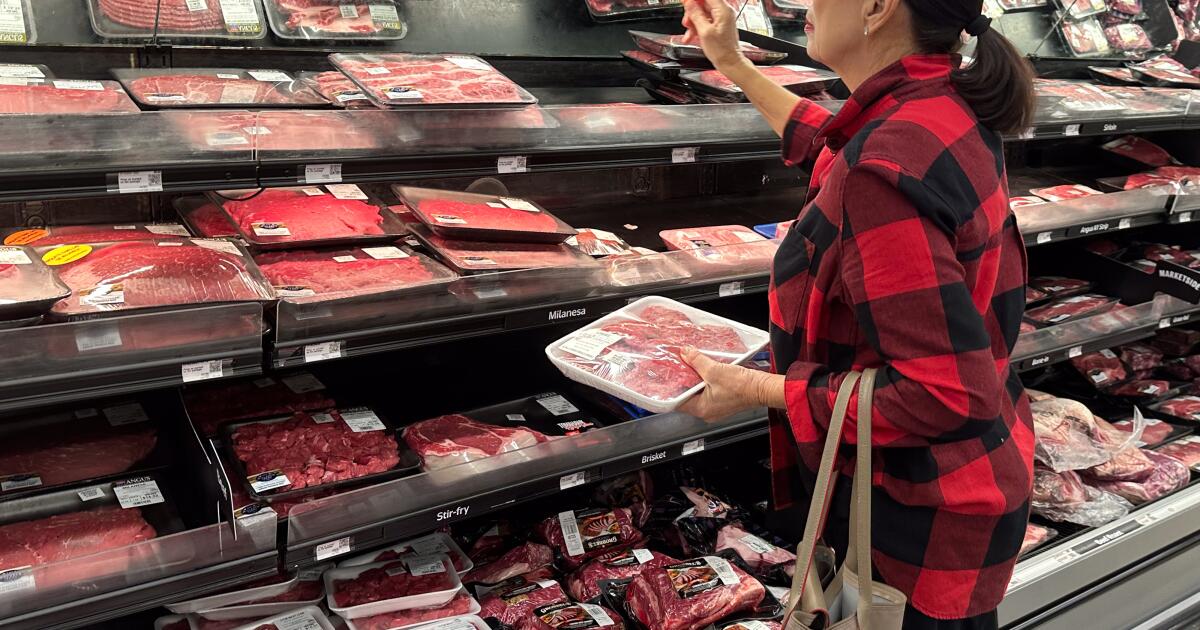
MAHA says red meat and beef tallow will make you healthy. The American Heart Assn. isn’t buying it

Air Force discovers another diamond gem in Malakye Matsumoto of Sherman Oaks Notre Dame

Newsletter: Energy shock has Brussels on edge

Florida High School Football Rankings: Top 25 teams – Oct. 21

How old is Bo Nix? What to know about Oregon quarterback ahead of 2024 NFL Draft

Cleary's 21 help Le Moyne down Central Connecticut State 69-64 in OT

99th annual Pony Swim held in Virginia

Indiana Members Credit Union announced as new anchor tenant at Bottleworks District
Newsletter: Energy shock has Brussels on edge

Suspension lifted for helicopter pilots who hovered near Kid Rock’s home

Read the Judge’s Decision on the Trump Administration’s Subpoena Against Penn

Man wearing ICE uniform brutally beaten in Honolulu not affiliated with agency, DHS says

Analysis: Hezbollah backs Iran ambassador as conflict deepens Lebanon rifts
-

 South-Carolina3 days ago
South Carolina vs TCU predictions for Elite Eight game in March Madness
-

 Miami, FL6 days ago
Jannik Sinner’s Girlfriend Laila Hasanovic Stuns in Ab-Revealing Post Amid Miami Open
-

 New Mexico1 week ago
Clovis shooting leaves one dead, four injured
-

 Minneapolis, MN6 days ago
Boy who shielded classmate during school shooting receives Medal of Honor
-

 Tennessee1 week ago
Tennessee Police Investigating Alleged Assault Involving ‘Reacher’ Star Alan Ritchson
-

 Culture1 week ago
Do You Know the Comics That Inspired These TV Adventures?
-
 Science1 week ago
As mosquitoes go year-round in L.A., a promising fix hits a snag
-

 Technology1 week ago
YouTube job scam text: How to spot it fast