California
High-speed rail project slated to received $20 billion in state funding

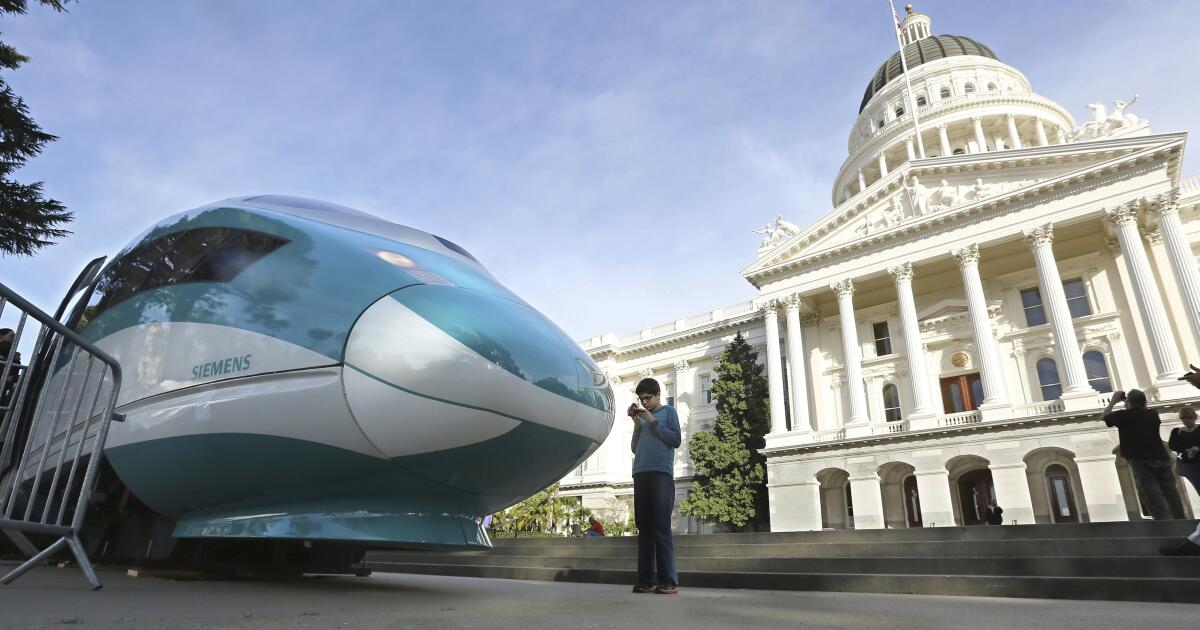
California’s high-speed rail project is slated to receive $1 billion a year in funding through the state’s cap-and-trade program for the next 20 years — a relief to lawmakers who had urged the Legislature to approve the request as billions of dollars in federal funding remain in jeopardy.
State leaders called the move, which is pending a final vote from the Legislature, a necessary step to cementing investments from the private sector — an area of focus for project officials. And the project’s chief executive, Ian Choudri, said the agreement is crucial to completing the current priority — a 171-mile portion from Merced to Bakersfield — by 2033.
“This funding agreement resolves all identified funding gaps for the Early Operating Segment in the Central Valley and opens the door for meaningful public-private engagement with the program,” Choudri said in a statement. “And we must also work toward securing the long-term funding — beyond today’s commitment — that can bring high-speed rail to California’s population centers, where ridership and revenue growth will in turn support future expansions.”
The project was originally proposed with a 2020 completion date, but so far, no segment of the line has been completed. It’s also about $100 billion over the original $33 billion budget that was originally proposed to voters and has received considerable pushback from Republican lawmakers and some Democrats. The Trump administration recently moved to pull $4 billion in funding that was slated for construction in the Central Valley; in turn, the state sued.
Still, advocates of the project believe it’s crucial to the state’s economy and to the nation’s innovation in transit.
“We applaud Governor Newsom and legislative leaders for their commitment and determination to make High-Speed Rail a success,” former U.S. Secretary of Transportation and Co-Chair of U.S. High Speed Rail Ray LaHood said in a statement. “The agreement represents the most important step forward to date for this transformational project.”
State Sen. Dave Cortese (D-San Jose), who chairs the Senate’s Transportation Committee, said the Legislature “must act quickly to pass this plan and keep California on track to deliver America’s first true high-speed rail.”
Construction on the project has been limited to the Central Valley. Choudri has said that the project could take decades to connect the line from Los Angeles to San Francisco and it’s unclear when construction would begin elsewhere in the state. A recent report from the authority proposed next alternatives for the project that would connect the Central Valley to Gilroy and Palmdale. In those scenarios, regional transit would fill in the gaps to San Francisco and Los Angeles.
L.A.-area lawmakers recently requested an annual $3.3-billion investment in transit from the state’s cap-and-trade fund, acknowledging that although high-speed rail is a state priority, L.A. County should not be overlooked when it comes to increasing more immediate transit investments in the state’s most populous county. Citing equity, health and climate needs, the delegation pushed for greater investment in bus, rail and regional connectors.
According to a recent report from the Southern California Assn. of Governments, L.A. County accounts for 82% of Southern California’s bus ridership. Although public transit use is high, lawmakers and transit leaders have said that expansion and improvements are necessary.
“Millions of Los Angeles County residents already depend on Metro bus and rail, Metrolink, and municipal operators. Yet service has not kept pace with need: transit ridership is still 25-30% below pre-pandemic levels, even as freeway traffic has nearly fully rebounded,” the delegation’s letter stated. “Without significant investment, super commuters from the Valley, South LA, and the Inland Empire remain locked into long, expensive car trips.”
Funding commitments for L.A. County transit were maintained from the last budget, but the delegation’s request for billions in cap-and-trade funds has yet to come through.
“The state budget deal in June 2025 restored $1.1 billion in flexible transit funding from the GGRF, which benefits transit operations statewide, including L.A. County,” Sen. Lola Smallwood-Cuevas’ (D-Los Angeles) office said.
Smallwood-Cuevas said the point of the request was to ensure that transit needs of the Los Angeles region aren’t lost.
“We recognize what it means when folks in L.A. County get out of their cars and onto public transit — that is the greatest reduction that can happen,” she said. “We fully intend to see an opportunity where we can address some of that ridership and look at ways to ensure an equitable opportunity that invests in our regional transit public transit, while we also work to build what I call the spine of our transit, a high speed rail program that will run up and down the state and connect to our regional public transit arteries.”
State Sen. Henry Stern (D-Los Angeles) said that the state’s investments toward wildfire recovery in Pacific Palisades and Altadena “does not mean that you should leave the largest segment of drivers anywhere in the world languishing in traffic forever.”
“It’s not that there’d be nothing [for transit funding],” Stern said. “It’s just that we think there should be more.”
The Los Angeles area isn’t facing the same state funding hurdle of the Bay Area, where lawmakers have scrambled to obtain a $750-million transit loan, warning that key services like BART could be significantly affected without the funds.
Roughly $14 billion has been spent on the high-speed rail project so far, which has created roughly 15,000 jobs in the Central Valley. Theoretically, the train will eventually boost economies statewide.
Eli Lipmen of MoveLA believes that the investments will help transit in the Los Angeles region by expanding access, long before there’s a direct high-speed rail connection.
“Wer’e building an incredible transit system with LA Metro, but we need that regional system to get out to Orange County, San Bernardino, Riverside, Ventura County,” Lipmen said.
“So we’re making those investments even if high-speed rail doesn’t come here right away to improve those connections for constituents. That’s a good thing.”


NEWYou can now listen to Fox News articles!
As the nation prepares for its 250th Independence Day celebration, a decades-long California Fourth of July fireworks tradition that has raised millions for local children’s programs is going dark this year after the California Coastal Commission rejected a final effort to keep it alive, citing environmental concerns to protect the bay.
“We’ve raised over the past 14 years $2 million for kids programs here in Long Beach,” event organizer John Morris told Fox News Digital, adding the July 3 event is fully funded by the local community.
“This community pays for everything — everything. City fees, and the city doesn’t give us a break. We pay $20,000 to the city for police and fire, which I’m fine with, because there’s 100,000 people enjoying the fireworks,” said Morris, a Long Beach resident and business owner.
Morris, who owns the Boathouse on the Bay restaurant, had planned a scaled-up fireworks display this year to mark America’s 250th Independence Day.
CALIFORNIA BEACH TOWN BANS THE USE OF BALLOONS
Long Beach residents have enjoyed the fireworks organized by John Morris for over a decade. (Scott Varley/MediaNews Group/Torrance Daily Breeze via Getty Images)
In January, Coastal Commission staff rejected the proposal, and last week commissioners unanimously upheld that decision despite an appeal backed by local, state and federal officials.
Regulators warned Morris last year that 2025 would likely be the final year for fireworks at the event, as they continue pushing organizers to switch to drone shows they say are more environmentally friendly.
The decision stands in contrast to other approvals by the commission, including a permit granted to SeaWorld allowing up to 40 nights of fireworks.
“They get 40 nights in Mission Bay. All I’m asking for is 20 minutes — it doesn’t make any sense,” Morris said.
Morris, 78, also pushed back on the environmental concerns cited by the commission, pointing to years of testing around the event.
CLIMATE EXECUTIVE WARNS CALIFORNIA ‘FUNCTIONALLY BANKRUPT,’ $1T SHORTFALL COULD SHAKE NATION
Due to the lack of fireworks, Morris has decided to cancel the July 3rd celebration.
“We’ve had 10 years of environmental studies,” Morris said. “We test the water before and after the fireworks and send a robotic camera into the bay to check for debris — there’s never been any. It’s been spotless.
“We’ve also had eight years of bird reports to make sure we’re not harming wildlife. We’ve never had an issue. We’ve never been written up one time. So what is it really about?”
Joshua Smith, a spokesman for the California Coastal Commission, told Fox News Digital that permits are determined on a case-by-case basis, citing environmental concerns to “protect the bay.”
CLICK HERE TO DOWNLOAD THE FOX NEWS APP
Organizer John Morris said environmental studies are regularly conducted to measure the impact of the fireworks show on the bay. (Allen J. Schaben/Los Angeles Times via Getty Images)
Smith said Morris was approved for a permit to hold a drone show in lieu of fireworks. Morris told Fox News Digital such a show would cost about $200,000 — roughly four times more than traditional fireworks.
Smith confirmed that SeaWorld received a permit allowing 40 nights of fireworks. When pressed on the discrepancy, he reiterated that decisions are made individually and declined to provide further details.
Morris said the loss of the fireworks show will be felt across the community, from local businesses to families who have made the event an annual tradition.

LOS ANGELES (AP) — In the wide-open race for California governor, billionaire Tom Steyer is on a spending binge.
The hedge fund manager-turned-liberal activist is using his personal fortune to saturate TV screens and mobile phones with advertising, while his competitors accuse him of trying to use his vast wealth to buy the state’s most powerful job.
Steyer’s ads — in which he promises to bring down household costs or rails against federal immigration raids — appear inescapable at times in heavily Democratic Los Angeles, the state’s largest media market. Data compiled by advertising tracker AdImpact show Steyer has spent or booked over $115 million in ads for broadcast TV, cable and radio — nearly 30 times the amount of his nearest Democratic rival.
If he makes it through the June 2 primary election, Steyer could easily eclipse the 2010 record set by Republican Meg Whitman, who spent $178.5 million in a losing bid for governor, much of it her own money. At the time, it was the costliest campaign for statewide office in the nation’s history.
Even when ad buys from all his major competitors are combined, along with ad purchases by independent committees supporting candidates, Steyer is outspending the field by tens of millions of dollars.
“Billionaire money is flooding our state in an attempt to buy this election,” former U.S. Rep. Katie Porter, one of Steyer’s chief rivals, warned her supporters this month.
Mail-in ballots are set to go out to voters next month. Steyer is among a crowd of candidates hoping to seize a spotlight after former Democratic U.S. Rep. Eric Swalwell’s dramatic departure from the race following sexual assault allegations that he denies.
But while Steyer has ticked up in polling amid his spending splurge, he has not broken away from the field, leaving some wondering if he’s getting value for his dollars.
“If your first round of ads doesn’t move you dramatically (in the polls), the third, fourth, fifth, six, seventh and eighth rounds won’t either,” said veteran Democratic strategist Bill Carrick, who for years advised the late Democratic U.S. Sen. Dianne Feinstein. “There is something inherently holding Steyer back.”
In recent prior campaigns for governor, at this stage a leading candidate was taking control of the race. This year, voters appear to be shrugging at a contest that lacks a star candidate among seven leading Democrats and two Republicans.
“Somehow the campaign is frozen,” Carrick added.
History shows that money doesn’t always translate into votes.
Billionaire developer Rick Caruso spent over $100 million in 2022 in his bid to become Los Angeles mayor, much of it his own money, but he was handily defeated by Mayor Karen Bass, who spent a fraction of Caruso’s total. Billionaire former New York City Mayor Michael Bloomberg spent more than $1 billion of his own money on his 2020 presidential bid before dropping out. And Steyer’s money was unable to lift him into contention in the 2020 presidential contest, when he dropped out early in the year after a poor finish in the South Carolina primary.
Steyer has never held elected office.
In a 2019 interview with The Associated Press, Steyer was asked what he would say to people who think he’s trying to buy the presidency.
“I don’t think that’s possible,” Steyer said at the time, before adding, “I’m never going to apologize for succeeding in business. That’s America, right?”
His campaign did not respond directly when asked about similar criticism facing his run for governor.
“Tom now stands as the only Democrat with the grassroots energy, institutional backing and resources to advance to the general election,” spokesperson Kevin Liao said in a statement.
The governor’s race was recently reordered by two developments: Swalwell, a leading Democrat, abruptly withdrew from the race then resigned from Congress, following sexual assault allegations. Meanwhile, President Donald Trump endorsed conservative commentator Steve Hilton.
Still, there is no clear leader.
Polling in late March and early April by the nonpartisan Public Policy Institute of California found a cluster of candidates in close competition: Democrats Steyer and Porter, Republicans Hilton and Chad Bianco, and Swalwell. Other candidates were trailing. The polling was conducted before Swalwell withdrew.
Democrats have feared the party’s large number of candidates could lead to them getting shut out of the general election in November. That’s because California has a primary system in which only the top two vote-getters advance to the general election, regardless of party.
Leading Democrats are all claiming to have picked up support since Swalwell’s exit. Steyer nabbed one plum endorsement, when the influential California Teachers Association, which previously backed Swalwell, recommended him.
In his ads, Steyer promises to “abolish” U.S. Immigration and Customs Enforcement, which has been staging raids across California. In another, he laments the state’s punishing cost of housing, “Everybody needs an affordable place to live,” he says.

Rapper was stabbed 16 times by fellow inmate in May 2025 while 10-year sentence in Megan Thee Stallion shooting case
Tory Lanez has filed a $100 million lawsuit against the California Department of Corrections stemming from a May 2025 incident where the rapper was stabbed in prison.
Lanez — born Daystar Peterson and currently serving a 10-year sentence after being found guilty in the Megan Thee Stallion shooting case — also sued the warden and guards at the California Correctional Institute in Tehachapi, where the rapper was stabbed 16 times in an “unprovoked life-threatening attack” by another inmate, the lawsuit states.
Peterson was hospitalized following the May 2025 incident, suffering a collapsed lung among stab wounds to his back, torso, and head.
According to the Associated Press, the lawsuit criticized the Department of Corrections for housing Peterson with fellow inmate and alleged attacker Santino Casio, who was serving a life sentence for second-degree murder. “The choice to house Casio with Peterson was known or should have been a known danger,” the lawsuit said, adding that Tory Lanez’ “high-profile celebrity status” made him a target.
The lawsuit also said that prison guards were slow to respond to the shanking, and didn’t employ flash grenades or other measures to halt Casio’s attack.; Casio was not charged for stabbing Peterson, the Associated Press notes.
Lanez, who following his hospitalization was transferred to San Luis Obispo County’s California Men’s Colony, also alleges in the lawsuit that he never received his possessions from the California Correctional Institute in Tehachapi, including songbooks filled with lyrics to his unreleased music.
Lanez is serving a 10-year prison sentence for shooting Megan Thee Stallion in the foot during a confrontation in the summer of 2020. He was eventually convicted on several firearms charges, including assault with a firearm, in December 2022. In November 2025, his appeal was denied by a three-judge panel, and the 10-year sentence was upheld.
-

 Culture26 minutes ago
Poetry Challenge: Memorize “The More Loving One” by W.H. Auden
-
 Lifestyle32 minutes ago
Photos: How overfishing in Southeast Asia is an ecological and human crisis
-

 Technology44 minutes ago
Blue Origin successfully reused its New Glenn rocket
-

 World50 minutes ago
Distress call captures tanker under fire, Iran shuts Hormuz trapping thousands of sailors
-

 Politics56 minutes ago
Trump ally diGenova tapped to lead DOJ probe into Brennan over Russia probe origins
-

 Health1 hour ago
Experts reveal why ‘nonnamaxxing’ trend may improve mental, physical health
-

 Sports1 hour ago
‘Demon’ Finn Balor settles score with Dominik Mysterio at WrestleMania 42
-

 Technology1 hour ago
iPhone and Samsung flashlight tricks you should know