California
High-speed rail project slated to received $20 billion in state funding

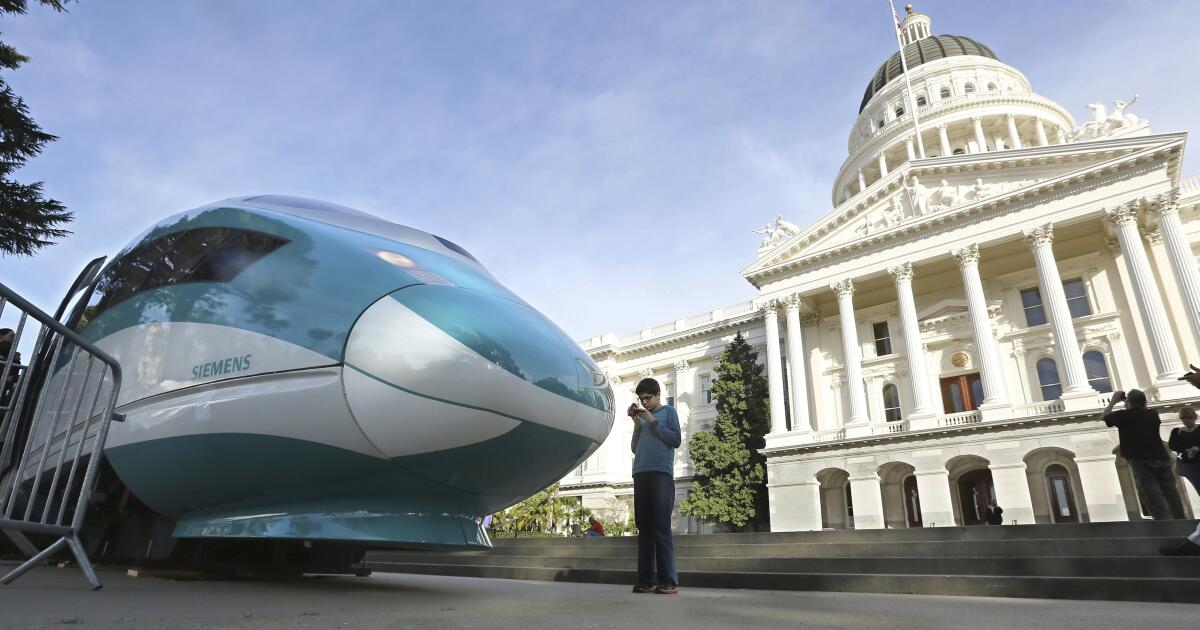
California’s high-speed rail project is slated to receive $1 billion a year in funding through the state’s cap-and-trade program for the next 20 years — a relief to lawmakers who had urged the Legislature to approve the request as billions of dollars in federal funding remain in jeopardy.
State leaders called the move, which is pending a final vote from the Legislature, a necessary step to cementing investments from the private sector — an area of focus for project officials. And the project’s chief executive, Ian Choudri, said the agreement is crucial to completing the current priority — a 171-mile portion from Merced to Bakersfield — by 2033.
“This funding agreement resolves all identified funding gaps for the Early Operating Segment in the Central Valley and opens the door for meaningful public-private engagement with the program,” Choudri said in a statement. “And we must also work toward securing the long-term funding — beyond today’s commitment — that can bring high-speed rail to California’s population centers, where ridership and revenue growth will in turn support future expansions.”
The project was originally proposed with a 2020 completion date, but so far, no segment of the line has been completed. It’s also about $100 billion over the original $33 billion budget that was originally proposed to voters and has received considerable pushback from Republican lawmakers and some Democrats. The Trump administration recently moved to pull $4 billion in funding that was slated for construction in the Central Valley; in turn, the state sued.
Still, advocates of the project believe it’s crucial to the state’s economy and to the nation’s innovation in transit.
“We applaud Governor Newsom and legislative leaders for their commitment and determination to make High-Speed Rail a success,” former U.S. Secretary of Transportation and Co-Chair of U.S. High Speed Rail Ray LaHood said in a statement. “The agreement represents the most important step forward to date for this transformational project.”
State Sen. Dave Cortese (D-San Jose), who chairs the Senate’s Transportation Committee, said the Legislature “must act quickly to pass this plan and keep California on track to deliver America’s first true high-speed rail.”
Construction on the project has been limited to the Central Valley. Choudri has said that the project could take decades to connect the line from Los Angeles to San Francisco and it’s unclear when construction would begin elsewhere in the state. A recent report from the authority proposed next alternatives for the project that would connect the Central Valley to Gilroy and Palmdale. In those scenarios, regional transit would fill in the gaps to San Francisco and Los Angeles.
L.A.-area lawmakers recently requested an annual $3.3-billion investment in transit from the state’s cap-and-trade fund, acknowledging that although high-speed rail is a state priority, L.A. County should not be overlooked when it comes to increasing more immediate transit investments in the state’s most populous county. Citing equity, health and climate needs, the delegation pushed for greater investment in bus, rail and regional connectors.
According to a recent report from the Southern California Assn. of Governments, L.A. County accounts for 82% of Southern California’s bus ridership. Although public transit use is high, lawmakers and transit leaders have said that expansion and improvements are necessary.
“Millions of Los Angeles County residents already depend on Metro bus and rail, Metrolink, and municipal operators. Yet service has not kept pace with need: transit ridership is still 25-30% below pre-pandemic levels, even as freeway traffic has nearly fully rebounded,” the delegation’s letter stated. “Without significant investment, super commuters from the Valley, South LA, and the Inland Empire remain locked into long, expensive car trips.”
Funding commitments for L.A. County transit were maintained from the last budget, but the delegation’s request for billions in cap-and-trade funds has yet to come through.
“The state budget deal in June 2025 restored $1.1 billion in flexible transit funding from the GGRF, which benefits transit operations statewide, including L.A. County,” Sen. Lola Smallwood-Cuevas’ (D-Los Angeles) office said.
Smallwood-Cuevas said the point of the request was to ensure that transit needs of the Los Angeles region aren’t lost.
“We recognize what it means when folks in L.A. County get out of their cars and onto public transit — that is the greatest reduction that can happen,” she said. “We fully intend to see an opportunity where we can address some of that ridership and look at ways to ensure an equitable opportunity that invests in our regional transit public transit, while we also work to build what I call the spine of our transit, a high speed rail program that will run up and down the state and connect to our regional public transit arteries.”
State Sen. Henry Stern (D-Los Angeles) said that the state’s investments toward wildfire recovery in Pacific Palisades and Altadena “does not mean that you should leave the largest segment of drivers anywhere in the world languishing in traffic forever.”
“It’s not that there’d be nothing [for transit funding],” Stern said. “It’s just that we think there should be more.”
The Los Angeles area isn’t facing the same state funding hurdle of the Bay Area, where lawmakers have scrambled to obtain a $750-million transit loan, warning that key services like BART could be significantly affected without the funds.
Roughly $14 billion has been spent on the high-speed rail project so far, which has created roughly 15,000 jobs in the Central Valley. Theoretically, the train will eventually boost economies statewide.
Eli Lipmen of MoveLA believes that the investments will help transit in the Los Angeles region by expanding access, long before there’s a direct high-speed rail connection.
“Wer’e building an incredible transit system with LA Metro, but we need that regional system to get out to Orange County, San Bernardino, Riverside, Ventura County,” Lipmen said.
“So we’re making those investments even if high-speed rail doesn’t come here right away to improve those connections for constituents. That’s a good thing.”



The IPOs of SpaceX, OpenAI and Anthropic could deliver billions of dollars to California’s coffers.
We’ve seen this movie before.
In 2022, California recorded a nearly $100 billion surplus, saved just $10 billion in its rainy day fund and then spent the rest. Two years later, a $56 billion deficit loomed.
Now, with the state facing ongoing operating deficits of more than $10 billion, we’re back in familiar territory.
The coming IPO windfall is a rare second chance. But we’ll only benefit from it if we first fix the structural flaw that’s caused us to squander every previous boom — a budget reserve that isn’t built to hold what we put in it.
The stakes this time are higher than ever. The war in Iran raised recession risk, and the federal government is systematically dismantling the funding streams California has depended on for decades.
When Washington retreats, Sacramento has to choose: cut services, raise taxes or have enough saved to bridge the gap. Right now, we don’t have enough saved.
We’re not outside observers wringing our hands. We helped shape the fiscal architecture the state is now straining against, and we’re here to say: It needs to be rebuilt.
As California state controller, one of us campaigned alongside Gov. Arnold Schwarzenegger to pass Proposition 58 in 2004 — creating California’s first Budget Stabilization Account. The other authored the Assembly Constitutional Amendment that became Proposition 2 in 2014 — the stronger, harder-to-raid replacement that voters approved with 69% support.
California’s tax system is the envy of progressive states and the nightmare of budget directors. We tax the wealthy at high rates, capture enormous capital gains revenue in boom years and then discover — every single time — that the peak doesn’t last.
If California treats the IPO windfall from SpaceX, Anthropic and OpenAI as permanent revenue, our state would repeat exactly the mistake we made four years ago.
Gov. Gavin Newsom and Assemblymember Avelino Valencia have each proposed important reforms to strengthen the fund. First, they call for requiring the state to make deposits until the fund reaches 20% of the general fund total, rather than the current 10%. Second, they propose changing an arcane accounting rule that treats saving for future downturns as spending.
We see one additional opportunity to make the rainy day fund even stronger.
If we want a larger budget reserve, we have to do more than merely allow it — we need to require it. Proposition 58 taught us everything we need to know on this front: Between 2004 and 2014, with that proposition fund in place, only two deposits were made. If we want consistent deposits during the boom times, they can’t be optional.
These reforms should be a win-win for the California Legislature. A larger reserve is the most durable protection that public sector workers, social service recipients and education advocates have against the kind of emergency cuts that have repeatedly gutted programs during downturns.
It’s also the strongest argument against tax increases in a recession because you don’t need to raise taxes if you actually save during the booms.
Building a stronger rainy day fund isn’t the cautious choice. It’s the visionary one — the closest thing we have to investing in the next generation of Californians.
We built the last rainy day fund because we’d lived through the consequences of not having one. We’re making the same argument again, for the same reason except now the stakes are higher. This time, the federal backstop is weaker, and the next storm is closer than it looks.
Fix the fund this year. The next generation of Californians will thank us for it.
Mike Gatto served in the state Assembly between 2010 and 2016, and he authored the measure that created California’s current rainy day fund. Steve Westly served as state controller between 2003 and 2007, and he co-championed Proposition 58, California’s original rainy day fund. Westly chairs the 21st Century Alliance, a nonpartisan organization focused on solutions to the state’s most pressing challenges.

CHICO, Calif. — A shooting at a library in Northern California on Monday left two people dead and a suspect is in custody, according to police.
Police responded to a 911 call soon after 5 p.m. in which the sounds of gun shots and people screaming could be heard coming from inside the Chico branch of the Butte County Library, Billy Aldridge, the city’s chief of police, said during a news conference.
Once officers were inside the library, the suspect fled out of the back, he said. Additional law enforcement behind the library took the suspect into custody, according to Aldridge.
“The incident this evening was obviously very sad, traumatic for a lot of people. Very traumatic for our community,” he said.
The streets around the library were closed temporarily and a family reunification center was set up for the people who were inside the building.
A child was also taken to the hospital with a minor injury.
Aldridge said there is no serious threat to the public and law enforcement are investigating the shooting.
The police didn’t release the suspect’s name nor details on what prompted the shooting. Law enforcement said they believe the shooter acted alone.
Law enforcement are also not releasing the names of the people killed until next of kin have been notified.
The county urged the public to avoid the area and said all Butte County library branches will be closed Tuesday.
The county in a post on Facebook offered “deepest condolences to everyone affected, including the victims, their loved ones, library staff, and all those impacted by this heartbreaking incident.”
Copyright © 2026 by The Associated Press. All Rights Reserved.

CALIFORNIA CITY, Calif. (KERO) — A 12-year-old boy is dead and another child was hospitalized after two unleashed dogs attacked a group of children at Central Park in California City on Friday, June 18.
California City Mayor Edwin Hawkins said police responded to the scene after reports that four children had been mauled.
Fernando Torres Moreno, 12, jumped into a nearby lake to escape the charging dogs. Officers pulled Fernando from the water, and he was taken to the hospital, where he died the next day.
A second child suffered serious, though non-life-threatening, dog bite wounds and has since been released from the hospital. Two additional children were shaken but did not require medical treatment.
Authorities say the dogs, both mixed breed, were off-leash but in the presence of their owner when the attack unfolded.
The investigation remains active and ongoing. No arrests have been made.
This story was reported on-air by a journalist and has been converted to this platform with the assistance of AI. Our editorial team verifies all reporting on all platforms for fairness and accuracy.
Stay in Touch with Us Anytime, Anywhere:
-

 San Francisco, CA5 minutes ago
San Francisco Supervisor Jackie Fielder to return following mental health leave
-
Dallas, TX8 minutes ago
Impact: How Jeffery Simmons’ extension could affect Quinnen Williams
-
Miami, FL13 minutes ago
Jaylen Brown bidding war? Haslem drove this? All the fallout from Antetokounmpo trade to Miami
-

 Boston, MA20 minutes ago
Your next Uber ride in Boston could be a taxi
-

 Denver, CO23 minutes ago
Nuggets 2026 NBA mock draft tracker 2.0: What national experts predict Denver will do
-

 Seattle, WA28 minutes ago
How to watch Bosnia vs. Qatar in next Seattle World Cup match
-
 San Diego, CA35 minutes ago
San Diego Unified leaders propose policy to limit technology in classrooms
-
 Milwaukee, WI38 minutes ago
Racine’s Greek community reflects on Giannis’ celebration of Greek culture

