California
Fuel, energy prices raise the pressure as California officials take next steps on climate

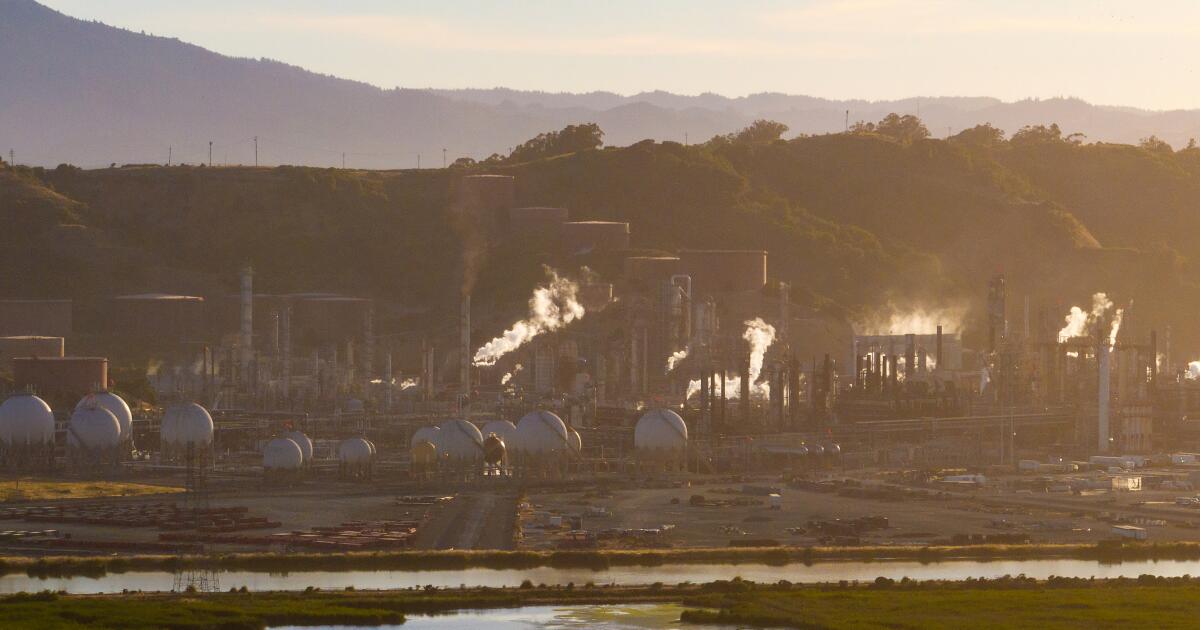
As California regulators prepare for a massive update of the state’s signature climate program, they face mounting pushback from lawmakers and oil industry groups who warn it could drive up already-high energy costs.
Lawmakers voted last year to reauthorize the cap-and-invest program — formerly known as cap-and-trade — through 2045. The program progressively lowers the amount of greenhouse gas emissions allowed in the state, and lets emitters buy and sell unused pollution credits, or allowances. It is key to California’s climate strategy and generates billions in revenue for the state each year.
Although the program was always designed to ratchet down on emitters, some legislators who supported the extension say the draft unveiled by the California Air Resources Board could hit consumers and the energy sector hard at the wrong time.
Among the proposed updates, the plan would tighten the cap on carbon dioxide emissions by 118 million tons by 2030. It would also adjust the state’s system of free allowances, which have historically been given to oil refineries and other industrial facilities in the hope of keeping them in California. It would shift more of those free allowances from natural gas utilities to electric utilities.
A wave of public comments from lawmakers, oil companies, environmental advocates and consumers flooded the state Air Resources Board in advance of this week’s deadline, and the agency will have until May to revise the plan and put it to a final vote.
Among the most notable critics are Democratic lawmakers who voted to extend the program last year. Some are concerned the plan would raise costs for refineries, driving more of them out of California and leaving the state more dependent on imported refined fuels. Others are worried the plan doesn’t do enough to address high electricity costs.
In a letter to the state Air Resources Board, a coalition of 15 Democratic Assembly members, including Majority Leader Cecilia Aguiar-Curry (D-Winters), warned that the plan moves too fast for emitters to keep up, which they said will destabilize California’s complex network of fuel, gas and energy resources and push more refiners to leave the state. Phillips 66 and Valero have already announced plans to shutter major refineries in Los Angeles and Benicia.
“This proposed regulatory update would further burden an already struggling energy market across multiple sectors and compound stress on the very infrastructure that has punished California consumers with the highest energy prices in the nation,” the lawmakers wrote.
Oil industry groups raised similar concerns. The Western States Petroleum Assn. which represents refiners, warned that their costs could rise $1.5 billion annually by 2035.
Chevron executive Andy Walz said the added costs could translate to roughly $1.70 more per gallon of gasoline by that year.
“Affordability is a top concern for California residents and Chevron, and these proposed amendments would only exacerbate the high cost of living in the state,” Walz said.
But how much regulations contribute to gasoline costs in California is disputed. Officials with the state Air Resources Board said the proposal largely maintains the status quo for refineries. It includes “flexibilities that support doing business in California and help ensure liquid fuel supply remains reliable, affordable, and resilient throughout the transition to carbon neutrality,” spokeswoman Lindsay Buckley said in an email.
The updated program would also deliver $180.7 billion in statewide benefits, including $123 billion in avoided health costs thanks to cleaner air, and up to $485 billion in global savings due to avoided climate damage, Buckley said.
“The cap-and-invest program is the most cost-effective way for California to achieve its statutorily mandated climate goals,” she said.
At the same time, some lawmakers and advocates say the proposal disproportionately burdens the electricity sector at a moment when utility bills are soaring.
Assemblywoman Jacqui Irwin (D-Thousand Oaks), who wrote legislation extending the program last year, led a separate letter from more than two dozen Democratic lawmakers urging the air officials to speed up free allowances for electric utility companies in order to “meaningfully address electricity affordability in the near-term.”
They were also concerned the plan would result in lower climate credits for consumers — twice-yearly rebates that appear directly on people’s electric bills.
Policy analysts agreed the current plan burdens electric utilities, which could translate into higher bills.
Still, the proposal is a “strong starting point” that can be fine-tuned to better balance emissions cuts with affordability, said Clayton Munnings, executive director of Clean and Prosperous California, an environmental economics nonprofit focused on the cap-and-invest program.
The California Air Resources Board “had a very strong first start, but I think there’s a clear pattern in stakeholder feedback,” he said. “The intent here was to lower utility bills, and we should make good on that promise.”
On the fuel side, Munnings said the program was designed with refineries in mind, and regulators still have plenty of tools to address their concerns if needed. What’s more, he said the carbon market largely shrugged at the proposed removal of 118 million credits, and the cost of releasing one ton of carbon pollution went down — indicating that even tighter reductions could be warranted.
Indeed, an analysis by the nonprofit Environmental Defense Fund and the modeling firm Greenline Insights found that the state Air Resources Board could remove as many as 180 million allowances from the market and still preserve household affordability benefits.
Ensuring the program delivers on its promised emission cuts is crucial, said the Environmental Defense Fund’s California state director Katelyn Roedner Sutter. The state is not on track to meet its targets, including a 40% reduction in greenhouse gas emissions by 2030 and at least 85% by 2045.
“Cap-and-invest is so important because it helps reduce emissions, it generates desperately needed revenue, and it is the most cost-effective approach to reducing greenhouse gas pollution that we have,” she said.
The debate is unfolding as global oil prices soar amid the U.S.-Israeli war on Iran, which has disrupted shipping and production in the Middle East. Crude prices briefly surged beyond $119 a barrel this week.
National gasoline prices averaged $3.60 a gallon Thursday, according to AAA, up from $2.94 one month ago. In California, gas averaged $5.37 a gallon, up from $4.55 a month ago.
But according to the California Energy Commission, only about 6% of the price of retail gasoline in the state is attributable to the cap-and-invest program, while nearly 37% comes from the cost of crude oil.
That’s precisely why the state should stay the course, Roedner Sutter said.
“The best thing California can do is lean on its cost-effective climate policy, which is cap-and-invest, and continue moving the state away from dependence on fossil fuels,” she said. “In the long run, that is what is going to protect Californians most — not being dependent on this volatile industry.”
The state Air Resources Board is expected to revise the proposal in the coming weeks before bringing it to a vote in May.


BAKERSFIELD, Calif. (KBAK/KBFX) — The California Highway Patrol is urging drivers to stay focused on the road as they head out for Fourth of July celebrations.
The holiday weekend can be a dangerous time on our roads as millions of drivers are expected to travel.
CHP Officer Jorge Toro joined Eyewitness News Mornings to share how drivers can stay safe behind the wheel.
Officer Toro also highlighted the importance of sober driving over the holiday.
BE THE FIRST TO COMMENT
He says anyone hosting a party should make sure all of their guests get home safely, ensuring anyone who may be impaired doesn’t drive.

California is returning a stretch of rugged Mendocino County coast to the Indigenous nations whose ancestors once stewarded its shores.
State transportation officials recently approved the transfer of Blues Beach and the surrounding bluffs to Kai Poma, a nonprofit founded by representatives of the Sherwood Valley Band of Pomo Indians, Round Valley Indian Tribes and Coyote Valley Band of Pomo Indians.
The transfer of 136 acres just south of the community of Westport will mark the first time land managed by the California Department of Transportation has been returned to Indigenous tribes.
“This is beyond huge,” said J. Carlos Rivera, tribal chairman of the Sherwood Valley Band of Pomo Indians. “It’s enormous from our tribal perspective that we are basically obtaining the land that our people once lived on before colonization.”
California purchased the swath of rocky cliffs and windswept shoreline in the 1960s to expand the construction of Highway 1 and create a scenic viewpoint for highway travelers, according to a California Coastal Commission report.
More recently, public access has been largely unregulated, and summer weekends and holidays have drawn large groups who camp and party on the beach, at times driving through sensitive areas, damaging cultural sites and leaving behind trash, the report states.
Kai Poma plans to conduct cultural and archaeological resource studies and environmental surveys and then prepare a resource management plan for the property, according to planning documents. The nonprofit and the Coastal Commission have drafted a public access management plan that states the land will be open from sunrise to sunset.
Rivera described the entire property as a sacred site. The coastal waters are used by tribal people for seaweed and abalone gathering, and the shores host youth cultural camps, he said. “Protecting the land, it has a deeper meaning for us because we’re connected to the land,” he said.
The effort to acquire the land took years — and required a change in state law. Caltrans lacked the ability to transfer land to tribal governments until 2021, when Gov. Gavin Newsom signed a bill sponsored by state Sen. Mike McGuire (D-Healdsburg) that enabled the transfer, according to a news release issued at the time. The law also bars commercial activity on the property and requires public access be maintained.
“With 136 acres now officially transferred into tribal stewardship, one of the most spectacular stretches of the Mendocino Coast will be forever protected,” McGuire said in a statement.
“This agreement, the first of its kind in California, gives these three dynamic Native American tribes the rightful opportunity to reclaim sacred lands and cultural traditions on this special piece of earth. And it’s about damn time.”
The land transfer cleared its last regulatory hurdle June 26 with the approval by the California Transportation Commission, said Neil Thapar, an attorney who works as an advisor and legal consultant to Kai Poma. Caltrans staff will next record the deed transferring the title from the state of California to Kai Poma, which is expected to happen any day, he said.


Fireworks Safety Guide
Essential safety tips for buying, handling, and watching fireworks to ensure a safe celebration.
With July 4 falling on a Saturday this year, many businesses and organizations are taking the day off Friday, July 3, to mark America’s 250th birthday. From banking to mail service, here’s what’s open and closed for the holiday weekend.
Most federal offices closed, mail service to continue
Non-essential federal offices will be closed on July 3. However, mail service will continue as normal, and post offices are scheduled to remain open.
Most California government offices to remain open
Most California government offices will be open on July 3, with some exceptions.
DMV offices throughout the state will be open. However, the Employment Development Department will be closed.
DMV offices that offer Saturday hours will be closed on July 4.
Private parcel services to remain open
UPS and FedEx are both scheduled to operate normally on July 3, but will suspend service on July 4.
Stock markets closed
Both the New York Stock Exchange and Nasdaq will be closed on July 3.
Most banks to stay open
While most banks were expected to operate normally on July 3, some may operate under modified holiday hours. All banks will be closed on July 4.
Online banking services should remain operational.
Grocery stores
Most major grocery chains will be open on both July 3 and July 4. Trader Joe’s locations will be open for regular business on July 3 but will close early at 5 p.m. on the Fourth of July.
Retailers
Many major retail stores, such as Walmart and Target, plan to operate under normal business hours on both July 3 and 4. All Costco warehouse stores operate under normal business hours on July 3, but will close on July 4.
Restaurants
Most major restaurant chains remain open on July 4, but some will have limited hours. All Raising Cane’s locations will close on July 4.
-

 Los Angeles, Ca20 seconds ago
2 arrested after 3 LASD deputies injured during East L.A. World Cup celebration
-

 Detroit, MI18 minutes ago
Ex-girlfriend in custody after Taylor man found fatally stabbed, police say
-

 San Francisco, CA30 minutes ago
Marina braces for Golden Gate Bridge fireworks show, massive crowds
-

 Dallas, TX33 minutes ago
Maradona’s ‘Hand of God’ ball heads to auction in Dallas
-

 Miami, FL38 minutes ago
Miami-Dade sheriff urges residents to celebrate Fourth of July safely
-

 Boston, MA45 minutes ago
Jaylen Brown says Celtics showed ‘lack of respect’ after trade to 76ers – The Boston Globe
-

 Denver, CO48 minutes ago
Who are the Top 5 offensive linemen in Denver Broncos history?
-

 Seattle, WA53 minutes ago
Seattle’s Lake Union to light up with big July 4 fireworks show for America’s 250th

