
Connect with us

California

Firefighters gain ground on 3 huge Southern California blazes

Published

on

Firefighters gain ground on 3 huge Southern California blazes


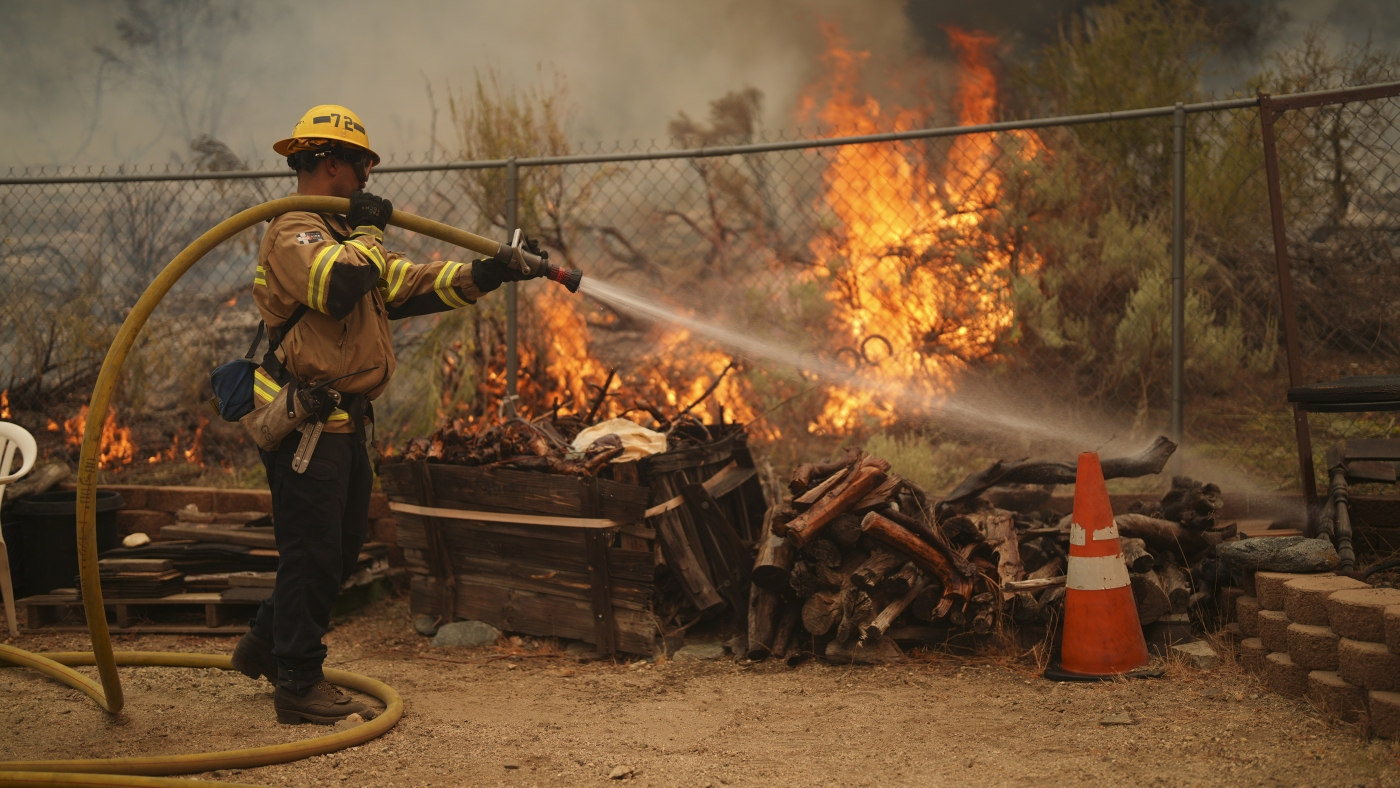
A firefighter douses flames in the perimeter of a property while battling the Bridge Fire on Sept. 11, 2024, in Wrightwood, Calif.

Eric Thayer/AP


hide caption

Advertisement

toggle caption

Eric Thayer/AP

LOS ANGELES — Helped by cooler temperatures, firefighters gained ground Friday against three blazes in Southern California and authorities began scaling back evacuation orders that displaced thousands of people.

Advertisement

The largest is the Bridge Fire east of Los Angeles, which has burned 81 square miles (210 square kilometers), torched at least 33 homes and six cabins and forced the evacuation of 10,000 people. The cause of the fire is not yet known. After days of burning without fire crews being able to stop its forward march, it was 3% contained on Friday.

“Firefighters made great progress on the ground, aided by aircraft to attack the fire aggressively 24 hours per day,” the California Department of Forestry and Fire Protection said in a statement.

While firefighters have made significant progress, the three major wildfires that have ravaged the mountains east of Los Angeles, destroying dozens of homes, injuring a dozen people, and burning more than 155 square miles (400 square kilometers), still pose significant threats to some communities.

California is entering the height of wildfire season and has already seen nearly three times as much acreage burn as during all of 2023.

Advertisement

Evacuation orders were being scaled back, including in parts of Big Bear where the Line Fire forced thousands of people to flee. Authorities say a delivery driver purposely started the blaze Sept. 5.

The fire has charred 59 square miles (153 square kilometers) in the San Bernardino mountains, where Southern Californians ski in the winter and mountain bike in the summer. It was 21% contained as of Friday.

The Line Fire is burning through dense vegetation that grew after two back-to-back wet winters when snowstorms broke tree branches, leaving behind a lot of “dead and down fuel,” Cal Fire Operations Section Chief Jed Gaines said.

The Big Bear Zoo said it moved all its animals to a zoo in the city of Palm Desert to protect them from the wildfires and escalating temperatures.

The fires have threatened tens of thousands of homes and other structures across Southern California since they escalated during a triple-digit heat wave.

Advertisement

Cooler weather that began midweek has helped firefighters slowly gain the upper hand in battling the blazes. No deaths have been reported, but at least a dozen people, mainly firefighters, have been treated for injuries, mostly heat-related, authorities said.

Jason Anderson, district attorney for San Bernardino County, said Thursday that nine arson-related charges have been filed against Justin Wayne Halstenberg, who is accused of starting the Line Fire.

Anderson said Halstenberg, 34, attempted to start three fires within an hour in the city of Highland. Two were extinguished by firefighters and a good Samaritan, and the third became the Line Fire, according to authorities.

“This is particularly galling in a community that unfortunately over the last couple of years has dealt with the scourge of wildfires,” he told reporters, adding that the suspect’s vehicle has been linked to three areas where the fires were started.

Halstenberg is due to be arraigned on Monday according to the San Bernardino County District Attorney’s Office, which said Friday that it did not have information about an attorney for him.

Advertisement

Halstenberg’s mother, Connie Halstenberg, told the Los Angeles Times that her son “did not light that fire.”

The full extent of the damage caused by the wildfires remains unclear, but Anderson said at least one home has been destroyed by the blaze.

Farther south, the Aiport Fire in Orange and Riverside counties has burned more than 37 square miles (96 square kilometers). Reportedly sparked by workers using heavy equipment, it was 8% contained as of Friday morning.

Ten firefighters and two residents were injured in the blaze, according to the Orange County Fire Authority. The fire has been difficult to tame because of the steep terrain and dry conditions — and because some areas hadn’t burned in decades. It destroyed at least 27 cabins in the Holy Jim Canyon area, authorities said.

In northern Nevada, Washoe County officials confirmed Friday that a wildfire that broke out south of Reno last weekend destroyed 14 homes the first two days but none since as containment continues to increase.

Advertisement

Authorities have lifted all but a few of the evacuation orders that initially forced covered as many as 20,000 residents. Power has been restored to all but about 140 customers, NV Energy said. No deaths or serious injuries were reported.

Containment of the Davis fire was estimated at 56%, with no growth in the perimeter for the third day in a row after it burned nearly 9 square miles (23 square kilometers) of timber and brush along the Sierra’ Nevada’s eastern slope near Lake Tahoe.

The Washoe County sheriff was seeking tips from the public as an investigation continued into the origin of the human-caused fire, which started Sept. 7 in a regional park about halfway between Reno and Carson City.


Source link

Advertisement

California

California bill to bar police from taking second job with ICE advances in state Assembly

Published

on

California bill to bar police from taking second job with ICE advances in state Assembly


Wednesday, March 4, 2026 4:43AM

CA bill to keep police from moonlighting with ICE advances

SACRAMENTO, Calif. (KABC) — A bill that would prevent police officers from moonlighting with federal immigration enforcement agencies, such as U.S. Immigration and Customs Enforcement, is advancing through the California State Assembly.

AB 1537 passed the State Assembly’s committee on public safety on Tuesday.

The bill also requires that officers report any offers for secondary employment related to immigration enforcement to their place of work.

Those failing to comply could face decertification as a peace officer in California.

Advertisement

The bill was introduced by Assemblymember Isaac Bryan, whose district includes Mar Vista, Ladera Heights, Mid-Wilshire and parts of South Los Angeles.

Copyright © 2026 KABC Television, LLC. All rights reserved.


Source link

Continue Reading

California

Can’t win in primary election? Drop out, California Democrats say

Published

on

Can’t win in primary election? Drop out, California Democrats say


play

California Democrats running for governor, your party has a message for you. Think carefully about your candidacy and campaign ahead of the swiftly approaching filing deadline.

California Democratic Party Chair Rusty Hicks urged candidates looking to assume the state’s highest office to “honestly assess the viability of their candidacy and campaign” as March 6, the final day to declare candidacy, nears. Hicks said that concerns about the crowded field of Democrat candidates “persist” in an open letter on Tuesday, March 3.

Advertisement

It comes as five leading candidates, several of which are Democrats — Katie Porter, Eric Swalwell, and Tom Steyer — are in a “virtual tie” per a recent poll, the Desert Sun reported, which is part of the USA TODAY Network.

Two Republican candidates pushing out California democrats in the gubernatorial bid may be “implausible,” but “it is not impossible,” Hicks said of the reasoning behind his latest message. Steve Hilton and Riverside County Sheriff Chad Bianco, both Republicans, lead in RealClear Polling’s average of various polls.

The party chair spotlighted the need for California Democrats’ leadership, particularly over Proposition 50, the voter-approved measure that will temporarily implement new congressional district maps, paving the way for Democrats to secure more seats in the U.S. House of Representatives.

“If in the unlikely event a Democrat failed to proceed to the general election for governor, there could be the potential for depressed Democratic turnout in California in November,” Hicks said. “The result would present a real risk to winning the congressional seats required and imperil Democrats’ chances to retake the House, cut Donald Trump’s term in half, and spare our nation from the pain many have endured since January 2025.”

Advertisement

During a press conference on March 2, Gov. Gavin Newsom said that when he is out in communities, people aren’t talking about the governor’s race. It’s an observation he called “interesting,” considering voting in the primary election starts in May.

“It’s been hard, I think, to focus on that race,” Newsom said, pointing to the attention on President Donald Trump, redistricting, and other matters.

What exactly is California Democratic Party asking of candidates?

In his open letter, Hicks gave directions to candidates.

First, assess your candidacy and campaign. If you don’t have a viable path to the general election, don’t file to get your name on the ballot for the primary election in June. Also, be prepared to suspend your campaign and endorse another candidate by April 15 if you decide to file but can’t show “meaningful progress towards winning the primary election.”

Advertisement

When is the next California election? Primary election in 2026

California voters will trim the field of candidates for governor on June 2. Only the two candidates who receive the most votes, regardless of party preference, will move on to the November election.  

Paris Barraza is a reporter covering Los Angeles and Southern California for the USA TODAY Network. Reach her at pbarraza@usatodayco.com.


Source link

Continue Reading

California

Supreme Court blocks California law limiting schools from telling parents about trans students

Published

on

Supreme Court blocks California law limiting schools from telling parents about trans students


The U.S. Supreme Court has temporarily blocked a California law that limited when schools could require staff to disclose a student’s gender identity, clearing the way for schools to tell parents if their children identify as transgender without getting the students’ approval.

Rear view of multiracial students with hands raised in classroom at high school

The decision came after religious parents and educators, represented by the Thomas More Society, challenged California school policies aimed at preventing staff from disclosing a student’s gender identity.

Erwin Chemerinsky, dean and professor of law at the University of California Berkeley School of Law, said the ruling favors parents’ ability to be informed. “The Supreme Court today rules in favor of the claim of parents to be able to know the gender identity and gender pronoun of the children,” Chemerinsky said.

Advertisement
FILE:{ }transgender flag against blue sky background { }(Photo: AdobeStock)

FILE:{ }transgender flag against blue sky background { }(Photo: AdobeStock)

The decision temporarily blocks a state law that bans automatic parental notification requirements if students change their pronouns or gender expression at school. The Thomas More Society called the decision a major victory for parents, saying the court found California’s policy likely violates constitutional rights.

Chemerinsky said the Supreme Court’s action is an emergency ruling. “This law is now put on hold. So what this means is that schools can require that teachers and other staff inform parents of the gender identity or gender pronouns of children,” he said.

scotus.PNG

Kathie Moehlig, founder and executive director of Trans Family Support Services, said she is concerned about how the ruling could affect students who do not have supportive families.

“I am really concerned about our kids that do come from these non affirming homes, that they know that they’re going to get in trouble, that they’re going to possibly have violence brought against them possibly kicked out of their homes,” Moehlig said.

Moehlig said parents should eventually know, but that the conversation should happen when a student feels safe. “Our students are going to be less inclined to confide in any adults that might be able to help to get them access to mental healthcare, to a support system. They may still tell their peers but they’re certainly not going to tell any other adult,” she said.

Advertisement

Equality California, a LGBTQ+ civil rights organization, shared a statement:

Equality California, the nation’s largest statewide LGBTQ+ civil rights organization, released the following statement from Executive Director Tony Hoang in response to today’s U.S. Supreme Court shadow docket ruling in Mirabelli v. Bonta regarding California’s student privacy protections for transgender youth. Today’s decision by the U.S. Supreme Court to intervene in this case is deeply disturbing. By stepping in on an emergency basis, the Court has effectively upended California’s student privacy protections without hearing full arguments and before the judicial process has run its course. While not surprising, this move reflects a dangerous willingness to short-circuit the established judicial process to dismantle protections for transgender youth. While this case continues to be litigated, the ruling revives Judge Benitez’s prior decision, which broadly targets numerous California laws protecting transgender and gender-nonconforming students — threatening critical safeguards that prevent forced outing and allow educators to respect a student’s affirmed name and pronouns at school. These protections exist for one reason: to keep students safe and ensure schools remain places where young people can learn and thrive without fear. To be clear: today’s decision does not impact California’s SAFETY Act, which prohibits school districts from adopting policies that forcibly out transgender students. The SAFETY Act remains in full effect, and we will continue defending it. Transgender youth deserve dignity, safety, and the freedom to learn without fear. We will never stop fighting for transgender youth and their families. Equality California will continue working with parents, educators, and advocates to ensure schools remain safe, welcoming, and focused on the success and well-being of every student.

The case now returns to the U.S. Court of Appeals for the Ninth Circuit, which will decide whether the California law is constitutional.


Source link

Continue Reading

Trending
