California
Firefighters gain ground on 3 huge Southern California blazes

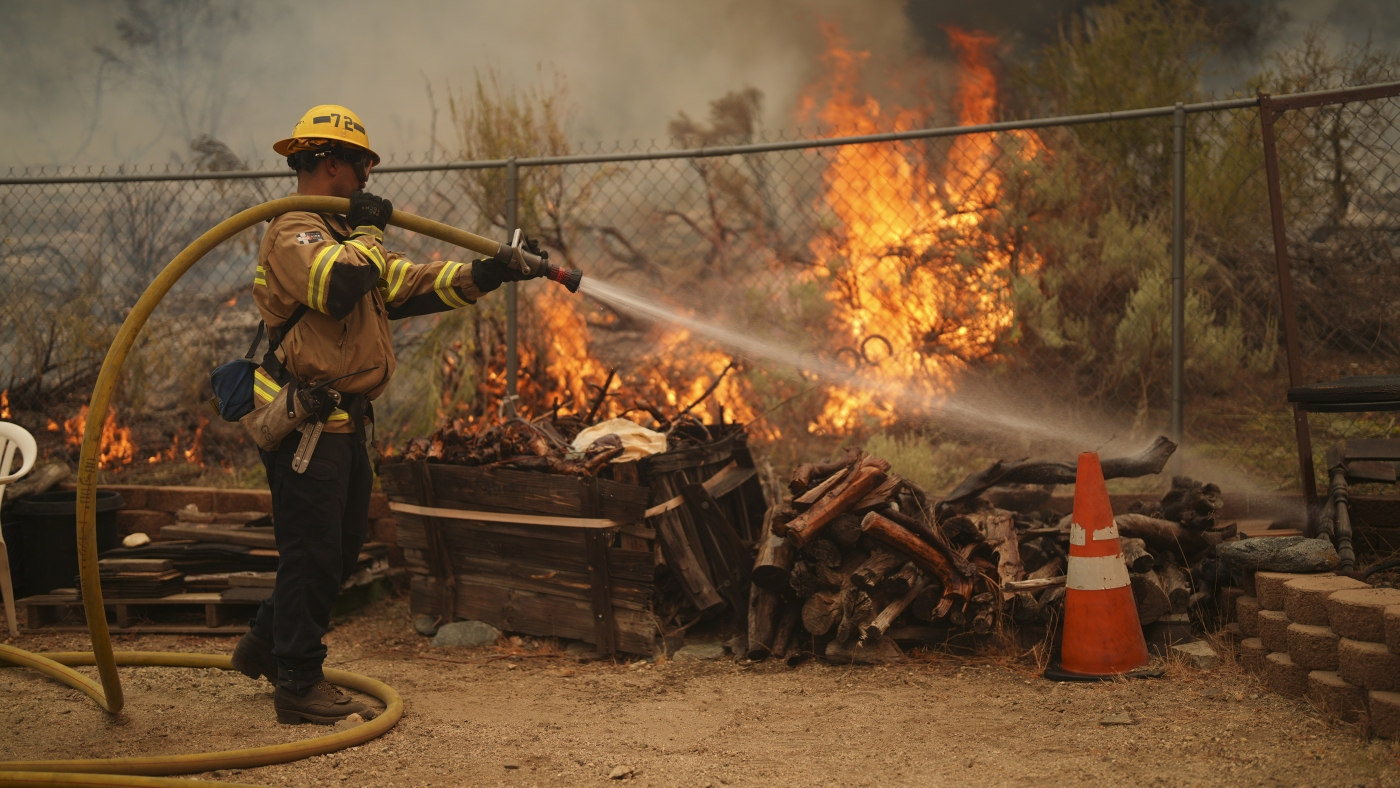
A firefighter douses flames in the perimeter of a property while battling the Bridge Fire on Sept. 11, 2024, in Wrightwood, Calif.
Eric Thayer/AP
hide caption
toggle caption
Eric Thayer/AP
LOS ANGELES — Helped by cooler temperatures, firefighters gained ground Friday against three blazes in Southern California and authorities began scaling back evacuation orders that displaced thousands of people.
The largest is the Bridge Fire east of Los Angeles, which has burned 81 square miles (210 square kilometers), torched at least 33 homes and six cabins and forced the evacuation of 10,000 people. The cause of the fire is not yet known. After days of burning without fire crews being able to stop its forward march, it was 3% contained on Friday.
“Firefighters made great progress on the ground, aided by aircraft to attack the fire aggressively 24 hours per day,” the California Department of Forestry and Fire Protection said in a statement.
While firefighters have made significant progress, the three major wildfires that have ravaged the mountains east of Los Angeles, destroying dozens of homes, injuring a dozen people, and burning more than 155 square miles (400 square kilometers), still pose significant threats to some communities.
California is entering the height of wildfire season and has already seen nearly three times as much acreage burn as during all of 2023.
Evacuation orders were being scaled back, including in parts of Big Bear where the Line Fire forced thousands of people to flee. Authorities say a delivery driver purposely started the blaze Sept. 5.
The fire has charred 59 square miles (153 square kilometers) in the San Bernardino mountains, where Southern Californians ski in the winter and mountain bike in the summer. It was 21% contained as of Friday.
The Line Fire is burning through dense vegetation that grew after two back-to-back wet winters when snowstorms broke tree branches, leaving behind a lot of “dead and down fuel,” Cal Fire Operations Section Chief Jed Gaines said.
The Big Bear Zoo said it moved all its animals to a zoo in the city of Palm Desert to protect them from the wildfires and escalating temperatures.
The fires have threatened tens of thousands of homes and other structures across Southern California since they escalated during a triple-digit heat wave.
Cooler weather that began midweek has helped firefighters slowly gain the upper hand in battling the blazes. No deaths have been reported, but at least a dozen people, mainly firefighters, have been treated for injuries, mostly heat-related, authorities said.
Jason Anderson, district attorney for San Bernardino County, said Thursday that nine arson-related charges have been filed against Justin Wayne Halstenberg, who is accused of starting the Line Fire.
Anderson said Halstenberg, 34, attempted to start three fires within an hour in the city of Highland. Two were extinguished by firefighters and a good Samaritan, and the third became the Line Fire, according to authorities.
“This is particularly galling in a community that unfortunately over the last couple of years has dealt with the scourge of wildfires,” he told reporters, adding that the suspect’s vehicle has been linked to three areas where the fires were started.
Halstenberg is due to be arraigned on Monday according to the San Bernardino County District Attorney’s Office, which said Friday that it did not have information about an attorney for him.
Halstenberg’s mother, Connie Halstenberg, told the Los Angeles Times that her son “did not light that fire.”
The full extent of the damage caused by the wildfires remains unclear, but Anderson said at least one home has been destroyed by the blaze.

Farther south, the Aiport Fire in Orange and Riverside counties has burned more than 37 square miles (96 square kilometers). Reportedly sparked by workers using heavy equipment, it was 8% contained as of Friday morning.
Ten firefighters and two residents were injured in the blaze, according to the Orange County Fire Authority. The fire has been difficult to tame because of the steep terrain and dry conditions — and because some areas hadn’t burned in decades. It destroyed at least 27 cabins in the Holy Jim Canyon area, authorities said.
In northern Nevada, Washoe County officials confirmed Friday that a wildfire that broke out south of Reno last weekend destroyed 14 homes the first two days but none since as containment continues to increase.
Authorities have lifted all but a few of the evacuation orders that initially forced covered as many as 20,000 residents. Power has been restored to all but about 140 customers, NV Energy said. No deaths or serious injuries were reported.
Containment of the Davis fire was estimated at 56%, with no growth in the perimeter for the third day in a row after it burned nearly 9 square miles (23 square kilometers) of timber and brush along the Sierra’ Nevada’s eastern slope near Lake Tahoe.
The Washoe County sheriff was seeking tips from the public as an investigation continued into the origin of the human-caused fire, which started Sept. 7 in a regional park about halfway between Reno and Carson City.

California
Mother, daughter found ‘alive and well’ after going missing on Southern California hiking trail

A mother and daughter who went missing after going for a hike on a difficult trail in San Bernardino County’s San Gorgonio Wilderness have been found “alive and well,” the sheriff’s department announced Friday.
The San Bernardino County Sheriff’s Department told KTLA they were uninjured and “walked out on their own.”
Krystal Meyers, 41, and her daughter Alexis Meyers Martinez, 21, were hiking on the Vivian Creek Trail Thursday but didn’t return, according to the San Bernardino County Sheriff’s Department.
They were last known to be at the 10,300-foot elevation mark above the High Creek switchbacks at 11 a.m., according to the San Gorgonio Search and Rescue team.
The Vivian Creek Trail is widely considered one of the more strenuous and hazardous routes in the San Gorgonio Wilderness.
The U.S. Forest Service says it’s the shortest and steepest route to the summit of Mount San Gorgonio and requires experienced mountaineering skills.
Officials did not provide any further details about the circumstances surrounding their disappearance.

BAKERSFIELD, Calif. (KBAK/KBFX) — The California Highway Patrol is urging drivers to stay focused on the road as they head out for Fourth of July celebrations.
The holiday weekend can be a dangerous time on our roads as millions of drivers are expected to travel.
CHP Officer Jorge Toro joined Eyewitness News Mornings to share how drivers can stay safe behind the wheel.
Officer Toro also highlighted the importance of sober driving over the holiday.
BE THE FIRST TO COMMENT
He says anyone hosting a party should make sure all of their guests get home safely, ensuring anyone who may be impaired doesn’t drive.

California is returning a stretch of rugged Mendocino County coast to the Indigenous nations whose ancestors once stewarded its shores.
State transportation officials recently approved the transfer of Blues Beach and the surrounding bluffs to Kai Poma, a nonprofit founded by representatives of the Sherwood Valley Band of Pomo Indians, Round Valley Indian Tribes and Coyote Valley Band of Pomo Indians.
The transfer of 136 acres just south of the community of Westport will mark the first time land managed by the California Department of Transportation has been returned to Indigenous tribes.
“This is beyond huge,” said J. Carlos Rivera, tribal chairman of the Sherwood Valley Band of Pomo Indians. “It’s enormous from our tribal perspective that we are basically obtaining the land that our people once lived on before colonization.”
California purchased the swath of rocky cliffs and windswept shoreline in the 1960s to expand the construction of Highway 1 and create a scenic viewpoint for highway travelers, according to a California Coastal Commission report.
More recently, public access has been largely unregulated, and summer weekends and holidays have drawn large groups who camp and party on the beach, at times driving through sensitive areas, damaging cultural sites and leaving behind trash, the report states.
Kai Poma plans to conduct cultural and archaeological resource studies and environmental surveys and then prepare a resource management plan for the property, according to planning documents. The nonprofit and the Coastal Commission have drafted a public access management plan that states the land will be open from sunrise to sunset.
Rivera described the entire property as a sacred site. The coastal waters are used by tribal people for seaweed and abalone gathering, and the shores host youth cultural camps, he said. “Protecting the land, it has a deeper meaning for us because we’re connected to the land,” he said.
The effort to acquire the land took years — and required a change in state law. Caltrans lacked the ability to transfer land to tribal governments until 2021, when Gov. Gavin Newsom signed a bill sponsored by state Sen. Mike McGuire (D-Healdsburg) that enabled the transfer, according to a news release issued at the time. The law also bars commercial activity on the property and requires public access be maintained.
“With 136 acres now officially transferred into tribal stewardship, one of the most spectacular stretches of the Mendocino Coast will be forever protected,” McGuire said in a statement.
“This agreement, the first of its kind in California, gives these three dynamic Native American tribes the rightful opportunity to reclaim sacred lands and cultural traditions on this special piece of earth. And it’s about damn time.”
The land transfer cleared its last regulatory hurdle June 26 with the approval by the California Transportation Commission, said Neil Thapar, an attorney who works as an advisor and legal consultant to Kai Poma. Caltrans staff will next record the deed transferring the title from the state of California to Kai Poma, which is expected to happen any day, he said.
-
 Lifestyle38 minutes ago
After weeks of speculation, Taylor Swift, Travis Kelce wed in New York
-

 Technology46 minutes ago
While you’re watching the World Cup, the feds may be watching you
-

 World53 minutes ago
Conservative Keiko Fujimori officially declared winner of Peru’s presidential runoff election
-

 Politics56 minutes ago
Trump hails America as ‘most exceptional nation ever to exist’ in Mount Rushmore speech
-

 Health1 hour ago
Scientists discover possible link between 9/11 and accelerated aging
-

 Sports1 hour ago
Messi, Argentina avoid a shocking upset in wild knockout stage match against Cape Verde
-

 Technology1 hour ago
Zoox robotaxi redesign brings big rider upgrades
-
 Business1 hour ago
Commentary: It’s not just vaccines — from infancy to adolescence, Republicans are waging war on children’s health

