California
California’s exodus isn’t just billionaires — it’s regular people renting U-Hauls, too

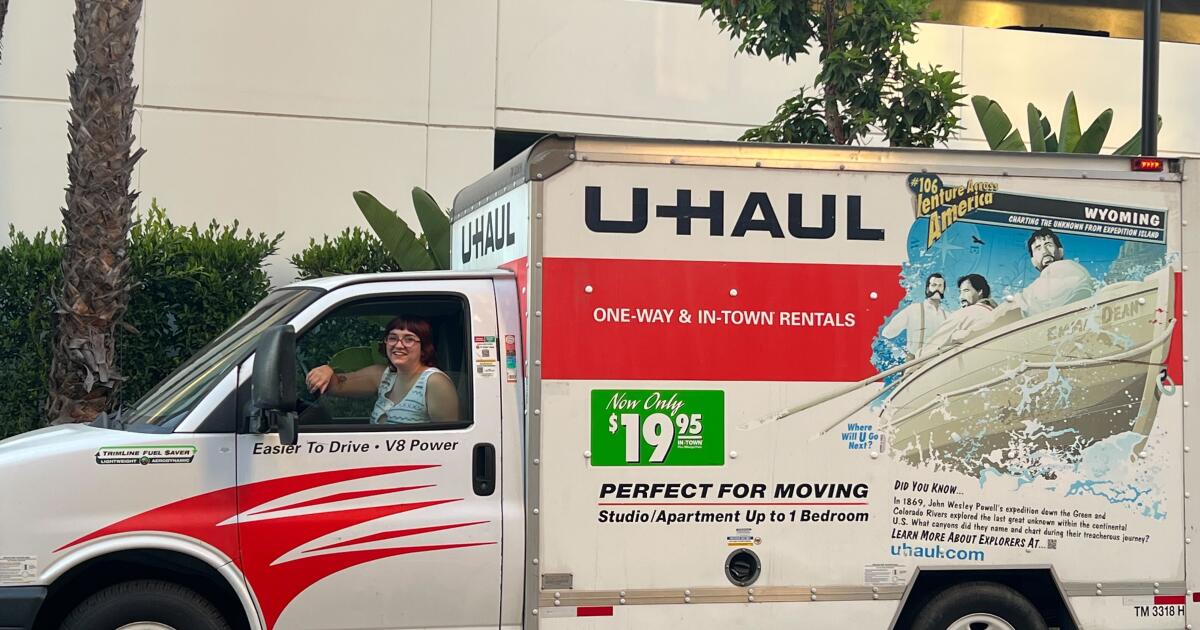
It isn’t just billionaires leaving California.
Anecdotal data suggest there is also an exodus of regular people who load their belongings into rental trucks and lug them to another state.
U-Haul’s survey of the more than 2.5 million one-way trips using its vehicles in the U.S. last year showed that the gap between the number of people leaving and the number arriving was higher in California than in any other state.
While the Golden State also attracts a large number of newcomers, it has had the biggest net outflow for six years in a row.
Generally, the defectors don’t go far. The top five destinations for the diaspora using U-Haul’s trucks, trailers and boxes last year were Arizona, Nevada, Oregon, Washington and Texas.
California experienced a net outflow of U-Haul users with an in-migration of 49.4%, and those leaving of 50.6%. Massachusetts, New York, New Jersey and Illinois also rank among the bottom five on the index.
U-Haul didn’t speculate on the reasons California continues to top the ranking.
“We continue to find that life circumstances — marriage, children, a death in the family, college, jobs and other events — dictate the need for most moves,” John Taylor, U-Haul International president, said in a press statement.
While California’s exodus was greater than any other state, the silver lining was that the state lost fewer residents to out-of-state migration in 2025 than in 2024.
U-Haul said that broadly the hotly debated issue of blue-to-red state migration, which became more pronounced after the pandemic of 2020, continues to be a discernible trend.
Though U-Haul did not specify the reasons for the exodus, California demographers tracking the trend point to the cost of living and housing affordability as the top reasons for leaving.
“Over the last dozen years or so, on a net basis, the flow out of the state because of housing [affordability] far exceeds other reasons people cite [including] jobs or family,” said Hans Johnson, senior fellow at the Public Policy Institute of California.
“This net out migration from California is a more than two-decade-long trend. And again, we’re a big state, so the net out numbers are big,” he said.
U-Haul data showed that there was a pretty even split between arrivals and departures. While the company declined to share absolute numbers, it said that 50.6% of its one-way customers in California were leaving, while 49.4% were arriving.
U-Haul’s network of 24,000 rental locations across the U.S. provides a near-real-time view of domestic migration dynamics, while official data on population movements often lags.
California’s population grew by a marginal 0.05% in the year ending July 2025, reaching 39.5 million people, according to the California Department of Finance.
After two consecutive years of population decline following the 2020 pandemic, California recorded its third year of population growth in 2025. While international migration has rebounded, the number of California residents moving out increased to 216,000, consistent with levels in 2018 and 2019.
Eric McGhee, senior fellow at the Public Policy Institute of California, who researches the challenges facing California, said there’s growing evidence of political leanings shaping the state’s migration patterns, with those moving out of state more likely to be Republican and those moving in likely to be Democratic.
“Partisanship probably is not the most significant of these considerations, but it may be just the last straw that broke the camel’s back, on top of the other things that are more traditional drivers of migration … cost of living and family and friends and jobs,” McGhee said.
Living in California costs 12.6% more than the national average, according to the U.S. Bureau of Economic Analysis. One of the biggest pain points in the state is housing, which is 57.8% more expensive than what the average American pays.
The U-Haul study across all 50 states found that 7 of the top 10 growth states where people moved to have Republican governors. Nine of the states with the biggest net outflows had Democrat governors.
Texas, Florida and North Carolina were the top three growth states for U-Haul customers, with Dallas, Houston and Austin bagging the top spots for growth in metro regions.
A notable exception in California was San Diego and San Francisco, which were the only California cities in the top 25 metros with a net inflow of one-way U-Haul customers.



Matt Mahan wants money to burn.
Photo: Casey Flanigan/Sipa USA/AP Photo
Finding new ways to raise money for political campaigns is a big cottage industry, particularly in California with its 14 expensive media markets. Now a novel wrinkle is being deployed by gubernatorial candidate and San Jose mayor Matt Mahan, as the New York Times explains:
Two months ago, Silicon Valley could not have been more agog about Matt Mahan, the moderate Democrat who had just entered the California governor’s race as a tech industry ally opposed to a billionaires’ tax …
Mr. Mahan quickly raised millions, including contributions from Sergey Brin, the Google co-founder. But he has struggled to gain traction among voters. Now, with the June primary fast approaching, Mr. Mahan’s supporters have concocted a rather unusual campaign-finance strategy.
The pitch: Help us raise $35 million by April 17, and you’ll get your money back if we fall short.
No, donors aren’t being promised a win or a refund. But they will get their money back if Mahan doesn’t raise enough money to become viable in the home stretch before mail ballots start being cast in early May (the end of the all-by-mail primary is June 3, the date by which those ballots must be postmarked). The conditional nature of these donations, moreover, means they will be anonymous until such time as Team Mahan hits the target and the money is transferred into an official campaign account. It provides a nice hedging device for big-money folk nervous about the fragile shape of the ten-candidate field that is vying for two general-election slots. And the cup-rattling is off to a pretty good start, says the Times:
The campaign is organized by David Crane, an influential California political fixer whose advocacy group, Govern for California, is popular among tech executives. Mr. Crane has told people in recent days that the group’s “escrow” account has $13.5 million so far with $5 million more in the pipeline, according to communications The Times reviewed. Donors pitching it include Michael Moritz, a billionaire venture capitalist and one of Mr. Mahan’s biggest supporters, and Blake Byers, a tech executive and investor.
Mahan’s money hustlers are his campaign’s strength and also one of his weaknesses. California progressives are intensely suspicious of the Silicon Valley bros who have been moving rapidly to the right in the last few years. Some have joined hands with Donald Trump and others have gravitated to “Abundance” Democrats, like Mahan, who have little tolerance for his party’s interest-and-constituency-group “base” and its policy preferences. If Mahan’s campaign did take off, it might stimulate a consolidation of support behind one of the more progressive candidates (probably Eric Swalwell, Katie Porter, or Tom Steyer). That’s particularly true now that Trump’s endorsement of Republican Steve Hilton has likely limited the number of Democratic participants in the general election to one.
For the moment, any Mahan surge is hypothetical. His late entry into the race at the end of January means he wasn’t even being included in early polls. The one public poll where he does appear, a March 15 survey from Berkeley IGS, showed him tied for seventh place at 4 percent. Yes, he needs money to catch up, but he also needs a compelling message that goes beyond “lefties hate me!” Said lefties would undoubtedly shrug and support Mahan if he is in a general election with Hilton. But they have plenty of other options — at least one of whom, Steyer, has more money to burn than Mahan can ever raise — before it comes to that.
See All
California
Attorney disputes federal claims after ICE shooting in California; family seeks medical update

The attorney for the man shot by U.S. Immigration and Customs Enforcement agents in Patterson is disputing federal claims and raising questions about what led up to the shooting, and what’s happening now at the hospital.
Carlos Ivan Mendoza Hernandez’s fiancée and attorney say they still don’t know his condition and are struggling to get basic information from authorities.
They’re also disputing ICE’s version of events and point to court documents that they say tell a very different story.
“I have a lot of concern right now about getting info, finding out how is he doing, is he alive, is he recovering and what is his situation,” said Patrick Kolasinski, Hernandez’s attorney.
Dashcam video captured the moments Tuesday morning when Hernandez tried to pull away from agents who were attempting to arrest him as ICE said he is wanted for questioning in El Salvador in connection with a murder. Kolasinski speculated that his reaction may have been driven by fear.
“I wasn’t with him, I can only imagine if you see what’s happening in immigration detention and find yourself about to be detained,” Kolasinski said. “It’s normal to try and flee.”
ICE claims Hernandez is a member of the 18th Street gang and is wanted in El Salvador. But his attorney says none of that is true.
“Carlos is a family man who was on his way to work when he was detained by ICE. He has had no criminal contacts in the United States,” Kolasinski said.
Court documents from 2019 show Hernandez was charged with aggravated homicide, which was later reduced to simple homicide. The court documents also shows Hernandez was found not guilty.
“He was, in fact, acquitted, so he cannot possibly have a warrant out for his arrest,” Kolasinski said.
CBS Sacramento reached out to ICE regarding the court document from El Salvador, but has yet to hear back.
“I think the problem is the training,” Kolasinski said. “You have a not dangerous person and when they try to flee. First of all, the car was way too far behind. When you do a traffic stop, you pull up close behind. If you’ve ever gotten a ticket, you’ll see CHP is on your bumper. Why? So this can’t happen.”
Hernandez’s attorney and his fiancée both say they’re now struggling to get basic information.
“Sheriff’s office, no one, no one responded to me, being searching for answers,” said Cindy, Hernandez’s fiancée.
Cindy said she didn’t hear from the authorities first, but from her sister. After arriving at the hospital, she said an FBI agent took her into a room.
“He said, ‘I’m going to record you because I need to have this recorded, right?’ So I was expecting him to talk to me about Carlos. I literally asked how he’s doing, is he’s in the hospital. He said, ‘I cannot share any information. I’m not authorized.’”
CBS Sacramento reached out to the FBI and is awaiting a response.
As they wait for answers, she said this goes beyond just one case.
“Right now it’s me and that’s the reason I’m here. I’m also representing our community,” Cindy said. “I don’t want this situation to continue and continue blaming these people, in this case, Carlos.”
Right now, his family and his attorney say they’re still attempting to find out his condition.
Kolasinski said Wednesday evening that Hernandez is detained under the U.S. attorney’s office. Kolasinski added that Hernandez underwent a medical procedure, but the family doesn’t know his condition.

Tori Spelling is feeling “grateful” after the “Beverly Hills, 90210” star and four of her children were involved in a serious car crash in California earlier this month.
“We are so grateful and so lucky, because it could have been so much worse,” Spelling said in a Tuesday Instagram video, adding that the last few days have been “overwhelming.”
The Riverside County Sheriff’s Office previously told NBC News the April 2 crash occurred after another driver allegedly ran a red light while speeding and hit Spelling’s car.
Spelling, 52, and seven children — four of her own and three of their friends — were taken to the hospital after the April 2 accident in Temecula, California. The sheriff’s officer said at the time that all occupants were evaluated at the scene, and no arrests were made. The cause of the collision, however, remains under investigation.
In the self-style video, Spelling detailed the incident from her point of view, saying that the driver who hit her car was “going crazy, crazy fast.”
“I’m just really grateful that in a split second, guardian angels were definitely with us that day, because in a split second, I looked to my right and I saw he was coming full on, full impact into the side of our car,” she said.
To avoid impacting the children as much as possible, Spelling said she had to turn hard left as fast as she could, causing them to spin out. TMZ, which first reported the incident, said Spelling and the children were treated for cuts, bruises, contusions, concussions, and other injuries.
“I just want to thank all of the first responders on the scene and to Inland Valley ER that took such great care of all of the kids and myself,” Spelling added in the video.
Video obtained by TMZ appeared to show Spelling speaking animatedly with first responders. Photos published by TMZ appeared to show Spelling’s car to be significantly less damaged than the other vehicle involved.
“I’m grateful to everyone who has reached out and repeatedly checked on us and offered to do whatever we needed to get us through this, and all the blessings everyone has sent,” Spelling added in the video.
Spelling shares five children with her ex-husband, Dean McDermott. It is unclear which of her four children was in the car involved in the crash.

Maine officials issue warning about scam involving roof replacement program

‘Riots,’ violence, questions over privately run youth facility in Maryland

Elliot Cadeau agrees to deal to return to Michigan basketball

Massachusetts judge, county prosecutor cleared in affair investigation

Community members show up to support Mercado Central, businesses hit hard by ICE surge

Florida High School Football Rankings: Top 25 teams – Oct. 21

How old is Bo Nix? What to know about Oregon quarterback ahead of 2024 NFL Draft

Cleary's 21 help Le Moyne down Central Connecticut State 69-64 in OT

99th annual Pony Swim held in Virginia

Indiana Members Credit Union announced as new anchor tenant at Bottleworks District

Video: How Trump’s Advisers Felt About Going to War With Iran

Unearthed clip exposes shocking claim by Newsom’s wife about inmates at violent California prison

Gaza journalists mourn Al Jazeera’s Wishah, killed by Israel

Exclusive: Trump weighs pulling some US troops from Europe amid NATO strains, official says

Video: The Fragile Cease-Fire in Iran
-

 Atlanta, GA5 days ago
1 teenage girl killed, another injured in shooting at Piedmont Park, police say
-

 Education1 week ago
Video: We Put Dyson’s $600 Vacuum to the Test
-

 Movie Reviews1 week ago
Vaazha 2 first half review: Hashir anchors a lively, chaos-filled teen tale
-

 Georgia2 days ago
Georgia House Special Runoff Election 2026 Live Results
-

 Pennsylvania3 days ago
Parents charged after toddler injured by wolf at Pennsylvania zoo
-

 Education1 week ago
Video: YouTube’s C.E.O. on the Rise of Video and the Decline of Reading
-
 Milwaukee, WI3 days ago
Potawatomi Casino Hotel evacuated after fire breaks out in rooftop HVAC system
-
 Entertainment1 week ago
Inside Ye’s first comeback show at SoFi Stadium