California
California legal weed industry in tumult over pesticides in pot


Nicole Elliott, right, Gov. Gavin Newsom’s cannabis advisor and his appointee to run the Department of Cannabis Control, speaks at a cannabis growers gathering in 2019.
(Andy Colwell)
SACRAMENTO —
A scandal over California’s failure to keep pesticides out of legal cannabis is causing turmoil throughout the industry, with a whistleblower retaliation lawsuit, the departure of a top cannabis official, the state hiring a private investigator, and a race in the private sector to form a shadow regulatory system in the face of crumbling consumer confidence.
Product testing, confidential lab reports, public records and interviews show California regulators have largely failed to address evidence of widespread contamination, after a Los Angeles Times investigation in June found high levels of pesticides in some of the most popular vape brands. Industry leaders fear those revelations give consumers one more reason to opt out of the higher-priced, highly taxed $5-billion legal market, beset by slumping sales and rising business failures as it is out-competed by the larger, unregulated underground cannabis economy.
Licensed sales in September hit a four-year low, allowing the legal market in smaller states such as Michigan to surpass that of California.
“There’s an understanding if we don’t clean this up, people are not going to buy in the regulated market,” said Tiffany Devitt, lobbyist for the March and Ash dispensary chain. She said The Times reporting of unaddressed pesticide contamination “created an urgency and momentum.”
Those concerns were underscored last week when the former laboratory division chief of the Department of Cannabis Control — whose sudden departure was previously reported by The Times — filed a civil lawsuit alleging the agency’s director had long ignored allegations of dangerous products and fraudulent testing labs. When that lab division chief, Tanisha Bogans, sought to involve criminal investigators and other state agencies, she was summarily fired, the suit claims.
A spokesman for the Department of Cannabis Control, David Hafner, said Friday the agency and its director, Nicole Elliott, would not comment on Bogans’ allegations. The agency has yet to file an answer in court to the complaint. However, Hafner confirmed that a private investigator hired by the cannabis agency in June was brought in to examine work within the division Bogans had supervised, “to improve its processes.” He could provide no further details.
The unusual hiring, on top of Bogans’ claims, indicates problems within the cannabis division responsible for protecting the public from unsafe products. An estimated 5 million Californians consume cannabis products each month, according to federal surveys.
Public contracting records show the private investigator was tasked to investigate “allegations of policy violations, misconduct, civil rights” and other issues. The $49,000 contract describes the investigative targets as including, but “not limited to,” managers and executive-level staff. The confidential findings are to be presented to Elliott’s office, as well as the department’s legal affairs and employment offices.
Bogans had been the cannabis department’s deputy director of laboratory services since December 2022. Her responsibilities included supervision of an agency testing lab in Richmond, an $11-million contract lab at UC San Diego, and the licensing of some three dozen private labs that test cannabis products before they can be sold to consumers. During that time, public records, interviews and confidential reports viewed by The Times show, the division failed to establish a system to verify the safety claims of private labs that cleared cannabis products for sale, nor could the agency get its own labs up and running to test for pesticides.
Multiple owners of private testing labs claimed they were being pushed out of business by competitors willing to falsify testing results.
Bogans’ lawsuit specifically pins the blame for failing to address those problems on Elliott and chief deputy director Rasha Salama.
The suit alleges Elliott and Salama sought to block action on “issues rampant throughout the California cannabis market,” including pesticide contamination, allegations of lab fraud, illegal cultivation and even an uninvestigated tip of fentanyl in licensed products.
Bogans’ lawsuit alleges Elliott for months failed to disclose industry complaints about labs issuing fraudulent potency and pesticide safety reports. When Bogans reported receiving additional such complaints from private lab owners, the suit alleges, Elliot responded with “hostility and accusations.”
Bogans claimed she was “severely reprimanded” and excluded from agency discussions when she told Salama she’d contacted law enforcement officers about allegations of fentanyl adulteration. Salama did not respond to requests for comment.
Finally, the lawsuit claims Bogans in January raised the prospect of pursuing criminal charges against those responsible for pesticides found in cannabis products being sold in stores. After hearing no response from her superiors for two weeks, she requested contact information to refer the unaddressed complaints to state environmental and criminal enforcement agencies. She said she was fired the next day.
Neither Bogans nor her attorneys responded to requests for comment.
Her dismissal coincided with questions sent by The Times to the Department of Cannabis Control seeking a response to why the agency had allowed scores of pesticide-contaminated products to remain on store shelves.
Subsequently, the department in January began a series of license suspensions and citations, including a $3-million fine against one brand with adulterated products, West Coast Cure, for storing cannabis inventory in parking lot trailers without video security. Four cannabis testing labs that had issued safety certificates for products found to be contaminated had their licenses suspended, denied or revoked.

This Backpack Boyz vape was found to contain more than two dozen pesticides, despite being declared clean by a state-certified lab.
(Jason Armond / Los Angeles Times)
Bogans’ lawsuit was filed Sept. 9 in Los Angeles County Superior Court.
On Sept. 12, Elliott sent out a staff email announcing Salama’s “upcoming departure” from the agency, without providing a reason for the resignation. Elliott described Salama as both her “closest partner” and “vital architect” of the state’s cannabis regulation.
“Wherever one might turn, Rasha’s keen intellect and tireless spirit have been woven into every thread of our progress,” the email said.
Salama’s last “official” day is Sept. 30. An agency spokesman said she continues to do work for the agency.
Other notable executive office departures include the resignation in May of Jeff Merriman, who ran the Cannabis Control agency’s compliance division; chief general counsel Matthew Lee, who moved to the governor’s office; and chief deputy for legal affairs Tamara Colson.
The Department of Cannabis Control has been under fire since June, when The Times in conjunction with industry newsletter WeedWeek published an investigation of pesticide contamination in the state’s legal cannabis supply chain. In August, state auditors criticized the agency for lax oversight of $100 million in cannabis licensing grants.
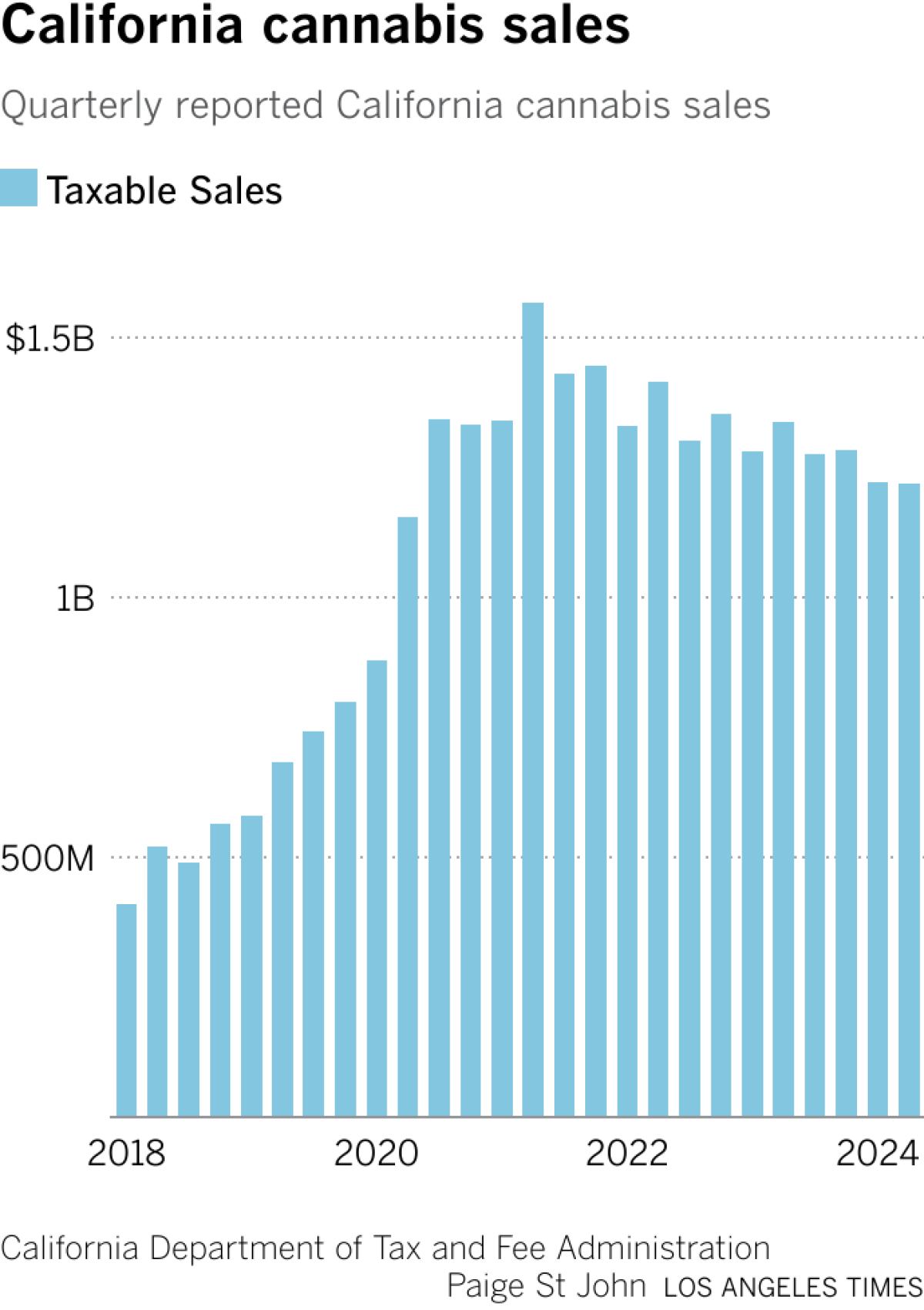
Despite a $5-million advertising campaign touting the safety of legal cannabis products, regulators were long aware of contaminated products reaching store shelves, The Times investigation found. Two industry labs provided documentation that for months they had sent regulators as well as Gov. Gavin Newsom’s office evidence of contaminated products without the state taking action. With no pesticide testing capability of its own, and despite millions of dollars in state spending for that purpose, the agency relied on screening conducted by private labs paid by the cannabis vendors whose products they tested.
A further story in July disclosed efforts by the Newsom administration to contract for other state agencies to undertake such testing. That effort has resulted in pesticide-related product recalls against five brands. But those recalls included only two of the dozens of pesticides private labs identified in legal cannabis products, and included products manufactured as long as a year before. Scores of other contaminated products identified by whistleblower labs and by tests published by The Times have not been recalled.
The expanded pesticide tests conducted for The Times by San Francisco-based Anresco Laboratories showed the presence of seven harmful chemicals — including a carcinogenic insecticide, pymetrozine — that aren’t on the list of 66 chemicals required to be screened for by the state. The Department of Cannabis Control more than eight months ago told The Times it was considering revising its mandatory testing list but has yet to do so.
The private sector is not waiting.
San Diego-based Infinite Chemical Analysis Labs has broadened its own pesticide testing capabilities to include 358 chemicals. At least three of California’s major cannabis retailers told The Times they are sending store products to Anresco and Infinite for expanded testing, and to check the veracity of safety certificates required before sale. In several instances, those retailers confirmed, they have pulled products from sale despite no public action by regulators.
Among retailers taking matters into their own hands is the 28-store Catalyst dispensary chain. Owner Elliot Lewis initially announced on social media platforms he would denounce and ban products that failed testing. Since then, citing worry about damaging the reputations of brands struggling to remain afloat, Lewis instead is promoting products that undergo expanded testing beyond the 66 chemicals required by the state. A blue sticker created for the purpose cites “Category 4” testing, a loosely defined term Lewis coined. It currently refers to products showing only trace levels of contamination under the expanded testing panels offered by Anresco and Infinite, so far the only labs to offer that service.
“We know the DCC is not going to move quickly nor have they moved quickly on any of it,” Lewis said. “A CAT 4 sticker, after doing a deep dive, was the best and fastest solution I could come up with.
“It’s sad to say, but I believe the responsibility of consumer safety lies with the legal cannabis industry.”
There are no prescribed pesticide levels that cannabis products must meet to be declared “Cat 4” but bulk cannabis oil manufacturers and brands have already begun to use the label.
Lewis said the Department of Cannabis Control has remained silent on his campaign, which he has heavily publicized.
The agency also has said little to lawmakers asking for an accounting.
Members of the California Legislature’s Inland Empire caucus cited the Los Angeles Times reporting in a July letter to Elliott and to the director of the state’s pesticide control agency, calling for stricter testing regimens.
The caucus letter, spearheaded by Assemblymember Freddie Rodriguez, (D-Chino) and signed by six other lawmakers, noted the ease with which illegal cultivators can slip harmful products into cannabis supply chains, both licensed and unlicensed.
“Even cannabis products that appear to be compliant with state regulations can be tainted with dangerous chemicals,” it said.
The lawmakers called for immediate routine pesticide testing of cannabis products sold on store shelves, and to raise the penalties for those who violate pesticide regulations.
A legislative liaison for the cannabis control department replied a week later outlining “measures already underway to address issues of concern, such as identifying contaminated products (including through random, retail shelf testing), assessing strict administrative penalties, and coordinating our enforcement efforts with local law enforcement.”
She included a fact sheet that cited a steep increase in license violation notices, illegal cultivation seizures, and a “675% increase in recalls, a number of which have been for pesticide contamination.” It did not note that statistic is so high because the agency in 2023 issued just four product recalls, all voluntary and including its first-ever recall for pesticide contamination, issued in December 2023.
Cannabis regulators have declined to provide records that would demonstrate the scope of any shelf testing conducted by the state agency. Legislation requiring the Department of Cannabis Control to conduct random testing died in September without action by the California Legislature, after regulators told bill negotiators they already conduct such oversight.
The caucus letter also called on cannabis regulators to collaborate more closely with local law enforcement agencies — the same effort for which Bogans said she was fired.
Elliott is a Newsom appointee, having worked for the governor previously as his cannabis advisor. She began her career as Newsom’s scheduling director and a liaison to the Board of Supervisors when he was mayor of San Francisco. Her husband, Jason Elliott, is a longtime Newsom campaign loyalist and until this summer served as Newsom’s deputy chief of staff.
Newsom often takes credit for helping to write the Prop. 64 ballot initiative in 2016 that launched California’s recreational cannabis market. But after the Times story, Newsom’s office said it would not intervene in the department’s handling of contaminated weed, and issued a statement in support of its ability to address the problem.

California
Mother, daughter found ‘alive and well’ after going missing on Southern California hiking trail

A mother and daughter who went missing after going for a hike on a difficult trail in San Bernardino County’s San Gorgonio Wilderness have been found “alive and well,” the sheriff’s department announced Friday.
The San Bernardino County Sheriff’s Department told KTLA they were uninjured and “walked out on their own.”
Krystal Meyers, 41, and her daughter Alexis Meyers Martinez, 21, were hiking on the Vivian Creek Trail Thursday but didn’t return, according to the San Bernardino County Sheriff’s Department.
They were last known to be at the 10,300-foot elevation mark above the High Creek switchbacks at 11 a.m., according to the San Gorgonio Search and Rescue team.
The Vivian Creek Trail is widely considered one of the more strenuous and hazardous routes in the San Gorgonio Wilderness.
The U.S. Forest Service says it’s the shortest and steepest route to the summit of Mount San Gorgonio and requires experienced mountaineering skills.
Officials did not provide any further details about the circumstances surrounding their disappearance.

BAKERSFIELD, Calif. (KBAK/KBFX) — The California Highway Patrol is urging drivers to stay focused on the road as they head out for Fourth of July celebrations.
The holiday weekend can be a dangerous time on our roads as millions of drivers are expected to travel.
CHP Officer Jorge Toro joined Eyewitness News Mornings to share how drivers can stay safe behind the wheel.
Officer Toro also highlighted the importance of sober driving over the holiday.
BE THE FIRST TO COMMENT
He says anyone hosting a party should make sure all of their guests get home safely, ensuring anyone who may be impaired doesn’t drive.

California is returning a stretch of rugged Mendocino County coast to the Indigenous nations whose ancestors once stewarded its shores.
State transportation officials recently approved the transfer of Blues Beach and the surrounding bluffs to Kai Poma, a nonprofit founded by representatives of the Sherwood Valley Band of Pomo Indians, Round Valley Indian Tribes and Coyote Valley Band of Pomo Indians.
The transfer of 136 acres just south of the community of Westport will mark the first time land managed by the California Department of Transportation has been returned to Indigenous tribes.
“This is beyond huge,” said J. Carlos Rivera, tribal chairman of the Sherwood Valley Band of Pomo Indians. “It’s enormous from our tribal perspective that we are basically obtaining the land that our people once lived on before colonization.”
California purchased the swath of rocky cliffs and windswept shoreline in the 1960s to expand the construction of Highway 1 and create a scenic viewpoint for highway travelers, according to a California Coastal Commission report.
More recently, public access has been largely unregulated, and summer weekends and holidays have drawn large groups who camp and party on the beach, at times driving through sensitive areas, damaging cultural sites and leaving behind trash, the report states.
Kai Poma plans to conduct cultural and archaeological resource studies and environmental surveys and then prepare a resource management plan for the property, according to planning documents. The nonprofit and the Coastal Commission have drafted a public access management plan that states the land will be open from sunrise to sunset.
Rivera described the entire property as a sacred site. The coastal waters are used by tribal people for seaweed and abalone gathering, and the shores host youth cultural camps, he said. “Protecting the land, it has a deeper meaning for us because we’re connected to the land,” he said.
The effort to acquire the land took years — and required a change in state law. Caltrans lacked the ability to transfer land to tribal governments until 2021, when Gov. Gavin Newsom signed a bill sponsored by state Sen. Mike McGuire (D-Healdsburg) that enabled the transfer, according to a news release issued at the time. The law also bars commercial activity on the property and requires public access be maintained.
“With 136 acres now officially transferred into tribal stewardship, one of the most spectacular stretches of the Mendocino Coast will be forever protected,” McGuire said in a statement.
“This agreement, the first of its kind in California, gives these three dynamic Native American tribes the rightful opportunity to reclaim sacred lands and cultural traditions on this special piece of earth. And it’s about damn time.”
The land transfer cleared its last regulatory hurdle June 26 with the approval by the California Transportation Commission, said Neil Thapar, an attorney who works as an advisor and legal consultant to Kai Poma. Caltrans staff will next record the deed transferring the title from the state of California to Kai Poma, which is expected to happen any day, he said.
-

 Georgia2 minutes ago
Georgia baseball has nation’s No. 1 transfer class
-

 Hawaii9 minutes ago
Man accused of trying to run over police officers in Kalihi arrested
-

 Idaho12 minutes ago
Fire burning near Ammon foothills – East Idaho News
-
 Illinois17 minutes ago
Illinois Launches Holiday DUI Crackdown
-

 Indiana24 minutes ago
Storm chance late on the Fourth, then heat tones down early next week | July 4, 2026
-

 Iowa26 minutes ago
Storm puts a pause to Savannah Bananas game at Kinnick Stadium
-
 Kansas32 minutes ago
Colombia fans in Kansas City celebrated victory Friday over Ghana in the Round of 32 World Cup match
-

 Kentucky39 minutes ago
Kentucky Democratic Senate candidate says voters deserve ‘honest answer’ about McConnell’s health

