California
California Launches $28 Billion Mental Health Overhaul: Proposition 1 on March 2024 Ballot – SM Mirror

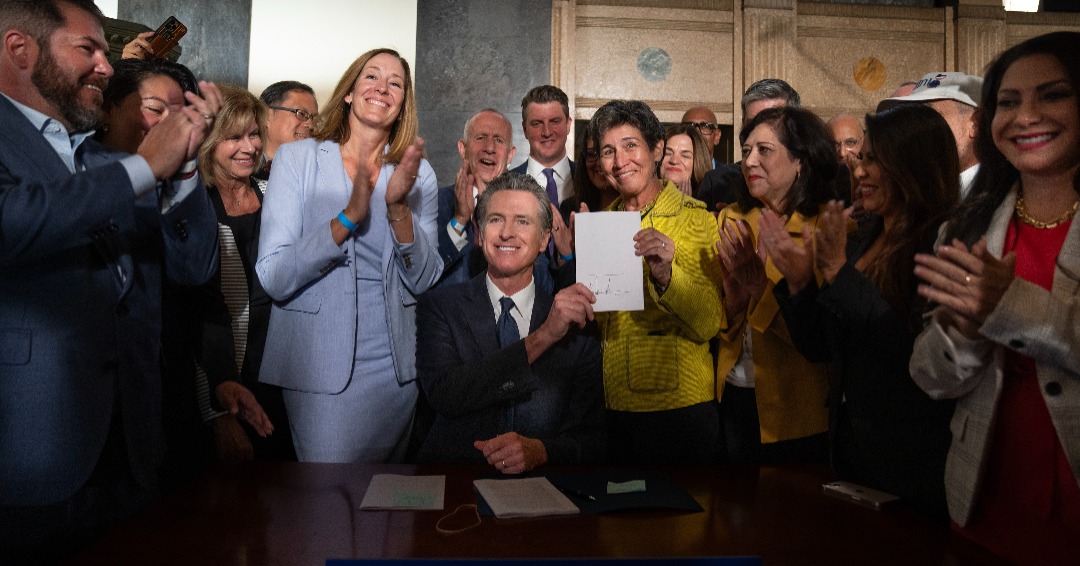
Governor Newsom Signs Bills to Tackle Crisis with $6.38 Billion Investment
By Dolores Quintana
In a groundbreaking move poised to reshape the landscape of mental health care in California, Governor Gavin Newsom signed into law two significant bills aimed at overhauling the state’s mental health and substance use disorder treatment systems. This marks the first substantial transformation in decades, with the legislative package collectively known as Proposition 1 set to go before Californian voters on the March 2024 ballot.
The newly enacted laws include Senate Bill 326, sponsored by Senator Eggman (D – Stockton), which modernizes the Mental Health Services Act, and Assembly Bill 531, championed by Assemblymember Irwin (D – Thousand Oaks), featuring a $6.38 billion bond dedicated to constructing new behavioral health housing and treatment facilities statewide.
Governor Newsom, flanked by legislative and local leaders, families, advocates, veterans, and healthcare professionals, emphasized the monumental impact of these legislative reforms. The bills aim to refocus existing funds, amounting to $6.38 billion, to prioritize individuals with profound mental health needs, those living in encampments, and those grappling with severe substance use issues.
The $6.38 billion bond component of the legislation is earmarked for the creation of 11,150 new behavioral health beds, supportive housing units, and 26,700 outpatient treatment slots. This expansive capacity is expected to significantly address the critical needs of various demographics, ranging from homeless Californians with severe behavioral health issues to children battling depression.

Governor Newsom underscored the urgency of these reforms, stating, “These reforms, and this new investment in behavioral health housing, will help California make good on promises made decades ago.” The comprehensive approach is designed to facilitate the transition of individuals from the streets and tents into effective treatment.
The signing of Senate Bill 326 modernizes the Mental Health Services Act to align with the current behavioral health system and demand for services. The reforms extend services to encompass treatment for substance use disorders, prioritize care for those with severe mental illnesses, allocate ongoing resources for housing and workforce, and continue investments in prevention, early intervention, and innovative pilot programs. The bill introduces enhanced accountability measures to ensure tangible results for all families and communities.
Assembly Bill 531, on the other hand, allocates the $6.38 billion general obligation bond to fund the construction of 11,150 new treatment beds and supportive housing units, along with outpatient capacity. This historic investment represents the most significant expansion of California’s behavioral health treatment and residential settings to date, specifically addressing the needs of homeless individuals with behavioral health issues and veterans. The bond includes a $1 billion set aside for veterans’ housing.
In tandem with these transformative legislative actions, Governor Newsom announced the “California Mental Health Movement,” a comprehensive plan to address the mental health and substance use disorder crises affecting communities across the state. This multi-year initiative encompasses over $28 billion and focuses on four key pillars:
- Treatment and Housing for Those Who Need it Most: An investment of $10.9 billion to create approximately 24,800 beds/units and 45,800 outpatient treatment slots for Californians with behavioral health issues.
- Increasing Access to Mental Health Services for All: An allocation of over $10.1 billion to expand access to behavioral health services for all Californians, transforming Medi-Cal, and developing a plan to raise private and commercial health plans’ standards.
- Building our Health Care Workforce: A $5.1 billion investment, with an additional proposed $2.4 billion through reforms to the Mental Health Services Act, to train and support over 65,000 new healthcare workers in the next five years.
- Supporting and Serving Kids: An investment of $4.6 billion to support children through the Master Plan for Kids’ Mental Health, enhancing funding for student behavioral health services in California’s 10,000 public schools.
First Partner Jennifer Siebel Newsom expressed pride in the initiative, stating, “The mental health crisis – especially amongst youth – is the most significant public health concern of our time.” The “California Mental Health Movement” strives for a comprehensive, holistic approach centered on recognizing the humanity in each Californian. With this landmark legislation and ambitious multi-year plan, California takes a monumental step toward addressing mental health challenges and fostering a healthier future for all residents.


Bruce Lee Day aims to honour the San Francisco-born martial arts legend as a cultural bridge and Asian-American icon.
Published On 2 Jul 2026
Martial arts icon Bruce Lee will become the first Chinese American in California history to be honoured with an annual namesake day.
California Governor Gavin Newsom signed a law on Tuesday afternoon, officially designating May 17 as Bruce Lee Day.
Recommended Stories
list of 4 itemsend of list
Lee was born in San Francisco in 1940 and returned to the city on May 17, 1959, aged 18, after spending his childhood in Hong Kong.
His daughter, Shannon Lee, CEO of the Bruce Lee Foundation, said the honour reflects her father’s enduring legacy as a bridge between cultures.
“From young people who found confidence and possibility in his philosophy, to families who finally saw themselves represented on screen, to athletes who still draw on his teachings of discipline and inner strength, his reach is profound,” she said in a statement.
State Assembly member Matt Haney, who represents San Francisco, called Lee the “epitome of the best of California”.
“At a time when Asian Americans were too often absent from or stereotyped on screen, Bruce Lee helped generations see themselves represented with strength and dignity,” he said.
The Bruce Lee Foundation and Asian-American groups hope Bruce Lee will be celebrated each year with voluntary activities, including cultural exhibits, public events and classroom lessons.
Born to Chinese parents touring the US with an opera, Lee held birthright citizenship. He moved to Hong Kong as an infant, became a child actor, and studied Chinese kung fu before returning to the US in 1959.
He enrolled at the University of Washington in Seattle in 1961, but dropped out to teach martial arts.
In the 1960s, Lee appeared in Hollywood, most notably as Kato in the TV series The Green Hornet, but said studios typecast him in racist roles and paid him less than white actors.
He returned to Hong Kong and starred in martial arts films, including The Big Boss and Fist of Fury.
Lee died tragically in 1973 at the age of 32 after an allergic reaction to pain medication.
His name and likeness remain widely popular.
Fans gather on his birthday, and a treatment he wrote for a television series inspired the HBO Max show “Warrior”.

See the best High Desert fireworks through the years
Fireworks have long lit up the California High Desert, from community shows in Victorville and Apple Valley to backyard celebrations that filled the night sky. Revisit Fourth of July moments through the years.
Each year, fireworks light up the sky across the United States for the nation’s Independence Day. With 2026 marking the nation’s 250th birthday, fireworks shows may be a bigger draw.
With California being so fire-prone, the state has strict fireworks laws, but does that mean that people won’t enjoy fireworks without risking jail time on July 4?
Are fireworks illegal in California?
The California Department of Forestry and Fire Protection, or CalFire, is the agency in charge of managing fireworks and classifying which ones are safe to light.
The California Fireworks Law was passed in 1938 and designated the Office of the State Fire Marshal as the only fireworks classification authority in the state, according to CalFire.
The fire marshal’s office classifies fireworks through lab analysis and field testing. It also requires that all parties dealing in fireworks, such as pyrotechnic operators, manufacturers, and retailers, have licensing.
Along with the aforementioned law, the State’s Explosive Law authorizes the fire marshal to “adopt regulations for the safe use, handling, storage and transportation of explosives,” CalFire says.
“Safe and Sane” fireworks are less likely to cause injury and generally mean that the fireworks do not explode or fly, according to the City of Fontana.
There are almost 300 communities in the state that allow “Safe and Sane” fireworks.
It is illegal in the state to sell, transport, or use fireworks that don’t carry the “Safe and Sane” seal or use any in a nonpermitted community. If convicted, you can face a fine up to $50,000, a year in jail or both, according to CalFire.
All other fireworks are considered illegal in the state and are prohibited from being operated by unauthorized parties in most jurisdictions.
Some illegal fireworks include:
- Wire Core Sparklers
- Sky rockets
- Bottle rockets
- Roman candles
- Aerial shells
- Firecrackers
- Other fireworks that explode, go into the air, or move on the ground in an “uncontrollable manner.”
How to safely use fireworks
CalFire has put out a list of safety tips to avoid injury when handling fireworks.
CalFire recommends:
- Use only State Fire Marshal-approved fireworks
- Verify local ordinances before purchasing or using fireworks.
- Always read the directions on labels.
- Children should always have an adult present.
- Only use fireworks outdoors.
- Avoid using fireworks near dry grass or other flammable materials.
- Only light one firework at a time.
- Have a bucket of water and a hose nearby in case of fire.
- During a drought, it is recommended that you use a bucket of reused water to submerge your firework after use to ensure it’s completely extinguished.
- Never place any part of your body directly over a fireworks device when lighting the fuse.
- Back up several feet immediately after lighting a firework.
- Never point or throw fireworks at another person.
- Never attempt to relight or fix fireworks.
- Never experiment with fireworks.
- Do not wear loose-fitting clothing while lighting fireworks.
- Never carry fireworks in your pockets.
Ernesto Centeno Araujo covers breaking news for the Ventura County Star. He can be reached at ecentenoaraujo@vcstar.com, 805-437-0224 or @ecentenoaraujo on Instagram and X.
California
California bill to block registered sex offenders from local office rejected by Senate committee

FRESNO, Calif. (KFSN) — California bill aimed at preventing registered sex offenders from holding local elected office was halted Tuesday after a Senate committee declined to advance the measure without changes opposed by its author.
Assembly Bill 2753, introduced by Assemblywoman Esmeralda Soria in February, would have prohibited anyone who is or has been required to register as a sex offender from running for local elective office.
“This issue is critical. We have heard loud and clear from the community that we must do something,” Soria said.
The proposal came to a stop in the Senate Elections Committee, where lawmakers argued the bill’s restrictions were too broad.
California’s sex offender registration system is divided into three tiers. Tier 1 offenders are generally required to register for 10 years, Tier 2 offenders for 20 years and Tier 3 offenders for life.
According to Soria, committee members proposed limiting the bill to Tier 3 offenders. She rejected those amendments, arguing that the legislation should apply more broadly.
“For this not to be the law today, where we’re banning people that have committed some of the most horrific crimes against children, against other people, you know, and we have survivors out there, I think it’s a disservice,” Soria said.
The bill had attracted significant support before reaching the Senate. It was backed by the Fresno City Council and passed the Assembly floor in April.
Fresno City Council President Nelson Esparza traveled to Sacramento to testify in favor of the measure and said he was disappointed by the outcome.
“I call it really a gut punch for our community, and what we had experienced here, and sort of the upheaval… I don’t think we want that to happen again here at Fresno,” Esparza said.
Esparza referenced controversy earlier this year involving registered sex offender Rene Campos, who sought a seat on the Fresno City Council but ultimately did not qualify for the ballot.
Opponents of the bill argued that candidacies should be decided by voters rather than restricted by law.
“It should be a decision made by the voters, so a person should not be barred from running for office and let the voters make the decision that makes the most sense for them,” said civil rights attorney Janice Bellucci.
With the committee declining to move the bill forward under its current language, efforts to enact the proposed restrictions have stalled for now.
Copyright © 2026 KFSN-TV. All Rights Reserved.
-

 Indiana4 minutes ago
Indiana BMV, ISP dispel rumours about Blackout license plates
-
 Kansas8 minutes ago
Linn County, Kansas, man killed in early Thursday crash
-

 Kentucky19 minutes ago
A Kentucky big man is predicted to be one of the SEC’s breakout stars this season
-
 Louisiana26 minutes ago
A little history lesson on the Revolutionary War, and Louisiana’s role
-

 Maine29 minutes ago
Maine justices to decide fate of transgender sports ballot question
-

 Maryland34 minutes ago
Search underway for missing man in Potomac River near Great Falls Park in Maryland
-

 Michigan41 minutes ago
Ocasio-Cortez backs El-Sayed in Michigan U.S. Senate race
-

 Massachusetts44 minutes ago
Improving Long-Term Care for Seniors in Massachusetts – Center for Retirement Research

