California
Commentary: Culling the field for California governor? Don’t look at me, says Betty Yee

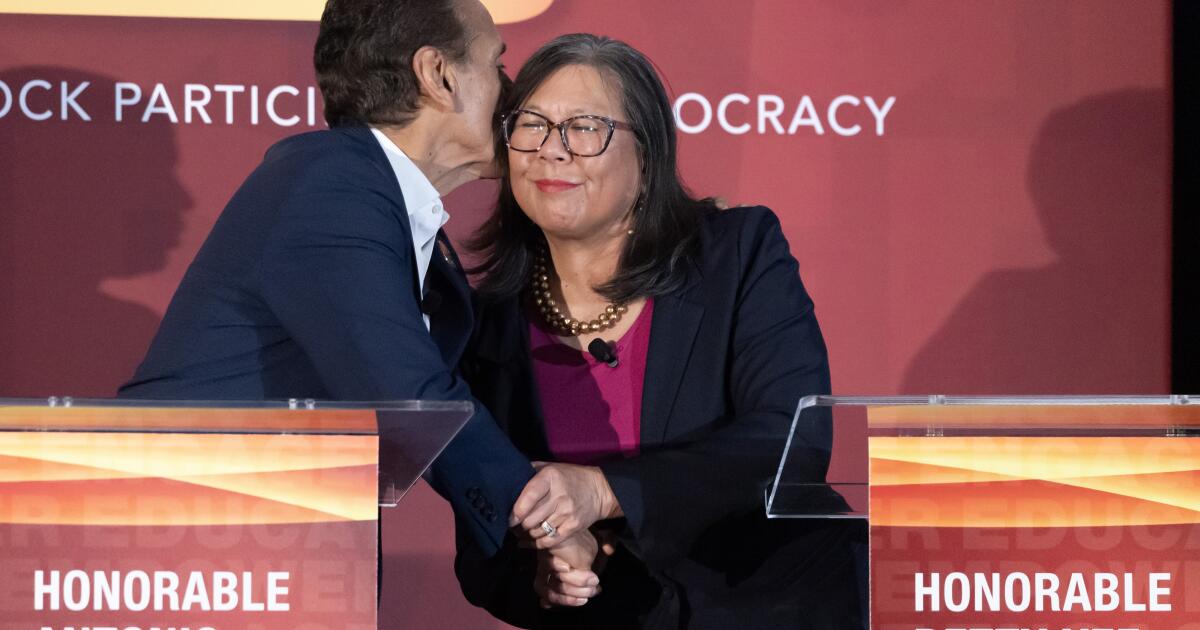
OAKLAND — Betty Yee knows what people are thinking. She’s heard what they’ve said and read the many emails she’s gotten.
The former state controller has been running for California governor longer than just about anybody in the cheek-by-jowl field. And yet the Democrat is bumping along near the bottom, a blip in polls and a laggard in the money chase.
But no, Yee said, she has no intention of quitting the race, as she’s been urged, and no fear that, by staying in, she’ll help two Republicans advance to November’s runoff, locking Democrats out of the governor’s office for the first time since George W. Bush was president.
“I just don’t see it,” Yee said, given the way Chad Bianco and Steve Hilton, the top GOP contenders, are smacking each other around, hoping to emerge as the undisputed Republican standard-bearer.
Beyond that, she said, it’s not as if anyone’s running away with the contest; most polls have shown the leading candidate — which depends on the survey — standing atop the pile with around 20% support.
That isn’t exactly landslide territory.
“The public is still shopping,” Yee said. “In the next month or so, we’re going to try to get [a TV ad] on the air, basically make our case and hope that can spread as voters are getting more focused on the race.”
Which is not to say Yee is delusional.
“As a candidate, I make that assessment every day about whether we’re going to be viable or not,” she said last week, just before stopping by the Alameda County voter registrar‘s office to file paperwork for the June 2 primary.
“Right now, it’s less than a 50-50 chance,” Yee said, suggesting it’s her job to boost those odds by getting voters to appreciate what she offers, which amounts to unvarnished talk about the challenges facing the next governor and the ways Sacramento — which has been run for years by fellow Democrats — isn’t working.
“ ‘Accountability’ has kind of become a dirty word … where it’s about who we’re going to throw under the bus, rather than stepping back and saying, ‘What have we gotten for the dollars that we spend and, if we’re not getting those outcomes, how do we do better?’ ”
Yee served two terms as controller, in effect the state’s chief financial officer, and 10 years before that on the Board of Equalization, which oversees property tax assessments. She’s isn’t trying to buy the governorship, like billionaire Tom Steyer, or leverage her political celebrity, like cable-TV fixtures Katie Porter and Eric Swalwell. Instead, Yee is running a grassroots campaign, visiting nearly all 58 California counties and holding as many face-to-face meetings as humanly possible.
“I’m in the trenches,” she said. “I knock on doors every election cycle because to me, that’s the reality check of where people really are in terms of their lives.”
Which is certainly an admirable approach, albeit a rather idealistic strategy in a state of nearly 23 million voters, spread over roughly 800 miles from north to south. It would take more than two years of round-the-clock campaigning just to give each and every one a quick handshake.
The most notable feature of Yee’s candidacy is her message. She’s not selling barn-burning populism or viral take-downs of President Trump — “I don’t have any gimmicks, I don’t swear, I don’t have a reality-TV show personality” — but rather practical know-how and a deep understanding of state government.
It’s almost quaint in today’s theatrical political environment.
Seated at a sidewalk table outside a coffee stand in downtown Oakland, Yee focused on California’s stretched-thin budget, which happens to be her area of expertise.
“People ask what would you do in your first days as governor, if you have the privilege of serving,” Yee said, as her butterscotch latte sat cooling. “I’d come clean with the voters about where we are fiscally.”
After years of surpluses, she said, the state is spending more than it can afford. Facing a structural deficit, the next governor will have to cut programs and raise taxes, not just one or the other, with corporations and California’s richest residents being forced to cough up more. (She’s dubious, however, of a proposed November ballot measure imposing a one-time 5% tax on billionaires, questioning whether it would stand up in court.)
Sacramento’s credibility, Yee suggested, is on the line.
Before any expansive new programs can be implemented — and she has some notions for how to make life more affordable, increase access to healthcare and create jobs — Californians have to be convinced their tax dollars are being well spent and delivering proven results. “I would really insist on and invite stricter accountability of what we do with our money,” Yee said.
She’s not beyond criticizing the current administration.
“I mean, I’ve been termed out as controller since January 2023. I still get calls from companies in the [European Union], Canada, even Mexico about how we want to do business with California. Who do we talk to?” Yee said. “So I’ll send them over to the governor’s Office of Business Development and they tell me, ‘Well, we try to call people, but nobody’s answering our call.’ ”
(In response, a spokesman for the Office of Business and Economic Development touted California as “a premier hub for international business” and described foreign trade and investment as major drivers of the state economy.)
As for Gov. Gavin Newsom, while she supports his teenaged trolling of Trump, she said it shouldn’t be done through official channels, , or on the taxpayers’ dime.
“We have to focus on making the state work,” Yee said, “and that’s where I’m more focused on because people … want service delivery. They want government to be responsive to their needs. Somebody just pick up the damn phone on the other line to help them.”
Tough medicine, as she described it, and “stabilization” — which is “kind of my theme” — won’t make a great many hearts go pit-a-pat. But Yee hopes that straight talk and her distinct lack of ornamentation will count for something with California voters.
“The climate now is that people are very drawn by the performative approaches,” she said. “However, I think that will change. I want to give [voters] credit, because I do think they are very discerning when they’re ready to mark their ballot.”
The coming weeks will test that premise. And Yee is staying put.


California is returning a stretch of rugged Mendocino County coast to the Indigenous nations whose ancestors once stewarded its shores.
State transportation officials recently approved the transfer of Blues Beach and the surrounding bluffs to Kai Poma, a nonprofit founded by representatives of the Sherwood Valley Band of Pomo Indians, Round Valley Indian Tribes and Coyote Valley Band of Pomo Indians.
The transfer of 136 acres just south of the community of Westport will mark the first time land managed by the California Department of Transportation has been returned to Indigenous tribes.
“This is beyond huge,” said J. Carlos Rivera, tribal chairman of the Sherwood Valley Band of Pomo Indians. “It’s enormous from our tribal perspective that we are basically obtaining the land that our people once lived on before colonization.”
California purchased the swath of rocky cliffs and windswept shoreline in the 1960s to expand the construction of Highway 1 and create a scenic viewpoint for highway travelers, according to a California Coastal Commission report.
More recently, public access has been largely unregulated, and summer weekends and holidays have drawn large groups who camp and party on the beach, at times driving through sensitive areas, damaging cultural sites and leaving behind trash, the report states.
Kai Poma plans to conduct cultural and archaeological resource studies and environmental surveys and then prepare a resource management plan for the property, according to planning documents. The nonprofit and the Coastal Commission have drafted a public access management plan that states the land will be open from sunrise to sunset.
Rivera described the entire property as a sacred site. The coastal waters are used by tribal people for seaweed and abalone gathering, and the shores host youth cultural camps, he said. “Protecting the land, it has a deeper meaning for us because we’re connected to the land,” he said.
The effort to acquire the land took years — and required a change in state law. Caltrans lacked the ability to transfer land to tribal governments until 2021, when Gov. Gavin Newsom signed a bill sponsored by state Sen. Mike McGuire (D-Healdsburg) that enabled the transfer, according to a news release issued at the time. The law also bars commercial activity on the property and requires public access be maintained.
“With 136 acres now officially transferred into tribal stewardship, one of the most spectacular stretches of the Mendocino Coast will be forever protected,” McGuire said in a statement.
“This agreement, the first of its kind in California, gives these three dynamic Native American tribes the rightful opportunity to reclaim sacred lands and cultural traditions on this special piece of earth. And it’s about damn time.”
The land transfer cleared its last regulatory hurdle June 26 with the approval by the California Transportation Commission, said Neil Thapar, an attorney who works as an advisor and legal consultant to Kai Poma. Caltrans staff will next record the deed transferring the title from the state of California to Kai Poma, which is expected to happen any day, he said.


Fireworks Safety Guide
Essential safety tips for buying, handling, and watching fireworks to ensure a safe celebration.
With July 4 falling on a Saturday this year, many businesses and organizations are taking the day off Friday, July 3, to mark America’s 250th birthday. From banking to mail service, here’s what’s open and closed for the holiday weekend.
Most federal offices closed, mail service to continue
Non-essential federal offices will be closed on July 3. However, mail service will continue as normal, and post offices are scheduled to remain open.
Most California government offices to remain open
Most California government offices will be open on July 3, with some exceptions.
DMV offices throughout the state will be open. However, the Employment Development Department will be closed.
DMV offices that offer Saturday hours will be closed on July 4.
Private parcel services to remain open
UPS and FedEx are both scheduled to operate normally on July 3, but will suspend service on July 4.
Stock markets closed
Both the New York Stock Exchange and Nasdaq will be closed on July 3.
Most banks to stay open
While most banks were expected to operate normally on July 3, some may operate under modified holiday hours. All banks will be closed on July 4.
Online banking services should remain operational.
Grocery stores
Most major grocery chains will be open on both July 3 and July 4. Trader Joe’s locations will be open for regular business on July 3 but will close early at 5 p.m. on the Fourth of July.
Retailers
Many major retail stores, such as Walmart and Target, plan to operate under normal business hours on both July 3 and 4. All Costco warehouse stores operate under normal business hours on July 3, but will close on July 4.
Restaurants
Most major restaurant chains remain open on July 4, but some will have limited hours. All Raising Cane’s locations will close on July 4.

Bruce Lee Day aims to honour the San Francisco-born martial arts legend as a cultural bridge and Asian-American icon.
Published On 2 Jul 2026
Martial arts icon Bruce Lee will become the first Chinese American in California history to be honoured with an annual namesake day.
California Governor Gavin Newsom signed a law on Tuesday afternoon, officially designating May 17 as Bruce Lee Day.
Recommended Stories
list of 4 itemsend of list
Lee was born in San Francisco in 1940 and returned to the city on May 17, 1959, aged 18, after spending his childhood in Hong Kong.
His daughter, Shannon Lee, CEO of the Bruce Lee Foundation, said the honour reflects her father’s enduring legacy as a bridge between cultures.
“From young people who found confidence and possibility in his philosophy, to families who finally saw themselves represented on screen, to athletes who still draw on his teachings of discipline and inner strength, his reach is profound,” she said in a statement.
State Assembly member Matt Haney, who represents San Francisco, called Lee the “epitome of the best of California”.
“At a time when Asian Americans were too often absent from or stereotyped on screen, Bruce Lee helped generations see themselves represented with strength and dignity,” he said.
The Bruce Lee Foundation and Asian-American groups hope Bruce Lee will be celebrated each year with voluntary activities, including cultural exhibits, public events and classroom lessons.
Born to Chinese parents touring the US with an opera, Lee held birthright citizenship. He moved to Hong Kong as an infant, became a child actor, and studied Chinese kung fu before returning to the US in 1959.
He enrolled at the University of Washington in Seattle in 1961, but dropped out to teach martial arts.
In the 1960s, Lee appeared in Hollywood, most notably as Kato in the TV series The Green Hornet, but said studios typecast him in racist roles and paid him less than white actors.
He returned to Hong Kong and starred in martial arts films, including The Big Boss and Fist of Fury.
Lee died tragically in 1973 at the age of 32 after an allergic reaction to pain medication.
His name and likeness remain widely popular.
Fans gather on his birthday, and a treatment he wrote for a television series inspired the HBO Max show “Warrior”.
-

 Colorado2 minutes ago
Suspect arrested after starting vehicle fire in Colorado Springs
-

 Connecticut4 minutes ago
Motorcyclist seriously injured after crashing into parked, unoccupied vehicle in Meriden
-

 Delaware9 minutes ago
Delaware Man Killed by Falling Camel
-

 Florida16 minutes ago
Florida Supreme Court reverses rule on knock-and-announce evidence
-

 Georgia19 minutes ago
FBI assigns 260 staffers to Georgia election investigation
-

 Idaho20 minutes ago
Trump OKs disaster declaration for northern Idaho counties
-

 Hawaii22 minutes ago
Hawaii commemoration of America’s birthday funded on a shoestring – The Garden Island
-

 Illinois32 minutes ago
Fireworks Near Me: July 4th Events Around Chicago Heights For 2026

