California
After party rift on shutdown, California Democrats try to refocus budget fight on Medicaid

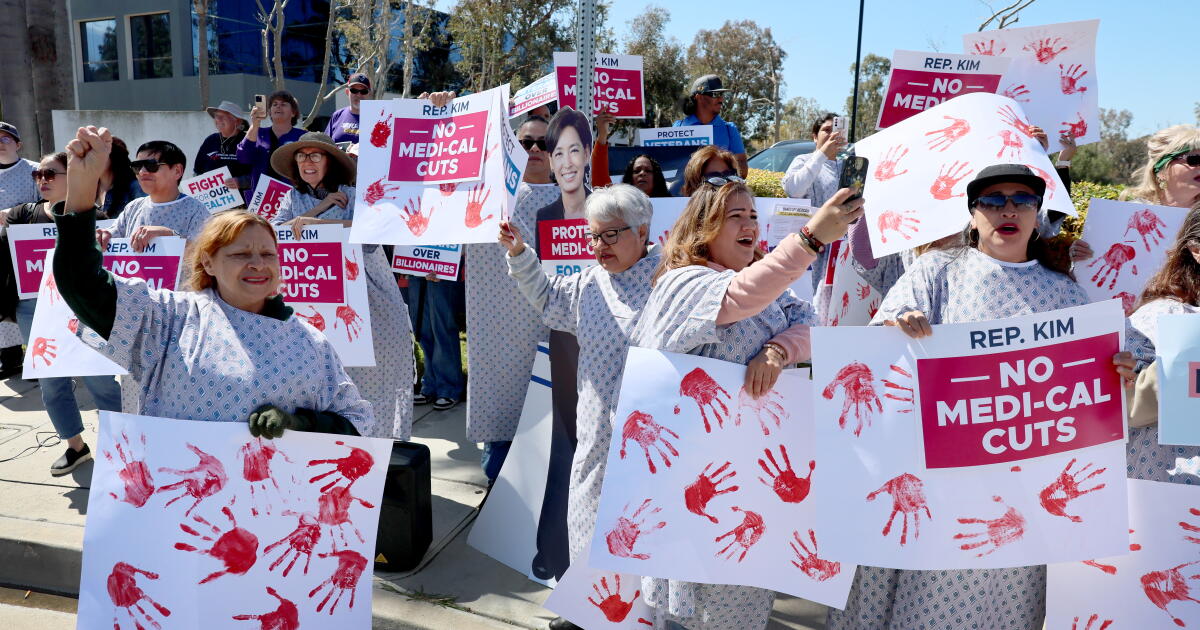
After a bruising Washington battle that averted a government shutdown but broke their party in two last week, leading California Democrats are trying to project a unified front on a central issue in the next big budget fight: Medicaid.
Republicans have already signaled their intention to cut hundreds of billions of dollars from the healthcare program for low-income residents, people with disabilities and other vulnerable groups in order to pay for tax cuts for the rich, the Democrats said — and must be stopped.
“Our budget should be a statement of our national values. What is important to us should be reflected in that budget. But what we see now is an assault on our values as they make this assault on our budget,” Rep. Nancy Pelosi said Tuesday at a UC San Francisco medical facility in her district, flanked by several other members of Congress, local doctors, community advocates and Medicaid recipients.
The event was part of a broader nationwide effort among Democrats to align on a clear message about Republican budget priorities that they say are threatening the well-being of average Americans — and before the frantic final days of negotiations or any vote in Washington.
They do not want to repeat the mistakes of last week, when Democrats split over the GOP’s stopgap measure to avoid a federal government shutdown.
Party leaders were accused of putting out muddled messaging about what was at stake, capitulating to Republicans in a rare moment when they had leverage, and handing President Trump and his party an important win at a time when they are running roughshod over the federal government and normal, bipartisan processes for funding it.
The episode exposed deep fissures in Democratic Party strategy, with former House Speaker Pelosi even making a rare and unsuccessful plea to Democratic senators to break with their leader, Senate Minority Leader Chuck Schumer of New York, and oppose the stopgap measure.
But on Tuesday, Pelosi and Schumer appeared aligned once more, if not on last week than at least on how to move forward. Pelosi’s event was part of a “Medicaid Day of Action” that Schumer had touted hours earlier on ABC’s “The View.”
“We have senators and congressmen going to all different parts of their states and districts talking about how bad the Medicaid cut would be,” Schumer said.
“We don’t agonize, we organize, and this day, today, we have scores of events across the country, starting in New York,” Pelosi echoed hours later. “And we’ll have them tomorrow and the next day and the next day.”
A host of Democrats held smaller events and roundtable discussions with healthcare providers in their own districts, including Rep. Sydney Kamlager-Dove in Los Angeles and Rep. Ted Lieu in Redondo Beach. Protesters also decried Medicaid cuts outside the Anaheim Hills office of Republican Rep. Young Kim.
The Democrats say their hyper-focus on Medicaid is not just bluster — though Republicans have framed it as such.
Trump has repeatedly said that his party is not going after people’s Medicare, Medicaid or Social Security benefits, and the White House has acted exasperated by claims otherwise, saying the administration supports only the elimination of fraud and abuse in such programs.
“What kind of a person doesn’t support eliminating waste, fraud and abuse in government spending that ultimately costs taxpayers more?” it said.
Republican members of Congress have made similar arguments, accusing Democrats of lying about Medicaid cuts just to rile up their base and win political points.
A protester holds a sign outside Senate Minority Leader Chuck Schumer’s office last week after he said he would vote to advance a GOP-written funding patch to avert a government shutdown, saying it was the better of two bad options.
(Michel Nigro / Pacific Press / LightRocket via Getty Images)
However, Republicans brought on the concern themselves by passing a budget resolution last month aimed at extending 2017 tax cuts, including by finding trillions of dollars in spending cuts to pay for them.
That resolution does not explicitly require Medicaid cuts, but it instructs the House Energy and Commerce Committee, which oversees Medicaid, to cut spending by $880 billion over the next decade.
Democrats say simple math makes clear that the only way the committee will be able to find that level of cuts is by cutting Medicaid, unless they want to cut Medicare, the health program for seniors, which Republicans have also said is off the table. The committee could cut everything else in its budget — completely — and still wouldn’t reach the savings Republicans have called for, an independent analysis by the Congressional Budget Office concluded.
At Pelosi’s event, Rep. Mike Thompson (D-St. Helena), the ranking Democrat on the House Ways and Means subcommittee on tax policy, said Republicans who are denying that their budget resolution calls for cuts to Medicaid aren’t telling the truth.
“We’re here because this president and the Republicans in Congress want to decimate Medicaid. They say no, they’re not going to touch Medicaid. That is a bald-faced lie,” Thompson said.
Medi-Cal, California’s version of Medicaid, covers nearly 15 million Californians, or more than a third of the state’s population, according to recent estimates from state health officials. Many of those patients are children.
But, as Thompson and others at the event noted, many others in the state would be affected by Medicaid cuts as well, because they would kneecap health systems and hospitals — particularly in rural and other poor communities where Medicaid patients make up a larger percentage of patients.
“We need to make sure our colleagues in red districts across the state understand this and they speak out,” Thompson said.
Sen. Adam Schiff agreed, calling such cuts “absolutely devastating to healthcare around the country, and most particularly to states like California that have so many of our residents who utilize Medicaid.”
Schiff said that healthcare systems throughout the state, especially in rural areas, are already in a “precarious position” financially, and that cutting Medicaid funding would set into motion a “cascading set of closures of hospitals and clinics.”
Dr. Josh Adler, executive vice president and chief clinical officer at UCSF Health, said more than 70% of the system’s in-patient care is roughly split between Medicare and Medicaid patients. Last year, he said, 58% of emergency department patients and 35% of the system’s in-patient population relied on Medicaid.
The cuts envisioned in Congress would “severely weaken the healthcare system that millions of Californians rely on for high-quality primary care and secondary care, while increasing the uncompensated care costs for hospitals that are already financially stressed,” he said.
Dr. Amy Herold, an OB-GYN and chief administrative and chief medical officer for Providence Queen of the Valley Medical Center in Napa, said her region is known for its tourism but is really a rural farming and service community — which is reflected in her system’s users.
Herold said 75% of the hospital’s patients are on Medicare or Medicaid, with more than 30% on Medicaid, and “that goes up to over 50% when you look at our pregnant ladies having their babies, including the one I delivered two days ago.”
The proposed cuts would make it difficult for her hospital to stay open, she said, despite the fact that it is the only one in her county with a trauma center and a labor and delivery center.
“There will be a healthcare desert, so not only do the people that are on Medi-Cal/Medicaid not have access to care, anyone — regardless of your insurance status — will not have access to care,” she said. “This is what keeps me up at night.”
Sascha Bittner, who serves on San Francisco’s Disability and Aging Services Commission and who is quadriplegic and has a speech disability and a vision disability from cerebral palsy, credited Medicaid with saving her life by providing her with home and community-based support and an array of healthcare services. In 2013, she said, she spent five months in the hospital with lymphoma, which would have cost her life or bankrupted her family without Medicaid.
“There are disabled children, elderly and other vulnerable people like me who depend on Medicaid,” Bittner said, “and the Republican plan to gut this crucial support is an attack on our very lives.”



California
California’s leading GOP candidate for governor reacts to Swalwell’s exit from race | CNN Politics

California’s leading GOP candidate for governor reacts to Swalwell’s exit from race
Republican Gov. candidate Steve Hilton joins CNN’s Dana Bash after one of his opponents, Rep. Eric Swalwell, exited the California governor’s race amid sexual misconduct allegations. “We desperately need change. And no Democrat can provide that,” Hilton says.

FRESNO, Calif. (FOX26) — A new effort to crack down on dangerous drivers in California is gaining attention as lawmakers push forward legislation aimed at repeat speeders.
Assembly member Esmeralda Soria has introduced a bill that would require certain drivers with multiple speeding offenses to install a device in their vehicles that automatically limits how fast they can go. The measure, known as the “Stop Super Speeders Act” (AB 2276), is designed to improve road safety and prevent deadly crashes.
The program could first roll out as a pilot in several counties, including Fresno, Kern, Los Angeles, San Bernardino, San Diego, Santa Clara, and Shasta. While the proposal was initially intended to be implemented statewide, consultants recommended starting with a smaller pilot program.
The legislation is driven in part by tragic cases like that of Paul Martinez, who was killed at just 21 years old after being struck by a speeding driver in Fresno. His father, Joe Martinez, says the loss is something he lives with every day.
“Being 21 years old and suddenly your entire life, dreams, goals—everything—is just wiped out by the distraction of one person who was speeding,” he said. According to reports, the driver who hit Paul was traveling 54 miles per hour in a 40 mph zone.
Traffic safety remains a serious concern in Fresno. Data from Smart Growth America ranks the city as the seventh worst in the nation for pedestrian deaths.
“I do not want to see another father who grieves every single day because he lost his child to someone driving recklessly,” Soria said.
Under AB 2276, judges would have the authority to require repeat offenders to install Intelligent Speed Assistance (ISA) devices in their vehicles. The technology functions similarly to cruise control but automatically adjusts a car’s speed based on posted limits using GPS data.
“Once the technology is installed, it knows the speed limit of the neighborhood or freeway and makes adjustments accordingly,” Soria explained. “This is for those folks who haven’t learned their lesson from simply getting a ticket.”
However, the proposal has drawn criticism from some groups. Opponents argue that the bill’s language is too broad and could create unintended safety risks. Critics say there are situations where drivers may need to accelerate quickly to avoid danger, and limiting speed could make those situations more hazardous.
Supporters counter that the bill is about accountability and protecting lives on the road.
“You would think this is a no-brainer bill,” said Martinez, “It holds repeat offenders accountable.”
The bill is still in the early stages of the legislative process. Its next step is review by the Assembly Appropriations Committee.

The California Republican Party will make endorsements of the candidates running for office — including for the state’s next governor — on Sunday during the final day of the California Republican Convention in San Diego.
Candidates made their plea for endorsement to the party’s delegates at the convention, held at the Sheraton San Diego Resort on Harbor Island, on Saturday — with promises to root out alleged misuse of spending, push forward voter identification initiatives and boost affordability in the state.
The party faces what could be an uphill battle to win in the majority Democratic state, and is also coming off the loss of Proposition 50 last year, in which voters overwhelmingly voted to redistrict the state to benefit Democrats.
Despite the challenges, Republican candidates and convention attendees showed up hopeful for their odds — with especially strong enthusiasm behind the two candidates for governor, Riverside County Sheriff Chad Bianco and former Fox News commentator Steven Hilton.
“This election has always been ours for the taking,” said Bianco. “It is up to us — conservative, common-sense Republicans — to show proven leadership, compassion and integrity matters.”
Hilton has been endorsed by President Donald Trump — a development some expect could hurt his chances of winning in the largely blue state.
But many of the candidates expressed support and alignment with the Trump administration and its policies, including efforts to ban transgender athletes in women’s and girls’ sports and abolish sanctuary cities, which limit cooperation with federal immigration enforcement.

“It’s going to be a whole new story in California,” Hilton said. “We are going to play our part in (Trump’s) golden age for America.”
That support for Trump was on full display at the convention, with loud cheers from the audience when the candidates mentioned the president’s policies and signs saying “Make California Golden Again,” co-opting his signature slogan.
Associate delegate from Ventura County Jennifer McCarthy says she wants a candidate with Trump’s ideals, which is why she’s supporting Hilton.
“I think he has the political and the business experience, plus the media experience, that he will be able to make the difference in California,” she added.
The party’s delegates will announce its endorsements during the final day of the convention on Sunday.

Along with the candidate forum, the convention on Saturday offered a series of events, including a book signing with former Trump administration press secretary Sean Spicer and a panel on voter identification and the future of elections.
Booths with volunteers promoting candidates and vendors selling merchandise lined the main hall of the convention, and bedazzled clothing for sale — along with rows of “Make America Great Again” hats and other Trump-related merchandise — further decorated the space.

San Diego resident Blake Marnell says he’s been often seen at Trump rallies wearing a signature suit with a brick pattern on it — to symbolize his support for the Trump administration’s border fence — but he left the outfit at home on Saturday, since the convention was more focused on California issues.
Marnell is supportive of Hilton for governor and says he thinks he will be able to reach independent voters as well as Republicans.
“I don’t see Steve Hilton as being a party politician,” he said. “He’s got a lot of crossover.”
But Louisa Millington, from Riverside, says Trump’s endorsement of Hilton is detrimental in a state like California.
“I would vote for (Trump) again today, but in California, we need a governor for California, not for Washington, D.C.,” she said. “We can’t have our president picking and crowning who’s going to be our governor in California.”

Trump tips DoorDash driver $100 for delivering McDonald’s to Oval Office

Can You Match This Sharp Line to Its Book?

Video: The New Aesthetic of ‘Euphoria’

The Mercedes EQS returns with massive range and charging gains

Iran secures UN role with backing from UK, France, Canada, Australia as US stands alone

Florida High School Football Rankings: Top 25 teams – Oct. 21

How old is Bo Nix? What to know about Oregon quarterback ahead of 2024 NFL Draft

Cleary's 21 help Le Moyne down Central Connecticut State 69-64 in OT

99th annual Pony Swim held in Virginia

Indiana Members Credit Union announced as new anchor tenant at Bottleworks District

Embattled Rep Tony Gonzales announces plans to resign amid sexual misconduct allegations

UN experts slam attacks on Gaza shelters, forced displacement in West Bank

DOJ fires at least 4 prosecutors involved in FACE Act cases during Biden administration

Melania Trump’s Epstein remarks turn up the heat on DOJ, Acting AG Todd Blanche to do more
Newsletter: Cautious optimism in Brussels as Orbán ousted in landslide Hungarian opposition win
-

 Atlanta, GA1 week ago
1 teenage girl killed, another injured in shooting at Piedmont Park, police say
-

 Georgia6 days ago
Georgia House Special Runoff Election 2026 Live Results
-

 Arkansas3 days ago
Arkansas TV meteorologist Melinda Mayo retires after nearly four decades on air
-

 Pennsylvania7 days ago
Parents charged after toddler injured by wolf at Pennsylvania zoo
-
 Milwaukee, WI1 week ago
Potawatomi Casino Hotel evacuated after fire breaks out in rooftop HVAC system
-

 Technology1 week ago
Anthropic essentially bans OpenClaw from Claude by making subscribers pay extra
-

 Austin, TX6 days ago
ABC Kite Fest Returns to Austin for Annual Celebration – Austin Today
-

 World1 week ago
Zelenskyy warns US-Iran war could divert critical aid from Ukraine