West
California officials ticket the 'Bubble Pirate,’ an artist and Navy veteran, for 'fluid littering'

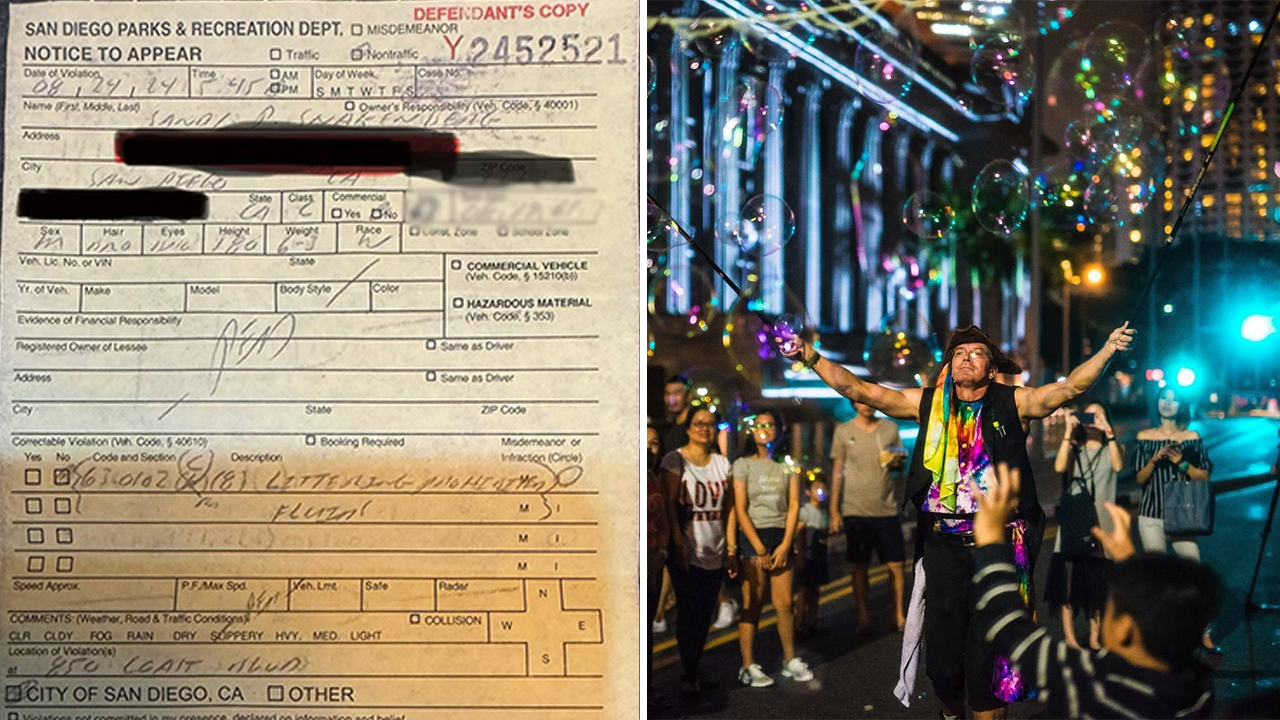
A Navy veteran in California has been entertaining the local community with his creative bubble performances for over 10 years.
But Sandy Snakenberg, known as the “Bubble Pirate,” was donning his pirate costume and performing his usual bubble show at La Jolla Cove in San Diego last week when he was issued a ticket by park officials, he told Fox News Digital.
The ticket alleges that Snakenberg, 63, violated San Diego’s municipal code against littering due to the fluid from his bubbles.
MASSACHUSETTS OFFICIALS SHUT DOWN BOY’S CHARITY ICE CREAM STAND: ‘DISAPPOINTED’
Snakenberg said in a phone interview that he asked the park ranger to note that the liquid was from bubbles, but the officer did not do so, he said.
The ticket mandates that Snakenberg appear in court in October.
Sandy Snakenberg, shown above, was given a ticket last week for “liquid fluid littering” while performing in La Jolla, California. He must appear in court in October. (Barry Alman)
Snakenberg told Fox News Digital he is a disabled Navy veteran who has traveled all over the world for a variety of jobs in his life.
He once owned a gym in Singapore, he said, to benefit individuals with special needs.
VANDALISM FOUND AT GETTYSBURG BATTLEGROUND, PRESERVATIONISTS REMOVE TRACES OF DEFACEMENT: ‘HALLOWED GROUND’
Snakenberg said he has dyslexia. He makes his living from his bubble artistry and entertainment, he said. The van with all of his equipment and props doubles as his home.
“I was becoming more involved with bubbles, more professionally, making my own juices, my own devices. I did a Ted talk while in Singapore,” he said.
Snakenberg was ticketed and must appear in court this October. (Sandy Snakenberg)
The Ted talk he delivered in 2016 is called “Lessons of the Bubbles.” It’s described online as a presentation of “his journey and lessons learned not just from the bubbles but from his observations of others when exposed or re-exposed to their magic.”
Said Snakenberg, “During that time, I suffered heart failure, [then] started to do a trip around the world doing bubbles modeled after my Ted talk.”
NEW JERSEY RESTAURANT BREAKS GUINNESS WORLD RECORD FOR LARGEST TEQUILA, MEZCAL LIBRARY
The talk was based on a sociological experience with bubbles and their “connective” properties, he said.
“I was just enjoying blowing the simple bubbles that you blow and people walking by were enjoying them,” he told Fox 5 San Diego. “I got kind of hooked sharing the joy of it.”
Snakenberg has been performing with bubbles for more than 10 years. (Barry Alman)
That grew into what he practices today.
“I practice what is known as bubbleology. It’s a real thing,” he said.
Lately, said Snakenberg, vendors and artists in the community have been getting “herded” into designated four feet-by-eight feet areas by officials.
“They’re making everybody fight for these four by eight spaces, which are limited,” he said.
“They are not in locations the artists would have chosen for themselves. I choose my location for safety reasons, both environmental and public, because if my bubbles go flying off into the streets, so will the kids.”
“If I thought I was in any way damaging the environment or hurting people, I wouldn’t be around very long,” Snakenberg told Fox News Digital. (Sandy Snakenberg, Barry Alman)
A City of San Diego Parks and Recreation Department spokesperson told Fox News Digital via email, “The City of San Diego values the rights of community members to engage in expressive activity in City parks, including artistic expression. This does require those engaging in these activities to do so in accordance with other City codes and regulations, including those related to littering and disposal of waste.”
“Rangers issued the lowest level citation available.”
The spokesperson added, “In this instance, Park Rangers attempted to educate the individual numerous times that the residual substances from the bubbles are in violation of the City’s municipal code as it relates to littering (SDMC 63.0102(c)(8) Littering). The individual uses up to six gallons of liquid per day with the residual chemicals ending up in the lawn areas, which can cause damage to the grass.”
“After witnessing numerous violations and receiving complaints from other park users, Rangers issued the lowest level citation available.”
Snakenberg said, “If I thought I was in any way damaging the environment or hurting people, I wouldn’t be around very long. I’ve been doing this for over 10 years.”
For more Lifestyle articles, visit www.foxnews.com/lifestyle
“It’s not just my livelihood, it’s something that is actually part of the community now,” he told Fox 5 San Diego — noting that many of the same people have been coming to see him perform for years.
Read the full article from Here

San Francisco, CA
Bay Area Teen Waymo Riders Nabbed For Allegedly Shooting Projectiles From Robotaxi

San Mateo Police said they were contacted by Waymo about the two 15-year-old riders after they were seen drinking and shooting from the vehicle. The vehicle was stopped as police responded and officers were able to safely remove the teens.
An investigation determined the teens were shooting Orbeez water beads and drinking while being chauffeured around the city.

Denver Nuggets standout forward Peyton Watson could find himself on another team before you know it.
With the Nuggets reportedly open to a sign-and-trade of Watson, could Denver really lose a core piece to their rotation?
It’s hard to imagine many teams being able to shoulder the financial weight of a Watson contract at this point because of the aprons and such, but he’s absolutely an asset to any contending team.
We’ve gone through and identified a few teams that make sense for Watson in the fall… including the one he’s already on at the moment. Hey, he might stay home, you never know!
The Clippers have been linked to Watson as a possible destination; he could help them immensely.
The Pistons have also been linked to Watson, which would help them a lot to contend for an NBA title.
Look, HYPOTHETICALLY, the Nets could move around some cap space with some player trades and such and get a deal done. They are one of the only teams in the NBA right now not in the negative with cap space.
The Grizzlies are the team with the least amount of negative cap space right now, per Spotrac. If they really wanted to pull off a Watson sign-and-trade… it would be hypothetically possible from a money standpoint.
Denver Nuggts
Look, it’s very possible Watson just stays in Denver on a brand-new deal. Who knows at this point?
Seattle, WA
14-year-old dies in Seattle e-bike crash at Colonnade Park after losing control on steep stairs – MyNorthwest.com

A 14-year-old boy was killed Monday evening after crashing a motorized electric bicycle while riding down a steep staircase at Seattle’s Colonnade Park, according to the Seattle Police Department (SPD).
Investigators said the teenager was riding an e-bike on a staircase inside the park, located beneath I-5 near the Ship Canal Bridge, when he lost control. He suffered severe head and body injuries.
Seattle Fire Department (SFD) medics attempted life-saving measures, but the teen died at the scene, according to police.
The crash happened at Colonnade Park, a popular mountain biking destination known for its technical trails and riding features. Police said the investigation determined the teen lost control while attempting to ride down the steep stairs. Because of the victim’s age, SPD’s Homicide Unit responded to conduct the investigation, though authorities said the death appears to have been a tragic accident.
The fatal crash comes as electric bicycles continue to grow in popularity among teenagers and young adults across Washington and the country.
Research published by the American College of Surgeons has found that riders injured on electric bicycles are more likely to suffer serious trauma than riders on traditional bicycles. The study found e-bike riders faced a 17% risk of internal injuries compared with 7.5% for riders on conventional bicycles, a difference researchers attributed in part to the heavier weight and higher speeds of electric bikes.
Under Washington law, electric bicycles capable of producing more than 750 watts of power or traveling faster than 28 mph while powered by a motor are not classified as e-bikes and may instead be regulated as motor-driven cycles or motorcycles.
The Seattle tragedy follows several recent serious crashes involving young e-bike riders. Earlier this year, a child was critically injured in Kirkland after an e-bike collided with a vehicle, while other fatal e-bike crashes involving teenagers have been reported in Illinois and Missouri.
SPD will continue to investigate the circumstances surrounding the crash.
Follow Luke Duecy on X. Read more of his stories here. Submit news tips here.

-
 Lifestyle9 minutes ago
We unpack the 2026 Emmy nominations : Pop Culture Happy Hour
-

 Technology17 minutes ago
Get a $30 credit when you reserve Samsung’s upcoming Galaxy phones
-

 World24 minutes ago
Critics say Turkey’s verbal attacks on Israel have crossed into antisemitism
-

 Politics27 minutes ago
WATCH: Dana White drops 2028 hints while raving about his favorite Trump cabinet secretary
-

 Health32 minutes ago
Katie Couric couldn’t remember the year or the president during frightening brain episode
-

 Sports39 minutes ago
Justin Verlander announces he will retire after this season: ‘I’ve realized that time has come’
-

 Technology41 minutes ago
Apple AI security update proves hackers move fast
-
 Business47 minutes ago
Fire-damaged Pacific Palisades shopping center sets reopening date

