West
California officials ticket the 'Bubble Pirate,’ an artist and Navy veteran, for 'fluid littering'

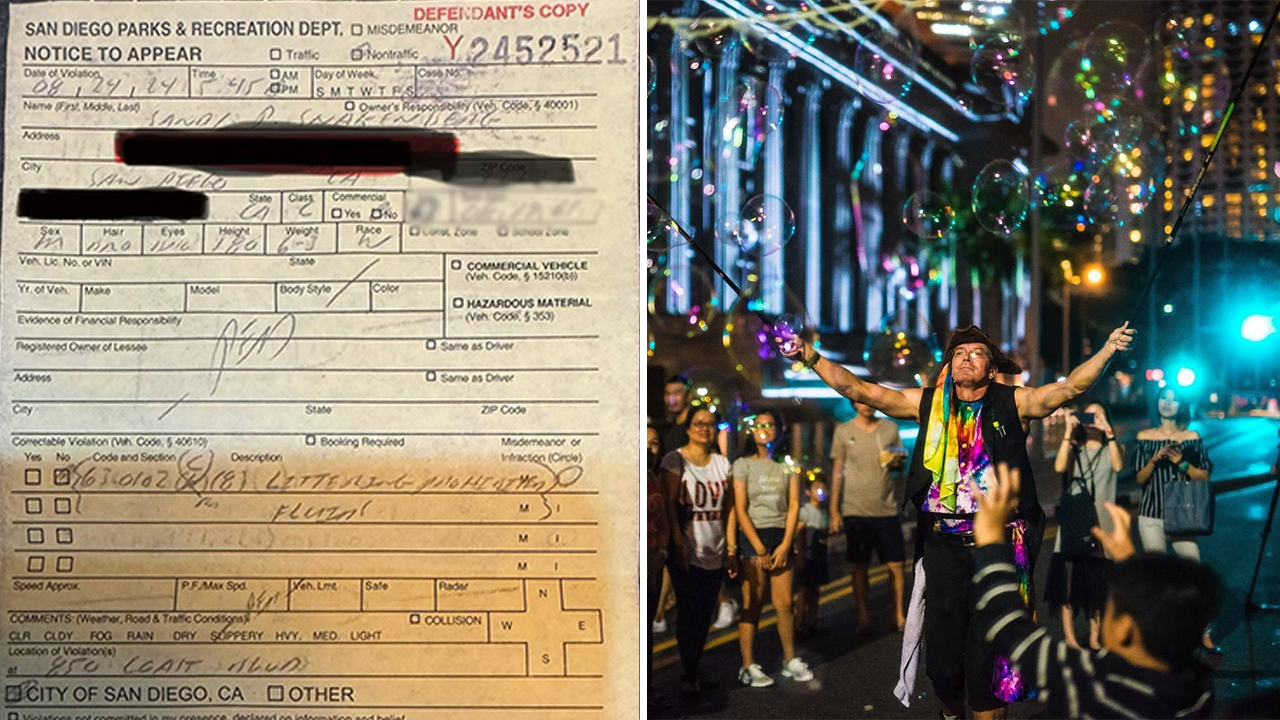
A Navy veteran in California has been entertaining the local community with his creative bubble performances for over 10 years.
But Sandy Snakenberg, known as the “Bubble Pirate,” was donning his pirate costume and performing his usual bubble show at La Jolla Cove in San Diego last week when he was issued a ticket by park officials, he told Fox News Digital.
The ticket alleges that Snakenberg, 63, violated San Diego’s municipal code against littering due to the fluid from his bubbles.
MASSACHUSETTS OFFICIALS SHUT DOWN BOY’S CHARITY ICE CREAM STAND: ‘DISAPPOINTED’
Snakenberg said in a phone interview that he asked the park ranger to note that the liquid was from bubbles, but the officer did not do so, he said.
The ticket mandates that Snakenberg appear in court in October.
Sandy Snakenberg, shown above, was given a ticket last week for “liquid fluid littering” while performing in La Jolla, California. He must appear in court in October. (Barry Alman)
Snakenberg told Fox News Digital he is a disabled Navy veteran who has traveled all over the world for a variety of jobs in his life.
He once owned a gym in Singapore, he said, to benefit individuals with special needs.
VANDALISM FOUND AT GETTYSBURG BATTLEGROUND, PRESERVATIONISTS REMOVE TRACES OF DEFACEMENT: ‘HALLOWED GROUND’
Snakenberg said he has dyslexia. He makes his living from his bubble artistry and entertainment, he said. The van with all of his equipment and props doubles as his home.
“I was becoming more involved with bubbles, more professionally, making my own juices, my own devices. I did a Ted talk while in Singapore,” he said.
Snakenberg was ticketed and must appear in court this October. (Sandy Snakenberg)
The Ted talk he delivered in 2016 is called “Lessons of the Bubbles.” It’s described online as a presentation of “his journey and lessons learned not just from the bubbles but from his observations of others when exposed or re-exposed to their magic.”
Said Snakenberg, “During that time, I suffered heart failure, [then] started to do a trip around the world doing bubbles modeled after my Ted talk.”
NEW JERSEY RESTAURANT BREAKS GUINNESS WORLD RECORD FOR LARGEST TEQUILA, MEZCAL LIBRARY
The talk was based on a sociological experience with bubbles and their “connective” properties, he said.
“I was just enjoying blowing the simple bubbles that you blow and people walking by were enjoying them,” he told Fox 5 San Diego. “I got kind of hooked sharing the joy of it.”
Snakenberg has been performing with bubbles for more than 10 years. (Barry Alman)
That grew into what he practices today.
“I practice what is known as bubbleology. It’s a real thing,” he said.
Lately, said Snakenberg, vendors and artists in the community have been getting “herded” into designated four feet-by-eight feet areas by officials.
“They’re making everybody fight for these four by eight spaces, which are limited,” he said.
“They are not in locations the artists would have chosen for themselves. I choose my location for safety reasons, both environmental and public, because if my bubbles go flying off into the streets, so will the kids.”
“If I thought I was in any way damaging the environment or hurting people, I wouldn’t be around very long,” Snakenberg told Fox News Digital. (Sandy Snakenberg, Barry Alman)
A City of San Diego Parks and Recreation Department spokesperson told Fox News Digital via email, “The City of San Diego values the rights of community members to engage in expressive activity in City parks, including artistic expression. This does require those engaging in these activities to do so in accordance with other City codes and regulations, including those related to littering and disposal of waste.”
“Rangers issued the lowest level citation available.”
The spokesperson added, “In this instance, Park Rangers attempted to educate the individual numerous times that the residual substances from the bubbles are in violation of the City’s municipal code as it relates to littering (SDMC 63.0102(c)(8) Littering). The individual uses up to six gallons of liquid per day with the residual chemicals ending up in the lawn areas, which can cause damage to the grass.”
“After witnessing numerous violations and receiving complaints from other park users, Rangers issued the lowest level citation available.”
Snakenberg said, “If I thought I was in any way damaging the environment or hurting people, I wouldn’t be around very long. I’ve been doing this for over 10 years.”
For more Lifestyle articles, visit www.foxnews.com/lifestyle
“It’s not just my livelihood, it’s something that is actually part of the community now,” he told Fox 5 San Diego — noting that many of the same people have been coming to see him perform for years.
Read the full article from Here



NEWYou can now listen to Fox News articles!
The Supreme Court on Monday cleared the way for California schools to notify parents if their children want to change their gender identity without approval from the student amid a challenge against the Golden State’s ban on so-called forced outing of transgender students.
The court granted an emergency appeal from a conservative legal group, the Thomas More Society, blocking, at least for now, a state law that prohibited automatic parental notification requirements if students change their gender expression or pronouns at school.
The Thomas More Society praised the decision as “the most significant parental rights ruling in a generation.” Two sets of Catholic parents represented by the legal group argued that the state law, signed by Gov. Gavin Newsom in 2024, caused schools to mislead them and secretly facilitate the students’ gender transitions.
Two sets of Catholic parents argued that the state law, signed into law by Gov. Gavin Newsom in 2024, caused schools to mislead them and secretly facilitate the students’ gender transitions. (Sean Rayford/Getty Images)
But California contended that students have the right to privacy about their gender expression, particularly if they fear rejection from their families who may not support their decision to adopt a new gender identity. The state also said school policies and state law sought to balance student privacy with parental rights.
Last year, state education officials told school districts that the state’s policy “does not mandate nondisclosure.” Newsom’s office also previously said that “parents continue to have full, guaranteed access to their student’s education records as required by federal law.”
The Supreme Court sided with the parents on Monday and reinstated a lower-court order blocking the law and school policies while the case continues.
“The parents who assert a free exercise claim have sincere religious beliefs about sex and gender, and they feel a religious obligation to raise their children in accordance with those beliefs. California’s policies violate those beliefs,” the majority wrote in an unsigned order, adding that state policies also burden the free exercise of religion.
The Thomas More Society praised the decision as “the most significant parental rights ruling in a generation.” (AP Photo/Julia Demaree Nikhinson, File)
Conservative Justices Samuel Alito and Clarence Thomas also said they would have gone a step further and granted the teachers’ appeal to lift restrictions for them. The three liberal justices dissented, saying the case is still working its way through lower courts and there was no need to take action now.
“If nothing else, this Court owes it to a sovereign State to avoid throwing over its policies in a slapdash way, if the Court can provide normal procedures. And throwing over a State’s policy is what the Court does today,” Justice Elena Kagan wrote.
A federal judge ruled in December 2025 that schools cannot prevent teachers from sharing information about a student’s gender identity with their parents, but an appeals court blocked that ruling last month, leading the plaintiffs to ask the nation’s highest court to step in.
TRUMP ADMIN FINDS CALIFORNIA BAN ON NOTIFYING PARENTS OF GENDER TRANSITIONS VIOLATED FEDERAL LAW
The Supreme Court sided with the parents and reinstated a lower-court order blocking the law and school policies while the case continues. (OLIVIER DOULIERY/AFP via Getty Images)
CLICK HERE TO DOWNLOAD THE FOX NEWS APP
The high court has been weighing whether to hear arguments in cases out of other states such as Massachusetts and Florida filed by parents who say schools facilitated gender transitions without notifying them.
The U.S. Department of Education also announced last month that the California law violates federal law. The findings of the federal investigation could put at risk the nearly $8 billion in education funding the federal government gives the state each year if state officials do not work with the Trump administration to resolve the violations.
The Trump administration is also pursuing legal action against California and threatening to withhold funding over a policy allowing biological males to compete in girls’ sports.
The Associated Press contributed to this report.
Related Article

Read the full article from Here

It’s 10 a.m. sharp, and Abby Kurtz gets her first assignment of the day. She’s received a time, a location in San Francisco and a target.
Her weapon of choice: an iPhone.
“Being a social agent is really the coolest thing ever,” she said.
Kurtz is a content creator working through an app called Social Agent, part of an expanding gig economy where more and more workers are trading stability for flexibility. Work that once required connections, planning, and a big budget can now be booked with a tap —extending the on-demand model from rides and meals to storytelling itself.
Just make a request, and someone like Kurtz can arrive within 30 minutes, camera-ready.
“What I look for when I’m shooting events is very crisp and clean content,” she said.
Her mission this time took her to Sutro Nursery, a nonprofit dedicated to growing native plants and that is hoping to grow its volunteer base, too. Board member Maryann Rainey said booking a Social Agent is a lot cheaper than hiring someone to do their social media full-time.
“I know I can’t do it myself, and I was certainly hoping that these young people would know how to do a good film,” Rainey said.
A typical job runs about $200, with same-day delivery. Agents earn around $50 an hour, plus tips. And if clients already have footage, they can upload it and have it turned into a finished piece.
The service is currently available in New York, Los Angeles, and Miami, with a slower rollout now underway in other cities.
Lisa Jammal, the company’s CEO, said the idea is simple: Let someone else do the shooting.
“We all are missing those beautiful moments because we’re always behind the phone,” she said.
As for Kurtz, after the shoot, she headed straight to a nearby coffee shop, where the clock started ticking. She had just over an hour to shape her raw material into a polished final cut.
“I think I’m going to give this reel a really peaceful, calming feel, but also informative and inviting,” she said.

Wisconsin man accused of setting fire to congressman’s office over TikTok ban gets 7 years in prison

Why is Popular Bracketologist Still Considering West Virginia for NCAA Tournament?
Explore small streams of Wyo. with WGFD XStream Angler challenge

Paramount ally RedBird says using Middle East money to help buy Warner Bros. could be a good idea

Fitness Class Volume Tied to Exercise Intensity Perception

Florida High School Football Rankings: Top 25 teams – Oct. 21

Cleary's 21 help Le Moyne down Central Connecticut State 69-64 in OT

How old is Bo Nix? What to know about Oregon quarterback ahead of 2024 NFL Draft

99th annual Pony Swim held in Virginia

Indiana Members Credit Union announced as new anchor tenant at Bottleworks District

Map: 4.9-Magnitude Earthquake Shakes Louisiana

Paxton vows he’s ‘staying in this race’ even if Trump backs Cornyn in Texas GOP clash

Which Kurdish groups is the US rallying to fight Iran?

Man accused of plot to assassinate Trump testifies Iran pressured him, says Biden and Haley were other possible targets

DHS defends McLaughlin against allegations husband’s company profited millions from ad contracts: ‘Baseless’
-

 World1 week ago
Exclusive: DeepSeek withholds latest AI model from US chipmakers including Nvidia, sources say
-

 Massachusetts1 week ago
Mother and daughter injured in Taunton house explosion
-

 Wisconsin4 days ago
Setting sail on iceboats across a frozen lake in Wisconsin
-

 Maryland4 days ago
AM showers Sunday in Maryland
-

 Florida4 days ago
Florida man rescued after being stuck in shoulder-deep mud for days
-

 Denver, CO1 week ago
10 acres charred, 5 injured in Thornton grass fire, evacuation orders lifted
-

 Massachusetts2 days ago
Massachusetts man awaits word from family in Iran after attacks
-

 Oregon6 days ago
2026 OSAA Oregon Wrestling State Championship Results And Brackets – FloWrestling