
Connect with us

West

California officials ticket the 'Bubble Pirate,’ an artist and Navy veteran, for 'fluid littering'

Published

on

California officials ticket the 'Bubble Pirate,’ an artist and Navy veteran, for 'fluid littering'

A Navy veteran in California has been entertaining the local community with his creative bubble performances for over 10 years.

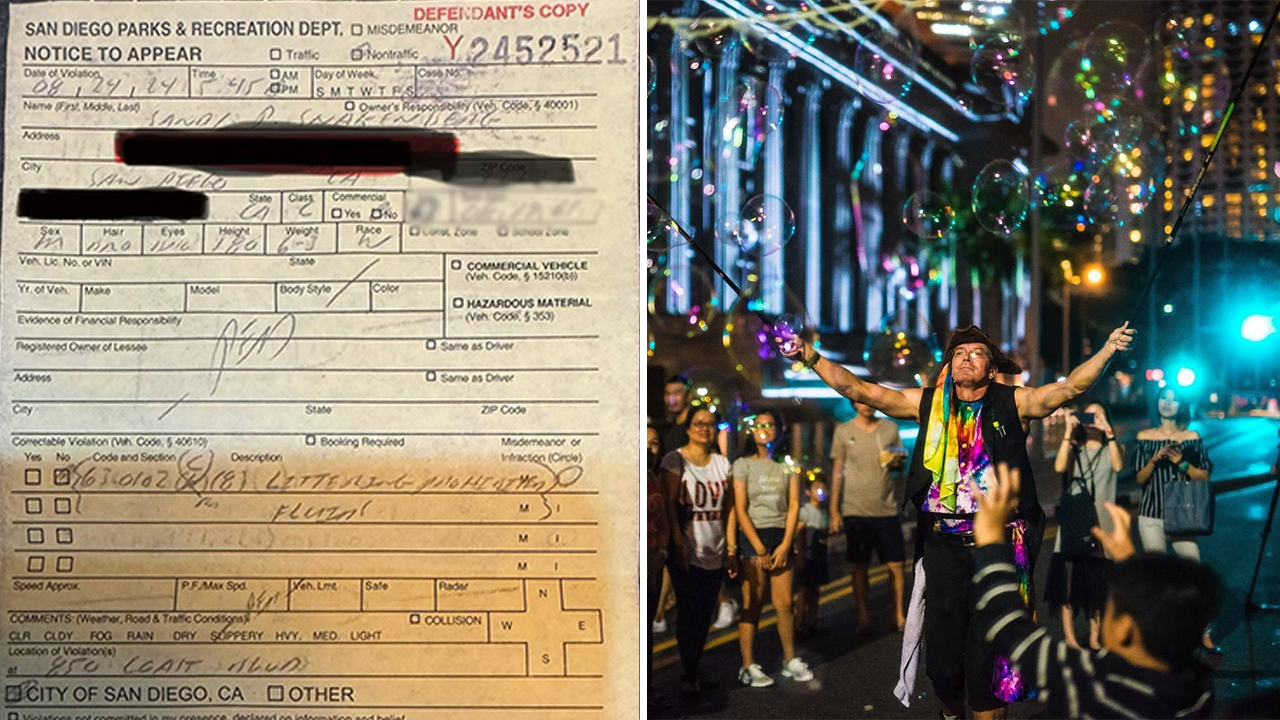
But Sandy Snakenberg, known as the “Bubble Pirate,” was donning his pirate costume and performing his usual bubble show at La Jolla Cove in San Diego last week when he was issued a ticket by park officials, he told Fox News Digital. 

The ticket alleges that Snakenberg, 63, violated San Diego’s municipal code against littering due to the fluid from his bubbles.

MASSACHUSETTS OFFICIALS SHUT DOWN BOY’S CHARITY ICE CREAM STAND: ‘DISAPPOINTED’

Snakenberg said in a phone interview that he asked the park ranger to note that the liquid was from bubbles, but the officer did not do so, he said.

Advertisement

The ticket mandates that Snakenberg appear in court in October.

Sandy Snakenberg, shown above, was given a ticket last week for “liquid fluid littering” while performing in La Jolla, California. He must appear in court in October. (Barry Alman)

Snakenberg told Fox News Digital he is a disabled Navy veteran who has traveled all over the world for a variety of jobs in his life. 

He once owned a gym in Singapore, he said, to benefit individuals with special needs.

VANDALISM FOUND AT GETTYSBURG BATTLEGROUND, PRESERVATIONISTS REMOVE TRACES OF DEFACEMENT: ‘HALLOWED GROUND’

Advertisement

Snakenberg said he has dyslexia. He makes his living from his bubble artistry and entertainment, he said. The van with all of his equipment and props doubles as his home. 

“I was becoming more involved with bubbles, more professionally, making my own juices, my own devices. I did a Ted talk while in Singapore,” he said. 

Snakenberg was ticketed and must appear in court this October.  (Sandy Snakenberg)

The Ted talk he delivered in 2016 is called “Lessons of the Bubbles.” It’s described online as a presentation of “his journey and lessons learned not just from the bubbles but from his observations of others when exposed or re-exposed to their magic.”

Said Snakenberg, “During that time, I suffered heart failure, [then] started to do a trip around the world doing bubbles modeled after my Ted talk.”

Advertisement

NEW JERSEY RESTAURANT BREAKS GUINNESS WORLD RECORD FOR LARGEST TEQUILA, MEZCAL LIBRARY

The talk was based on a sociological experience with bubbles and their “connective” properties, he said.

“I was just enjoying blowing the simple bubbles that you blow and people walking by were enjoying them,” he told Fox 5 San Diego. “I got kind of hooked sharing the joy of it.”

Snakenberg has been performing with bubbles for more than 10 years. (Barry Alman)

That grew into what he practices today.

Advertisement

“I practice what is known as bubbleology. It’s a real thing,” he said. 

Lately, said Snakenberg, vendors and artists in the community have been getting “herded” into designated four feet-by-eight feet areas by officials.

“They’re making everybody fight for these four by eight spaces, which are limited,” he said.

“They are not in locations the artists would have chosen for themselves. I choose my location for safety reasons, both environmental and public, because if my bubbles go flying off into the streets, so will the kids.”

Advertisement

“If I thought I was in any way damaging the environment or hurting people, I wouldn’t be around very long,” Snakenberg told Fox News Digital.  (Sandy Snakenberg, Barry Alman)

A City of San Diego Parks and Recreation Department spokesperson told Fox News Digital via email, “The City of San Diego values the rights of community members to engage in expressive activity in City parks, including artistic expression. This does require those engaging in these activities to do so in accordance with other City codes and regulations, including those related to littering and disposal of waste.”

“Rangers issued the lowest level citation available.”

The spokesperson added, “In this instance, Park Rangers attempted to educate the individual numerous times that the residual substances from the bubbles are in violation of the City’s municipal code as it relates to littering (SDMC 63.0102(c)(8) Littering). The individual uses up to six gallons of liquid per day with the residual chemicals ending up in the lawn areas, which can cause damage to the grass.”

Advertisement

“After witnessing numerous violations and receiving complaints from other park users, Rangers issued the lowest level citation available.”

Snakenberg said, “If I thought I was in any way damaging the environment or hurting people, I wouldn’t be around very long. I’ve been doing this for over 10 years.”

For more Lifestyle articles, visit www.foxnews.com/lifestyle

“It’s not just my livelihood, it’s something that is actually part of the community now,” he told Fox 5 San Diego — noting that many of the same people have been coming to see him perform for years. 

Read the full article from Here

Advertisement
Continue Reading
Click to comment

Leave a Reply

Your email address will not be published. Required fields are marked *

This site uses Akismet to reduce spam. Learn how your comment data is processed.

Alaska

Climate Change Is Helping an Invasive Predator Wreak Havoc on Iconic Alaskan Fish

Published

on

Climate Change Is Helping an Invasive Predator Wreak Havoc on Iconic Alaskan Fish


WILLOW, Alaska—Corey Ercolani pulled a northern pike from a gillnet and slit its belly with a knife. Inside its guts lay fresh evidence of a growing biological crime: a dead juvenile salmon. A coho, or silver salmon, to be exact. A technician with the Alaska Department of Fish and Game, Ercolani had set the net […]


Source link

Continue Reading

Arizona

Arizona man pleads guilty after illegally living in forest for years among ‘1,000lbs of trash’

Published

on

Arizona man pleads guilty after illegally living in forest for years among ‘1,000lbs of trash’


A man in Arizona has pleaded guilty to violating federal fire restrictions and unlawfully residing in a national forest, after authorities said he spent years living at a makeshift campsite surrounded by what officials described as “approximately 1,000 pounds of trash”.

Mark Aaron Gatz was arrested on 25 June at his illegal campsite in Arizona’s Tonto national forest, according to court records. A United States Forest Service (USFS) officer wrote in documents submitted to court that Gatz had been operating an “illegal campsite” with a “hot wood burning campfire” despite fire restrictions and that he had told investigators that he had been living in the forest for about eight years.

The officer wrote that a records check found that Gatz had previously received multiple citations and was the subject of six outstanding federal arrest warrants for earlier violations, including for building fires during fire restrictions, constructing on national forest service lands, unsanitary conditions and occupying national forest as a residence.

Gatz “said that he knew about current fire restrictions but had to have fire to eat”, authorities said. The documents show that USFS officers made contact with Gatz multiple times over the last year or so, and issued him warnings as well as a violation notice for having campfires during fire restrictions.

Advertisement

Notes from officers’ previous encounters with Gatz earlier this year, submitted into the court docket, state that authorities observed “trash such as clothing, pans, tools, and plastic cups scattered throughout the campsite along with a structure that was four feet in height build using wood panels”.

During an encounter with Gatz in May, officers reported observing “approximately 1,000 pounds of trash” at the site, which they said included tires, plastic bags, trash bags, aluminum cans and other items. They also wrote that they found that the campfire site had been left unattended by Gatz the previous day while still hot.

In a separate report filed by law enforcement from an encounter in February, one officer wrote that “upon arrival at the camp, I was flabbergasted by the amount of debris in the area”.

Investigators said that during that encounter, the debris consisted of three ladders, six to eight totes “overfilled with debris”, five 55-gallon drums, eight tires, multiple bicycle frames, 5 gallons of motor oil, plywood and other “miscellaneous lumber”, and they wrote that trash was scattered over approximately half an acre of Forest Service land and creating what officers described as public safety concerns.

In a separate report from July 2025, officers said they observed what they described as a “large messy campsite” while patrolling the area due to complaints “from the district office abut one large messy camp”.

Advertisement

“There was roughly half an acre of resources ruined due to so much trash and goods on the ground for an extended period of time,” the officer wrote.

This week, after Gatz pleaded guilty, he was sentenced to time served and three years of probation, according to court records.

A representative for Gatz did not immediately respond to a request for comment.


Source link

Advertisement
Continue Reading

California

How California Effectively Legalized an Open-Air Sex Market

Published

on

How California Effectively Legalized an Open-Air Sex Market

It’s midafternoon outside KIPP Academy of Opportunity, a charter school serving children in fifth through eighth grade on South Figueroa Street in residential Los Angeles. As children inside prepare for their futures, a young female struts by in high heels, wearing nothing but a bikini and a jacket. 

“We’ll see some police officers roll by and some young women out here just prostituting. They’re walking right by, and the police drive right by them,” the school’s gun-toting security guard said. “It’s normal.”

This is Figueroa Corridor, one of California’s most notorious sex markets. Here, prostitutes gather, night after night, selling sex acts that, according to one former cop, cost as little as $25. Last year, members and associates of a gang were indicted after allegedly trafficking adults and minors—including foster children—along the corridor and branding them with tattoos.

Advertisement

This was all the predictable result of public policy. In 2022, Governor Gavin Newsom signed a law decriminalizing loitering with intent to commit prostitution. When he signed the bill, Newsom suggested it would help would reduce the harassment of women.

We went to Figueroa to see the results for ourselves. As we walked the corridor, saw the sex market, and rode along with a former LAPD vice cop, one thing became clear: on Figueroa, human flesh is big business—something state leaders appear to have no desire to change.

The scene stretches across almost four miles of hot, dusty cement. Nearly nude women cluster at the start of side streets just off the main road. Lines of cars slowly cruise along, apparently hoping to buy. Pimps either oversee the prostitutes themselves, on a nearby phone, or through hired low-level watchers. Sirens blare constantly, but officers often just roll on by. When asked about activity on the corridor, one prostitute said, “money and p*ssy,” before twerking and walking away.

Stephany Powell, a former sergeant in an LAPD Vice unit and former executive director at Journey Out, a Los Angeles–based nonprofit serving human trafficking victims, rode with us along the corridor.

“Statistically, the average age of entry for human sex trafficking is between the ages of 12 and 14 years old,” she said. “We’d see 14-, 15-year-olds that were out on the prostitution tracks. We also would see 25-to-30-year-olds . . . some of them had been out on the streets on the prostitution tracks since age 13. And in those cases, nine times out of ten, they had a trafficker.”

Advertisement

Figueroa has been a sex-trafficking den for decades. But recent policy changes have made the corridor harder to police. In California, it had been a crime to loiter with the intent of committing prostitution since at least 1995. Patrol officers could use this law to curtail the street market—and stop, identify, and rescue trafficked minors.

That began to change in 2016. That year, then-Governor Jerry Brown signed S.B. 1322, prohibiting minors from being charged with solicitation of and loitering with intent to commit prostitution. The law was arguably well-intentioned, reflecting a belief that trafficked children shouldn’t be treated as criminals.

But that wasn’t enough for the state’s progressives. In 2021, State Senator Scott Wiener authored S.B. 357, a bill that would fully decriminalize loitering with intent to commit prostitution. A trio of the state’s most powerful progressive institutions—the Anti-Defamation League, the ACLU’s California chapter, and Equality California—rallied behind the bill, which passed in 2022.

Governor Gavin Newsom signed the bill in July of that year, suggesting that it would reduce the “harassment of women.” He also referenced “transgender adults,” seemingly endorsing LGBT activists’ view that the loitering statute had criminalized “walking while trans.”

“Black adults accounted for 56.1% of the loitering charges in Los Angeles between 2017-2019, despite making up less than 10% of the city’s population,” Newsom wrote. “To be clear, this bill does not legalize prostitution. It simply revokes provisions of the law that have led to disproportionate harassment of women and transgender adults.”

Advertisement

Since the law’s passage, however, Figueroa has more prostitutes than it did before. Before S.B. 357, Powell says she delivered around 30 makeup kits along the entire corridor each night that she engaged in outreach efforts. When we drove past a particularly active handful of blocks, Powell said that after “S.B. 357 passed, we counted about 60 girls just from this track [alone].”

More minors are apparently being trafficked, too. The Times reported that LAPD Sergeant Al Navarro’s officers, who work at the nearby 77th Street station, rescued 123 children in 2024—a nearly eightfold increase from 2022, the year before S.B. 357 took effect.

The law itself is driving these trends. Before S.B. 357, police officers could use a woman’s attire and behavior to determine that she was loitering to commit prostitution. Once that behavior was decriminalized, prostitutes began wearing hardly any clothes—and law enforcement found itself helpless to control the sex trade.

“A lot of the girls hardly have anything on, they’re practically naked. In many cases you can see right through whatever they’re wearing,” Powell said. “Before S.B. 357 . . . what would happen if we were working vice and we’d see somebody out there like that, we could arrest them for solicitation of prostitution. Now, in order for you to arrest them for solicitation of prostitution, there has to be an act involved.”

S.B. 357 has also enabled traffickers. In the past, a patrol officer could arrest a loitering prostitute to get her off the streets and encourage her to testify against a trafficker. Today, law enforcement has to use resource-strapped undercover units to target traffickers one-by-one.

Advertisement

“SB 357 removed a key enforcement tool that kept communities free from red light blight,” former Los Angeles County sheriff Alex Villanueva told us. “This ill-advised bill condemned the marginalized to be sex trafficked, and human trafficking has exploded.”

The situation is so dire that the federal government intervened. In August 2025, First Assistant U.S. Attorney Bill Essayli spearheaded the region’s first-ever RICO human trafficking case against the vicious Hoover Criminal Gang. Essayli’s office charged six members and associates of the Hoovers with various crimes, including sex trafficking of minors, money laundering, and sexual exploitation of a child.

The indictment spells out the depraved allegations. The Hoovers and their associates allegedly targeted adults and children as young as 14; branded their victims with tattoos; and, in some cases, required their victims to secure $1,000 per night. In one instance, a Hoover associate and two unindicted co-conspirators allegedly tried to kidnap prostitutes from San Bernardino, a plot that failed only when the two targets broke free and escaped.

On July 1, 2026, a federal follow-up operation took down another ten suspects, including the operator of a seedy motel, who was charged with “financially benefiting from the Hoover gang’s sex trafficking operation.”

City Journal’s four-day visit to the corridor took place just before the second operation against the Hoovers and revealed the challenges faced by the ongoing federal efforts. Figueroa still pulsed with activity, with the entire apparatus of apparent prostitutes, pimps, watchers, and Johns out in the open for all to see. Police drove on by. Women walk the corridor, risking disease, beatings, and death with each step.

Advertisement

When he signed S.B. 357, Gavin Newsom suggested that the new law would help reduce harassment against women. What it enabled instead is a wave of crime, suffering, and abuse.


Source link
Continue Reading
Advertisement

Trending
