West
Biden’s green energy fiasco, not Trump’s reforms, is jacking up your electric bill

NEWYou can now listen to Fox News articles!
There’s a battle to define a narrative about what’s to blame for rising electricity prices. Some claim higher electricity prices are due to President Donald Trump’s “one big beautiful bill,” which curtailed subsidies for “cheap” wind and solar installations. Others blame AI’s rapidly expanding appetite for electricity, while some blame inflation. None of these charges hold up under scrutiny.
But shifting blame, usually with the help of a complicit media, helps with the only thing that matters to most politicians: seizing political power.
This is readily seen in California Democrat Gov. Gavin Newsom’s trip to Belém, Brazil, to rub elbows with the global elite at the U.N.’s COP30 global climate conference on Nov. 11. Newsom, an all-but-declared candidate for the Democratic nomination for president in 2028, slammed the Trump administration for not attending the confab, accusing the president of “handing the future to China,” presumably in the category of selling solar panels embedded with secret kill switches.
Newsom went on to say that “We’re not turning backwards to the failed policies of the past — California is fighting for a clean-energy future, even as President Trump bends the knee to his Gulf-State patrons and takes a nap as the world burns.” Newsom also claimed that California is now operating its grid on “two-thirds clean energy,” with California operating on 100% non-fossil-fuel energy for at least part of the day nine out of 10 days this year.
NEWSOM CLAIMS TRUMP IS ‘HANDING THE FUTURE TO CHINA’ AT BRAZILIAN CLIMATE CONFAB THAT WH SKIPPED
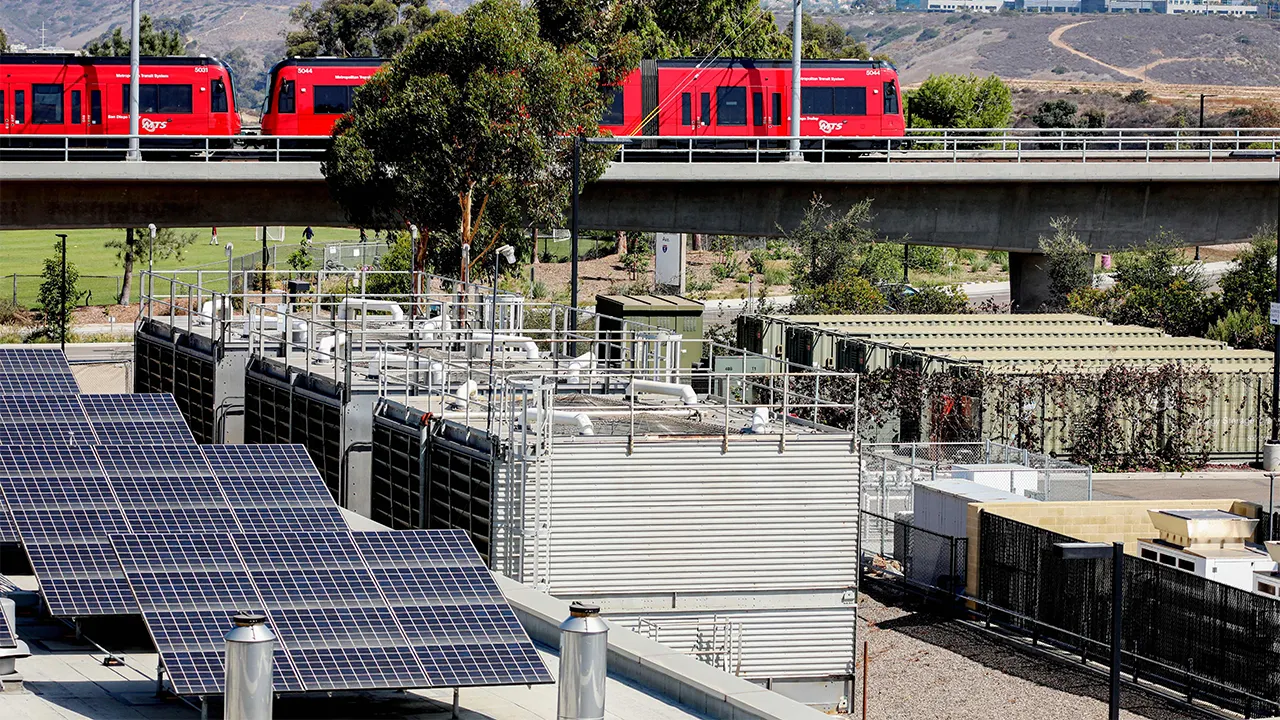
Solar power energy microgrid in California, as part of that state’s green energy push. (Photo by SANDY HUFFAKER/AFP via Getty Images)
But California now has the nation’s second-highest electricity prices, only behind Hawaii, with the Golden State’s electricity prices rising the most of any state since 2010: 127%, according to a new report from Jonathan A. Lesser, Ph.D., a senior fellow with the National Center for Energy Analytics.
The truth that Newsom doesn’t want Californians — or Democratic primary voters — to know is that “green” energy is expensive energy. That’s because, “60% of the time, (wind and solar) works every time” to borrow from the much-memed comedy “Anchorman.” And, it’s very costly to make sure the power is on when wind and solar aren’t producing.
This, Lesser notes, is one of the main culprits in rising electricity costs.
LIZ PEEK: TRUMP WHITE HOUSE FIRED UP ABOUT KING COAL’S RETURN TO POWER
The Biden-Harris administration’s reckless push for subsidized wind and solar — and California’s before that and since — has destabilized our grid and forced consumers to foot the bill for fortifying unreliable “green” energy with reliable gas power and expensive batteries — the latter of limited utility.
From the first quarter of 2010 to the second quarter of 2025, average residential electricity rates across the U.S. surged by about 63%, according to Energy Information Administration (EIA) data. But the pain isn’t evenly distributed. States like Massachusetts and California not only endured the steepest hikes, but now boast two of the nation’s highest rates — over 30 cents per kilowatt-hour in some cases.
Critics peddle all sorts of excuses for these increases. One target is data centers, those power-hungry hubs fueling AI and cloud computing. Sure, they consume a lot of power — Virginia, a data center hotspot, has seen demand rise. But Virginia’s rates? Below-average increases and still under the national norm. If data centers are the villain, why isn’t the Old Dominion suffering like California?
TRUMP’S UN SPEECH REVEALS INCONVENIENT TRUTH OF MASSIVE GREEN ENERGY COSTS
A recent International Renewable Energy Agency report touts falling costs for renewables. But as Lesser’s analysis shows, that’s a half-truth at best. Subsidies like the federal production tax credit — now $27.50 per megawatt-hour — let wind and solar operators undercut the market with negative bids, distorting wholesale prices and squeezing out reliable baseload plants — which end up not being built.
Here’s the missing link the green advocates ignore: the shift in our generating mix. Between 2010 and 2024, U.S. electricity capacity grew 16% to 1,325 gigawatts, outpacing a mere 5% rise in retail sales. Sounds good, right? Wrong. Dispatchable sources — coal, gas and nuclear, which can ramp up on demand — plummeted by 80 gigawatts. Intermittent wind and solar ballooned seven-fold, to 278 gigawatts.
California Governor Gavin Newsom traveled to Brazil for the COP30 World Climate Conference, touting his state’s energy policies while the Trump administration skipped the event. (Larissa Schwedes/picture alliance via Getty Images)
This trend accelerated in 2025: More than 1,900 megawatts of fossil fuel retired by July, with another 12,600 megawatts slated for shutdown by year’s end and into 2026. What’s replacing them? More subsidized wind, solar, and pricey batteries.
TRUMP’S ENERGY PRICE PROMISE IS COMING DUE. HE HAS THE POWER TO SOLVE THE CRISIS
It’s policy malpractice. States like New Jersey and New York forced premature closures of reliable power plants such as Oyster Creek nuclear in 2018 and Indian Point in 2021, which powered a quarter of New York City’s needs.
Biden-era EPA rules, now being rolled back under Trump, would have shuttered most coal plants by 2032. Mandates for cars to have “zero-emissions” by 2035 in places like California ignore reality. Where will they get the electricity? Wind and solar can’t provide inertia or reactive power, essential for grid stability.
CLICK HERE FOR MORE FOX NEWS OPINION
The fallout? Skyrocketing prices.
NEWSOM PUSHES CLIMATE RECORD ABROAD AS CALIFORNIANS SHOULDER AMERICA’S HIGHEST GAS COSTS
The truth that Newsom doesn’t want Californians — or Democratic primary voters — to know is that “green” energy is expensive energy.
Trump’s One Big Beautiful Bill Act — only now going into effect, so any electricity price increases to this point aren’t due to the law — flips the script. By rescinding President Joe Biden’s vehicle emission standards and fossil fuel crackdowns, it prioritizes affordable, dispatchable energy. Expect more nuclear builds, streamlined pipelines and fewer handouts to Big Green. This won’t spike prices — it’ll stabilize them by restoring reliable supply.
CLICK HERE TO DOWNLOAD THE FOX NEWS APP
Biden’s (and Newsom’s) green zealotry promised cheap power, but delivered the opposite: unaffordable, unreliable electricity that hampers economic growth. Trump’s reforms demonstrate that true energy independence means ditching the myths and embracing what works.
Americans deserve a grid that powers prosperity, not one that bankrupts it.
CLICK HERE TO READ MORE FROM CHUCK DEVORE
Read the full article from Here



SOUTH SAN FRANCISCO, Calif. – You’re not dreaming. Gas prices really are that high.
National average $4 a gallon, California $6
In fact, at the Shell station at 248 S. Airport Boulevard in South San Francisco, regular gas was going for $6.89 a gallon on Tuesday, about four weeks after the United States and Israel started a war in Iran.
Most people didn’t even stop to fill up; instead, drivers seemed to just pass the station by.
Juan Buenrostro did stop, though, and said it costs him about $300 to fill up his truck. He lives in Santa Cruz and had to drive to the Marina in San Francisco.
“It’s been crazy, man,” he said. “I have to work extra hours to make extra income. We’ve been struggling.”
That price is roughly double what the national average is. AAA said the average price of gas was $3.97 a gallon as of Tuesday, and the average price in California was $5.82.
Prices are so high that the state’s petroleum watchdog, the Division of Petroleum Market Oversight, has launched an investigation into possible price gouging, specifically at gas stations charging $7 or $8 a gallon.
A Chevron in downtown Los Angeles was selling gas for $8.71 a gallon this week.

Gas was selling for $8.71 a gallon at a downtown Los Angeles Chevron station. Photo: Fox11. March 23, 2026
Kate Gordon, CEO of California Forward and a former senior adviser to the U.S. Secretary of Energy, said $10 gas is not out of the question under certain conditions.
“Can you imagine a world where we’re paying $10 a gallon? … Yes, I can,” Gordon said.
Gas prices on March 24, 2026. Source: AAA
Last year, prices lower
A year ago, the average price in the United States was $3.13 a gallon, and the average price in California was $4.64 a gallon, according to AAA.
The highest average price for gas in California ever recorded was $6.44 on June 14, 2022, when Russia invaded Ukraine.
War in Iran
Regular gas was selling for $6.89 a gallon at a Shell gas station in S. San Francisco. March 24, 2026
Oil and gas prices have been soaring since the war in Iran began a month ago, and when Iran began retaliating against the United States by choking off the Strait of Hormuz – a critical oil passageway.
Gas prices are likely to remain elevated for some time, even if the war ends soon, because shipping and production have been disrupted and will take time to recover. Economists now expect slower growth this spring and for the year as a whole, as dollars that are spent on gas are less likely to be used for restaurant meals, new clothes, or entertainment.
Lower income households bearing the brunt
Lower and middle-income households are likely to be hit particularly hard, because they receive lower refunds, while spending a greater proportion of their earnings on gas.
Neale Mahoney, director of the Stanford Institute for Economic Policy Research, calculates that gas prices nationwide could peak in May at $4.36 a gallon, based on oil price forecasts by Goldman Sachs, followed by slow declines for the rest of the year. The notion that gas prices decline much more slowly than they rise is so ingrained among economists that they refer to it as the “rocket and feathers” phenomenon.
In that scenario, the average household would pay $740 more in gas this year, nearly equal to the $748 increase in refunds that the Tax Foundation has estimated the average household will receive.
And it’s only worse in California.
The impact will likely worsen the “K-shaped” narrative around the U.S. economy, analysts said, in which higher income households have fared better than lower-income households. The bottom 10% of earners spend nearly 4% of their incomes on gasoline, Pantheon Macroeconomics estimates, while the top 10% spend just 1.5%.

Two more days of record-breaking heat are forecast for northern Colorado this week, including in the Denver area, according to the National Weather Service.
Earlier forecasts from the weather service projected 90-degree temperatures in Denver on Wednesday, which would have marked the city’s first of the year and earliest on record. The expected temperature high has since dropped to 88 degrees, which would still break daily and monthly heat records, according to the weather service.
NWS Tuesday forecasts:
- 64 degrees in Dillion, breaking the 63-degree record for March 24.
- 75 degrees in Evergreen, breaking the 71-degree daily record.
- 81 degrees in Denver, breaking the 76-degree daily record.
- 83 degrees at Colorado State University in Fort Collins, breaking the 76-degree daily record.
- 83 degrees in Boulder, breaking the 76-degree daily record.
- 84 degrees at the University of Northern Colorado in Greeley, breaking the 80-degree daily record.
NWS Wednesday forecasts:
- 69 degrees in Dillion, breaking the 62-degree record for March 24.
- 80 degrees in Evergreen, breaking the 75-degree daily record.
- 88 degrees in Denver, breaking the 75-degree daily record and the 86-degree March heat record. Denver has broken or tied the March heat record three times so far this month, according to the weather service.
- 89 degrees at Colorado State University in Fort Collins, breaking the 76-degree daily record.
- 87 degrees in Boulder, breaking the 78-degree daily record.
- 89 degrees at the University of Northern Colorado in Greeley, breaking the 79-degree daily record.
This is a developing story and may be updated.
Get more Colorado news by signing up for our daily Your Morning Dozen email newsletter.

SEATTLE – A wet start to the day Tuesday with widespread showers and snow in the higher elevations. Snow levels will start low around 3000′ with a mix of rain and snow in the Cascade passes. Snow levels will start to rise to around 6000′ later in the day and evening.
A wet start to the day Tuesday with widespread showers and snow in the higher elevations.
Wind Advisory
There is a Wind Advisory for the coast and the north interior on Tuesday for gusts between 40-50 mph. Winds will remain strong along the coast, continuing the advisory through Wednesday afternoon.
There is a Wind Advisory for the coast and the north interior Tuesday for gusts between 40-50 mph.
Winds will be gusty for all of western Washington Tuesday with the Puget Sound seeing gusts up to 40 mph as well.
Winds will be gusty for all of Western Washington Tuesday with the Puget Sound seeing gusts up to 40 mph as well.
Highs Tuesday will be a few degrees below seasonal average, only reaching the low to mid 50s.
Highs Tuesday will be a few degrees below seasonal average, only reaching the low to mid 50s.
What’s next:
Showers will linger Wednesday with highs only in the upper 40s, then we will dry out for Thursday with milder temperatures. The Mariners home opener Thursday is looking dry with mostly sunny skies in the afternoon. This could mean the roof is OPEN! Showers will be gone by Friday into the weekend for a more spring-like forecast.
Showers will linger Wednesday with highs only in the upper 40s. (FOX 13 Seattle)
MORE NEWS FROM FOX 13 SEATTLE
Where is Jonathan Hoang? WA man with autism disappeared 1 year ago
As fuel prices rise, WA farmers face mounting challenges
Police say WA man shoots kid in the chest for throwing a water balloon
Seattle high-rises connected by decommissioned Boeing 747 fuselage
SCOTUS hears case that could impact WA ballot counting
To get the best local news, weather and sports in Seattle for free, sign up for the daily FOX Seattle Newsletter.
Download the free FOX LOCAL app for mobile in the Apple App Store or Google Play Store for live Seattle news, top stories, weather updates and more local and national news.
The Source: Information in this story came from the FOX 13 Seattle Weather Team and the National Weather Service.

Motown Museum in Detroit to Premiere New Psychedelic Soul Exhibit

Pain at the pump: One gas station in S. San Francisco near $7 a gallon

H-E-B plans new store on the eastern side of Dallas-Fort Worth

Motorcyclist killed in crash on Biscayne Boulevard, deputies say

Another crop of Boston College NFL hopefuls get a chance to shine at Eagles’ annual Pro Day

Florida High School Football Rankings: Top 25 teams – Oct. 21

How old is Bo Nix? What to know about Oregon quarterback ahead of 2024 NFL Draft

Cleary's 21 help Le Moyne down Central Connecticut State 69-64 in OT

99th annual Pony Swim held in Virginia

Indiana Members Credit Union announced as new anchor tenant at Bottleworks District

See How the LaGuardia Plane Crash Unfolded

Mullin confirmed as DHS chief as lawmakers near solution on shutdown standoff

Von der Leyen clinches Australia trade deal

Trump administration places Christopher Columbus statue on White House grounds

See TSA Wait Times at Major U.S. Airports
-

 Detroit, MI6 days ago
Drummer Brian Pastoria, longtime Detroit music advocate, dies at 68
-

 Oklahoma1 week ago
Family rallies around Oklahoma father after head-on crash
-

 Georgia1 week ago
How ICE plans for a detention warehouse pushed a Georgia town to fight back | CNN Politics
-

 Alaska1 week ago
Police looking for man considered ‘armed and dangerous’
-

 Movie Reviews5 days ago
‘Youth’ Twitter review: Ken Karunaas impresses audiences; Suraj Venjaramoodu adds charm; music wins praise | – The Times of India
-

 Education1 week ago
Video: Turning Point USA Clubs Expand to High Schools Across America
-
 Science1 week ago
Long COVID leaves thousands of L.A. county residents sick, broke and ignored
-

 Sports3 days ago
IOC addresses execution of 19-year-old Iranian wrestler Saleh Mohammadi