Alaska
Sen. Sullivan defends approach to Trump administration during address to Alaska Legislature


JUNEAU — U.S. Sen. Dan Sullivan defended his stance on the administration of President Donald Trump in response to questions from Alaska lawmakers after his annual address Wednesday, even as he called on them to unanimously adopt a resolution opposing one of Trump’s policy ideas.
“In terms of the president and his team, my North Star, in terms of my dealing with those guys, is what’s good for Alaska and what’s good for our country,” Sullivan said. “When they do things that I don’t like, there’s times that I will beat them up in public.”
Sullivan made the comment in response to a question from Anchorage Democratic state Sen. Forrest Dunbar, after a speech in which Sullivan, who is up for reelection this year, extolled Trump and declared Alaska was experiencing a “comeback” under his leadership.
“You said ‘yes’ to Trump many times,” Dunbar said. “I’m wondering if you’re willing to say ‘no.’”
“You want to put out a tweet, smashing them on certain issues or criticizing them?” Sullivan asked in response. “Sometimes that works, but sometimes, if you want results, that’s not always the best way to get results.”
Sullivan listed federal funding freezes and worker layoffs as areas where he disagreed with Trump in recent months. He said his office “made huge impacts on all of those issues,” though he has often refrained from speaking publicly about those topics or responding to questions from reporters about them.
“I push back publicly and in private on all kinds of things — with always the North Star for me, how to be effective for all of you, for the people I represent and for my country,” said Sullivan.
Sullivan’s speech surveyed many familiar themes. He decried former President Joe Biden’s past environmental policies, which he said hindered resource development in Alaska; he celebrated Trump’s executive order seeking to expand the state’s resource industries; he promised progress on a long-sought natural gas pipeline; he praised a GOP-backed bill that extended tax cuts first enacted in 2017; he downplayed lawmakers’ concerns over cuts to Medicaid enacted to pay for those tax cuts; he criticized Senate Minority Leader Chuck Schumer, D-New York, for blocking legislative provisions that would have benefited Alaska; and he lauded a new rural health program that he said would direct more than $1 billion in new federal funding to the state.
Sullivan’s speech focused primarily on areas where he said he agrees with the president. But he called on the Legislature to pass a resolution opposing Trump’s move to charge $100,000 for visas that are used by educators coming to Alaska from other countries, primarily the Philippines, to fill vacant teaching positions in rural districts.
Alaska has increasingly relied on teachers from other countries amid stagnant school funding and other concerns that have made attracting educators to the state from the Lower 48 increasingly difficult. Sullivan said he is working with other members of Alaska’s congressional delegation to seek an exemption to Trump’s visa surcharge.

Around three dozen protesters gathered outside the Capitol ahead of Sullivan’s address, speaking against several of his policy positions. Some lined the hallways as Sullivan entered the Alaska House chamber, holding signs reading, “We the People Do Not Consent.”
“When I entered the U.S. military, 60 years ago, I took an oath to protect and defend the U.S. Constitution,” Juneau resident Paul DeSloover said. “Sen. Sullivan, when he entered the Marines, took the same oath, and he likes to say ‘Semper Fi’ because he’s a Marine. But (it) should be, ‘Semper Timidus,’ because he is a timid coward.”
Erin Jackson-Hill, member of the left-leaning activist group Stand Up Alaska, criticized Sullivan’s support of the SAVE Act, a bill that would require proof of citizenship to vote. Alaska Republican U.S. Rep. Nick Begich also supports the legislation, whereas Alaska Republican U.S. Sen Lisa Murkowski opposes it.
“I call on Sen. Sullivan to show a modicum of the bravery shown by our other senator and stand up and say the SAVE Act is wrong. It will disenfranchise people,” Jackson-Hill said.
Sullivan said in a press availability after the speech that he believes “voting should be easy, and cheating should be hard.” He said he does not believe voter fraud is widespread in Alaska, but that it is elsewhere in the country.
“I think having an ID requirement that makes sure that the people who are voting in our country are Americans is not unreasonable,” Sullivan said. “Even though it’s not a big issue here, it is a big issue in other parts of the country. And I’m a senator for Alaska, but I’m also a senator for America.”
Reviews both nationwide and in Alaska have found that voting by noncitizens is exceedingly rare.
In response to a question from a reporter, Sullivan criticized U.S. Immigration and Customs Enforcement operations in Minneapolis. He said he supports “deporting illegals with violent criminal records.”
“ICE needs to refine its techniques and tactics. It was horrendous, regardless of the situation, in my view, that two Americans were killed,” said Sullivan. “That should not have happened. I think there’s practices that they need to learn from. At the same time, I strongly support our law enforcement.”
The Daily News’ Iris Samuels reported from Anchorage and Mari Kanagy reported from Juneau.



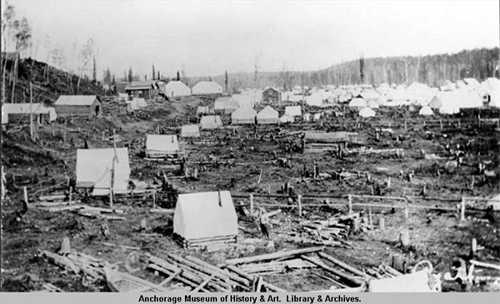
It was 111 years ago today that Anchorage began as the largest Alaskan city it is at present.
It was April 9th, 1915 that President Woodrow Wilson made his final decision as to the route of the Alaska Railroad from Seward to Fairbanks. The route led to the move of the headquarters from Seward to the tent city at Ship Creek in Anchorage, causing a boom in the area’s population.
2,ooo individuals from the Knik area scrambled to the Ship Creek area at first word of the railroad construction and this lawless, muddy area quickly became the foundation of the city of Anchorage.
The tent city would dissolve a mere three months later when 600 fixed lots were auctioned off on the bluffs above the creek and the townsite of Anchorage was formed.

The 2026 Traditional Games begin in the capital city on Friday. Around 200 participants from around the state and at least three other countries will compete through Sunday at Juneau Douglas High School: Yadaa.at Kalé.
The free event is co-hosted by the Central Council of the Tlingit and Haida Indian Tribes of Alaska and Sealaska Heritage Institute, with an opening ceremony featuring a parade of the athletes Saturday at 12:30 p.m.
KTOO’s Mike Lane spoke with coach, competitor and co-founder Kyle Kaayak’w Worl to learn about the importance of the games and what’s new this year.
Listen:
The following transcript has been lightly edited for clarity.
Mike Lane: What exactly are the games?
Kyle Worl: So the event has a collection of Indigenous games, and they’re mostly from the north, the Arctic. So you have the high kicks that are traditional Iñupiaq or Inuit games. We have stick pulls from the Interior Dene people. But this year, we’ve kind of broadened the perspective of traditional games and we are also including some traditional games in the form of workshops from our guests from New Zealand and Mexico. And then we have some canoeing activity as well, which is canoeing is one of our traditional forms of games here in Southeast as well.
Mike Lane: How many events are there in total?
Kyle Worl: There are 12 competitive events where you can medal in. They hold cultural significance.
The seal hop is a game that is based on a hunting technique that was used in the Arctic to sneak up to seals laying out on the ice flow. And back when harpoons were used, you had to be able to get in range to hand throw that harpoon, and simply walking up to the seal wouldn’t work, you’d scare it off and it would jump back in the ocean. So the hunters developed a technique to hop like a seal to sneak up to the seal, and that’s what this game is based on. You’re in a like a push-up position on your hands and toes, and you have to hop for the greatest distance and the furthest distance places in the game, and it’s a game of both endurance and also pain tolerance. You’ll see the athletes, they’ll sometimes break skin as they hop on their their knuckles. It depends on the age groups — high schoolers, boys, they hop on their first knuckles, but the adults that compete have to hop on a closed fist. So we’ll see some pretty battered hands with broken skin as they go along the gym floor.
Mike Lane: You’ve got people coming from all over the world to compete and also put on some workshops.
Kyle Worl: Yeah. So this event has grown every year, and it’s, we always say, what can we do next year to bring it to the next level? And we wanted to bring a more international perspective to the games, because we know there’s there’s traditional games from all across the world. So we have teams from New Zealand and Mexico. Even Labrador in far eastern Canada is coming. So it’s very much a sporting event, but it’s also a cultural exchange, and that’s a really important aspect of this, is our sports are connected to our culture, and we want to make this an opportunity to learn from each other and learn about the variety of Indigenous games. So on Friday, we’ll have workshops with our Maori guests and our Mexican athletes. I know the Mexican workshop is an Aztec hip ball game where they have a, I think it’s like a 10 pound rubber ball that you hit with your hips. It’s been highlighted in movies like “El Dorado” and such, that’s where I first heard about it.
But it’s pretty cool to think that after all these years, we’re having these international guests come to our event, that it’s really grown into something pretty amazing. So we’re pretty excited.
Mike Lane: Who participates. I mean, is there an age range?
Kyle Worl: The minimum age is 11, and we have three age categories. We have middle school — which is sixth, seventh and eighth — high school, ninth through 12th. And then we have an open adult category.
Mike Lane: So 11 years old is the Youngest and what’s the oldest?
Kyle Worl: Because we have an adult division, some of the coaches of these high school teams also sign up. I’m not sure who the oldest is, but I’m sure there’s going to be a few people in their 40s, maybe older.
Mike Lane: So there’s no ceiling?
Kyle Worl: No upper age limit. You’re never too old to do the games. And I always say there’s a game for everyone. They’re not all about jumping and kicking, which may get harder with age. We have games like the Dene stick pull, which is a technique based game, and it’s based on grabbing a salmon out of the water. So it’s, it’s more about balance and technique. We have archery too, and there’s a lot of skill to it but it’s not something that’s going to hurt your leg.
Mike Lane: And there’s artwork.
Kyle Worl: Yeah. So we’re really lucky that Corinne James agreed to design our 2026, shirts, and she did a formline design of Nalukataq, which is the blanket toss from the Iñupiaq people. And she did her interpretation in formline. It’s a really beautiful design. It’s going to be on all of our shirts. We have a pin made of it. So we’ve been really lucky to get really amazing Southeast Tlingit, Haida, Tsimshian artists to provide us art each year.
Mike Lane: Kyle, thanks for your time.
Kyle Worl: Thank you.

Many statewide candidates talk about putting Alaskans first, ahead of Outsiders. The problem is most of them are just putting some Alaskans ahead of others. We need more candidates in the mold of Ted Stevens and Don Young, leaders who weren’t willing to divide us, urban versus rural, just to win an election. Ironically, neither the Indiana-born Stevens nor California-native Young were originally from Alaska. It makes you wonder how our state’s most honored and beloved politicians would fare in today’s electoral environment.
This “me-first” populism dominates modern Alaska issue campaigns, too. It’s no accident that Outside groups promote “trawl bycatch” as the root of all evil when it comes to today’s fish wars: No one trusts science anymore (thanks, Joe Biden), and the pollock fleet has demonstrable ties to Seattle, making trawlers easy targets.
Of course, pollock and seafood are no different than Alaska’s other natural resource industries — all of which rely on capital and labor from Outside. If your flight back to Alaska happens during a shift change, you’ll share the plane with plenty of Lower 48-based roughnecks and miners, not just fishery workers.
But are the pollock trawlers really all that “Outside”? Stevens and Young didn’t think so. They had a clear vision for the Bering Sea’s role in Alaska’s economic future. Their legislative genius was to create mechanisms that “Alaskanized” our state’s natural resource wealth. They gave land to the regional Native corporations, which used their oil, minerals and timber to develop local economies and workforces and pay dividends to Alaskans.
Stevens and Young tackled seafood in a two-step move: First, they claimed the Bering Sea away from the Soviet and Japanese fleets and made it available for American fishermen (yes, most of them were in Seattle at the time). But the Seattle fleets delivered their catch to processors in Alaska, creating jobs on shore. Then Stevens and Young created the Western Alaska Community Development Quota program so Western Alaska villages could build wealth and eventually buy up the Seattle fleets, especially the large factory trawlers.
Today, those villages control more than a third of the Bering Sea pollock fleet and major elements of the crab, cod and flatfish fleets. Unless we let Outside groups shut it down, the Alaskanization of the Bering Sea will continue, just like Uncle Ted and Don intended.
CDQ is the rural economic engine few know about, but we should all be talking about. The program generates more than $70 million annually for economic development and social programs in 65 Bering Sea villages — including in the very poorest parts of Alaska. In many villages, the local CDQ group is the largest or the only private sector employer. And unlike government programs, CDQ doesn’t rely on federal largesse — it’s off-budget and self-sustaining, costing taxpayers nothing over the last 35 years.
CDQ groups fund a wide variety of programs, doing things government programs cannot do in places other businesses would never invest: They buy fish, creating markets for local fishermen; they give out heating oil in late winter, when other supplies run low; they provide scholarships and job training where few others do; and they operate local companies, including boat builders and mechanic/welder shops, putting local employment ahead of profits. That’s real economic activity that never leaves the state, despite what you read on social media.
Unfortunately, the attacks on trawl might just pull down CDQ, too, because most CDQ revenue comes from the pollock factory ships. Anti-development “charitable” foundations are the real outsiders in this debate. They have poured more than $30 million into Bering Sea policy fights since 2021, hoping to put another resource industry scalp on their wall. Disclosures are shady at best, but a lot of that money goes to Washington, D.C.-based New Venture Fund (aka SalmonState) and myopic Native groups that aren’t part of CDQ.
With that much chum in the water, other Alaska groups are taking up the anti-trawl crusade and pivoting from their traditional causes, like Kenai River habitat conservation or public lands access. Be sure to thank them if rural Alaska loses thousands of jobs and the cost of everything goes up because we don’t backhaul seafood out of Alaska anymore. If the outside interests and their allies win and pollock trawling gets shut down, the Stevens-Young vision for Alaska’s seafood industry dies, too, along with tens of millions spent annually across the state and hundreds of millions invested by Alaskans in the fishing industry.
Rick Whitbeck is a veteran of resource development advocacy and a 40-year Alaskan by choice. He currently serves as the director of strategic engagement for CVRF, a CDQ organization for 20 Y-K area villages. The views here are his own and not his employer’s.
• • •
The Anchorage Daily News welcomes a broad range of viewpoints. To submit a piece for consideration, email commentary(at)adn.com. Send submissions shorter than 200 words to letters@adn.com or click here to submit via any web browser. Read our full guidelines for letters and commentaries here.

What NFL draft analysts are saying about Utah prospect Spencer Fano

The state is racing to implement nearly $200 million in rural health transformation projects – VTDigger

Birdball Prepares to Host Virginia Tech – Boston College Athletics

Program cuts could lead to WA campground, trail closures

Wisconsin becomes 33rd state to legalize online sports betting

Florida High School Football Rankings: Top 25 teams – Oct. 21

How old is Bo Nix? What to know about Oregon quarterback ahead of 2024 NFL Draft

Cleary's 21 help Le Moyne down Central Connecticut State 69-64 in OT

99th annual Pony Swim held in Virginia

Indiana Members Credit Union announced as new anchor tenant at Bottleworks District

Video: How Trump’s Advisers Felt About Going to War With Iran

Unearthed clip exposes shocking claim by Newsom’s wife about inmates at violent California prison

Gaza journalists mourn Al Jazeera’s Wishah, killed by Israel

Exclusive: Trump weighs pulling some US troops from Europe amid NATO strains, official says

Video: The Fragile Cease-Fire in Iran
-

 Atlanta, GA5 days ago
1 teenage girl killed, another injured in shooting at Piedmont Park, police say
-

 Education1 week ago
Video: We Put Dyson’s $600 Vacuum to the Test
-

 Movie Reviews1 week ago
Vaazha 2 first half review: Hashir anchors a lively, chaos-filled teen tale
-

 Georgia2 days ago
Georgia House Special Runoff Election 2026 Live Results
-

 Pennsylvania3 days ago
Parents charged after toddler injured by wolf at Pennsylvania zoo
-
 Milwaukee, WI3 days ago
Potawatomi Casino Hotel evacuated after fire breaks out in rooftop HVAC system
-

 Education1 week ago
Video: YouTube’s C.E.O. on the Rise of Video and the Decline of Reading
-
 Entertainment1 week ago
Inside Ye’s first comeback show at SoFi Stadium