Connect with us

Alaska

OPINION: Ballot Measure 1 puts Alaska’s small businesses and workers at risk

Published

on

OPINION: Ballot Measure 1 puts Alaska’s small businesses and workers at risk


By Sarah Oates, Kati Capozzi, Jillian Simpson, Rebecca Logan, Thor Stacy and Alicia Maltby

Updated: 1 hour ago Published: 1 hour ago

As the debate around Ballot Measure 1 picks up steam, Alaskans from all walks of life should take a closer look at the real consequences this measure would inflict. Despite claims of this initiative supporting working Alaskans, it is clear it will do more harm than good — especially for small businesses and workers who are already struggling just to get by in today’s difficult economic environment.

Advertisement

The first red flag is who is funding this effort. Once again, groups from outside Alaska seek to use our state as a social experiment by passing risky legislation that can then be expanded into other states. As is often the case, these outsiders don’t seem to understand our state’s unique economy. BM1′s supporters have proposed something that will unleash widespread negative consequences. How? It is written with vague language and overly broad definitions that leave too much open to interpretation. This will create confusion for business owners and lead to unnecessary and costly legal battles. Even worse, the measure has been crafted without considering how it will affect our small businesses — the backbone of our economy — nor the workers who rely on them for their livelihoods.

Ballot Measure 1 will force small businesses, already struggling to meet payroll, to absorb the cost of extended mandatory sick leave. This isn’t just a problem for the businesses. When employers are required to provide significantly more paid time off, those costs are passed on to consumers through higher prices on goods and services. With Alaska’s cost of living already soaring, do we really want to make everyday necessities even more expensive? The irony is that these rising costs hurt everyone, including the very workers Ballot Measure 1 claims to protect.

Small businesses, from your favorite local restaurant to the independent contractor trying to make a living, will be hit hardest by these changes. Adding increased labor costs to their balance sheets will force many of them to cut employee hours, reduce staff or even close their doors altogether. And who suffers when that happens? Again, the very workers the measure claims to protect.

Ballot Measure 1 also ignores the realities of Alaska’s labor market. Our state is different from the Lower 48 — our remote geography, harsh weather conditions, and limited population already pose challenges for employers. The additional burdens created by this measure would make those difficulties worse and discourage new businesses from setting up shop in Alaska. That means fewer job opportunities for Alaskans.

Unfortunately, we cannot pick and choose the parts of the ballot measure we like and leave the rest. This is an all-or-nothing vote, and the consequences of passing it in its entirety are too severe to ignore.

Advertisement

The authors of this measure may have been well-intended, but they’ve overlooked the unique needs of Alaska’s workforce. They didn’t consult with local experts or engage with the very people who will be most impacted by these changes. Organizations like ours are sounding the alarm because we understand what’s at stake for the businesses and workers we represent. Alaskans deserve better than this one-size-fits-all approach that fails to address the unique challenges we face. We need policies that support both employers and employees, not measures that drive up costs and hurt the people they mean to help.

We urge our fellow Alaskans to learn more about the issue, and ultimately choose to vote no on Ballot Measure 1. Let’s protect our small businesses, safeguard current and future jobs, and ensure that Alaska remains a place where opportunity thrives.

Sarah Oates is president and CEO of Alaska CHARR.

Kati Capozzi is president and CEO of the Alaska Chamber.

Jillian Simpson is president and CEO of the Alaska Travel Industry Association.

Advertisement

Rebecca Logan is CEO of the Alaska Support Industry Alliance.

Thor Stacy is state director of the National Federation of Independent Business, Alaska.

Alicia Maltby is president and CEO of Associated Builders and Contractors of Alaska.

The views expressed here are the writer’s and are not necessarily endorsed by the Anchorage Daily News, which welcomes a broad range of viewpoints. To submit a piece for consideration, email commentary(at)adn.com. Send submissions shorter than 200 words to letters@adn.com or click here to submit via any web browser. Read our full guidelines for letters and commentaries here.


Source link

Advertisement

Alaska

‘Just-add-water living at its finest’: An Alaska bike journey rolls along

Published

on

‘Just-add-water living at its finest’: An Alaska bike journey rolls along


Forest Wagner pushes his fat bike on a drifted-in section of trail in Minto Flats National Wildlife Refuge on March 25, 2026.(Photo by Ned Rozell)

MANLEY HOT SPRINGS — It’s so quiet in these spruce hills and tamarack swamps that 27 hours and 50 miles passed between when Forest Wagner and I said goodbye to one human being at Old Minto and hello to the next near Baker.

Space is in ample supply here on these pressed-in snow trails between towns and villages of Interior Alaska.

Forest and I are out here riding these ephemeral ribbons of blue-white moving westward, with a goal of reaching Nome.

Last Saturday, when it warmed to minus 12 degrees Fahrenheit, I lurched my loaded fat bike out of my home in Fairbanks. Saying goodbye to my wife and dogs, I rumbled eastward on a boot-packed trail that after a mile led to a plowed bike path. I then rolled through the familiar University of Alaska Fairbanks campus and onward 8 miles to Forest’s cabin.

Advertisement

He handed me a mug of coffee and an egg sandwich. Then we started pedaling our fat bikes down Chena Pump Road until we reached the Tanana River.

Forest Wagner, left, and Ned Rozell pause in front of the tripod on the ice of the Tanana River at the town of Nenana. When river ice breaks up, whoever guesses the exact time the tripod falls and pulls a cable will be the winner of the Nenana Ice Classic. (Photo by Ned Rozell)

We found a trail groomed for a multi-sport winter race, turned right, and headed downstream on our home river, there half a mile wide. It was a day when the weather finally nodded toward spring. Fair-a-dise showed up with bluebird skies as the day warmed to 8 degrees Fahrenheit.

After a month of pillowy snows and crazy cold temperatures and re-telling people our new takeoff days to semi-suppressed eye rolls, we were finally unstuck from the glue of town.

If an object wasn’t hanging off our bikes, we didn’t need it. No more fiddling with the load or obsessing on the 7-day weather forecast. Just big ol’ tires humming on dry snow.

Now, five days and 145 miles later, Forest and I are digesting French toast and bacon our friend Steve O’Brien cooked for us as we wait on the dryer in the Manley washeteria. When we get a few dollar bills we will take showers.

The Tolovana Roadhouse at the mouth of the Tolovana River is open for travelers to rent a bunk in the original structure from the 1925 Serum Run lifesaving dog team mission. Ned and Forest slept here. (Photo by Ned Rozell)

It’s a good life here on the trail, just-add-water living at its finest. Eat everything in front of you, apply some sunblock and keep mashing on the pedals.

Steve O’Brien is one of the many people helping us move westward. In one of the most clutch moments, my wife Kristen and our friend Jen Wenrick appeared wearing headlamps on the packed snow ramp off the Tanana River in Nenana. They handed us burgers and fries from the Monderosa.

Advertisement

After a surprise tough day due to soft trail that had us working real hard, those burgers and Cokes were like oxygen.

There have been many other acts of kindness from Jenna and David Jonas, Steve Ketzler, Forest’s dad Joe Wagner and others. Tonic for the body and soul.

Jenna Jonas holds her daughter Juniper while her other daughter Celia looks on. Jenna and David Jonas hosted Ned and Forest at their Tanana River homestead on the first night of the bikers’ trip. (Photo by Ned Rozell)

We will meet more excellent people, including some old friends, as we ratchet toward Nome.

When my satellite tracker is on, you can see our arrow creeping across the landscape here: https://share.garmin.com/NedRozell.


Source link

Advertisement
Continue Reading

Alaska

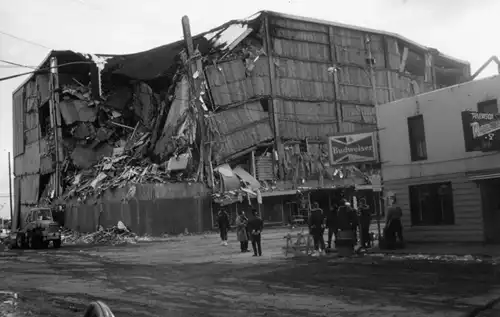
This Day in Alaska History-March 27th, 1964

Published

on

This Day in Alaska History-March 27th, 1964


The largest landslide in Anchorage occurred along Knik Arm between Point Woronzof and Fish Creek, causing substantial damage to numerous homes in the Turnagain-By-The-Sea subdivision. Courtesy of Wikipedia

J.C. Penney Department Store at Fifth Avenue and D Street, Anchorage District, Cook Inlet Region, Alaska, 1964. Courtesy of USGS

It was on this day in 1964 that a massive 9.2 earthquake in Southcentral Alaska.

The massive quake at 5:36 pm on March 27th caused much devastation throughout the region and generated a huge tsunami that inundated many communities in the region.

The quake was the largest in the history of the United States and initially killed 15 people while the resulting tsunami killed an additional 100 people in the new state and another 13 in California as well as five in Oregon.

Advertisement

The megathrust earthquake endured for four minutes and thirty-eight seconds and ruptured over 600 miles of fault and moved up to 60 feet in places.

The deadly quake occurred 15 and a half miles deep 40 miles west of Valdez and generated a ocean floor shift that created a wave 220 feet high.

As many as 20 other smaller tsunamis were generated by submarine landslides.


Source link

Advertisement
Continue Reading

Alaska

Opinion: Alaska’s public schools were once incredible. They can be that way again.

Published

on

Opinion: Alaska’s public schools were once incredible. They can be that way again.


(iStock / Getty Images)

I grew up greeting friends and neighbors on my walk to my neighborhood Anchorage public school, just as my kids do now. It’s an essential, and value-added, part of living in our community.

In the late 1990s, when I attended Service High School, I had amazing teachers. My AP chemistry teacher left the oil and gas industry to teach. He could have earned significantly more money in another field, but teaching was competitive enough, given pensions and compensation, that he stayed in the job he loved and gave a generation of students a solid foundation in chemistry.

Now, my kids, who are in first, third and fifth grade, face a different reality. Teachers across our state are leaving in droves. Neighborhood schools across Alaska are closing. Art and music are being combined, which is nonsensical — they are not the same and they are both valuable independently. When he was in second grade, my oldest had a cohort of more than 60 students in his grade — split between two teachers. When he enters sixth grade next year, there will be no middle school sports and he will lose out on electives. Support systems and specialists to help when kids are falling behind have been cut. I’m lucky that my children have had amazing teachers, but many excellent teachers are nearing retirement age or don’t have a pension and are pursuing other careers. What happens then?

Despite skyrocketing inflation, last year was the first time in years that our schools received a significant increase in the Base Student Allocation — and that money doesn’t begin to make up for what they have lost over the years. Even that increase had to overcome two vetoes from what a recent teacher of the year calls “possibly the most anti-public education governor in the history of Alaska.” Shockingly, my own representative, Mia Costello, despite voting for the increase, failed to join the override to support education. She has failed to explain that decision when asked.

Advertisement

State spending on corrections is up 54% since 2019; meanwhile, spending on education is up only 12% in the same timeframe. Schools are now working with 77% of the funding they had 15 years ago when accounting for inflation.

When we starve our public schools of funding, Alaska families leave. No one wants their child to suffer from a subpar education and the lower test scores and opportunities that come with it. A significant number of people are working in Alaska but choosing not to raise their families here.

To the elected officials who preach school “choice” but starve public schools: our family’s choice is our neighborhood school. It’s our community. It’s where our friends are. Neighborhood public schools, which are required to accept all children, should be the best option out there. Public schools should be a good, strong, viable option for communities and neighborhoods across our great state. Once, they were.

I am thankful for those in the Legislature working to solve these problems. This includes HB 374, which raises the BSA by $630, and HB 261, which would make education funding less volatile.

It breaks my heart that across the state, dedicated teachers keep showing up for our kids while being underpaid and undervalued. Underfunding our schools is also a violation of Alaska’s constitution, which requires “adequate funding so as to accord to schools the ability to provide instruction in the standards.”

Advertisement

Not so long ago, Alaska’s public schools were adequately funded, and they produced well-educated students and retained excellent teachers. It’s up to all of us to reach out to our elected officials and urge them to make that the case once again.

Colleen Bolling is a lifelong Alaskan and mother of three who cares deeply about Alaska’s schools.

• • •

The Anchorage Daily News welcomes a broad range of viewpoints. To submit a piece for consideration, email commentary(at)adn.com. Send submissions shorter than 200 words to letters@adn.com or click here to submit via any web browser. Read our full guidelines for letters and commentaries here.


Source link

Advertisement
Continue Reading
Advertisement

Trending