Alaska
Alaska's pristine rivers are turning a rusty orange even when seen from space, likely because of melting permafrost: study

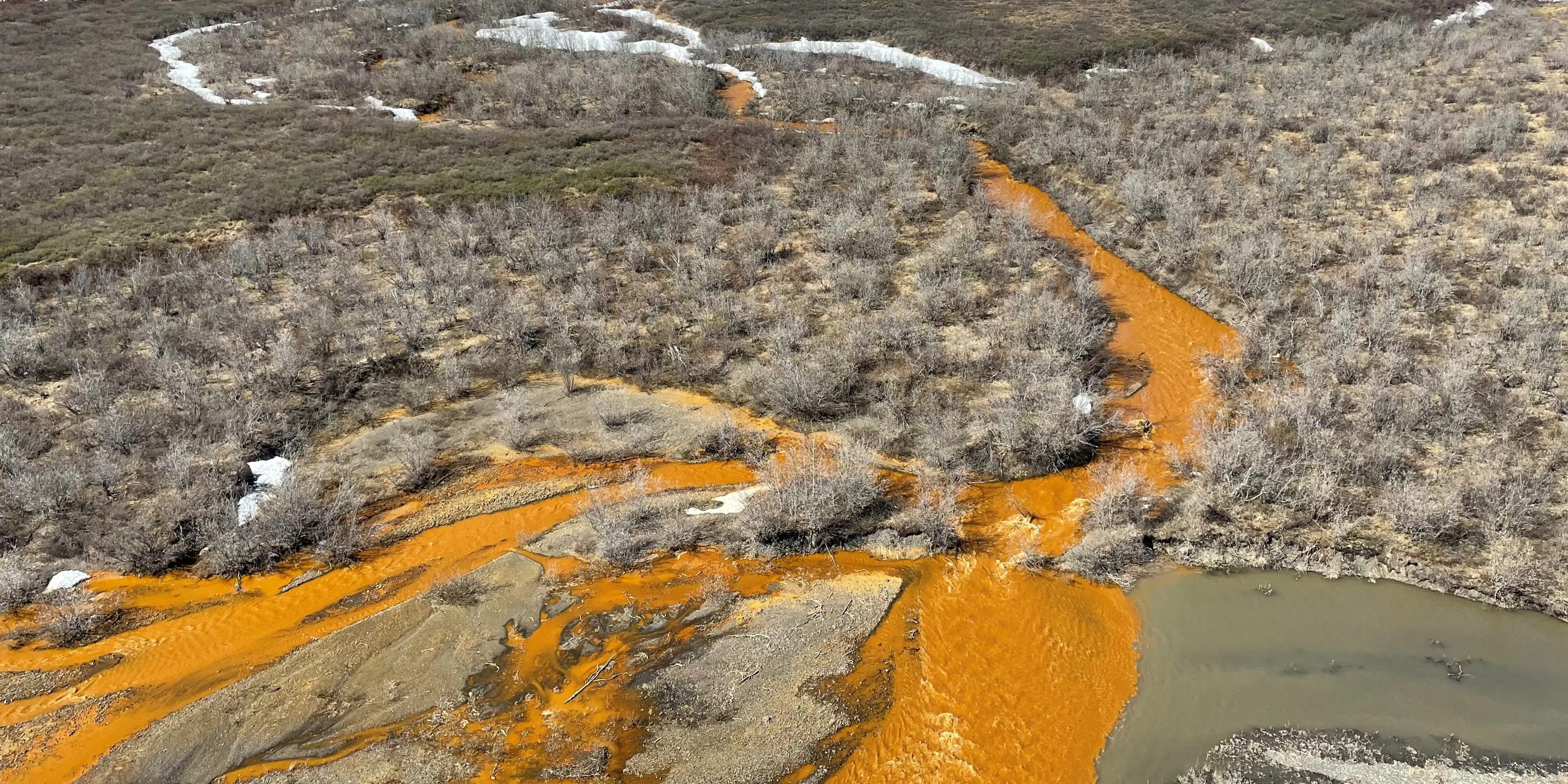
At least 75 of Alaska’s brooks and streams have been turning a dirty orange likely due to thawing permafrost, with some rivers so impacted that the discoloration can be seen via satellite, a new study says.
This phenomenon, which researchers say comes amid unusually rapid warming in the region, was first observed in the northwestern state in 2018, scientists told Business Insider’s Jenny McGrath in January.
The researchers have been stumped by it for years. But their findings, published Monday in the peer-reviewed Communications Earth & Environment journal, say that the waterways’ rusty color likely comes from minerals uncovered by the thaw.
Previously locked beneath Alaska’s permafrost, these minerals are now exposed to water and oxygen, causing them to release acid and metals like zinc, copper, iron, and aluminum, the study said.
The dissolved iron is thought to be the main culprit behind the “rusting” of the rivers, which typically occurs in July and August when the thaw is the most pronounced.
But the implications of the melt go far beyond color. These waters are becoming so acidic that some are registering pH levels of 2.6, or between the equivalent of the acidity of lemon juice and orange juice.
Pure water has a pH value of 7. Rivers and lakes typically have a pH value of 6.5 to 8, and acid rain has a pH value of 4.2 to 4.4.
Jon O’Donnell/National Park Service
“These findings have considerable implications for drinking water supplies and subsistence fisheries in rural Alaska,” researchers wrote.
They added that the region has already suffered the “complete loss” of two fish species due to the acidity: juvenile Dolly Varden trout and the Slimy Sculpin. Chum salmon and whitefish are also at risk of population decline, they said.
The changes could be devastating for indigenous tribes in the region, which rely heavily on fishing, researchers noted.
The 75 orange streams observed were scattered across northern Alaska over a span of about 600 miles, the study said. All of them were in remote areas, miles away from human activity that could impact land, such as roads or mining.
Researchers highlighted satellite images of the Agashashok River, a tributary of the Kuguroruk River, and the Anaktok Creek tributary of the Salmon River in northwest Alaska. They said all three have turned considerably redder in the summer months of the last 10 years.
Joshua Koch, US Geological Survey
Scientists warn that Alaska is warming at a rate two to three times the global average.
The Biden administration projected in November that the state would need an estimated $4.8 billion in infrastructure repair and adaptation over the next 50 years due to rising temperatures and damage from flooding, erosion, and permafrost thaw.
According to the administration’s multiagency report, Alaska’s fishing and tourism industries, which collectively provide more than 90,000 jobs and $2.57 billion in wages, are also at risk, with fish stocks expected to collapse and winter tourism likely falling.



The Alaska Senate plans to vote today on a new draft of a bill that would reduce taxes on the Alaska LNG project. It’s the last day of a special session Gov. Mike Dunleavy called to consider the issue.
Dunleavy and pipeline developer Glenfarne, which owns a 75% stake in the project, say a measure replacing a 2% annual property tax with a much smaller tax on gas throughput is essential to allowing the project to attract investors and court lenders. Dunleavy and Glenfarne applauded the version of the bill that passed the House a week ago.
The Alaska LNG project, estimated by the developer to cost up to $54.5 billion, includes an 807-mile pipeline, a conditioning facility on the North Slope to remove gas impurities such as carbon dioxide, and a liquefaction plant on the shores of Cook Inlet to export the gas to Asia. The project would be split into two phases: first, a shorter in-state pipeline to provide gas to Alaskans, and then the much more expensive — and much more lucrative — export infrastructure.
The Senate’s new draft retains many of the House’s provisions with some important changes.
Perhaps the most significant changes are to the project’s timeline: to be eligible for tax relief, the developer must commit to a final investment decision for the first phase by Jan. 1, 2028, and construction of the in-state pipeline would need to be complete by the end of 2032.
The House’s version required only that construction begin by Jan. 1, 2032.
The faster timeline is an effort to address Southcentral’s looming shortage of natural gas, said Sen. Bert Stedman, a Sitka Republican and a co-chair of the Senate Finance Committee. The Department of Natural Resources’ production forecast envisions demand outstripping Cook Inlet gas production by 2032, requiring producers to dip into storage.
“There’s been a lot of concern out of the Railbelt with the declining volume in Cook Inlet,” Stedman said.
But the more aggressive timeline sparked concerns from minority Republicans on the committee; it increases the risk on an already risky, marginal project, they said.
“That’s very damaging,” said Sen. Mike Cronk, a Tok Republican and the Senate minority leader. “There’s so many factors that we don’t control.”
Putting a “hard construction date” in the bill may be a “poison pill,” Cronk said.
Glenfarne and Gov. Mike Dunleavy did not immediately respond to requests for comment on the new version of the bill.
Stedman suggested future legislatures could revise the date to account for “unforeseen black swan events.”
“We can change these and modify these going forward,” Stedman said. “This is not in the Constitution, so I think there’d be some consideration under good faith trying to get the project constructed.”
The tax rate at the heart of the bill — the so-called alternative volumetric tax on gas flowing through the pipeline from the North Slope to Southcentral Alaska — would be fixed, rather than a weighted average tied to the cost of each component of the project.
The Senate draft sets the tax initially at 6.2 cents per 1,000 cubic feet of gas throughput, starting five years after gas begins to flow through the pipeline. The tax would take effect sooner if throughput reaches 500 million cubic feet per day, which is more than double what Southcentral Alaska uses now.
The tax would rise to 10.6 cents per 1,000 cubic feet once Phase 2 of the project, which includes the liquefied natural gas export facility, is up and running. The tax revenue from that mirrors what the Department of Revenue estimates the weighted tax that passed the House would yield.
The rates would rise between 1% and 3% each year, depending on inflation.
The House backed 30-plus years of tax breaks. Some senators were skeptical of that, so their version doubles the tax rate ten years after exports begin, then doubles them again in 2060.
The new bill retains key conditions for the tax relief included in the House’s version: the developer must commit to building a spur line to Fairbanks and negotiate project labor agreements with unions. It also includes up to $80 million in community impact funding for municipalities: $40 million due shortly after the final investment decision for each project phase.
It also includes House-passed price controls on in-state gas. Utilities would pay no more than $16 per million British thermal units, adjusted for inflation. That’s roughly $16.60 per 1,000 cubic feet, substantially higher than current Southcentral gas rates — about $10 — but likely cheaper than imported gas, according to Southcentral’s gas utility.
Also notable is an omission from the bill. It does not include a measure that had been under discussion that would subject large so-called S corporations and other pass-through entities in the oil and gas business, like LLCs, to the state’s corporate income tax.
Glenfarne, in its only comments so far on the new bill, urged lawmakers not to include that tax in the final version.
“If the Senate passes a bill with the proposed S Corp tax, it will introduce major hurdles for Alaska LNG to secure the right financing to build the project,” the company said in a statement provided by spokesperson Tim Fitzpatrick.
Senators are due to amend the bill and take a final vote later today.
The special session expires at midnight tonight, but Gov. Mike Dunleavy has already signed a proclamation calling another special session to begin Saturday.
Asked whether the new special session represented a contingency plan in an event the bill failed to pass, Dunleavy spokesperson Jeff Turner declined to say.
“We will see what happens,” Turner said.
This is a developing story. Check back for updates.

Alaska’s eight prettiest downtown strips sit in towns as different from each other as the landscapes around them. Skagway draws cruise ship visitors to its Gold Rush history. Sitka pairs Russian Orthodox history with totem-lined trails just beyond downtown. Wrangell is one of the oldest towns in the state. Each downtown is worth spending time in, though Sitka, Ketchikan, and Wrangell are the only ones on this list accessible solely by air or water. In winter, clear dark nights can bring Northern Lights over several of these towns. After a day out, fresh seafood is never far away.
Skagway
Skagway is located in Alaska’s panhandle and is known as the gateway to the Klondike Gold Rush and a major cruise ship destination. For those who love nature and history, visit Klondike Gold Rush National Historical Park and hike part of the 33-mile Chilkoot Trail, the historic route between Dyea, Alaska, and Lake Bennett, British Columbia. Backpackers can stay at designated campsites along the route, with permits required in season. For food, check out Skagway Brewing Company, which offers craft beers and American comfort foods. Another seasonal Skagway option is Salty Siren, whose menu features Alaskan golden king crab, seafood chowder, fish and chips, and pulled-pork sandwiches.
Sitka

Sitka sits on Baranof Island and is known for its rich Tlingit and Russian heritage, gorgeous outdoor scenery, and variety of wildlife. Sitka is only accessible by sea or air and is a popular stop on cruises. The area offers lots of outdoor activities, including fishing, hiking, and kayaking. Tourists like to visit St. Michael’s Russian Orthodox Cathedral, a National Historic Landmark whose original 1844-1848 building was reconstructed after a 1966 fire. For a short walk through Sitka’s layered history, visit Sitka National Historical Park, where visitors can enjoy a scenic coastal trail lined with totem poles. Grab a bite to eat at Beak Restaurant for delicious seafood. Or if you’re craving pizza or wings, visit Mean Queen for some comfort food.
Talkeetna
Talkeetna is a historic place in Alaska’s Matanuska-Susitna Borough, famous as a gateway to Denali, North America’s highest peak, which welcomes tourists and climbers from all over the world. Beginning as an Alaska Railroad headquarters, this historic location has an artistic vibe and a vibrant art scene despite its small population. Locals and visitors enjoy flightseeing, rafting, fishing, and delving into the unique history, including Stubbs, the late honorary cat mayor who held the ceremonial role until his death in 2017. For those hoping to see the Northern Lights, Talkeetna’s dark winter skies can be a good base when skies are clear and aurora activity is strong. Once you’re hungry, grab some friends and visit Homestead Kitchen for some traditional rustic options like burgers and flatbreads. Then grab a craft beer at Denali Brewpub in their rustic setting.
Homer
Found on the Kenai Peninsula, Homer is famous for its gorgeous views of Kachemak Bay, the Homer Spit, and distant volcanoes. Here’s a perfect spot for those hoping to see wildlife and enjoy other outdoor activities, like hiking and fishing. Across the bay, Kachemak Bay State Park is reached by water taxi or air taxi and offers views of the mountains and the ocean. Or head to Bishop’s Beach, which is dog-friendly, and enjoy the soft sand with your four-legged best friend. After experiencing the beautiful scenery of Homer, grab some dinner at the Twisted Goat and dig into some comfort food, including pizza, fish and chips, and burgers. On a nice day, visitors won’t want to miss a local favorite, Water Rudders, which offers a beautiful view from its patio.
Seward
Located about 120 miles south of Anchorage, Seward is a scenic port town at the head of Resurrection Bay. It’s loved for its beautiful views of the mountains, marine wildlife, and glaciers, and it serves as a gateway to Kenai Fjords National Park. Here, visitors can take a hike, join in on ranger-guided tours, kayak, and so much more. For those wanting an aerial view, Seward Helicopter Tours offers flights over glaciers and other beautiful sites. For those looking to camp, Waterfront Park offers RV and tent sites with views you can’t beat. After enjoying sightseeing, grab some seafood or steak at Ray’s Waterfront with a wood-paneled dining room overlooking the marina and mountains. Or get some comfort food at The Highliner Restaurant, where the menu includes crab cakes and fish tacos, just to name a few.
Ketchikan
Ketchikan is located on Revillagigedo Island in Alaska’s Tongass National Forest, known for its rich native culture, totem poles, and salmon fishing. The town is a popular cruise ship destination and is only accessible by boat or plane. Here, visitors can enjoy wildlife viewing, especially in the summer months. For a beautiful site, look into Misty Fjords National Monument and see sheer granite cliffs, towering 3,000-foot rock walls, deep saltwater fjords, and waterfalls within Tongass National Forest. Locals and visitors enjoy spending time at Creek Street, a historic boardwalk built on pilings over the creek, which is now filled with shops, cafes, and galleries. Grab a bite to eat at The Alaska Fish House with beautiful views out the window and live music. Or order crab and seafood at Ketchikan Crab & Go, a seasonal spot at Salmon Landing that caters to the cruise-season crowd.
Valdez
Found in Southcentral Alaska, Valdez is known for its stunning mountain views, water scenery, and being the southern terminus of the Trans-Alaska Pipeline. This former Gold Rush town is a popular destination for fishing, glacier tours, and wildlife viewing, and is accessible via the Richardson Highway from Anchorage and Fairbanks. For shore views of icebergs and the face of Valdez Glacier, head to Glacier View Park at the end of Airport Road. For an easy family-friendly outing near town, try Dock Point Trail, a short coastal loop with ocean and Duck Flats views. In summer, The Potato serves handmade comfort food and beer or wine from its harbor-view location in Valdez. Or get some pizza or fish and chips at The Fat Mermaid. It has a laid-back setting and views of the marina.
Wrangell
Wrangell is found in Southeast Alaska, located on Wrangell Island in the Inside Passage, and is known for its Tlingit culture, variety of wildlife, and access to the Stikine River. This is one of Alaska’s oldest towns and offers plenty of outdoor activities like hiking, glacier exploration, and fishing, and is only accessible by air or the Alaska Marine Highway. Anan Wildlife Observatory is a must-visit to see bears, both black and brown, who call it home. You’ll have to take a boat or a floatplane to get there. Access the Stikine River from Wrangell for more wildlife viewing. For food, try Filipino, Thai, sushi, and other Asian dishes at Michelle’s Taste of Asia, a casual, family-run restaurant. Or grab pizza at Hungry Beaver Pizza and Marine Bar by Wrangell’s Inner Harbor.
These eight towns show a side of Alaska that operates at a different pace from the state’s most visited destinations. The downtowns are small, the history runs deep, and the wildlife has a way of showing up whether you plan for it or not.

Alaska Airlines has given its chief financial officer, Shane Tackett, another responsibility — president.
Tackett will assume his additional role at the SeaTac-based airline on June 29, according to a news release Wednesday.
Tackett will continue leading the organization’s finance, fleet management, investor relations, supply chain, internal audit and information technology functions, according to the release. His new responsibilities as president include oversight of Alaska Airlines’ commercial division.
Tackett previously held positions in labor relations, e-commerce and financial planning at the company, according to his LinkedIn profile.
“I started at Alaska more than 25 years ago, and over that time we’ve built a stronger, more resilient airline with a clear strategy for the future,” Tackett said in a statement.
He said he is excited to lead more of the organization in his new role and deliver to guests, employees and owners.
In a statement, Alaska Airlines CEO Ben Minicucci said Tackett has led the company through challenges and helped it grow over his 25-year tenure.
“Bringing commercial and finance leadership together under Shane will strengthen alignment and accelerate our priorities as we continue advancing our strategy and creating long-term value for our stakeholders, said Minicucci, who also serves as CEO and president of the airline’s parent company, Alaska Air Group.
Tackett’s promotion comes as the airline navigates challenging macroeconomic factors, including rising fuel costs and weakening consumer demand for travel.
Alaska Air Group — which includes Alaska and Hawaiian Airlines, as well as regional carrier Horizon Air and ground support company McGee Air Services — saw its profits drop 70% in 2025 year over year. It continued to face financial woes in 2026.
The company lost $193 million in the first three months of 2026 as it dealt with skyrocketing jet fuel prices due to the war in Iran.
-

 Kentucky6 minutes ago
Opinion – Caleb Franz: Cassiuis Marcellus Clay – Kentucky's original free speech champion
-

 Louisiana9 minutes ago
Talent, fitness honors awarded on Preliminary Night 2 of Miss Louisiana
-

 Maine14 minutes ago
Local control is holding education back in Maine | Opinion
-

 Maryland21 minutes ago
Maryland Lottery Mega Millions, Pick 3 results for June 19, 2026
-

 Michigan23 minutes ago
Defenseman Cam Reid commits to Michigan
-

 Massachusetts29 minutes ago
Fisherman reels in white shark off Massachusetts, then snags the hook from its toothy mouth
-

 Minnesota36 minutes ago
Lynx rally with defense to down Golden State for 11th win in 12 games
-

 Mississippi38 minutes ago
Mississippi Lottery Mississippi Match 5, Cash 3 results for June 19, 2026

