West
Actor James Woods recalls chaotic moments as Palisades fire gained momentum, praises 'good' neighbors for help

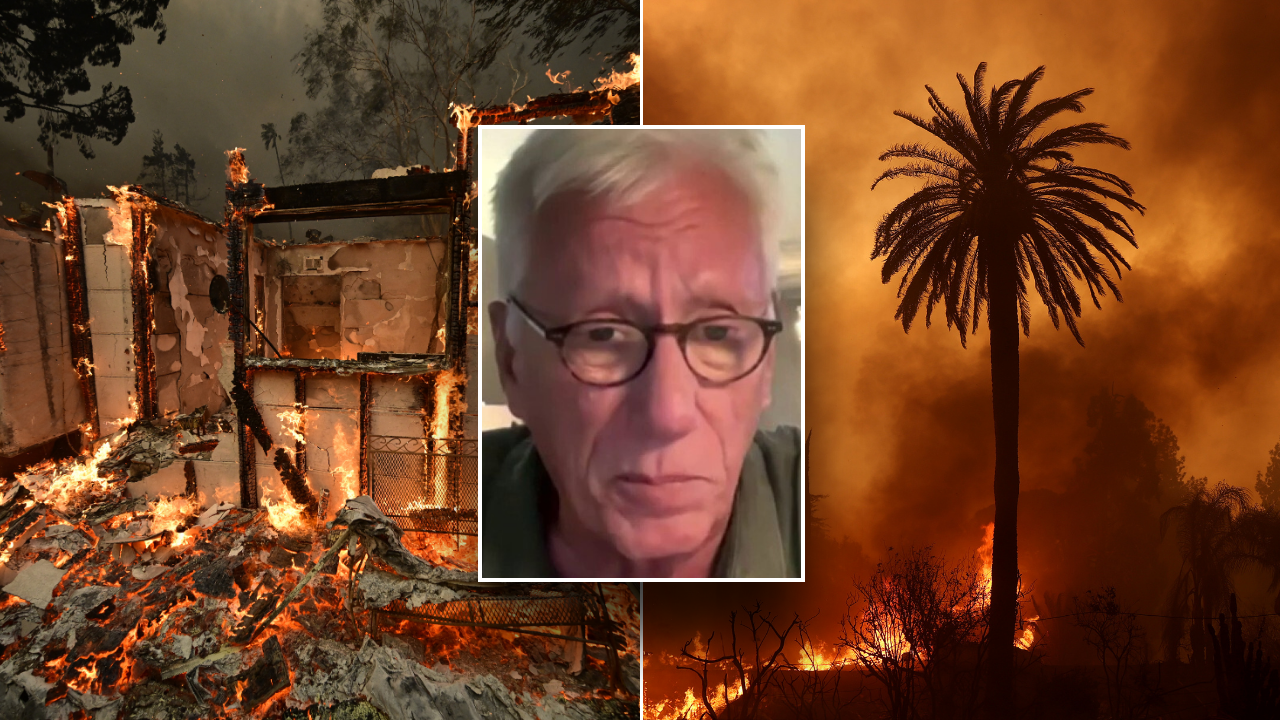
Actor James Woods recalled the chaotic moments Tuesday afternoon in Pacific Palisades as a deadly wildfire began sweeping across his neighborhood, destroying home after home.
Woods and his family fled their house as the flames inched closer and closer. He’s unsure if his house is still standing but told “The Ingraham Angle” Wednesday “it’s possible.”
“It’s astonishing that what happened during this experience was that we found out that none of us is a celebrity. None of us is a poor person or a rich person, a Democrat or a Republican. We were just neighbors, just really helping each other,” said Woods.
RAGING PALISADES FIRE DESTROYS HIGH SCHOOL FEATURED IN MULTIPLE HOLLYWOOD FILMS
A structure burns during the Palisades Fire in the Pacific Palisades neighborhood of Los Angeles, California, US, on Tuesday, Jan. 7, 2025. Uncontrolled wildfires tore through parts of the Los Angeles region, fanned by extreme winds, forcing thousands of residents to flee and grounding firefighting aircraft. Photographer: Kyle Grillot/Bloomberg via Getty Images
The multiple-time Emmy Award winner added that his neighbor ran over to his house after he and his family had evacuated to try and stop the flames from coming onto his deck, even staying overnight to fight the blaze.
“It was an extraordinary experience of realizing how essential good neighbors, good friends, good relative[s] [are],” said Woods.
His neighbor told him Wednesday morning that the houses to the left and right of him had burned down, as well as “every house” across the street, but Woods’ roof was still visible.
PHOTO GALLERY: PALISADES FIRE BEFORE AND AFTER
A fire-damaged Bank of America branch is seen after the Palisades Fire swept though in the Pacific Palisades neighborhood of Los Angeles, Wednesday, Jan. 8, 2025. (Eugene Garcia/AP)
Officials estimated Wednesday morning that more than 1,000 structures had burned as the wildfire continues to besiege Los Angeles County.
Woods told Fox News host Laura Ingraham he saw a firetruck parked in front of his house as the blaze started growing, but the firefighters couldn’t pump any water because “there was none.”
Erik Scott, the public information officer for the Los Angeles Fire Department, acknowledged in a post on X that there were indeed challenges with regard to water pressure.
“LADWP [Los Angeles Department of Water and Power] proactively filled all available water storage tanks, including three 1-million-gallon tanks located in the Palisades area,” Scott wrote. “However, water availability was impacted at higher elevations, which affected some fire hydrants due to limited replenishment of water tanks in those areas. The extreme demand caused a slower refill rate for these tanks which created a challenge for our firefighting effort.”
An airtanker made a drop on the Palisades Fire. (Brian van der Brug / Los Angeles Times via Getty Images)
Woods called out California Gov. Gavin Newsom for his alleged fire mismanagement and said the ongoing aftermath of the wildfire is more than a “wake-up call.”
“If it is true that things were handled this way. If it is true that Gavin Newsom is the absolute blithering idiot that I believe he is in the way he has handled fire management in this state again and again and again and again, this isn’t a wake-up call. This is the kind of thing they have tribunals for – where they try people and say, you had an oath of office to perform certain duties,” said Woods.
“When you’re the fire chief, this isn’t a social justice exercise that you’re in charge of. This is you getting water to areas that need water because there are fires in hundred-mile-an-hour winds burning houses to the ground.”
Read the full article from Here


MISSOULA, Mont. — The University of Montana officially welcomed Dr. Jeremiah Shinn on Tuesday as the university’s 20th president.
Shinn’s tenure begins July 1.
“It’s my goal to lead UM in a way that makes this state proud,” Shinn said. “Together, we will build on our strengths to make UM even more aligned with the needs of students and the realities of today’s workforce.”
He joins the university after serving as interim president of Boise State University, where he led efforts aimed at enhancing student engagement, strengthening campus partnerships and expanding access to affordable education opportunities for students.
“President Shinn is a proven leader whose commitment to the success of students is unwavering,” said Clayton Christian, Montana commissioner of higher education. “He is a strong addition to the Montana University System, and I am confident he will maintain UM’s positive momentum while also steering the institution in new ways that will serve our state.”
The following was sent out by the University of Montana:
The University of Montana today officially welcomed Dr. Jeremiah Shinn as the 20th president of the flagship institution.
Shinn’s tenure leading UM begins July 1.
“It’s my goal to lead UM in a way that makes this state proud,” Shinn said. “Together, we will build on our strengths to make UM even more aligned with the needs of students and the realities of today’s workforce.”
Shinn joins UM after a successful tenure as the interim president of Boise State University, where he led efforts to enhance student engagement, strengthen campus partnerships and expand access to affordable education opportunities for students.
“President Shinn is a proven leader whose commitment to the success of students is unwavering,” said Clayton Christian, Montana commissioner of higher education. “He is a strong addition to the Montana University System, and I am confident he will maintain UM’s positive momentum while also steering the institution in new ways that will serve our state.”
Shinn takes the helm at UM during an important time, as the University prepares to welcome the class of 2030 to campus next month.
“Our students deserve a university built for the world they’re entering, not the one we’re leaving behind,” Shinn added. “At a time when the value of higher education is being questioned, UM will meet this moment. Not with arguments, but with proof. In our work, in our graduates and in our service to Montana.”
Prior to serving as Boise State interim president, Shinn was vice president for student affairs and enrollment management. He also served as vice president for student affairs at Louisiana State University. Shinn earned a Ph.D. from Eastern Michigan University, a Master of Arts from the University of Michigan and a Bachelor of Science from Arkansas Tech University.

A Tesla Semi was involved in its first known fatal crash, killing two people on U.S. 50 in Nevada on Sunday morning.
The driver of the Class 8 electric truck reportedly fell asleep before rear-ending two passenger vehicles stopped at a red light, according to preliminary statements from investigators.
What happened on US-50 in Dayton
At around 7:20 a.m. on Sunday, June 28, deputies from the Lyon County Sheriff’s Office responded to a major collision at the intersection of U.S. 50 and Traditions Parkway in Dayton, Nevada, east of Carson City.
A semi-truck struck two passenger vehicles that were stopped at the traffic signal, according to the Nevada Highway Patrol and Lyon County Sheriff’s Office. Two people were pronounced dead at the scene, and a third person was flown by Care Flight to a local hospital with life-threatening injuries.
The couple killed were identified by family as Sergio “Boo” and Jennifer Villanueva, who were stopped westbound at the light when they were hit from behind. The two were known locally for volunteering with the Boxers and Buddies dog rescue.
“Preliminary statements obtained at the scene suggest the driver of the truck might have fallen asleep,” the Lyon County Sheriff’s Office said. The Nevada State Police Highway Patrol is investigating.
The truck was a Tesla Semi
Local outlets, including the Reno Gazette-Journal and KOLO, described the vehicle only as a “semi-truck,” and the Nevada Highway Patrol has not officially released the make.
However, images from the scene clearly show a Tesla Semi — the distinctive center-seat, cab-forward tractor — pulling a white dry-van trailer. The identification was first flagged by FreightWaves’ Timothy Dooner.
That makes this the first known fatal crash involving Tesla’s electric semi truck. Tesla builds the Semi at its new high-volume production line at Gigafactory Nevada, a 1.7-million-square-foot plant located near Sparks, roughly an hour from the crash site. Tesla operates its own fleet of Semis out of the factory, and the truck’s location on U.S. 50 is consistent with that operation, though the operator has not been confirmed.
Tesla only began ramping customer deliveries of the Semi in 2026 after years of delays, with fleets like DHL and California port drayage operators taking early units. There are still only a few hundred of the trucks on the road, which makes a fatal crash involving one a notable first for the program.
No self-driving — and the emergency braking question
The reported cause — a driver falling asleep — puts the focus on the truck’s safety systems, not any self-driving software. Tesla does not offer Full Self-Driving on the Semi. Both production trims are listed as “designed for autonomy,” but the feature is still in testing: a Tesla Semi was spotted in California carrying FSD test hardware just three days before the crash, running without a trailer near Tesla’s engineering facilities. In other words, the driver was in full manual control.
That leaves the question of automatic emergency braking: why didn’t the truck slow or stop itself before hitting stationary vehicles at a lit intersection? AEB is designed for exactly this scenario — it detects vehicles or obstacles in the truck’s path and applies the brakes when a collision is imminent, regardless of driver input.
Most modern Class 8 trucks are already equipped with collision-mitigation systems from suppliers like Bendix and Detroit Assurance, and U.S. regulators have a proposed rule that would mandate AEB on all new heavy trucks, requiring them to fully stop for other vehicles at speeds up to 62 mph.
Tesla originally said the Semi comes with Enhanced Autopilot as standard and uses “the same camera set” as its passenger vehicles — the hardware that runs Automatic Emergency Braking as standard on the Model 3 and Model Y, braking for obstacles at speeds between roughly 3 and 124 mph. It has also said the Semi’s independent motors and wheels have active controls designed to prevent jackknifing. But Tesla has never published a Semi-specific active-safety spec, and it is not clear whether the truck’s forward-collision braking behaves the same way as in its cars, or whether it engaged before the crash.
Tesla did not immediately respond to a request for comment.
Tesla already builds drowsiness detection — into its cars
Fatigue-detection technology is increasingly common in commercial trucking, but it remains an option rather than a standard or federally required feature. Most systems use an AI driver-facing camera that watches for prolonged eyelid closure, yawning, and head-nodding, then alerts the driver in real time. Fleets buy them from vendors like Netradyne, Lytx, Samsara, and Seeing Machines, and truck makers offer them as options — Detroit Assurance 5.0, for example, includes a driver-facing camera that ties into Bendix SafetyDirect.
Adoption is climbing fast among large carriers, and the FMCSA is evaluating whether to require fatigue monitoring for interstate trucking. Drowsy driving is a factor in an estimated 6,000 fatal crashes a year in the U.S., according to AAA Foundation research.
Tesla is arguably ahead on this — in its cars. The company rolled out a “Driver Drowsiness Warning” in 2023 that uses the cabin-facing camera to detect yawns and blinks and warn the driver, activating above 40 mph with Autopilot disengaged. Tesla has not said whether the Semi has a cabin-facing camera or the same feature — a notable gap for a truck reportedly involved in a fatal crash because its driver fell asleep.
But the system is also notoriously easy to game.
Electrek’s Take
This is a tragic story, and the first thing to say is that two people are dead and a third is fighting for their life. Our condolences go to the Villanueva family.
It’s also important to be precise about what this is and isn’t. This was not an autonomous driving crash. Tesla does not offer Full Self-Driving on the Semi — it’s still test-fleet hardware, spotted validating sensors in California just days earlier — so the driver was likely in full manual control. A driver falling asleep is a human-fatigue failure, not a software one, and anyone folding this into the FSD debate is confusing the story.
The real question here is about active safety. If a driver falls asleep and a truck plows into cars stopped at a red light, automatic emergency braking is the last line of defense that’s supposed to prevent a fatality — and it’s a system the entire trucking industry is moving toward mandating. Tesla originally said that the Semi ships with Enhanced Autopilot, but that was back when it unveiled the vehicle. Since entering production, Tesla has been quiet about the autonomous features its first commercial vehicle.
Tesla Semi is equipped with the same cameras that give its cars standard AEB, but it has never spelled out whether the truck’s forward-collision braking works the same way. Given that Tesla ships AEB on every car it sells, you’d expect the Semi to have an equivalent or better system. Whether it engaged here is a question that should get answered as the investigation proceeds.
If you’re powering an EV — or an entire fleet — home solar is one of the smartest ways to lock in low energy costs. With electricity rates climbing nearly 10% last year, home solar protects you against future rate increases. And with lease and PPA options, you can go solar with zero upfront cost and start saving immediately. If you want to find the best deal, check out EnergySage. It’s a free service with hundreds of pre-vetted installers competing for your business, so you save 20 to 30% compared to going it alone. No sales calls until you pick an installer. Get your free quotes here.

FTC: We use income earning auto affiliate links. More.

As I sit in an Albuquerque auditorium at the 3rd Annual New Mexico Draggy Awards, surrounded by drag queens, kings, and everyone in between, I find myself wiping away tears for the second time that evening.
New Mexico transgender advocate Bunnie Cruse is standing on the stage giving out an award for activism, and she calls Democratic U.S. Congresswoman Melanie Stansbury to the stage.
“Your existence is an act of resistance; an act of resilience and fuck Trump!” shouts Stansbury from the stage while wearing a black and white dress and a beat-up pair of red Converse. Fans clack, and the crowd erupts in cheers.
Related: Dispatches from Route 66: How queer communities are rebuilding safety along the Mother Road
Albuquerque: Where hope took the stage
Stansbury then quotes an invocation she heard earlier that week at the opening of the Obama Presidential Center: “Hope is a call to action. Resilience is a call to action. Change is a call to action, and continuing to fight for our democracy is a call to action.”
Hope radiates from the stage. I’m just passing through New Mexico, yet I find myself feeling seen by an elected official in a way I rarely do back home in Ohio.
Less than 24 hours earlier, I had been in Amarillo listening to transgender people describe contingency plans for their families if one of them were detained. Now, in Albuquerque, a member of Congress stood onstage at a drag awards ceremony celebrating the very community that had been living in fear just one state away.
My third week on Route 66 searching for the Mother Road’s LGBTQ+ story, past, present, and future became a study in what hope looks like when communities feel safe enough to be visible. To better understand why Albuquerque felt so different, I sat down with leaders from Bold Futures, a statewide advocacy organization for women and people of color.
A museaum display in Albuquerque, New Mexico.Alysse Dalessandro for The Advocate
“I think that’s one of the most beautiful things about organizing with folks is that they don’t even know about their brilliance until they’re given a safe place to sort of feel some softness and have some space,” shares Bold Futures Executive Director Charlene Bencomo.
That emphasis on safety is intentional. Bold Futures has been organizing for these marginalized voices since its founding in 1999, and its community-driven approach reflects New Mexico as a whole.
“New Mexico is a really unique place, and I think it is because of the culture and the heritage that we have,” says Bencomo. “We are more community-driven than individualistic a lot of times. We move in community. So when we’re taking a story to a decision-maker, we’re not just saying, ‘Here are the statistics, this is the bottom line.’ We’re saying, ‘Here are the statistics, here’s the bottom line, and here are the people who are going to tell you about what it looks like in their neighborhood.’”
Charlene Bencomo’s words that New Mexicans “move in community” stuck with me during my four days in Albuquerque. By the end of my time there, I understood exactly what she meant.
Related: Dispatches from Route 66: Discover the queer stories hidden along the iconic road trip
Pride written into the road
The more time I spent in Albuquerque, the more I realized that resistance was woven into the fabric of New Mexico. During a Route 66 History Tour in the city, I learned that long before Route 66 reached the city, New Mexico had already fought to preserve its identity by resisting pressure to rename the territory during its path to statehood.
Just 14 years after becoming a state, Route 66 cut through the heart of town. Today, that same stretch of Central Avenue continues to tell Albuquerque’s story. Unlike many places I’d visited along Route 66, here you don’t have to dig through museums or archives to find its LGBTQ+ history. It’s painted directly onto Historic Route 66 in the form of rainbow crosswalks.
Writer Alysse Dalessandro standing at the Route 66 sign in Albuquerque, New Mexico.Alysse Dalessandro for The Advocate
I learned that these crosswalks commemorate the city’s first Pride March, when 25 University of New Mexico students marched from Morningside Park to the intersection of Morningside Drive and Central Avenue in 1976.
To this day, Albuquerque’s Pride march still traverses Route 66 down Central Ave. Each year, Bold Futures hosts a Family Pride in Morningside Park. For the organization’s 15th Family Pride, they themed it around a Quinceañera Fiesta, intentionally weaving Pride into this Mexican cultural tradition.
“We have all the cultural staples but then make them part of Pride,” shares Bold Futures Deputy Director Heather Smith. “So now you’re also exposing people who are there, who are not familiar with those cultural traditions; they’re learning them, and it’s a cultural exchange.”
Rather than asking LGBTQ+ people to choose between their cultural and queer identities, Family Pride celebrates both at once and invites the broader community to learn alongside them.
Route 66 hasn’t just been a gathering place; it has also long been a place where LGBTQ+ travelers searched for safety, sex, and community. A 1977 edition of Bob Damron’s Address Book, a national gay travel guide, listed the stretch of Central Avenue from the University of New Mexico to the area near The Loon as a cruising spot.
Old Downtown Albuquerque.Alysse Dalessandro for The Advocate
The queer-tolerant hotels such as the Alvarado Hotel and the Franciscan that once lined Central Ave are gone, but new hotels are still filling that need. Although the Bob Damron Address Book is no longer the go-to resource for LGBTQ+-friendly places to stay, the intention behind this book’s existence is still something I use on my own travels.
While looking for safe places to stay along Route 66 as a queer traveler, I used the Booking.com Travel Proud filter to find accommodations in Albuquerque. This allowed me to see only results for hotels that have completed Booking.com’s LGBTQ+ hospitality training. It led me to Hotel ZAZZ, a woman-owned boutique hotel along Route 66. Here was another place where I felt safe and seen.
The “other” Route 66
This visibility continued when I visited the Albuquerque Museum exhibit: The Other Route 66: 100 Years of People, Identity, and Place in Albuquerque. While other museums mostly idealized Route 66, this exhibit intentionally sought out the narratives most often ignored, presumably for their discomfort: the migrant experience, the exoticism of Indigenous communities, and the dangers for Black travelers, to name a few.
Once I reached a sign that read “The ‘Other’ Route 66,” I finally found my own visibility. Museum after museum, I felt erased and othered, but here was finally a visible inclusion of the LGBTQ+ experience on display in a Route 66 exhibit. The small display included 3 reproductions of ads for Central Ave’s gay clubs, a Pride route map, and a recent photograph from a local Pride. It was not much, but it was something.
Preservation as Resistance
At the Arizona Route 66 Museum in Kingman, I learned about Angel Delgadillo, the Seligman barber whose efforts are widely credited with launching the preservation movement that saved Route 66 from fading into history. After Interstate 40 bypassed Seligman and Route 66 was officially decommissioned in 1985, Delgadillo noticed visitors still going out of their way to stop at his barbershop to reminisce about the Mother Road. He decided to do something about it.
As I listened to the story of Route 66’s preservation, I realized it wasn’t really about saving a highway. There was a faster way to cross the country. Preserving Route 66 was about preserving the stories that gave it meaning. It was about refusing to let a community disappear. It’s Andie Smith showing up to the Edwardsville Town Square every Friday. It’s Steve Blundell buying the District Hotel. It’s Chief Egunwale Amusan creating the Real Black Wall Street Tour. It’s me driving more than 3,000 miles to document the LGBTQ+ history of Route 66 before more of it disappears. Different communities. Different histories. The same determination to refuse erasure.
Klingman, Arizone Route 66 sign.Alysse Dalessandro or The Advocate
Delgadillo rallied fellow business owners to secure historic recognition for Route 66, founding the Historic Route 66 Association of Arizona and creating a preservation model that communities along the Mother Road continue to follow today.
“If Angel Delgadillo and these other rallying people had not fought for their communities and for Route 66, it would just have remained forgotten about, “ Katie Barthlow, a communications specialist for the Historic Route 66 Association of Arizona, told me.
One of the Historic Route 66 Association of Arizona’s former officers is an out gay man. I didn’t have the opportunity to interview him during this trip, but learning he had helped preserve Route 66 left me wondering how many other LGBTQ+ people had quietly shaped the Mother Road without becoming part of its public history.
The Arizona Route 66 Museum doesn’t yet answer that question. But museum leadership readily acknowledged that LGBTQ+ history belongs in the story of Route 66 and that uncovering it will require the kind of archival research and community connections that have shaped my own journey. Alongside exhibits on the Green Book, the class struggles of the Dust Bowl migration, and the contributions of Asian Americans like restaurateur Charlie Lim, the museum paints a broader picture of who shaped the Mother Road, even if that work isn’t finished yet.
Making space to be seen
Kingman’s Route 66 history is thoroughly documented. Its LGBTQ+ history is far less visible. Unlike Flagstaff, where Pride flags lined storefronts, I had to search much harder for signs of queer community in Kingman.
I found Gideon Freeman, owner of The Bearded Baker, sitting beneath a Progress Pride flag hanging outside his garage-turned-home bakery. He tells me about how he helped to bring the first Mohave Pride to Kingman in 2019. Their first Pride event saw more than 3000 attendees. For him, Kingman’s lack of LGBTQ+ visibility isn’t about lack of support but a lack of space.
“We just need more space here to connect,” says Freeman. “There’s a lot of us here, we just don’t see each other very often. So we’ve been trying to build that community.”
Freeman directed me to Feral Tattoo, where I expected their regular Wednesday art night but instead found a group gathered around a table discussing voter education and sharing stories about life as LGBTQ+ people in town.
Just as Angel Delgadillo realized preserving Route 66 would depend on ordinary people taking action, I’ve found the same is true of the LGBTQ+ community along the Mother Road. In places with fewer dedicated resources, that work often falls to individuals like Feral Tattoo’s owner, Willow Kroenke, who are willing to make themselves visible.
Kroenke told me that being visibly queer has made them fear for their family’s safety, but they also don’t know how to build community without that visibility.
“I think if there was any lesson in Route 66, it would be to look at the people that have been fighting for equal rights for the last hundred years,” says Kroenke. “I look at what the Black Panthers did with the Rainbow Coalition. When I don’t know what to do, I make kids breakfast because that’s what they did. When I don’t know what to do, I bring my friends flowers because that’s what Marsha did.”
Listening to Willow, I found myself crying in a tattoo shop in Kingman. Three weeks earlier, I had set out looking for the hidden LGBTQ+ history of Route 66. By the time I reached Arizona, I realized that history doesn’t preserve itself. It survives because ordinary people choose to carry it forward: for their neighbors, for their communities, and for those who come after them by refusing to let the stories of those who came before disappear. That, more than anything, has been the story of Route 66.
-

 Illinois4 minutes ago
Illinois Product Farmers Market Highlights Local Flavors and Family Traditions
-

 Indiana11 minutes ago
2 Indiana men plead guilty in Montana oxycodone conspiracy case
-

 Iowa14 minutes ago
Iowa’s governor and her family on weeklong tour of Iowa tourist sites – Radio Iowa
-

 Kansas19 minutes ago
New mural to be unveiled Thursday afternoon in North Topeka
-

 Kentucky26 minutes ago
Former Northern Kentucky school bus driver sentenced in child pornography case
-

 Louisiana28 minutes ago
Audit finds barriers hinder Louisiana WIC enrollment – American Press
-

 Maine34 minutes ago
How to safely enjoy the water in Maine as temperatures rise
-

 Maryland41 minutes ago
Rep. Glenn Ivey, Community Members Discuss Gun Violence Solutions

