Sports
Why Olympic distance runners might be flocking to Flagstaff ahead of L.A. Games

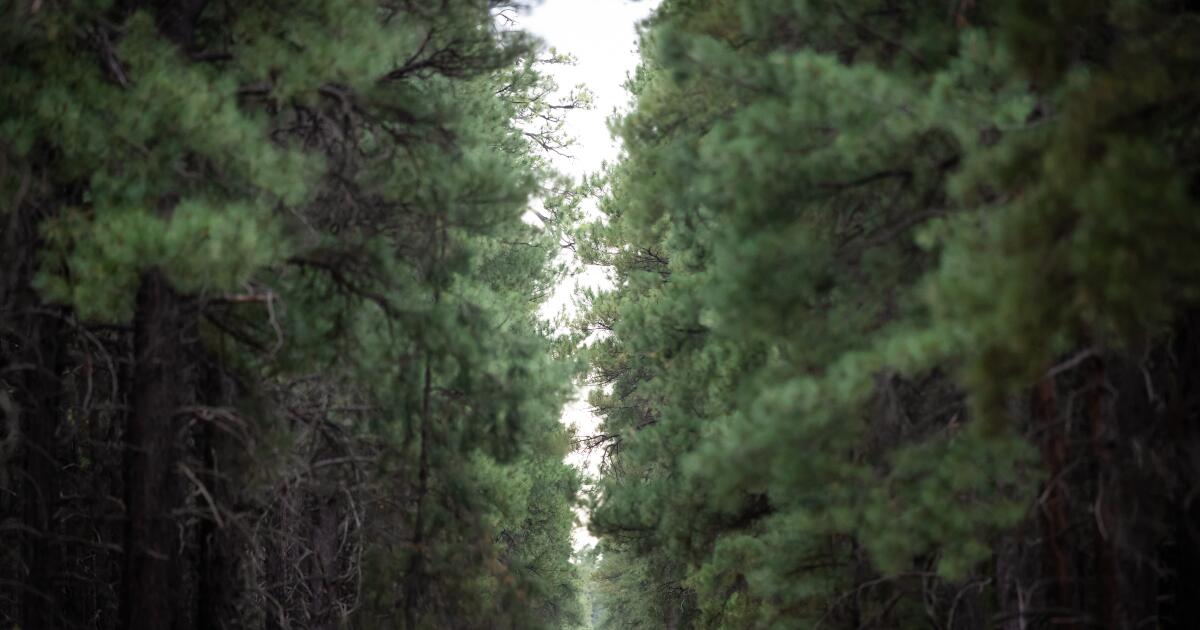
For centuries the snow-capped San Francisco Peaks, which tower over the high desert of northern Arizona, have held sacred meaning for more than a dozen Native American tribes.
To the Navajo “the summit that never melts” was a place where deities lived. For the Hopi, the mountains provided life-giving rain and spiritual sustenance while the Havasupai’s creation story is centered on the four peaks, which they believed were at the center of the earth.
The mountain tops are no less divine to some who live in their shadows today. For decades, endurance athletes have been making the pilgrimage to Flagstaff, at the southern edge of the Colorado Plateau, to live and train in the rarefied air more than a mile and a quarter above sea level. And the results have been breathtaking.
“For a distance runner, there’s no place in the world like Flagstaff,” said Matt Baxter, who broke New Zealand’s national indoor record at 5,000 meters after moving to Arizona.
More than 240 Olympians and Paralympians made the winding two-hour drive up Interstate-17 from Phoenix to Flagstaff to train at altitude on their way to the Tokyo Games three years ago. Among them were Norway’s brash 1,500-meter champion Jakob Ingebrigtsen; American marathon medalist Molly Seidel; Zac Stubblety-Cook, the only Australian male to win a gold medal in swimming; and French triathlon medalist Vincent Luis.
2024 Paris Summer Olympic Games
That doesn’t include the four dozen or so world-class athletes who live and train in Flagstaff for much or part of the year. And the number of Olympians who either lived or trained in Flagstaff before going to Paris this month — a list that includes U.S. distance runners Nico Young, Grant Fisher and Woody Kincaid plus Guatemalan national record-holder Luis Grijalva — could be even larger.
“It’s been the busiest year ever,” said Dan Bergland, a sports physiologist with HYPO2, a sports management organization that helps arrange training camps in Flagstaff for national teams and individual international athletes.
Sitting at a table inside a Whole Foods near the Northern Arizona University campus, a space he considers his office, Bergland ticked off a list of visitors during what was just an average spring week.
“I have Norwegian athletics. I have Canadian athletics, Canadian triathlon,” he said. “Israel and Hong Kong swimming just left two days ago. Olympians from Belgium, Austria, just all over the place.”
That has given the sleepy college town of 75,000, once known primarily as the gateway to the Grand Canyon, a hand in producing what is probably the highest number of Olympic athletes per capita of any city in the world. The secret is in Flagstaff’s thin air, which carries less oxygen. That forces the body to adapt by producing more oxygen-rich red blood cells, cells the athletes take with them when they return to lower levels, boosting performance by 1% to 2%.
Altitude training can improve an athlete’s maximal oxygen consumption, or VO2 max, and lessen the effects of fatigue.
“For athletes who don’t want to cheat, altitude training is one of the unique ways to enhance a training response and improve the blood volume and red cell mass in particular,” said Dr. Benjamin Levine, professor of internal medicine at UT Southwestern and director of Texas Health Dallas’ Institute for Exercise and Environmental Medicine. “When the difference between winning a gold medal and even making the final is fractions of a percent, that can make a difference.”
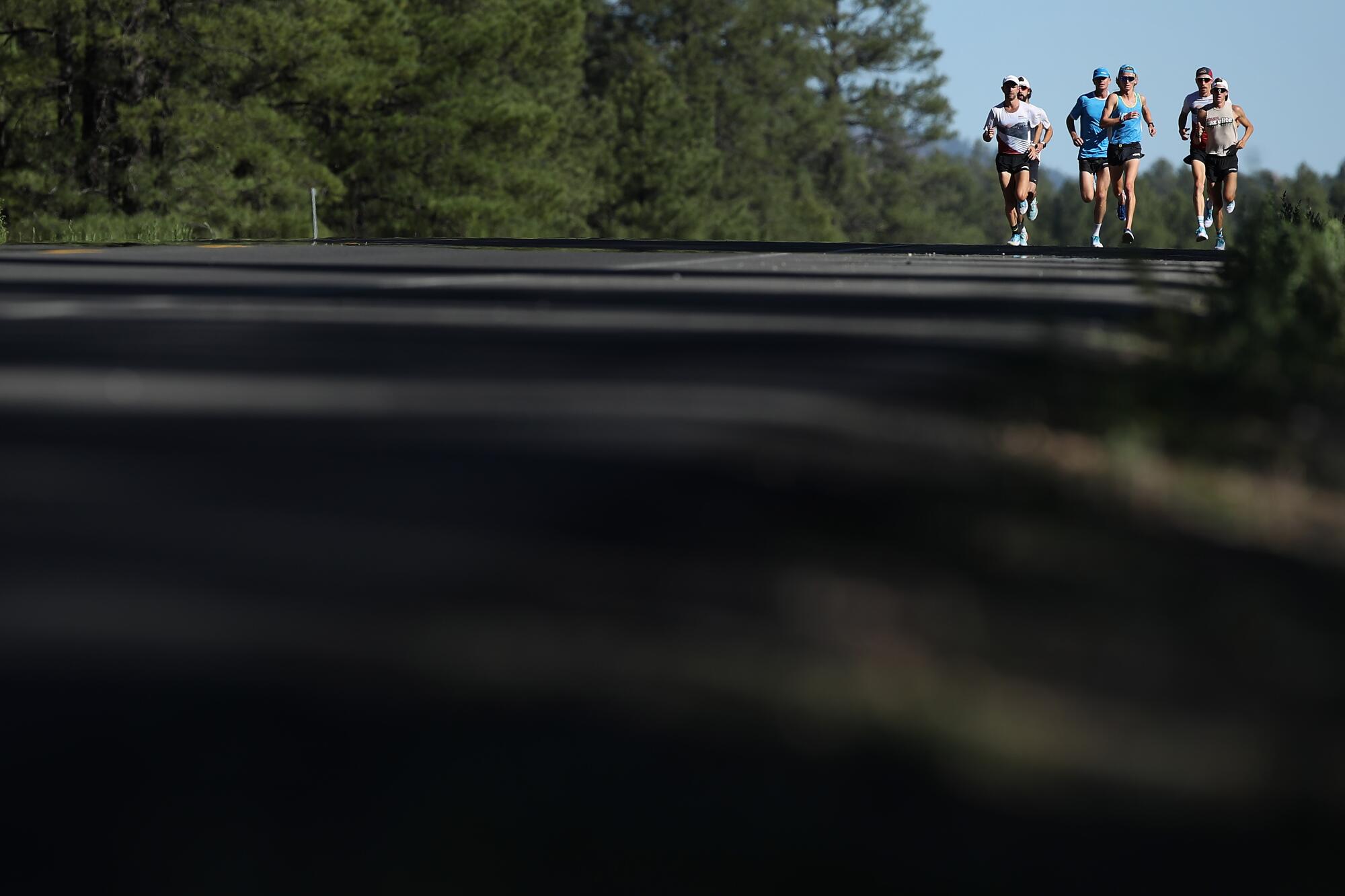
A group of runners from New Zealand train on a road in Flagstaff.
(Christian Petersen / Getty Images)
The effects of altitude training have been known for decades and have been among the factors credited for the success of East African distance runners, who hold every major world record from the 3,000-meter steeplechase through the marathon. And at 7,000 feet, Flagstaff is smack dab in the middle of the physiological sweet spot, high enough to reap the benefits of living at altitude but not high enough to produce adverse side effects such as headaches, nausea, dizziness and sleep problems that can occur above 9,000 feet.
And here’s the best part: You don’t even have to break a sweat to take advantage of that.
“The whole reason you’re at altitude is to produce those extra red blood cells,” said Ben Rosario, executive director and former coach of the HOKA Northern Arizona Elite running team, which is squeezed into a nondescript Flagstaff strip mall between a financial services office and a company that books whitewater rafting trips.
“The actual training you do, the actual time that you’re running, is not what makes altitude so special,” he said. “Your body increases its aerobic capacity just by living at altitude.”
Long, low-intensity runs can certainly aid in that process. Yet even world-class athletes are unable to run fast at altitude, which is where Flagstaff’s other geographic benefit becomes a factor.
The city sits on the Mogollon Rim, at the southern edge of the Colorado Plateau, which drops off as rapidly as it rises. The winding two-lane road out of the city drops nearly 2,700 feet in 30 miles before reaching Sedona; take I-17 another 30 miles to Cottonwood or Camp Verde, and the altitude is less than half that of Flagstaff.
That’s important because it allows athletes to live high and train low, maximizing the physiological effects of living at altitude but allowing them to do the kind of high-intensity workouts in Sedona and Cottonwood that would be impossible at Flagstaff.
Mount Elden just outside Flagstaff offers runners the chance to train on trails that reach close to 9,000 feet in elevation.
“If you’re doing everything at 7,000 feet, you have to go at a slower pace just because you’re at altitude,” said Baxter, who literally wrote the book on running in Flagstaff with “Running Up the Mountain: Northern Arizona Altitude, Lumberjack Attitude and the Building of a Distance Dynasty,” a detailed, quirky and entertaining look at people who made the sport flower in the desert.
A runner’s leg turnover is different at altitude, Baxter said. Even with the cardiovascular benefits of altitude, it becomes difficult to run fast there, with marathoners typically running 10 to 15 seconds a mile slower in the thin air than at sea level. It also takes longer to recover at 7,000 feet, which can turn an easy run into a grueling, stressful one for a runner’s body.
So if going up the mountain can help build stamina, going go down the mountain can help build speed.
“I’ll go down to sea level to race a 5K and the first mile feels all out. Although my lungs and everything are good, my legs are not used to running that fast for that long,” Baxter said. “Going down to Sedona or Cottonwood to do some of those faster workouts helps get you ready for when you actually race.”
A study Levine conducted with James Stray-Gundersen and Robert Chapman proved that, showing that living high and training low — the so-called “HiLo paradigm” — improved sea level running performance even in elite athletes by 1.1% after just 27 days.
“That was the novel twist,” said Levine, who 10 years ago spoke at the American College of Sports Medicine’s D.B. Dill Historical Lecture on the topic. “You could get the best of both worlds. You could acquire the acclimatization response [but go] down the hill to train.”
Added Rosario: “The value of learning to run fast at 7,000 feet, I can’t speak to the physiology of it. But at least mentally, when you go down for a race, you feel on top of the world.”
The locals refer to the trip from Phoenix to Flagstaff as “going up the mountain” since the road rises more than a mile in altitude as it winds through red rock canyons, past saguaros, junipers and wildflowers, in an ecosystem that is home to more than three dozen species of butterflies.
It’s a breathtakingly unique, sometimes other-worldly environment — so much so that NASA used it as a stand-in for the moon. Beginning in 1967, at a heavily guarded site among the cinder fields at Sunset Crater, about half an hour north of Flagstaff, Apollo astronauts simulated moon walks, tested equipment, drove the moon buggy over the spiky lava fields and took a crash course in geology. All 12 men who have walked on the moon trained first outside Flagstaff.
It was the arrival of four other men a year later that put the city on the Olympic map.
For George Young, Jim Ryun, Billy Mills and Conrad Nightingale, northern Arizona was also the perfect place to train for the Olympics since the 1968 Summer Games would be the first held higher than 500 feet above sea level.
“There are those that will die,” Swedish coach Onnie Niskanen warned when the IOC awarded the Olympics to Mexico City.
The Mexican capital is 349 feet higher than Flagstaff and physiologist Jack Daniels convinced the four men that northern Arizona was the best place to both test out Niskanen’s theory and explore the effects of thin air on runners.
It wasn’t as if the negative impact was unknown. In 1925, A.V. Hill, a Nobel Prize-winning physiologist coined the term “oxygen debt” to describe what happens when individuals exercise with an inadequate supply of oxygen. Because the thin air at altitude did not allow enough oxygen to be absorbed by the body, lactic acid was produced earlier, and at slower speeds, leading to poor muscular recovery.
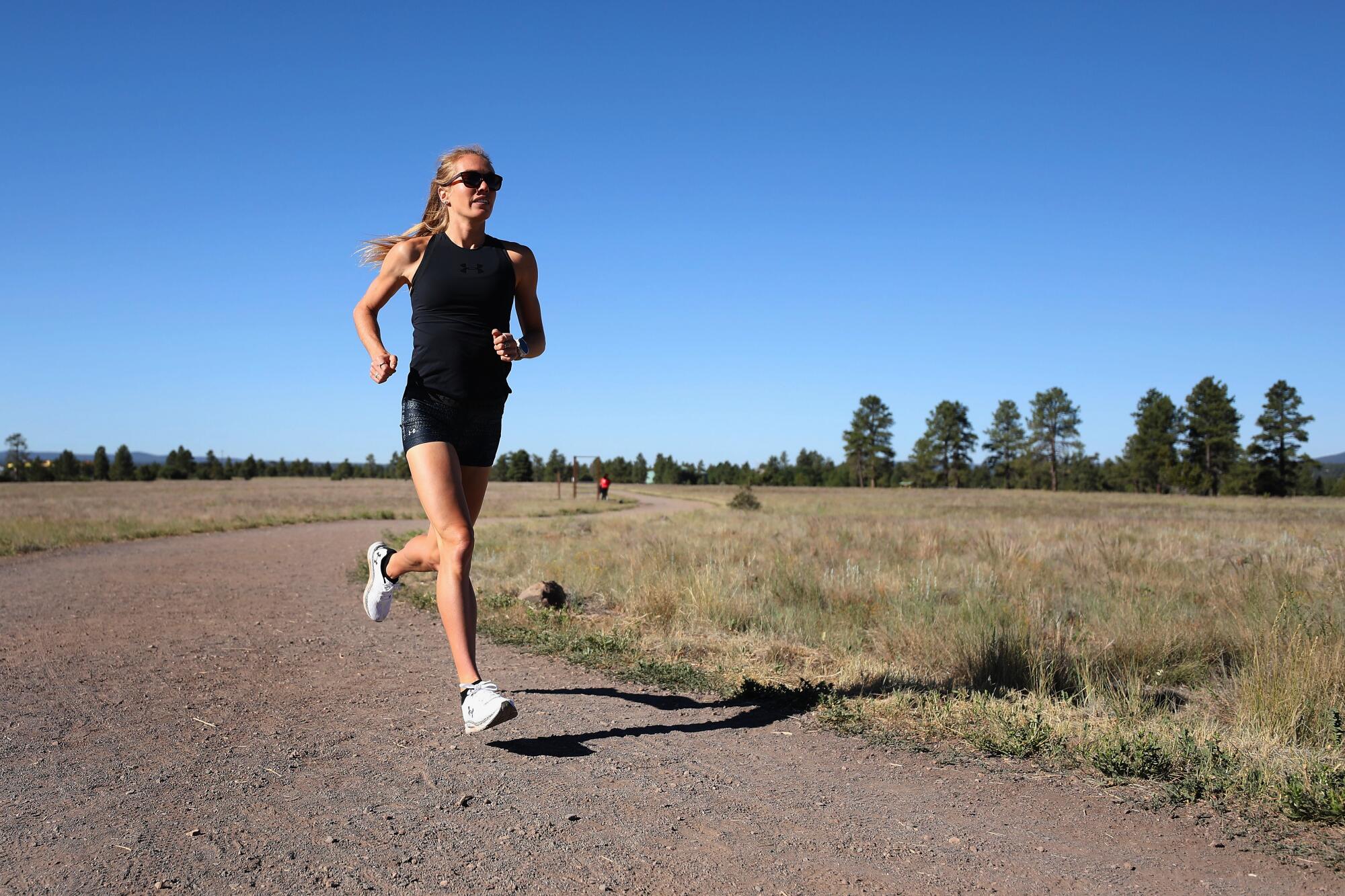
Tokyo Olympics distance runner Rachel Schneider trains at Buffalo Park in Flagstaff in July 2020.
(Christian Petersen / Getty Images)
Thirty-five years later, another researcher, Bruno Balke, theorized that athletes should acclimate to altitude before competing there. But it wasn’t until Daniels came to Flagstaff ahead of the Mexico City Olympics that physiologists began to understand that training in an oxygen-born environment could have beneficial results by forcing the body to produce extra red blood cells.
As Baxter describes in his book, the runners alternated between easy runs on the dirt trails that wound through the largest Ponderosa Pine forest in the world and punishing track workouts in the mountain air. Daniels used crude methods to monitor the athletes. At one point, he sat on the hood of a car that drove alongside Ryun, whose mouth was covered by a tube connected to a pipe held by Daniels. The expired air samples, collected in rubber bags, marked a novel attempt to measure the impact of altitude on endurance athletes.
“We were totally naive,” Mills said. “No knowledge on how to do it.”
The presence of Ryun, the fastest miler in history at the time, Mills, the reigning Olympic champion at 10,000 meters, and Young, the U.S. record-holder in the steeplechase, raised Flagstaff’s profile. Two months before the Mexico City Games opened, more than 130 Olympians from four countries descended on the city for a track meet.
Nobody, as it turned out, died while competing in Mexico City. Yet the effects of altitude and the studies taken to understand the impact of thin air on human performance leading into those Games — among them, Daniels’ rudimentary yet revolutionary research — changed the way athletes and coaches approached training.
But it fell to former UCLA coach Bob Larsen and Joe Vigil, who coached distance runners for the U.S. Olympic team, to push that science forward when they took their athletes to the 7,900-foot altitude of Mammoth Lakes ahead of the 2004 Athens Olympics. In the previous 16 years, only one American had medaled in an Olympic event longer than 800 meters, but after living at altitude in Mammoth and training down the hill in Bishop, Meb Keflezighi broke the American record at 10,000 meters, then finished second in the men’s marathon, and Deena Kastor broke the American record in the women’s 10,000 and was third in the Athens marathon.
No other country won two medals in the marathon that summer.
“We did some things that got everybody’s attention,” said Larsen, a member of the national track and field Hall of Fame. “Everybody had kind of given up that they were going to be able to catch [the Africans].”
A template had been set and in the four Olympics that followed Athens, Americans won nine medals in the distance events. Now most of the world’s distance runners do high-low training at least part of each year.
“If your event lasts longer than two minutes, if you’re in the Olympics, probably 95% of your competitors are trying it out at some point,” Bergland, the HYPO2 physiologist, said.
Abby Nichols is no stranger to altitude, having won three Pac-12 Conference championships while at Colorado (elevation: 5,430 feet). Boulder, she found, drew a lot of world-class runners, as does Mammoth, Park City, Utah, and Santa Fe, N.M., places where it’s easy to live high and train low. So it wasn’t the geography or the thin air that lured her to Flagstaff when she turned pro.
It was everything else she found there.
“When I first visited, I really liked how it was more clean and quiet. I liked how rustic and mountainy it was,” said Nichols, a finalist at 5,000 meters in last month’s Olympic trials and one of 19 runners on Rosario’s storefront team. “And then here there’s way more people to run with. It feels more like a community.”
With its trendy coffee shops, gastro pubs, diverse arts scene and outdoors lifestyle, the former railroad town now home to a world-class university has become an attractive city for young people, with a median age less than 26.
“The town itself is starting to be the attraction,” said Rosario, 44, who came to Flagstaff from St. Louis a dozen years ago. “It’s big enough that you can go out and have a nice meal, but it’s small enough that you’re not overwhelmed.
“A lot of those things came together. It’s just really snowballed and now it’s the place to be.”
Runners are also drawn by the more than 700 miles of scenic hiking/biking/running trails and plentiful training partners. Then there’s the fact it’s socially acceptable for a 26-year-old to go to bed at 9 or 10 p.m. to get up early the next morning to run.
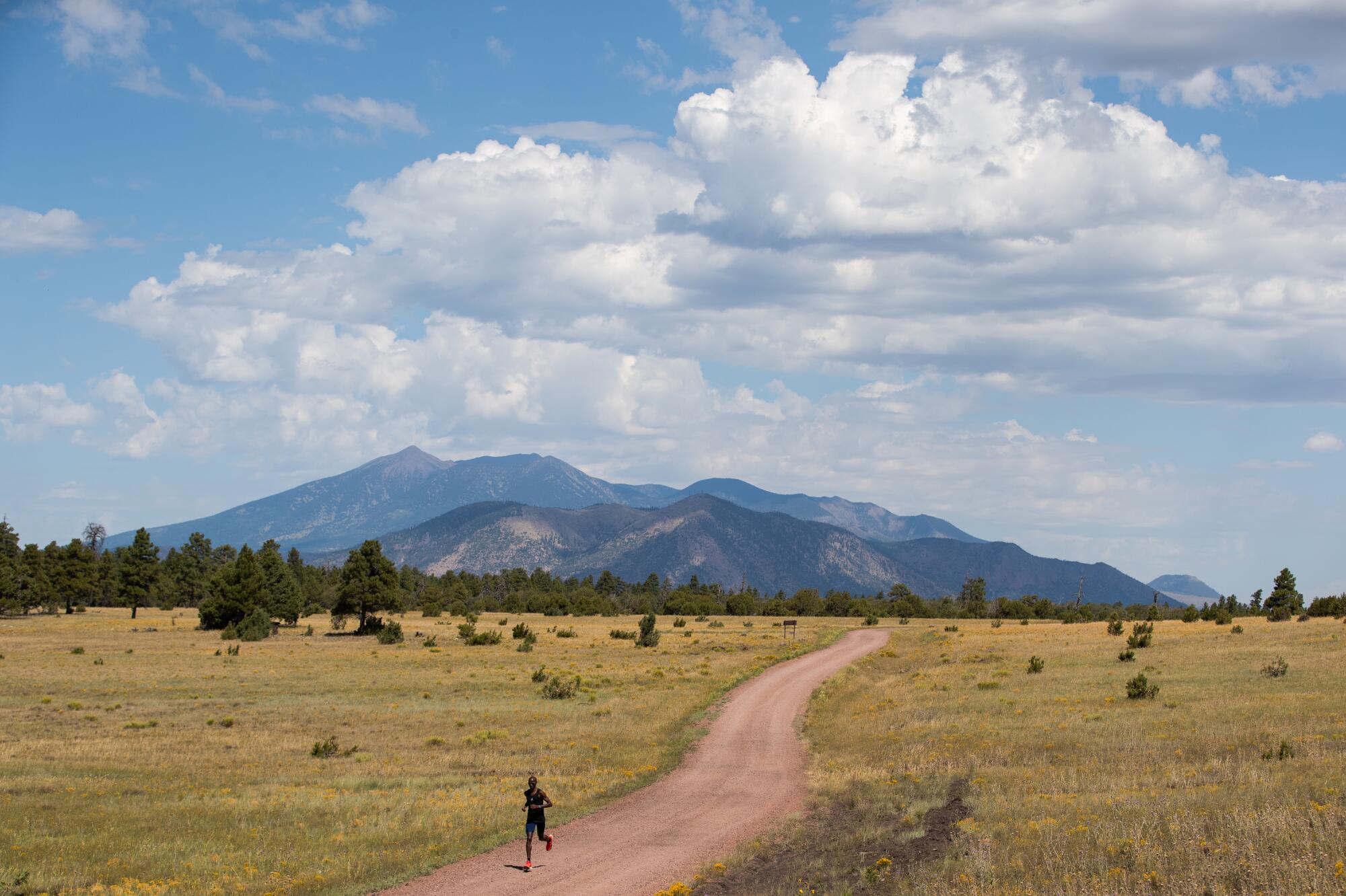
Distance runner Mo Farah takes part in a training session near Flagstaff in August 2019.
(Michael Steele / Getty Images)
“There’s just such a great overlap,” Baxter said. “You have the college program, which is the best distance program in the country. You have all these elite professional athletes in town, you have all these teams come in. So you have times where you have hundreds of really high-quality athletes in town.
“Then you have the community side as well.”
Like the Thursday morning summer bagel runs, for which up to 100 runners — from beginning joggers to Olympic hopefuls — gather at a bagel shop downtown for a trail run.
“It’s just the comprehensive package,” Rosario said. “The fact that so many people have come here and have had success, you want to add your name to the growing list of people from Flagstaff that have won medals, won marathons, won national titles. That becomes part of it as well.”
From his makeshift office outside Whole Foods, Bergland, a former competitive triathlete, struggled to keep up with the number of Olympians and Olympic hopefuls wanting to come to Flagstaff ahead of the Paris Games, which begin next week. In addition to runners, HYPO2 has been arranging training visits to Flagstaff for swimmers, cyclists, triathletes — anyone who can benefit from working out in the thin air — for the last 15 years.
“Hosting Olympic athletes from around the world is a huge point of pride for Flagstaff,” said Ryan Randazzo, the media relations and marketing project manager for Discover Flagstaff, part of the city’s economic vitality division.
Randazzo said he was unaware of economic-impact figures for Olympic training alone but, he said, tourism brings in more than $750 million and is responsible for about one in 10 jobs in Flagstaff.
“Olympic teams traveling here not only stay for weeks at a time, but also travel with trainers, coaches and other staff,” he said. “They visit local attractions like the Grand Canyon, stay in local accommodations and enjoy the restaurants in the city, so it’s safe to say their economic benefit is substantial.”
Many of the visiting athletes eventually wind up using the synthetic track or the 10-lane pool at NAU, the highest-elevation 50-meter swim facility in North America and a place where visitors are greeted with a sign that reads, “Welcome to 7,000 feet. Catch Your Breath.”
There have been times the pool is in such demand, Bergland has been forced to limit countries to one lane at a time. Often, swimmers from different countries wind up racing one another.
“I watched the world championships for swimming and a lot of them had just been here,” Bergland said of the swimmers. “It kind of brings a lot of different people together, moreso probably than other places.”
And it’s only going to grow. In 2028, the Olympics will be in Los Angeles, a 90-minute flight from Flagstaff. That means athletes will not only be able to train there in the lead-up to the Games, but those who are competing in more than one event will have the ability to fly back to Flagstaff between races.
Some teams have already made reservations to train in the city ahead of and during the L.A. Games.
“Flagstaff is going to be crazy. There’s no reason why you would go anywhere else in the world, “ Baxter said. “It’s going to be the place to go for athletes who are getting ready for those L.A. Games.
“And I think Flagstaff is going to thrive off of that.”


NEWYou can now listen to Fox News articles!
The best Indianapolis 500 finish could be subjective, depending on which driver a fan was rooting for to win.
It certainly is in the eye of the beholder.
So take this list for what it’s worth. One view of the 10 best finishes in Indianapolis 500 history. Of course, it skews to more recent decades when the runs have come a little faster and the finishes have had a tendency to be a little closer.
We’ll add one each day to this list of fantastic finishes ahead of the 110th running of the Indy 500 on May 24 (12:30 p.m. ET on FOX).
10. Ericsson outduels O’Ward (2022)
After a red flag, Marcus Ericsson held off Pato O’Ward in a two-lap shootout. The shootout didn’t last two laps, though, as there was a crash on the final lap behind them. Ericsson had a comfortable lead when the red flag came out for a crash with four laps to go, a situation where in past Indianapolis 500 races, they likely would have ended the race under caution with Ericsson as the winner.
9. Foyt survives chaos (1967)
How does a driver who wins by two laps end up on this list? It’s because the win nearly didn’t happen on the last lap. A big crash with cars and debris littering the frontstretch just ahead of Foyt as he came to the checkered flag forced him to navigate through the wreckage for the win.
8. Sato can’t catch Franchitti (2012)
This was one of those finishes where the leader holds on for the win, but boy did the leader have to hold on. Takuma Sato tried to pass Dario Franchitti early on the final lap but to no avail and Franchitti sped off for the victory. This was one of those Indy 500s that made you hold your breath all the way to the checkered flag.

No. 8 UCLA stuck with right-hander Taylor Tinsley throughout the Los Angeles Regional and that faith in the senior paid off.
During the Bruins’ NCAA tournament opener at Easton Stadium, Tinsley gave up 10 runs before her teammates rallied for a walk-off win. She returned less than 24 hours to pitch against South Carolina, giving up two earned runs in a victory. Tinsley was back in the circle Sunday afternoon, yielding one run in UCLA’s 15-1 victory over the Gamecocks to advance to the super regionals.
“I am proud of Taylor’s resiliency, the ability to do whatever she can to help this team,” UCLA coach Kelly Inouye-Perez said. “She got stronger through the weekend. I am proud of that.”
Tinsley and her teammates will host Central Florida in a super regional that begins Friday.
“I feel good,” Tinsley said after pitching three key games in three days. “I could have gone more innings if needed.”
South Carolina right-hander Jori Heard gave up only one hit through two innings, keeping UCLA’s potent bats relatively quiet. The Gamecocks had runners on first and second with two outs in the second, but Tinsley escaped the inning with a pop-up to left field.
The Bruins got on the board first with a two-run home run from left fielder Rylee Slimp in the third inning. The Bruins followed it up by loading the bases with no outs in the fifth for right fielder Megan Grant.
Grant cooked up a grand slam to make it 6-0. She has 40 home runs, extending her hold on the NCAA single-season home run record. Oklahoma freshman Kendall Wells trails Grant with 37 homers.
“Its just incredible because I am blessed to be able to say the number 40,” Grant said.
South Carolina broke through on an RBI single from left fielder Quincee Lilio to cut UCLA’s lead to 6-1 in the fifth inning after being held to just one hit since the first inning. The Gamecocks couldn’t cash in the rest of the way.
The Bruins resumed scoring in the sixth inning, with the bases loaded and Grant at bat again. Fans at Easton Stadium anticipated another grand slam, holding up their cellphones hoping to catch some magic. Grant served up a two-run RBI single to expand the lead 8-1.
Jordan Woolery added to the scoring with a two-run RBI double down the left-field line, and Kaniya Bragg hit a home run to left-center field. Soo-jin Berry put a bow on the win with one more home run.
Sports
Pro wrestling star learns what ‘land of opportunity’ means in US as he details journey from Italy to America

NEWYou can now listen to Fox News articles!
Cristiano Argento has been tearing up opponents in the ring for the National Wrestling Alliance (NWA) as he worked his way up the ladder to get a few shots at some gold.
But the path to get to one of the most prestigious pro wrestling companies in the U.S. was long and a path that not many wrestlers have taken.
Argento was born and raised in Osimo, Italy – a town of about 35,000 people located on the east side of the country closer to the Adriatic Sea. He told Fox News Digital he started training in a ring at a boxing gym before he got started on the independent scene in Italy. He wrestled in Germany, Sweden, France and Denmark before he came to the realization that, to become a professional wrestler, he needed to make his way to the United States.
ZERO BS. JUST DAKICH. TAKE THE DON’T @ ME PODCAST ON THE ROAD. DOWNLOAD NOW!
Cristiano Argento performs in the National Wrestling Alliance (Instagram)
He first worked his way to Canada to get trained by pro wrestling legend Lance Storm. He moved to Canada, leaving most of his friends and family behind and without a firm grasp on the English language.
“At the time, my English was horrible. I didn’t speak any English at all,” he said. “But I was with my friend, Stefano, he came with me and he translated everything for me. I probably missed 50% of the knowledge that Lance Storm was giving to us because I was unable to understand. I was only given a recap and everything I was able to see. I’m sure if I was doing it now with a proper knowledge of English, it would have been a different scenario.
“Eventually, I moved back to Italy after the training and I said, OK, now, I want to go to the U.S. So, I studied English more properly, and eventually I got my first work visa that was in Texas. I was in Houston for a short period of time. I trained with Booker T at Reality of Wrestling. I got on his show, which was my debut in the U.S. That was awesome. I eventually got a new work visa in Pittsburgh, Pennsylvania, where I currently live since 2017. Since then, my wrestling career, thankfully, kept growing, growing, growing and growing until now wrestling for the NWA. One of the bigger promotions in the U.S.”
Argento said that his family thought he was “nuts” for chasing his pro wrestling dream.
He said they were more concerned about his well-being given that he was half-way around the world without anyone he knew by his side in case something went sideways.
“My family, friends, everybody was like why do you want to move to the opposite side of the world not knowing the language, not knowing anybody, by yourself, to try to become a professional wrestler? And I was like, well, we have one life, I love, and that’s what I’m gonna do,” he told Fox News Digital. “Eventually, my family was really supportive. But when I first said, ‘Hey, mom and dad, I want to do that.’ They looked at me like, ‘Are you nuts? Are you drunk or something? What are you talking about?’ And I said, no that’s what I want to do. And they knew I loved this sport because in Italy I was traveling around Europe, spending time in Canada training, so they started to understand slowly that’s what I want to do with my life. They were proud of me.
Cristiano Argento works out in the gym. (Instagram)
“They’re still proud of me. I think more like the fact that you’re gonna try that, that it’s hard than more like you’re gonna leave us. The fact like, oh, my son is gonna go on the opposite side of the world for a six-hour time difference and we’re gonna see him maybe, when, like, I don’t know. Not often. I think it was more that. And for me too, it was really hard. It was heartbreaking not being able to see my family every day or every month. Like once a year if I’m lucky. I think that was the biggest part for them because of concern or that I was here by myself and if I have any issue or any problem, I didn’t have nobody. So they were scared. Like, you get sick, if you have a problem, anything, and they’re not being able to be here next to me. But they were really supportive since day one.”
Argento is living out his dream in the U.S. He suggested that the moniker of the U.S. being the “land of opportunity” wasn’t far from what is preached in movies and literature – it was the real thing.
“I was inspired by people who came to the U.S. and made it big,” Argento told Fox News Digital. “The U.S. was always like the land of opportunity. That’s how they sell it to us and this is what it is. I feel like, in myself, that was true because anything I tried to do so far I was able to reach a lot more than if I wasn’t here. I’m not yet where I’d like to be but I see like there’s so many opportunities in this country. Not just in wrestling but like in any business to reach the goal. I’m really happy of the choices I did here.
National Wrestling Alliance star Cristiano Argento poses in Times Square in New York. (Instagram)
CLICK HERE TO DOWNLOAD THE FOX NEWS APP
“But my big inspirations were big-time actors who moved to the country, who didn’t know English, with no money, no support system. I had one dream, I have to go right there to make it happen and I’m gonna go and do it and I’m gonna make it happen. So those people were always the biggest inspiration even if it wasn’t in wrestling, just how they handled their passion, how they pursued their dream without being scared of anything, how far you are, how alone by yourself … You don’t know the language, you’re like, let’s go, let’s do it.”
Outside of the NWA, Argento has performed for the International Wrestling Cartel, Enjoy Wrestling and Exodus Pro Wrestling this year.
-

 World2 minutes ago
Canada confirms hantavirus case linked to cruise ship outbreak that has killed three passengers
-

 Politics8 minutes ago
Trump reads Bible as thousands pack National Mall for America 250 prayer rally
-

 Health14 minutes ago
Frequent museum visits tied to reduced cellular aging, research finds
-

 Sports20 minutes ago
Indy 500: Counting Down The 10 Best Finishes In Race History
-

 Technology26 minutes ago
Your 401(k) is the new identity theft target
-
 Business32 minutes ago
Why this Hollywood director thinks AI can save L.A. film jobs
-
 Entertainment38 minutes ago
Pedro Pascal goes undercover for ‘Star Wars’ surprise at Disneyland
-
 Lifestyle44 minutes ago
How Route 66 inspired Disney’s ‘Cars’ and Cars Land — and the ride that never came to be

