Sports
‘Wait a minute, are you serious?': How Las Vegas became the center of the NBA offseason


LAS VEGAS — Twenty years ago, the shape of the NBA offseason changed forever.
Once players were drafted, teams would send their prospects to various small summer leagues scattered across the country. But in 2004, a new idea spawned in Las Vegas, seeking to bring the entire league together in one place.
Co-founded by player and coach agent Warren LeGarie alongside Albert Hall, they wanted everyone in the NBA universe traveling to Vegas each July. Now, the league is much more than just a scouting event for the next generation of NBA players. It has become the epicenter of the NBA offseason.
Jerry West, the late Hall of Fame player and executive: It first started when we did (a league) in LA. Teams wanted to showcase their players. Along the way, young kids like Kobe Bryant came in and with all the hype they had, the place would sell out every night. Teams started coming out there because they wanted to give their younger players a chance to play. When they moved to Long Beach, my gosh, it was really popping. But then they moved it back to LA and it sort of died out.
Warren LeGarie, Las Vegas Summer League co-founder: When I first started, I walked into a gym at Loyola Marymount (in Los Angeles), I didn’t know what to expect. I had a successful business selling fresh fruits and vegetables on the streets of LA from midnight until eight in the morning. All of the sudden, I walked into (the gym) and my life had meaning.
Monty McCutchen, NBA Senior Vice President of Development and Training for Referee Operations: After 30 years, I’ve seen a lot of iterations of summer league. I started as a young referee trying to get into the CBA when it was at Loyola Marymount. It was much more — I don’t use this term pejoratively — but lazy. It was this thing that was there and teams used it, but it didn’t have the energy to it the way this does now.
Rod Thorn, former NBA Executive Vice President of Basketball Operations: When Warren was pitching (over the years), he was like everybody wants to go to Vegas. I was like, “Wait a minute, are you serious?” But you had the Rocky Mountain League in Salt Lake City that didn’t have that many teams. Then you had the Orlando League with more teams, but no fans were there.
LeGarie: The hottest summer league going at the time, with 16 teams, there was Boston. You stayed in the hotels downtown, played at this small university where it was just one gym. They did it the old school way where guys are scrapping trying to find their calling in basketball. But then they had the Democratic National Convention and forgot to book hotel rooms and everything’s sold out.
Danny Ainge, former Boston Celtics GM and current Utah Jazz CEO: There was a national convention and we didn’t have a place (to play) and the city was packed. Once (the convention) went away, it was hard to restart again. So (Vegas) became the place.
By 2004, LeGarie was making progress with Thorn’s successor, Stu Jackson, to get a league together in Las Vegas. Once the Boston league shut down, the opportunity finally arrived.
LeGarie: After having met with (then-NBA Commissioner) David Stern at the (2004) All-Star game in LA, Stu calls me and goes, “You want to do a summer league? We’ll give you the authority to do it.”
Thorn: The commissioner talked about it with (former deputy commissioner) Russ Granik and myself and some of the marketing people about what they thought about it. It got a favorable response from that crew and he just decided to do it. Let’s take a whack at it and see if it works.
LeGarie: The good news was I got it. The bad news was, what the f— do I do now? The first call I made was to Albert (Hall), who I had connected with many years earlier in Seattle when I brought George Karl in from Europe to take over for KC Jones coaching the Seattle SuperSonics. I called Albert and said, “Summer league, what do you think?”
Albert Hall, Las Vegas Summer League co-founder: Warren got six teams, I went to work on the marketing, (then-agent and future Warriors GM) Bob (Myers) went to work on sponsorship and team stuff, and we just went for it.
West: Warren, who had been involved (with the Long Beach league), saw the potential to move it up to Vegas.
Hall: The first year was just like who f—ing knows? We got a credit card, let’s see if we can do this.
The first thing they needed to secure couldn’t be paid for with a credit card. They needed a venue to host the tournament. To book the Thomas and Mack Center at UNLV, LeGarie reached out to the late Chip Hooper, an event booker for major musical acts at the time, such as Dave Matthews Band, Black Eyed Peas and Phish.
LeGarie: Chip goes to the guy who runs Thomas and Mack arena and we didn’t pay rent our first year because (Hooper) promised he would get Phish, who was going to play there for New Years anyway. So that saved us right there.
Hall: Then we were 45 days out and we didn’t even have a hotel. So I send a size 20 shoe to the guy at the New York-New York (hotel and casino) with a proposal (written on it) that says, “Hey, we’re just trying to get our foot in the door.” He’s like, “What the f— is this?” We ended up getting a hotel for the teams at New York-New York.
I found a timeshare place at the Fairfield Inn and we put our staff up there. The key though is we had to sit in on all the timeshare meetings. After we sat in on the first one, we were trying to hide from the management at the hotel because they wanted us to go every day.
Dennis Rodgers, initial summer league intern and current Los Angeles Clippers Director of Basketball Communications: It was right on the corner where Tupac got shot, but we had a washer and dryer and everyone was in an adjoining room together. When we’d get back after working a 15-hour day, we’d quickly pass the front desk so we didn’t get roped into a timeshare presentation. I was very young, so they probably thought I was someone’s kid or something.
Becky Hammon coached the San Antonio Spurs to the Vegas League title in 2015. (Garrett Ellwood / NBAE via Getty Images)
Hall: Warren and Danny (Ainge) had known each other forever, so Danny built his first summer league teams with Rajon Rondo, Al Jefferson, Kendrick Perkins, Tony Allen and Gerald Green.
Ainge: Every team brings multiple people from scouting and coaching staffs here and they’re assigned to every game at the summer league. I used to always joke with Kendrick Perkins when he’d say, “Where have you been for the last couple weeks?” I’d say, “I’m out looking for players better than you.”
Hall: Boston was loaded and then we needed a sixth team, so Orlando came on late with Dwight Howard as the No. 1 pick. So we had this gym with big-time guys and nobody knew they were playing there. They thought it was some circus act cruising through Vegas, but this was real NBA players.
Rodgers: On the strip, you see people passing out flyers with girls on it. Well, that was us passing out game schedules and ticket info for summer league.
Hall: That first year, it was like we had no one there. I always joke that we had inflatable people in the stands.
Rodgers: We had this blow-up NBA logo that we put on the street corner outside UNLV. But Vegas in July is monsoon season, so a lot of times the logo would go down and I’d sprint outside to hold this gigantic NBA logo up. It was anything to help grow the league because nobody knew that first year. We didn’t have social media, so you had to hit the ground running.
Those first two years, we really struggled for attendance. But then in our third or fourth year, we went from six to 10 teams and the word was getting out that it was a great opportunity to not only come to a fun city, but the people in charge knew what they were doing and your young guys would get to play on a national stage.
Ainge: Everybody was going to be there. It was going to be an opportunity not to just play, but see every team in the NBA, so you get a chance to scout. It was a simplification of everybody’s job in the summertime.
Keith Grant, former Dallas Mavericks Assistant GM: (LeGarie) picked my brain on a lot of things. I had been the Mavericks’ guy for summer leagues and we just talked about having practice facilities and things to make it one-stop shopping.
As the summer league became the focal point for offseason scouting as teams sought to find training camp invites, eventually all 30 franchises joined in. That eventually led to the NBA revising its annual calendar to conduct all sorts of business during the summer league. The league shifted its officiating training program and tech expo to Vegas. The summer league began hosting the Sports Business Classroom to provide training programs for people looking to break into the NBA business. Just about every facet of the league’s growth and innovation made July in Vegas a key date.
Grant: In the old days, the NBA had league meetings in the fall at Palm Springs or Boca Raton, but there was no basketball involved. When you add the basketball to it, it’s a win-win.
Thorn: League meetings were (now) being held in Las Vegas concurrent with the (summer) league. It made sense. I think it goes back to most people enjoying going to Vegas because there’s a lot to do there.
LeGarie: Our idea was to make it so that people not only want to be here, but they feel it’s necessary to be here because if you’re not in Vegas, you’re missing out.
Ainge: It’s a place where we have conventions of all sorts, from general manager conventions to ownership board meetings to personal assistant meetings and players union meetings. Every imaginable role that you can play in the NBA, you’re gonna have a meeting here in Vegas. Those conventions were in different places, different times of the year. Now it’s all one-stop shopping.
LeGarie: We always believed this would become like South by Southwest. In addition to basketball, we’d bring in music, people doing documentaries about athletes, a cross-section of everything else.
Thorn: There’s always speculation that if and when the NBA does expand, Las Vegas probably will be one of the cities. It’s a place that does a good job of promoting itself and people like to go there.
Hall: With Sports Business Classroom, we have a place where these kids can learn from the best and brightest. Teams are now recruiting out of our SBC program.
LeGarie: We had the winners of the research paper (competition) from the MIT Sloan Sports Analytics Conference to present here. Every year, we’d hear analytics is important. So we brought in analytics speakers. The cap became a big issue because very few people understood it, so it became a weapon and you could cripple another team if you knew that cap.
The underlying Machiavellian reasoning behind these programs was the guys who grew from them into positions of power would say, “We’re going to Vegas, those f—ing guys were there for me when nobody else really was.” So it was a little bit selfish from that standpoint.
West: Warren’s a character and we’re losing characters. I’ve always been attracted to people like that. They do things differently, but at the end of the day, they’re great guys and get it accomplished. The league has supported him and given him a boost in a sense. It’s his vision and they wanted to be a part of it. They’re smart enough to know how important this is.
It provides an unbelievable opportunity for young people who love the game and have something they want to become in their lives. You see all these young people trying to get experience and there are going to be head coaches that come from this experience in the summer league. It encompasses almost everything an organization does.
McCutchen: When I was younger, (referee training) morning sessions were 15 or 20 minutes and we met in a room the size of a bedroom. (Now) we meet in a conference room that has 100 people in the room and two gigantic screens. We train every morning in a classroom and then we’re in the gym all day to evaluate and educate the next generation of referees. The neat thing about that is that you start building relationships now. Referees are going to be able to build relationships with young assistant coaches who aspire to be head coaches and young draft picks. I always remembered the people I came in with, so those things are invaluable.
Rodgers: It’s an incredible opportunity for young people to break into the industry. I mean, at the Clippers, we have five people who started NBA summer league employed. You have 100-to-130 interns every year now. When I started, it was just me.
Hall: We didn’t want it to become this corporate-type thing. We were like this has to keep its street cred and grittiness to it because that’s what it’s all about. You get to see eight games a day and you’re rubbing elbows with everybody.
West: One of the things that’s really interesting is you see all the men who have watched the teams and players they love and they bring their sons. It’s almost a legacy bringing these people back.
McCutchen: Families can come here at less cost than going to a playoff game, for example. And so there’s a whole new way in which we’re generating new generations of fan bases through this sense of the electric meeting place that the summer league has become.
Ainge: Every summer league is a fun time. There’s something new and fresh. Whether you just have one second-round pick or you have a couple young free agents you want to take a look at, there’s always something new and I love that part of it.
Required reading
NBA roots run deep in Las Vegas with Kareem’s historic achievement, summer-league games
(Photo illustration: Sean Reilly / The Athletic. Photos: Chris Gardner, Ethan Miller, Cassy Athena, Allen Berezovsky, Bart Young / Getty Images)



Sports
Thekla embarrasses Stardom’s Starlight Kid after retaining AEW World Women’s Championship at Forbidden Door

NEWYou can now listen to Fox News articles!
Thekla has had every reason to talk as much trash as she’s done.
She made her debut in All Elite Wrestling (AEW) last year and quickly moved up the ladder to win the AEW Women’s World Championship in a strap match against Kris Statlander in February. She’s continued to hold the title even when three opponents were thrown her way at Double or Nothing.
COMPLETE PRO WRESTLING COVERAGE ON FOX NEWS DIGITAL
Thekla enters the ring during the women’s pro-wrestling event “Stardom” at Korakuen Hall in Tokyo, Japan, on Jan. 13, 2025. (Etsuo Hara/Getty Images)
Thekla declared war on Stardom and New Japan Pro-Wrestling (NJPW) in the buildup to Forbidden Door. She demanded that Stardom send its best to challenge her at Forbidden Door, and they obliged. Starlight Kid stepped up against the “Toxic Spider” and the two put on a great match in front of the pro wrestling audience at the SAP Center in San Jose, California.
Thekla taunted Starlight Kid throughout the match and it appeared she got more than she bargained for at points during the match.
Starlight Kid wouldn’t stay down and gave every effort to bring the AEW Women’s World Championship back to Japan with her. Starlight Kid worked on Thekla’s knee toward the end of the match. But the champion would not quit.
Starlight Kid enters the ring during the Women’s Pro-Wrestling “Stardom” 15th Anniversary at Edion Arena Osaka in Osaka, Japan, on Feb. 7, 2026. (Etsuo Hara/Getty Images)
Thekla got out of the submission hold and avoided being pinned by mere seconds. Thekla was put to the test more than any other opponent she’s faced since becoming the champion.
The “Toxic Spider” hit two stomps and finally put away Starlight Kid to retain the title.
With Stardom president Taro Okada in attendance, Thekla continued her assault against Starlight Kid. Skye Blue and Julia Hart came out to support Thekla. Hart handed Thekla a pair of scissors and the champion ripped the mask off Starlight Kid’s head and spit in it.
Thekla taunted Okada with the mask and hit the wrestling executive with it.
Thekla enters the ring during the women’s pro-wrestling event Stardom at Yokohama Budokan in Yokohama, Kanagawa, Japan, on March 8, 2025. (Etsuo Hara/Getty Images)
CLICK HERE TO DOWNLOAD THE FOX NEWS APP
Thekla stayed the champion and added a trophy to her mantel.
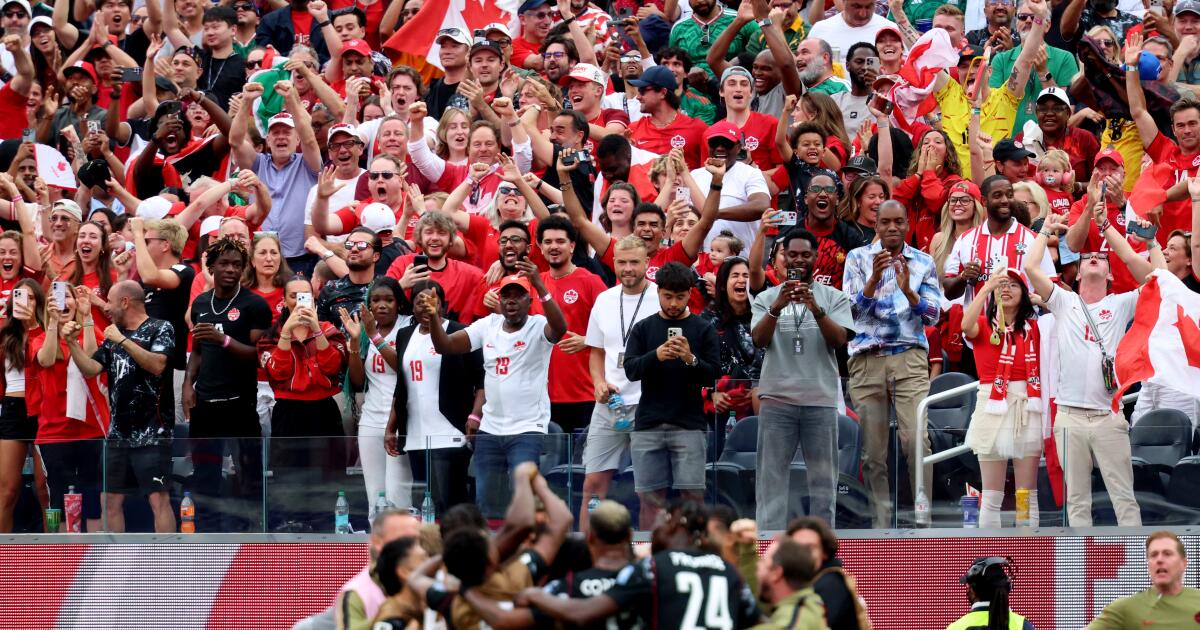
Remember when we were sure the World Cup would suffer from all the issues that had everyone seeing red before the first ball was kicked?
And remember when we were certain soccer could never catch on in this country?
Despite controversies over visas and ticket prices and transportation, and in spite of consternation over expansion and new rules, the game has, as usual, proved too good to fail.
And we, the American people, have become unusually engrossed in it.
We’ve been tuning in on TV in record numbers and, even at exorbitant prices, helping to sell out our 70,000-some-capacity stadiums. Before group play was even finished, this tournament — staged also in Mexico and Canada — already outdrew the 1994 World Cup, which was hosted by the United States and set an attendance record of nearly 3.6 million.
We’ve been loving the healthy cultural exchange, and we’re being reminded that cultural barriers of traditional sports fandom can be breached.
So now, to keep our interest from drying out like a pitch on a hot summer day, the goal should be to keep the market saturated with soccer. That will take Major League Soccer tearing down all the walls.
It’s already turned the page on its calendar, adopting a summer-to-spring season format that will better blend with the global game.
Now MLS needs to make its games easier to watch, and to do its part to make the sport easier to play.
Canada goalkeeper Maxime Crépeau, left, celebrates with teammate Jonathan David after a 1-0 win over South Africa at the World Cup on Sunday.
(Kelvin Kuo / Los Angeles Times)
While the proverbial iron is hot, it needs a strike like Stephen Eustáquio’s winning rocket in the 92nd minute of Canada’s 1-0 victory against South Africa on Sunday at SoFi Stadium.
Eleven players on the two teams were MLS representatives — including Eustáquio, who spent the last six months in LAFC’s midfield.
Goalkeeper Maxime Crépeau, who played two seasons with LAFC and now plays for Orlando City, stopped the only shot he saw for his second clean sheet this World Cup, which saw the Canadians succeed in their first knockout stage appearance.
There’s been no avoiding MLS players in this World Cup. The greatest of them is piling up goals for Argentina: Lionel Messi, the Inter Miami superstar, is now the all-time World Cup goal-scorer (with 19).
MLS has set an attendance record too, with 45 players participating. It ranks as the league with the second-most players apart from the top five European leagues. LAFC had three current players in the mix.
But wait. Record skip. Before you celebrate the MLS’s contributions to this soccer spectacle, check with the VAR. Yep, without the 13 MLS players representing nations that rank 40th or lower in FIFA’s world ranking, there actually would be fewer than the 37 MLS participants at the World Cup four years ago.
A baby’s first steps are for celebrating, but three decades after the league’s formation, MLS is still searching for a giant leap. It’s still having a mean time of trying to make “fetch” happen for real.

It would help to make its games more readily available — not to the already converted, but to fans who didn’t even know what they didn’t know about soccer until the World Cup began in their backyards.
MLS has already brought MLS from behind Apple’s season pass paywall. And the league and streaming service also reportedly have agreed to a revised media rights deal that will end at the end of the 2028-29 season, three and a half years earlier than expected.
But the hat trick would be to remove the need to subscribe to streaming service to watch MLS games altogether, and then get those matches onto the networks people know to tune into for their sports.
Normalize watching American soccer.
And stop gatekeeping. MLS’s developmental programs are too restrictive and exclusive — they’re not developing more soccer players, they’re curtailing who can play.
It’s in the league’s interests, and the sport’s in this country, to encourage as many players to play as much as they can — including for their high school teams, which MLS Next bars.
They’ve got people in the tent; the goal should be to make them want to stay.
To make them want to join the world’s circus, not to let it pack up and move on, out of sight and out of mind, until it swings back through years from now.

NEWYou can now listen to Fox News articles!
Golf humbles many, including those who are the best in the world.
Just ask J.T. Poston at the Travelers Championship on Sunday.
What started out as a chance to put a low score on the card at the 13th hole after getting greenside in two shots, Poston, the world No. 32 in the Official World Golf Ranking, posted a 12 in an absolute meltdown that derailed his entire day.
J.T. Poston plays a shot from the first tee during the first round of the Travelers Championship at TPC River Highlands in Cromwell, Conn., on June 25, 2026. (Jordan Bank/Getty Images)
While Poston may not have been in contention, he wasn’t picturing himself at the bottom of the leaderboard by the end of the tournament, but the 12 was the main reason behind finishing 6-over and 1-over on the tournament for 69th place out of the remaining 72 that made the cut.
So, what exactly happened to Poston?
MICROPHONE ENDURES GOLFER SHANE LOWRY’S WRATH DURING MELTDOWN AT US OPEN
Well, the 13th hole began with a perfect tee shot that found the middle of the fairway. Then, his second shot found a greenside bunker, but professionals sometimes don’t mind finding those bunkers because of how great their short game is. A good bunker shot and Poston has a chance at birdie on the par-5.
But things went awry from there, as the bunker shot came out quite short, leaving him with a chipping situation. Again, professionals understand that’s not the end of the world, with a chance at par after a solid chip.
The nightmare was just beginning for Poston, though, as his fourth shot went clear across the green and ended up in the water on the other side.
From there, Poston had to drop not once, but three separate times because he couldn’t get his ball back on the green. On his 10th stroke, he finally got the ball into a putting position.
J.T. Poston stands on the first tee box during the second round of the Travelers Championship at TPC River Highlands in Cromwell, Conn., on June 26, 2026. (Ben Jared/PGA Tour)
Poston still had to keep going, putting his 11th stroke and missing it before a tap-in 12 and ending the meltdown in front of the fans.
Poston spoke about the multiple drop balls near the water that continued to roll back into the drink.
“It’s not really rough, where you can kind of blast it out,” Poston said, per Golfweek. “It’s into the grain, but it looks like you can get enough golf ball on it, which is why I kept trying to hit a good chip.”
Poston was asked if he even thought about putting it out of the greenside rough with his chips clearly not working out.
“I feel like it’s just going to hop and that takes all the speed out of it,” he responded. “And you’ve got this big false front you got to get it over. So my worry with trying to putt it was it would not have enough speed to really get there.”
J.T. Poston plays a tee shot on the first hole during the second round of the Travelers Championship at TPC River Highlands in Cromwell, Conn., on June 26, 2026. (Ben Jared/PGA Tour)
CLICK HERE TO DOWNLOAD THE FOX NEWS APP
Poston didn’t bounce back on the 14th hole either, as he posted a double bogey on the par-4 to put himself down even more. In the end, Poston posted a 76 on the day to finish off his tournament.
Meanwhile, the Travelers Championship will come down to a playoff that must be played on Monday after Viktor Hovland and Scottie Scheffler found themselves deadlocked at 21-under after the latter sank a putt to force it. Hovland’s putt to win it all just missed and Scheffler took advantage of the open opportunity.
Follow Fox News Digital’s sports coverage on X and subscribe to the Fox News Sports Huddle newsletter.
-

 Technology2 minutes ago
The Flipper Zero creators’ Busy Bar productivity display will go on sale next month
-

 World5 minutes ago
Families watch in horror as skydiving plane crashes in France, killing all 11 aboard
-

 Politics10 minutes ago
DOJ launches grand jury probe into Marxist mogul Neville Roy Singham’s funding of leftist groups
-

 Health17 minutes ago
America’s lifespan has doubled since 1776 — experts reveal what changed
-

 Sports20 minutes ago
Thekla embarrasses Stardom’s Starlight Kid after retaining AEW World Women’s Championship at Forbidden Door
-

 Technology25 minutes ago
AI may spot deadly heart risk in a routine ECG
-
 Business32 minutes ago
SpaceX IPO sparks race for luxury housing in Southern California
-
 Entertainment35 minutes ago
Movies, books, art and music to explore as America turns 250

