Sports
Quebec City lost its NHL team 30 years ago. Is the PWHL how pro hockey makes its return?


QUEBEC CITY — Tucked away at the event level inside the Videotron Centre is 20,000 square feet of empty space.
It’s mostly used for storage, and sometimes catering. But the space, according to venue staff, has been set aside with the hope of someday turning it into a state-of-the-art locker room for the return of the Quebec Nordiques.
It’s been almost 30 years since the NHL left Quebec City. The Nordiques moved to Denver in May 1995, becoming the Colorado Avalanche. Various attempts to revive the franchise over the intervening decades have been unsuccessful.
“It was a tragedy,” said Jocelyn Thibault, who played in the Nordiques’ final two seasons. “When you lose a professional team, it leaves a big hole in a city. It put a hole in a lot of people’s hearts.”
On Sunday, regular-season pro hockey returned to Quebec City for the first time in decades.
The Professional Women’s Hockey League brought its “Takeover Tour” of neutral-site games across North America to the city, with the Montreal Victoire playing the Ottawa Charge in front of a sold-out crowd of more than 18,000 fans — the second-largest announced attendance of the season.
“It was just unbelievable to see that crowd in front of us,” said Montreal forward Catherine Dubois, who grew up in Quebec City. “I had chills the whole time. It was very special.”
Une journée de rêve, tout simplement magique, pour Catherine Dubois, native de Québec 🥹
A magical homecoming for Catherine Dubois pic.twitter.com/XWhQxa8PEL
— Victoire de Montréal (@PWHL_Montreal) January 20, 2025
The PWHL, which is in only its second season, is already looking to add up to two teams as early as the 2025-26 season. With its facility, proximity to the league’s other Canadian franchises and fan support, Quebec City makes a strong case for expansion.
Is a women’s hockey team the most likely way to bring back pro hockey to the city?
It may not be an NHL city anymore, but Quebec City is still a hockey city.
On Friday night, two days before the PWHL game, fans filed into a local rink to watch the Cégep Limoilou Titans, the top-level women’s team in the city. The Titans are one of the top teams in the Quebec college hockey league — though Cégep is not college in the traditional sense, but rather a pre-university program that is unique to Quebec’s education system. With the return of starting goalie Marilou Grenier, who had a shutout for Team Canada in the gold medal game of the U18 women’s world championship earlier this month, there was reason to celebrate.
“We always have a lot of attendance around here,” said Titans assistant coach Laurence Beaulieu, who played one season in the now-defunct Canadian Women’s Hockey League. “It’s not like this everywhere in the league, only (Quebec City). That’s what makes it a hockey town and incredible for professional hockey.”
One of the key arguments in favor of the PWHL expanding to Quebec City is the passionate fans who have been waiting not just for pro hockey but for any professional team to get behind. There hasn’t been a top-level professional franchise in the city since the Nordiques left, but that hasn’t stopped people from showing up for their local teams.
The Laval University football team set a record for attendance with over 20,000 fans at a game during the 2024 season. The Quebec Capitales baseball team had the second-best average attendance in the Frontier League last season. The Quebec Remparts, who play in the Quebec Maritimes Junior Hockey League, have the best attendance across Canadian junior hockey with more than 9,000 fans each game despite the team’s current rebuild.
“Whatever sporting events there are in our city, fans are always present,” said Tommy Castonguay, the vice president of hockey operations for the Remparts. “The community is really supportive of sports and they’re behind their teams.”
Fan support — along with ticket sales — is just one of the many areas PWHL executives will examine when considering where to potentially add its next two franchises. The top priority, according to Amy Scheer, the league’s senior vice president of business operations, is the venue.
Quebec City checks that box, too.
The Videotron Centre opened in 2015, and was built in a very public attempt to lure the NHL back to the city. It seats just over 18,000 for hockey. And despite largely being a junior hockey rink – home to the Remparts – it is a truly professional hockey facility with a large home locker room and four big additional locker rooms, which can be made into eight smaller ones when more teams come to town, as they do during the historic Quebec International Pee-Wee Tournament. There are family and team lounges, workout and training facilities and office space for staff.
🔥@quebec_remparts pic.twitter.com/0RGY0pbRWa
— Victoire de Montréal (@PWHL_Montreal) January 19, 2025
“We built it with all the facilities for NHL hockey,” said Martin Tremblay, the CEO of Quebecor Sports and Entertainment, which owns the Remparts. “It’s why the Remparts are so well treated, and it would be the same thing for a PWHL team. They would have the same access to all these facilities too.”
The Videotron Centre is a public arena, owned by Quebec City, but is managed by Quebecor. A Quebec City PWHL team would likely still be owned by Mark Walter, the billionaire owner of the Los Angeles Dodgers who owns the PWHL and its six existing franchises, but could be operated locally in partnership with the team at Quebecor — or at least supported by the venue staff.
Should the city get a team, Tremblay said they could build a new locker room, offices and more treatment rooms for the team with some of the space that’s been earmarked for the Nordiques. And while some concerts and other events are held at the venue, there should be more than enough dates to give a PWHL team 15 home games. There’s also the Pavilion Guy-Lafleur only a few hundred metres away as a secondary practice rink option.
“We have the space, we have our team to help,” he said. “So I think all the ingredients are there.”
The league will also look at the youth hockey landscape and how the PWHL can affect the community.
Girls hockey registration in the province has increased by almost two thousand over the last three years. In 2023-24, nearly 8,000 girls registered to play hockey in Quebec, according to Hockey Canada, which is fourth among provinces in the country, behind Ontario, Alberta and British Columbia. That’s up from around 6,000 in 2021-22.
Locally, a lot of girls still play against boys, and the Cégep Titans team is the only Division 1 girls hockey team in the city, which has long led to many top players leaving the city to play in Montreal or at private schools in the U.S.
“A lot of girls just stop playing because they don’t want to move away,” said Daphné Morin, another goalie for the Titans. “I think if there was a pro team here, a lot of girls would continue to play hockey. It would give us something to look forward to in our own city.”
Quebec City is also geographically close to the PWHL’s current footprint with teams in Toronto, Ottawa, Montreal, New York, Boston and Minnesota. The league’s collective bargaining agreement mandates teams fly to games more than six hours or 400 miles away.
That means Montreal, Ottawa and perhaps Boston — the Tsongas Center is within the CBA limit, but their primary venue could change if attendance doesn’t improve — could all take bus trips. That’s compared to other Canadian expansion candidates such as Vancouver or Edmonton, which would necessitate air travel for all six current franchises.
There is a school of thought that a team in Quebec City could siphon support away from the league’s successful Montreal franchise. However, having a team in Quebec City could also reignite one of the most intense rivalries in the sport.
“Growing up in Montreal, we hated the Nordiques,” said Thibault. “The rivalry was so alive. I think having an NHL or PWHL team in Quebec City would just help both franchises.”
Not to mention, a team in Quebec City would likely draw more fans from the regions surrounding the city — even from neighboring Maine or New Brunswick — that are much further from Montreal. Of course, the PWHL will look further into the ticket sales from Sunday’s game and see where people came from — did they come from Montreal or Ottawa? How many were from the local area? — to see how sustainable the support for a team might be, and if it would affect its other franchises.
Marie-Philip Poulin, arguably the greatest women’s hockey player and captain of the Montreal Victoire, grew up 50 miles outside of Quebec City. (Minas Panagiotakis / Getty Images)
All that said, some of the challenges the Nordiques faced are now question marks for the PWHL.
With a population of around 560,000 — 850,000 if we include the metropolitan area — Quebec City is a smaller market compared to other candidates for PWHL expansion, such as Detroit with around 630,000 in the city and 4.3 million in the metro area.
Quebec City was the smallest market in the NHL, and the second smallest major-league city behind only Green Bay, Wisc., home of the NFL’s Green Bay Packers. And when the NHL eventually expands again, it’s more likely to look to Atlanta and Houston, massive television markets, over reviving the Nordiques.
There was also a limited corporate base in the region at the time the Nordiques existed, and despite fan support at the old Colisée, the franchise was financially ailing before it ultimately decamped to Denver. The local economy is more diverse now than it was then, with major insurance companies (such as Desjardins and Beneva) based in the metro area and a growing information and communication technologies industry.
“We’re not the same city that we were 30 years ago,” said Tremblay. “At that time we were a civil servant city. Now we have insurance companies, (tech) companies. We have big head offices in Quebec City and with young professionals.
“The reasons why (the Nordiques) left don’t exist anymore in my mind.”
Still, Quebec City will need to compete with major North American markets also interested in PWHL expansion. According to Scheer, the league will examine more than 20 proposals from interested parties. Previous stops on the league’s barnstorming tour included a sellout in Vancouver (19,038), and a U.S. attendance record in Denver (14,018). Detroit, St. Louis and Pittsburgh are other strong candidates.
“We’ve been to many markets that have supported us, have been there for us, and there’s a lot of cities that want us there,” said Montreal goalie Ann-Renée Desbiens, who grew up outside Quebec City. “Obviously my heart supports Quebec City if they want a team.”
There’s also the practical challenge of the PWHL adding a team to a Francophone city. The league already has a team in the province of Quebec, but Montreal is a more diverse, bilingual city compared to the predominantly French-speaking Quebec City.
Desbiens said she didn’t think the language would be a major barrier and that any issues English-speaking Nordiques players had were “a different reality.”
“That was a long time ago,” she said. “Kids nowadays learn English way faster than what we did. People are so welcoming (here), and I know the population would go above and beyond to make everybody feel welcome … So that’s not a worry of mine.”
The league understanding the culture, language and Quebec identity would be critical to a team’s success. And the PWHL would likely need some Francophone stars to market to local fans. The best women’s hockey player in the world, Marie-Philip Poulin, grew up around 50 miles outside of Quebec City, but she already captains the Montreal Victoire. Desbiens plays for the Victoire as well.

GO DEEPER
Fifteen years after first ‘golden goal,’ Marie-Philip Poulin returns to the place her legend began
Would they be willing to leave for their hometown team?
It’s also fair to wonder whether fans’ desire to bring back the Nordiques would equate to support for a PWHL franchise. While many locals say the “dream” is still an NHL franchise, they’re also resigned to the fact that a return is unlikely.
The PWHL, however, feels like a much more realistic dream.
Even with a rival team (Montreal) in town, fans packed the Videotron Centre on Sunday with an announced sellout of 18,259. Poulin, Desbiens and Dubois — who scored her second goal of the season in the first period — were given loud ovations during player introductions and nearly every time they touched the puck.
“This city lost their NHL franchise and they’ve supported their QMJHL team (better) than anywhere in the nation,” said Thibault. “I don’t see why they wouldn’t support their PWHL team.”
(Illustration: Will Tulos / The Athletic. Photos: Michael Chisholm, Chip Somodevilla / Getty Images)



Sports
Giants valued at $10.8B as Tisch family seeks equity transfer with Epstein investigation looming: report

NEWYou can now listen to Fox News articles!
As New York Giants co-owner Steve Tisch and his siblings look to transfer an equity stake to a children’s trust, the overall value of the franchise has been revealed.
An NFL memo obtained by ESPN earlier this month found the Tisch family — Steve, Jonathan and Laurie — are seeking a transfer of their collective equity stake in the franchise to their children. The proposed stake was 23.1% of the team.
The proposed transfer of equity values the team at $10.8 billion, according to Sports Business Journal, which would put a 23.1% stake at roughly $2.5 billion.
New York Giants co-owner Steve Tisch arrives for NFL owners meetings in New York City, New York on Oct. 21, 2025. (Seth Wenig/AP Photo)
For comparison, Miami Dolphins owner Stephen Ross sold 1% of his team to billionaire entrepreneur Lin Bin with the valuation at a record $12.5 billion.
Julia Koch, a board member with Koch Industries, also bought a 10% stake in the Giants with a valuation at $10.3 billion in October 2025.
GIANTS CO-OWNER STEVE TISCH, SIBLINGS LOOK TO TRANSFER EQUITY STAKE TO CHILDREN’S TRUSTS, NFL MEMO SHOWS
It’s also worth noting that the NFL memo stated, “Following the transactions, the Sellers will no longer own any interest in the Club.”
It is unknown if the transfer requests have anything to do with Steve Tisch’s name appearing in the Epstein files released by the U.S. Justice Department in January. His name appeared more than 400 times in the files, and while he said at the time he knew of Epstein, he denied visiting Epstein’s infamous island.
Steve Tisch executive vice president of the New York Giants looks on before pre-season football game against the Carolina Panthers at MetLife Stadium on Aug. 18, 2023 in East Rutherford, New Jersey. (Rich Schultz/Getty Images)
“We had a brief association where we exchanged emails about adult women, and in addition, we discussed movies, philanthropy and investments,” Steve Tisch said in a statement on Jan. 31. “I did not take him up on any of his invitations and never went to his island. As we all know now, he was a terrible person and someone I deeply regret associating with.”
The U.S. Justice Department released more than 3 million documents related to the Epstein investigation, which included email exchanges from April 2013 and June 2013 between Tisch and Epstein. Some of those exchanges appear to show conversations about women.
NFL commissioner Roger Goodell said in February the league would look into Steve Tisch’s association with Epstein.
“Absolutely we will look at all the facts,” Goodell said at a news conference in San Jose, California, during Super Bowl week. “We’ll look at the context of those and try to understand that. We’ll look at how that falls under the (league personal conduct) policy. I think we’ll take one step at a time. Let’s get the facts first.”
New York Giants co-owner Steve Tisch during warms up prior to the National Football League game between the Washington Redskins and the New York Giants on Oct. 28, 2018 at Met Life Stadium in East Rutherford, New Jersey. (Rich Graessle/Icon Sportswire via Getty Images)
The Tisch family has been involved in Giants ownership since 1991 alongside the Mara family, which founded the franchise in 1925.
Fox News’ Chantz Martin and the Associated Press contributed to this report.
Follow Fox News Digital’s sports coverage on X and subscribe to the Fox News Sports Huddle newsletter.
Sports
Ohtani. Yamamoto. Sasaki. A 12-story ‘cultural bridge’ between L.A. and Japan to debut in Torrance

Robert Vargas is in a bit of a time crunch.
The Los Angeles-based artist has embarked on one of his most ambitious murals. Titled “Samurai of the Diamond,” it features the Dodgers’ trio of Japanese stars — two-way player Shohei Ohtani and pitchers Roki Sasaki and Yoshinobu Yamamoto — in larger-than-life fashion on a 12-story wall of the DoubleTree Hotel in Torrance.
Artist Robert Vargas takes a break from painting Saturday to show his progress on his newest mural.
(Genaro Molina / Los Angeles Times)
As of early Saturday afternoon, Vargas still had a lot of painting to do in order to have the mural finished by the official unveiling at 10 a.m. Tuesday. Anyone familiar with Vargas and how he works, however, knows he will get it done.
“It may be finished at 9:59, but at 10 o’clock we will unveil this,” Vargas said
Koreatown resident Diego Guerrero is one of those who knows Vargas’ style. After witnessing the artist working on his massive Fernando Valenzuela mural in Boyle Heights during the fall of 2024, Guerrero said he had “full faith” Vargas would meet his deadline this time around.
“I know he’s got this,” Guerrero said while visiting the DoubleTree site Saturday. “Last time he was doing this, it was raining and even that time he pulled it off. So I have no doubt he’ll finish it.”
Vargas said the new piece was conceived as a follow-up to the massive mural of Ohtani he painted on the side of the Miyako Hotel in Little Tokyo soon after the former Angels pitcher signed with the Dodgers prior to the 2024 season. In two seasons with L.A., Ohtani has won two National League MVP awards and helped the Dodgers win two World Series championships.
The Dodgers signed Yamamoto during the same offseason and Sasaki a year later. Both pitchers played key roles in the team’s 2025 postseason run. Yamamoto went 7-1 with two complete games and pitched for the final out in Game 7 of the World Series against the Toronto Blue Jays. Sasaki moved to the bullpen for the playoffs and recorded three saves and two holds.
“If [the Ohtani] mural was about ushering in a new era and a new face here in Los Angeles, this mural is about building a cultural bridge from Los Angeles to Japan and really emphasizing the greatness that these foreign-born Japanese players are contributing not only to the team, but to this community’s identity,” Vargas said. “And also inspiring to kids who can look up and see heroes that look like them from this community.”

Robert Vargas paints an image of Shohei Ohtani as part of the local artist’s ‘Samurai of the Diamond’ mural Saturday at the DoubleTree Hotel in Torrance.
(Genaro Molina / Los Angeles Times)
Known for its large Japanese American population and concentration of Japanese businesses, Torrance signed friendship city agreements with Bizen (Yamamoto’s hometown) in August 2024 and Oshu (Ohtani’s hometown) in October 2024.
Vargas, who has a home in Japan because of the frequent mural work he does there, came up with the idea of a Torrance mural honoring the Dodgers’ Japanese stars around that time.
“I feel that they are examples of how to do things right on and off the field,” Vargas said of the three players. “Their work ethic is really reflected in the culture. That’s why Ohtani is so respected out there on the field, not just for what he’s doing with the bat or with the baseball but just how he conducts himself. It’s refreshing.”
His idea received support from local leaders, such as Mayor George Chen and city council member Jon Kaji.
“Ever since the Dodgers signed Shohei Ohtani in December, 2023, the community has rallied around Ohtani, Yoshinobu Yamamoto and Roki Sasaki giving us all a sense of pride,” Kaji said in an email to The Times. “…’Samurai of the Diamond’ exemplifies the unifying power of sports that transcends borders and nationalities.”
Chen wrote in a separate email: “There are many Dodgers fans in the City of Torrance and the greatness of these 3 players have been great role models to young and old. They are performing at the highest levels in MLB, yet they have shown us that even great athletes and celebrities can maintain a certain level of maturity, respectful to others, picking up trash, not retaliating when attacked, and always showing great sportsmanship.”
The wall will include an interactive feature: When visitors scan a QR code, they will see each player come to life and throw a strike, with animation provided by the AR Firm. Also, lights are being installed in the parking lot to illuminate the mural at night.
“It’s going to be a destination,” Vargas said.
DoubleTree general manager Linda Amato, who is also the executive chairperson of the Discover Torrance visitors bureau, said the hotel plans to create “opportunities for guests to gather outdoors, enjoying [Dodgers] games under the stars alongside the interactive mural.”
“The response from the community has been incredible,” Amato said in an email. “There’s a real sense of excitement — people are stopping by daily to watch the progress and engage with the project. It’s brought a new energy to the city. Robert Vargas has been amazing throughout the process, often speaking with visitors about his vision and techniques, which adds to the overall experience.”

Vargas hand-picked the DoubleTree Hotel in Torrance as the location for his latest mural, despite the wall’s deep ridges, which make it difficult to paint.
(Genaro Molina / Los Angeles Times)
Vargas hand-picked the DoubleTree as the site, even though he said the hotel’s exterior “presents the most difficult surface challenge” he has faced. The wall is lined with thick, vertical grooves, described by Vargas as “almost like a lattice surface because the corrugation is so deep.”
Because of that, Vargas — who always works freehand and does not use spray paints — has to carefully paint each section with a brush, as even a roller will not work on that surface. He calls the process “very exciting.”
Actor Edward James Olmos, who was visiting Vargas at the site Thursday morning, thinks his longtime friend is nuts.
“That’s the worst f— texture I’ve seen in my life,” the 79-year-old “Stand and Deliver” actor said of the wall’s surface. “Not one artist I’ve ever known would even want to try to do this. He chose it. I told him he’s off his a—. Have you ever seen that texture before? Never.”
Vargas he said he’s not thinking about that or any other challenges when he’s several stories in the air working on a project he knows will mean a lot to many people.
“When I’m up there and I think about the community that’s down here and how excited they are to see an image like this — not only because of what the content is, but that it’s happening here in Torrance and not just in Little Tokyo — they feel very, very proud,” Vargas said. “So the wind conditions, the heat conditions, the scaling, all of that becomes secondary when you think about why you’re creating it.”
On Saturday afternoon, East Los Angeles resident Edgar Reyes came out to see the super-sized artwork being created in real time.
“It’s just amazing to be able to witness it and see how people are coming together,” said Reyes, who described himself as a “big Robert Vargas fan.” “I think for Torrance this is a good thing because you see a lot of murals in the east side of L.A. because there’s a lot of graffiti artists and all that, compared to over here. So it’s something really huge for Torrance, I believe.”
Koreatown resident Diego Guerrero, who also visited the site on Saturday, said it is “mesmerizing” to watch Vargas work and called the mural “mind-blowing.”
“It’s so huge,” Guerrero said. “You could see it from miles away. And it’s like, hey, I know them — they’re part of the Dodgers. But not just that. They’re part of the minority. They’re Japanese players, we’re Hispanics, but we’re the same. We want to feel like we’re represented and we’re here. The world will see us, you know?”
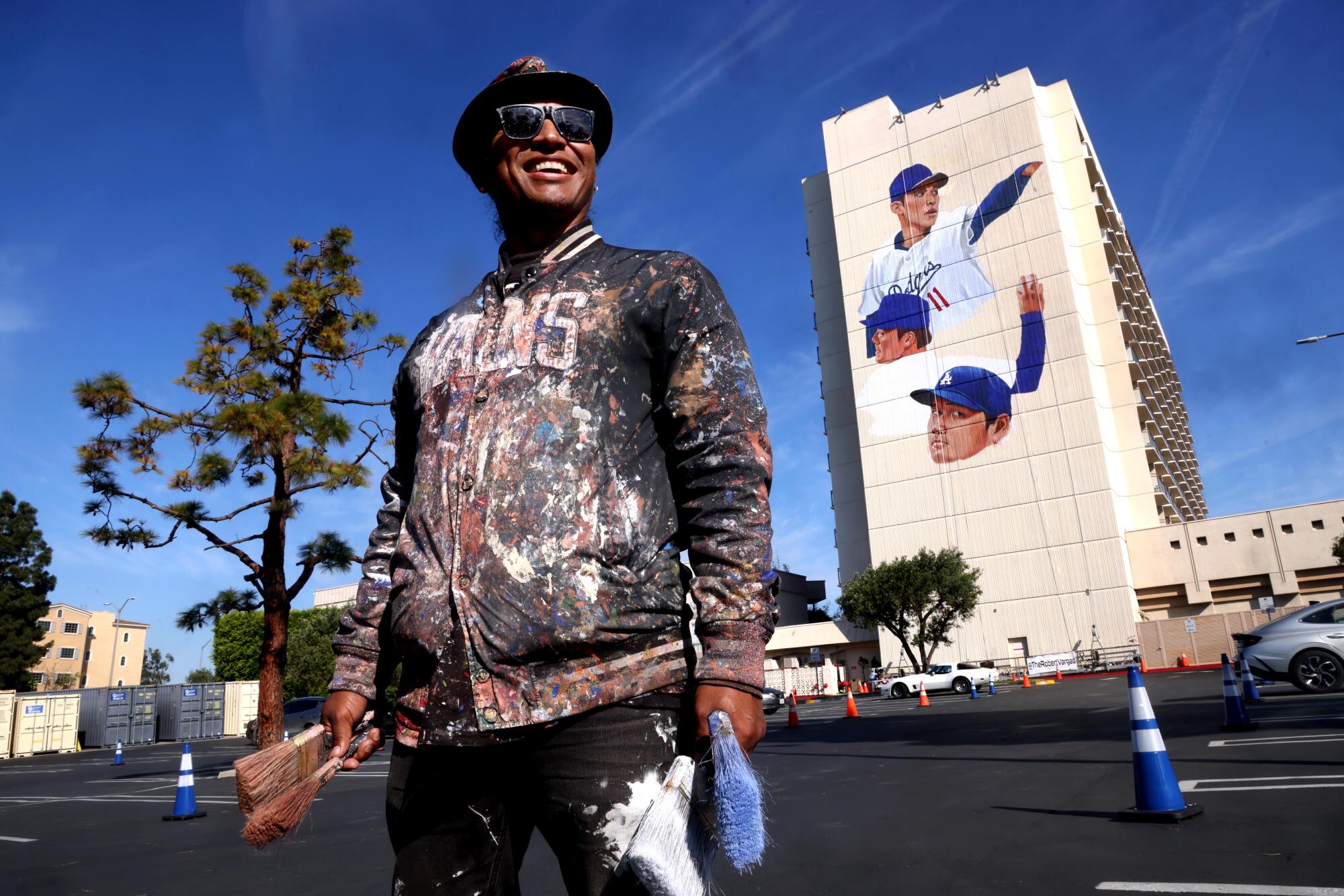
Robert Vargas plans to finish his ‘Samurai of the Diamond’ mural in time for its official unveiling Tuesday at 10 a.m.
(Genaro Molina / Los Angeles Times)
Around midday Saturday, Vargas faced another delay when high winds caused him to temporarily come down from the wall. He had already made arrangements to be able to work through the night on Saturday and said he was prepared to work nonstop, if necessary, to be finished in time for the unveiling two days before the Dodgers’ season opener Thursday against the Arizona Diamondbacks.
“I’m going to get it done,” he said.
“My time frames are pretty ambitious, but I also know what I’m capable of when it comes to my speed,” Vargas added. “And also I think that my process is really charged by my intention of why I’m creating these pieces, and that is what fuels me to completion.”

NEWYou can now listen to Fox News articles!
Kansas City, KS – With the 2026 FIFA World Cup just three months away, cities across the United States are racing to finalize training facilities that national teams will call home during the global tournament.
Among them is Kansas City, which will serve as the base camp for defending champion Argentina national football team, a major win for the region as it prepares to welcome both players and tens of thousands of international fans.
Base camps are critical to World Cup operations. They serve as home headquarters where teams live, train and recover while traveling between match sites throughout the competition.
WORLD CUP 2026: WHAT ARE THE HOST COUNTRIES, CITIES, STADIUMS?
World Cup 2026 signage is displayed in Kansas City, one of the tournament’s host cities. (Olivianna Calmes)
“From private practice fields to player recovery rooms, these facilities are designed to support some of the biggest names in soccer,” said Alan Dietrich, who has worked closely with organizers.
Local leaders have spent more than a year pitching their cities to international teams, hoping to showcase not just athletic facilities but the broader community.
“We started actually over a year ago with countries beginning to visit,” Dietrich said.
WORLD CUP DEMAND SPARKS LODGING SCRAMBLE IN KANSAS CITY
Tourism officials say the opportunity extends far beyond the sport itself. Hosting a base camp allows cities to introduce themselves to global audiences and build long-term international relationships.
To show support for Kansas City’s bid for the men’s 2026 FIFA World Cup, the KC2026 Bid Committee and Outfront media installed a 90×90-foot banner on Main Street in Kansas City, Missouri. (Jill Toyoshiba/The Kansas City Star/Tribune News Service via Getty Images)
“We knew that the World Cup was going to be kind of our first chance and probably our biggest chance to be engaging these international markets,” said Devin Aaron with Visit KC.
A locker room shows the “We are FIFA 2026 Kansas City” sign in Sporting KC training facility (Olivianna Calmes)
Early expectations had Argentina basing in Miami, but Kansas City ultimately stood out during the selection process.
“When Argentina visited, they really loved it here,” Dietrich said. “They loved our facilities, they loved our people.”
The team will train at Sporting Kansas City’s Compass Minerals National Performance Center, a state-of-the-art facility in Kansas City, Kansas that will serve as Argentina’s training home base during the tournament.
THE 2026 FIFA WORLD CUP LESS THAN 100 DAYS OUT! HERE’S WHAT TO KNOW
The complex features multiple professional grade fields and elite level training amenities designed for international competition.
Inside, players will have access to private dining areas, meeting rooms and dedicated recovery spaces designed to help them rest between matches.
A resting room for World Cup players (Olivianna Calmes)
“If they’ve traveled a lot and they’re tired, they can come in here, turn the lights out and get a nice nap,” Dietrich added.
Up to 100,000 Argentine fans are expected to travel to Kansas City during the tournament, a preview of the global crowds set to flood World Cup host cities across the U.S.
Across the U.S., cities selected as host sites and base camps are preparing for similar surges, as teams finalize training locations and fans follow their national squads.
Cities across the US which are hosting World Cup games (Fox News)
CLICK HERE TO DOWNLOAD THE FOX NEWS APP
The 2026 World Cup will be the largest in history, expanding from 32 to 48 teams and spanning host cities across the United States, Canada and Mexico, with each location competing for global visibility and long-term economic impact.

Video: Passenger Jet and Fire Truck Crash at LaGuardia Airport, Leaving 2 Dead

Here’s what Metro Detroit homebuyers face heading into spring season

Preparations for SMART expansion to Healdsburg set to begin

Construction underway on Harold Simmons Park’s first attraction

‘Confident’ Bencic takes out Anisimova, eyes Gauff next in Miami

Florida High School Football Rankings: Top 25 teams – Oct. 21

How old is Bo Nix? What to know about Oregon quarterback ahead of 2024 NFL Draft

Cleary's 21 help Le Moyne down Central Connecticut State 69-64 in OT

99th annual Pony Swim held in Virginia

Indiana Members Credit Union announced as new anchor tenant at Bottleworks District

See TSA Wait Times at Major U.S. Airports

Senate hopeful with deep Dem ties slapped with scathing complaint targeting alleged family payout ‘scheme’

How the Iran war is about to hit your wallet

Suspect in slaying of Loyola University student was in the country illegally, officials say

Video: Plane Collides With Vehicle at LaGuardia Airport
-

 Detroit, MI5 days ago
Drummer Brian Pastoria, longtime Detroit music advocate, dies at 68
-

 Oklahoma1 week ago
Family rallies around Oklahoma father after head-on crash
-

 Georgia1 week ago
How ICE plans for a detention warehouse pushed a Georgia town to fight back | CNN Politics
-
 Science1 week ago
Federal EPA moves to roll back recent limits on ethylene oxide, a carcinogen
-

 Alaska1 week ago
Police looking for man considered ‘armed and dangerous’
-

 Movie Reviews5 days ago
‘Youth’ Twitter review: Ken Karunaas impresses audiences; Suraj Venjaramoodu adds charm; music wins praise | – The Times of India
-
 Science1 week ago
Long COVID leaves thousands of L.A. county residents sick, broke and ignored
-

 Education1 week ago
Video: Turning Point USA Clubs Expand to High Schools Across America