Sports
Patt Morrison: As the world arrives in Paris for the Olympics, Paris food goes local. How can L.A. compete?

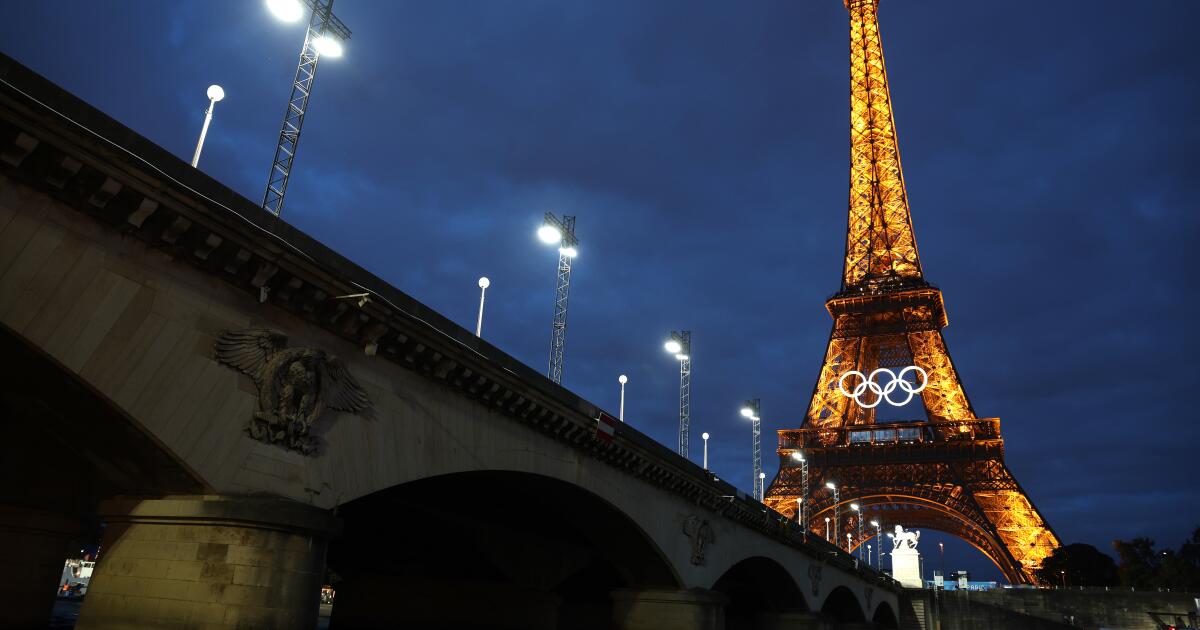
How do you say “locavore” en francais?
When Olympic athletes and members of the press sit down to dine on the bounty of France next month, some of what’s on their plates will have been grown and gardened and harvested — from underground garages to road medians to rooftops — in Paris.
Not every course of every meal, not by a long shot. Perhaps a microgreens or endive salad, with shitake mushrooms? Serving up 13 million Olympics meals and snacks, all exclusively Parisian-made, is beyond the reach of even this city’s cuisine miracle workers. And this bit of food bandwidth won’t be getting athlete-style scores or Michelin stars, but it will be enough to show the yield and reach of Paris’ ambitious “Capital Agricole” projects.
Edible Paris is one section you’ll find on the city’s long, ambitious enviro menu — a larger regreening of the City of Light into the City of Lighter Environmental Impact. Paris has begun banishing cars and car pollution from the city’s heart, plans to add almost 250 acres of green space and another 75 acres dedicated to urban agriculture — beehives, hops, fruit trees, vegetables, cultivated largely on public property.
When I was in Paris a while back, I made my way into the august French Renaissance-style city hall, the Hotel de Ville, and up to the office of Audrey Pulvar, the deputy mayor in charge of sustainable food and agriculture and the systems to make them possible.
I knew I’d come to the right place when I looked out the window beyond her desk and saw — a window box. Those weren’t flowers she was growing there; they were beets and tomatoes.
The ParisCulteurs project envisions a cultivated world city that cultivates more than flowers and fashion. Like any modern city, Paris’ early inhabitants raised their own food; the Romans, who called the place Lutetia, coaxed grapes and figs from the Gallic soil.
At Versailles, some 20 miles outside Paris, Queen Marie Antoinette had the Hameau, her little model farm with its working dairy. On the walls of the Paris suburb of Montreuil there once grew peaches of legendary richness, and a very few are still cultivated with the tenderness afforded to babies.
Yet for centuries, the best of France’s goods and goodies have floated upriver or flowed downhill for the care and feeding of Paris.
Pulvar’s projects are like the tines of a fork, several in number but working toward the same aims of nutrition and environmental responsibility. Paris already serves 30 million “collective catering” meals a year, she told me — to students, kids in daycare, city workers, the elderly and needy.
The AgriParis program that will be feeding athletes and journalists throughout the Games intends eventually to make all of that food organic and sustainable, and half of it produced within about 150 carbon-considerate miles of Paris. That sounds like a vast territory, but now it’s almost three times that.
Another tine on the French fork is the urban agriculture project to educate Parisian schoolchildren and their families about food — where it comes from and what it takes to bring it to their plates. (This reminded me of the time 10 years ago when I hung out with Jamie Oliver as he was trying to get the LAUSD on board with his good-food program. He found that some high schoolers could not identify basic food origins — honey comes from bears? Guacamole from green apples?)
The city of Paris owns a lot of land and a lot of buildings, and Pulvar’s projects welcome green-minded small businesses wanting to rent those spaces and grow and market their goods in civic spaces like roadway medians, abandoned parking lots and the rooftops of city-owned buildings and apartment complexes.
Paris still has empty acreage like the “petite ceinture,” or small belt, an abandoned 19th century railroad track that encircles Paris, and it’s being transformed into agricultural gardens. On old walls of a Paris that grew beyond them, beer brewers rent the vertical stretches for growing hops. A school rooftop is being dedicated for an aromatic garden of herbs, berries, vegetables and a solar dryer for teas. And an urban farm created atop the city’s Charonne reservoir grows and sells microgreens to locals, and teaches the green-minded how to grow them, too.
The Railway Farm, also on the small belt, is a community project that, with the blessings of the city, developed an award-winning enclave of homeless and student housing, agriculture and composting workshops, and crops of herbs, berries and vegetables — and the restaurant to serve them.
City of light, city of the 2024 Olympics, city of locally grown food.
(Wally Skalij / Los Angeles Times)
Parisians’ default verb may sometimes seem to be “grogner,” to grumble, but Pulvar thinks most ordinary Parisians are fine with the projects, especially the nonprofit initiatives.
“After COVID,” she told me, “many people realized they wanted their lives to be different. Often, they are people in business school who now have business degrees and who wanted to change their lives. A lot of women [do], especially, and it’s oftentimes led by neighborhood initiatives, groups who conceive of a project and decide to work on improving the lives of the people in their neighborhoods.”
At first, French farmers were skeptical, though. “They felt like they were being told they were not needed in the countryside anymore. That was not the case at all,” Pulvar said. “Everyone knows that we cannot feed Paris with city agriculture [alone]. We will always need the farmers outside of Paris.”
Now, what can L.A. — host of the next Summer Olympics in 2028 — possibly do to compete?
Confession: We can’t compete, not in the urban agriculture category. If our past performance as host of the 1984 Olympics is how we’d qualify, I don’t think we’d even make the team.
Not too much was made of what athletes were eating in 1984. The L.A. Olympic Organizing Committee put forth a “food vision” manifesto, promising a Southern California bounty of “fruit and vegetables in a variety and quantity like very few places in the world.”
There were a few stories about restaurants hoping for a tourist customer surge, and an Olympic Restaurant Ethics Committee was formed by a few restaurants to pledge good service and no price gouging.
The Times surveyed renowned chefs and found that beyond some red-white-and-blue-frosted desserts, and foodstuff arranged to suggest the Olympic rings — fruit, antipasti, onion rings — most weren’t bothering. Ken Frank, of the then-new-ish La Toque, said, “Just because I’m serving a five-course menu during the Olympics doesn’t mean I will call it a ‘pentathlon.’” (Since then, Frank’s restaurants have earned him a restaurateur’s gold medals: more than a dozen Michelin stars.)
Los Angeles Magazine’s deep dive into Olympic food turned up this: Despite the usual calorific dishes and never-expiring canned fruit cocktail, in 1984, some of the cuisine available round the clock to athletes at the nine Olympic Village cafeterias also stretched to “regional favorites: cheese enchiladas, gazpacho, and avocado soup” and dishes “still unfamiliar to most Americans in 1984: ceviche, tabbouleh, oriental vegetables and water chestnuts.” Also, radically, there were doggie bags.
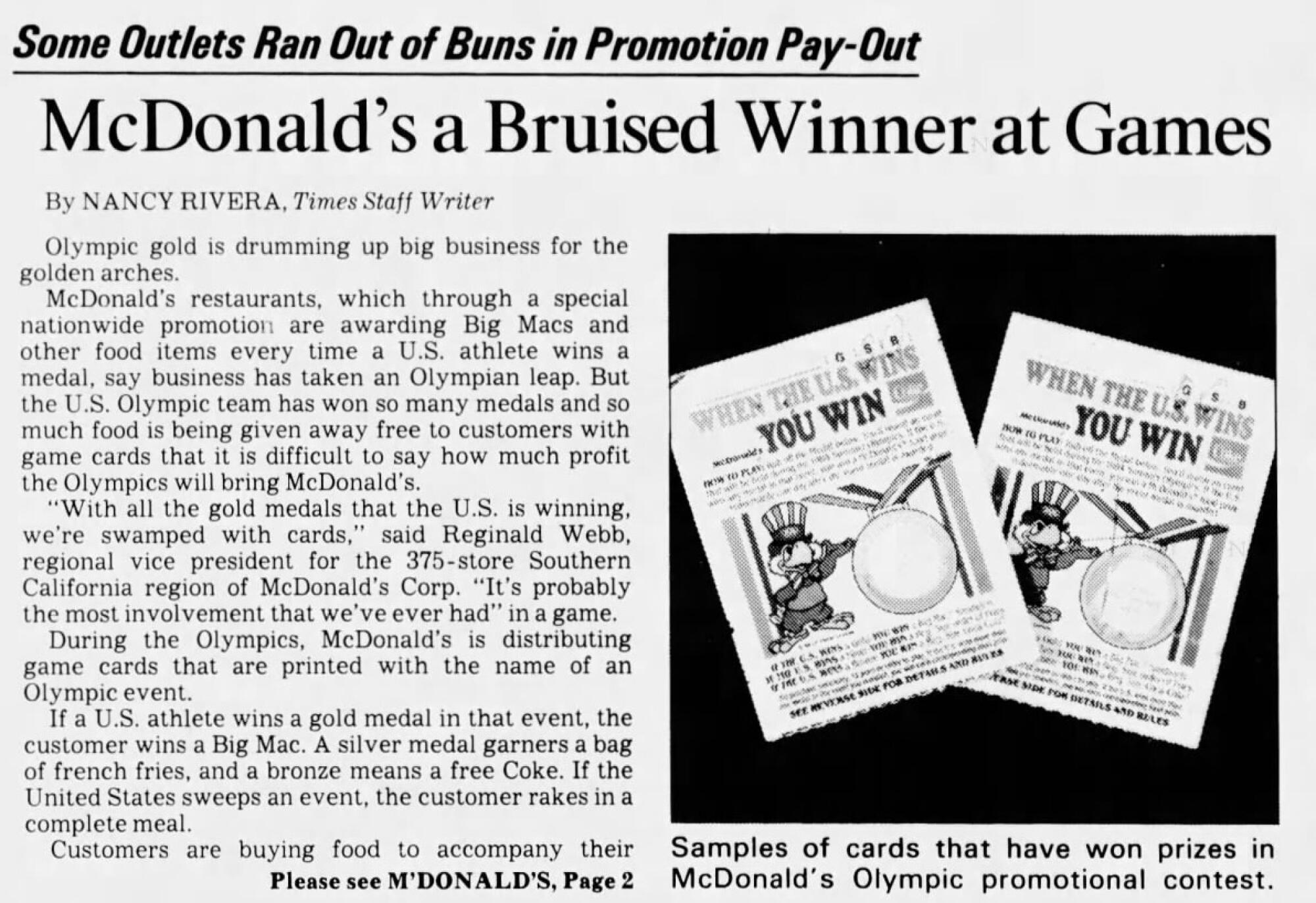
A clipping from The Times in August 1984 highlights the popularity and difficulty of an Olympics promotion put on by McDonald’s.
(Los Angeles Times archive / newspapers.com)
The best Olympics food story had nothing to do with what the athletes ate. McDonald’s promoted a game-card giveaway to customers, and for every card that matched up to an American athlete winning a medal, something on its menu — Cokes, fries, burgers — would be free.
McDonald’s hadn’t counted on the no-show-Commie effect of the Soviet boycott of the Games, so more Americans won medals in the Russians’ absence. A few franchises ran out of Big Mac buns. A McD’s regional VP told The Times back then that it was “the most successful” company games promotion, “but it’s also the most costly.”
And in 1932, when L.A. first landed the Summer Olympics, the L.A. Times’ “home services bureau” director offered some spirit-of-the-Games recipes: chicken curry for India — pretty daring then, no doubt -—and a “flag of all nations” ham, which turned out to be a pretty standard ham that was just ornamented with darling little flags from all the competing countries.
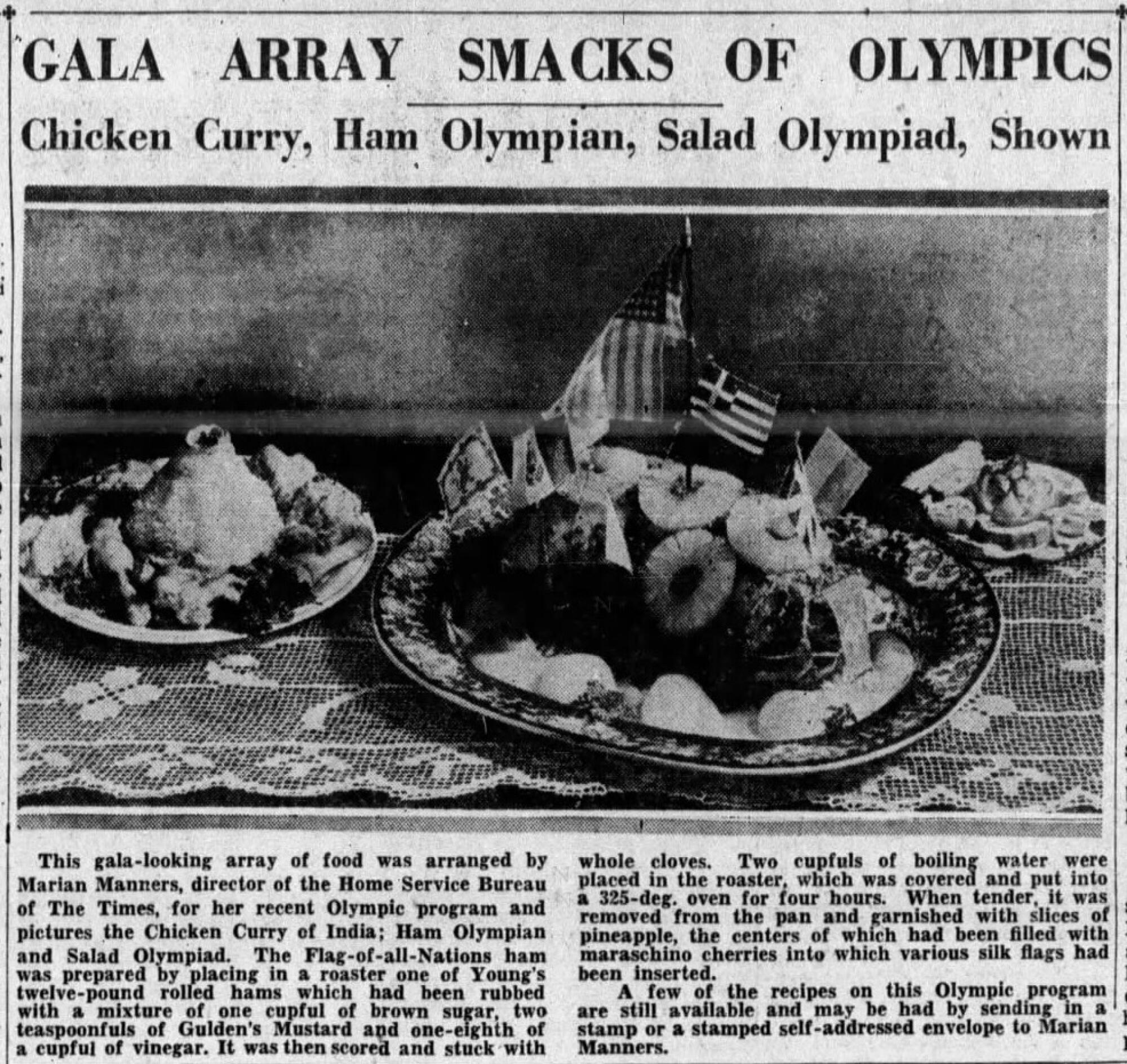
What makes this ham recipe “Olympian” — from an August 1932 edition of the Los Angeles Times about Olympic-themed food — seems to be mostly the flags.
(Los Angeles Times archive / newspapers.com)
We’ve long had a reputation as a cradle of health food culture. In the movie “Annie Hall,” Woody Allen aims his anti-L.A.-disdain at The Source, the pioneering health food restaurant on the Sunset Strip, by ordering “alfalfa sprouts and mashed yeast.” (The Source was operated by a kind of a culty guy who called himself Father Yod, but culty L.A. and culinary L.A. are ordinarily two different stories.)
Therefore, what we can’t match from Paris 2024, L.A. 2028 can contrast.
For every ounce of biotic-organic-supercleansing foodstuffs sold at Erewhon, we sell probably 10 pounds of the world’s most famous fast food. Most of the founding burger and taco empires were started up within maybe a hundred miles of L.A. City Hall. That’s what we should be peddling to the world’s greatest athletes: Welcome to L.A., and to all the basic food groups — salt, fat, sugar and guilty pleasure.
Go on! Have a burger! Have a doughnut! Taco trucks! Gas station sushi! Pho and poke bowls! Kosher burritos! Fatburgers and In-N-Out! Tommy’s hamburgers and Pink’s hot dogs! Fusion city, fusion food!
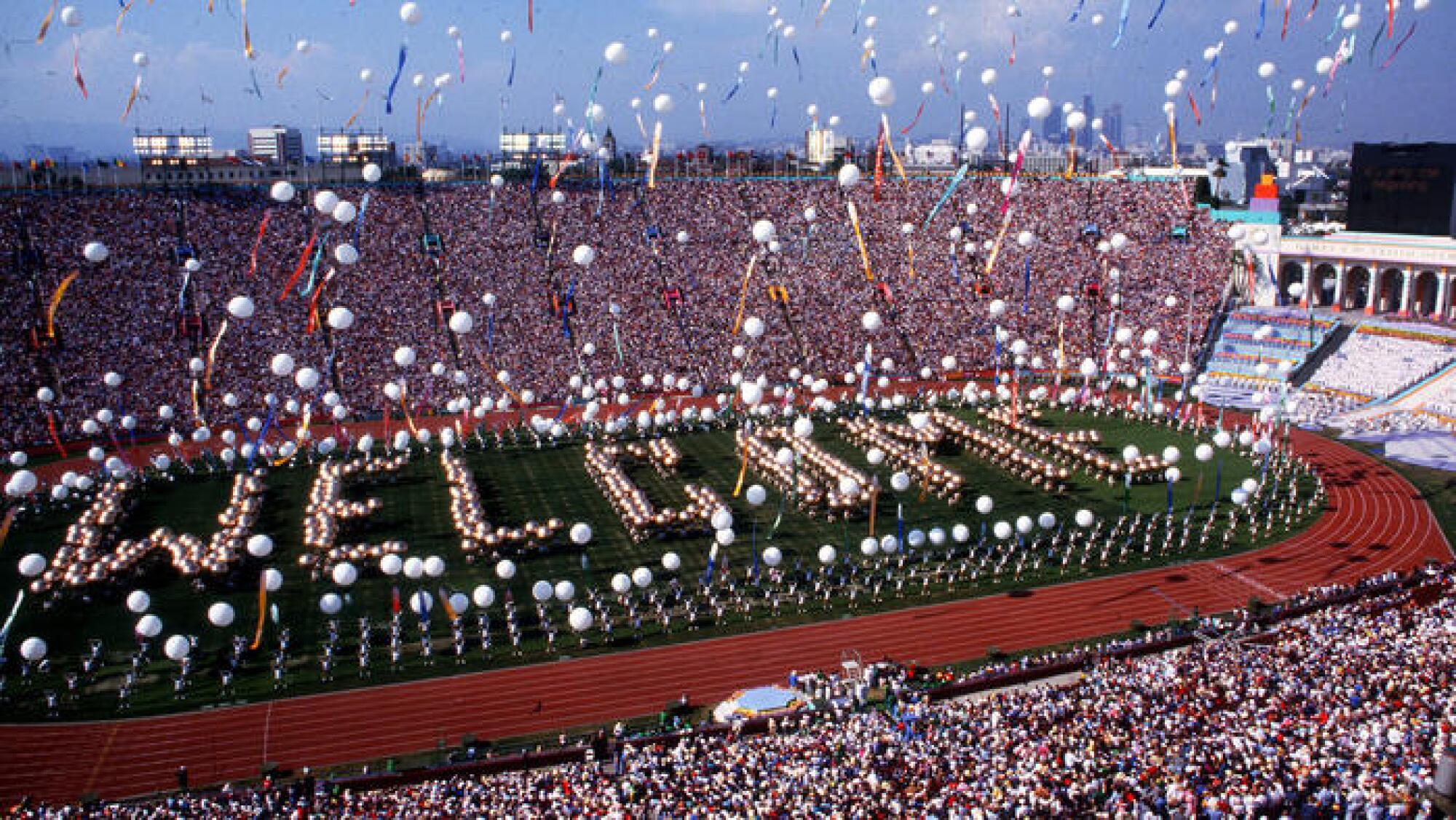
Welcome to L.A.! Enjoy the fast food (and the 1984 Olympics opening ceremony at the Coliseum)!
(Ken Hively / Los Angeles Times)
Perhaps only the Earl of Sandwich has done more for great fast food than Los Angeles.
We could give the athletes apps and maps to find some faves.
I envision social media accounts crammed with athletes’ selfies in front of Randy’s Doughnuts in Inglewood, an example of mimetic architecture — where the buildings look like the things they sell. (The Brown Derby was not mimetic because it didn’t sell derbies, but The Tamale in long-ago Montebello did sell tamales.)
And the ultimate pilgrimage: to the ground of the vanished Hinky Dink BBQ stand, the spot on old Route 66 at the border between Pasadena and Eagle Rock. About a hundred years ago, as the origin story goes, one of the boys in the Sternberger family may have scorched a burger and covered up the burn with a slab of cheese. Ladies and gentlemen, messieurs et mesdames, le cheeseburger.
Oh, and “locavore” in French? It’s “locavore.”

Explaining L.A. With Patt Morrison
Los Angeles is a complex place. In this weekly feature, Patt Morrison is explaining how it works, its history and its culture.



Sports
Stephen A. Smith called Zion Williamson a ‘food addict,’ is now feuding with the Pelicans on social
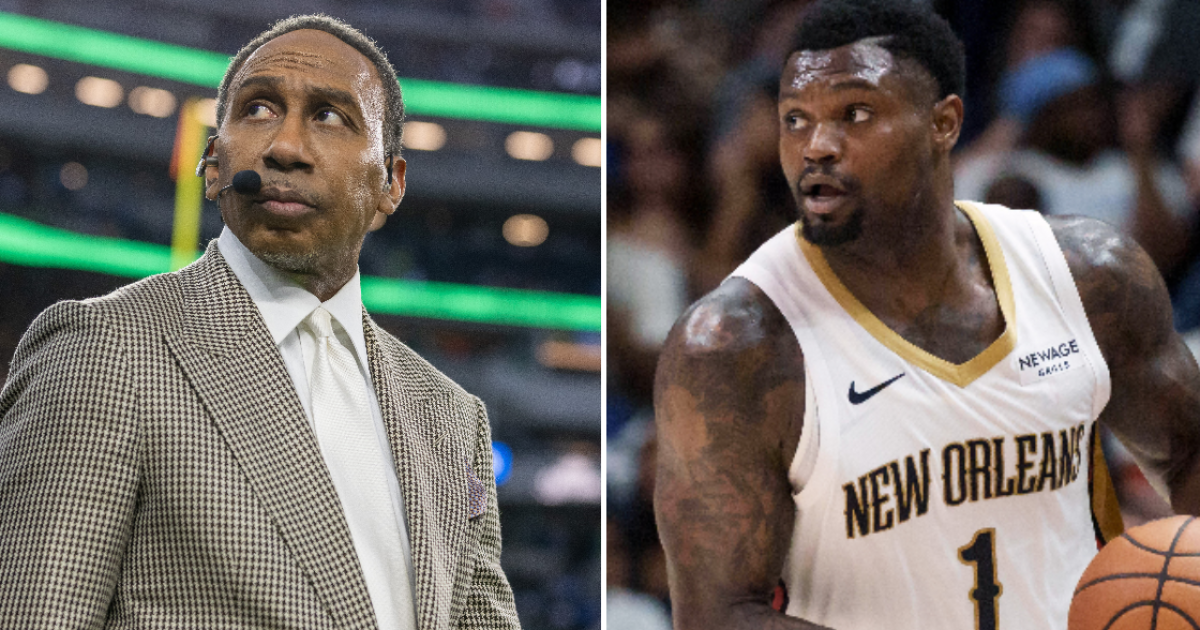
Williamson has been listed as 6-foot-6, 284 pounds since New Orleans selected him out of Duke with the No. 1 overall pick in the 2019 draft. His weight and fitness level have been regularly criticized, and the amount of time Williamson has missed because of injuries hasn’t helped (including all of the 2021-22 season following offseason right foot surgery).
After playing only 30 games last season because of a left hamstring strain and a lower back injury, Williamson reported for 2025-26 looking trim and in shape. He told reporters that he and Pelicans trainer Daniel Bove had come up with a strategy to address his fitness while rehabbing his hamstring and that he stuck to it.
“I haven’t felt like this since college, high school,” Williamson said at the time, “where I can walk in the gym and I’m like just, ‘I feel good.’”
Williamson has played in 46 of the Pelicans’ 63 games this season, already the third-most games he has played in his seven NBA seasons. In a recent interview with ESPN’s Malika Andrews, Williamson addressed how the past criticism affected him mentally.
“I would say the most difficult point was when I missed my third year with a broken foot, and there was a lot of criticism on my weight, my care for the game, etc.,” Williamson said. “But … while people were saying what they’re saying — and everybody’s entitled to their own opinion, it is what it is — I’m in Portland rehabbing, not knowing if my foot’s gonna heal, and it was frustrating. It was very frustrating.
“I was low. I was really low because I just wanted to play basketball. I just wanted to play the game I love, but every time you turn the TV on, every time I check my phone, it was nothing but negative criticism, man. At the time, it did a lot, like I said, it did a lot, but it was a blessing in disguise, and I learned from it and I grew from it.”
Sports
ESPN analyst Paul Finebaum questions Trump’s college sports reform meeting as potential ‘circus’

NEWYou can now listen to Fox News articles!
President Donald Trump will host a White House roundtable regarding college athletics reform later this week.
The panel is expected to include prominent coaches, college sports and pro sports league commissioners, and other professional athletes, according to OutKick.
The group will meet March 6 to examine solutions to key challenges, including NCAA authority; name, image and likeness issues (NIL); collective bargaining; and governance concerns.
President Donald Trump holds a football presented to him during a ceremony to present the Commander-in-Chief’s Trophy to the US Naval Academy football team, the Navy Midshipmen, in the East Room of the White House on April 15, 2025 in Washington, D.C. (BRENDAN SMIALOWSKI/AFP via Getty Images)
The meeting Friday will include big names like Nick Saban, Urban Meyer, Adam Silver and Tiger Woods. Trump has been adamant about “saving college sports,” even signing an executive order setting new restrictions on payments to college athletes back in July.
However, ESPN college analyst Paul Finebaum, who has previously hinted at a congressional run as a Republican, remains a bit skeptical.
“The easiest thing, guys, is just to say this is ridiculous,” Finebaum said to Greg McElroy and Cole Cubelic on WJOX. “And I read the other day, ‘Why is Nick Saban going?’ Why is anybody going? The bottom line is this. If something doesn’t happen very quickly, and I mean in the next short period of time, we’re talking about weeks, not years, then this thing could blow up.
“However it came about, I’m in favor of. The question now becomes, with some of the most powerful people in Washington in the same room, including the most powerful person in the country, can anything get done, or will it be a circus? Will it be just another show?”
U.S. President Donald Trump shakes hands with former Alabama Crimson Tide football coach Nick Saban as Trump takes the stage to address graduating students at Coleman Coliseum at the University of Alabama on May 01, 2025 in Tuscaloosa, Alabama. (Anna Moneymaker/Getty Images)
Trump’s order prohibits athletes from receiving pay-to-play payments from third-party sources. However, the order did not impose any restrictions on NIL payments to college athletes by third-party sources.
A House vote on the SCORE Act (Student Compensation and Opportunity through Rights and Endorsements), which would regulate name, image, and likeness deals, was canceled shortly before it was set to be brought to the floor in December.
The White House endorsed the act, but three Republicans, Byron Donalds, Fla., Scott Perry, Pa., and Chip Roy, Texas, voted with Democrats not to bring the act to the floor. Democrats have largely opposed the bill, urging members of the House to vote “no.”
President Donald Trump looks on before the college football game between the US Army and Navy at the M&T Bank Stadium in Baltimore, Maryland, on Dec. 13, 2025. (Alex WROBLEWSKI / AFP via Getty Images)
The SCORE Act would give the NCAA a limited antitrust exemption in hopes of protecting the NCAA from potential lawsuits over eligibility rules and would prohibit athletes from becoming employees of their schools. It prohibits schools from using student fees to fund NIL payments.
Fox News’ Chantz Martin and Ryan Gaydos contributed to this report.
Follow Fox News Digital’s sports coverage on X, and subscribe to the Fox News Sports Huddle newsletter
Related Article

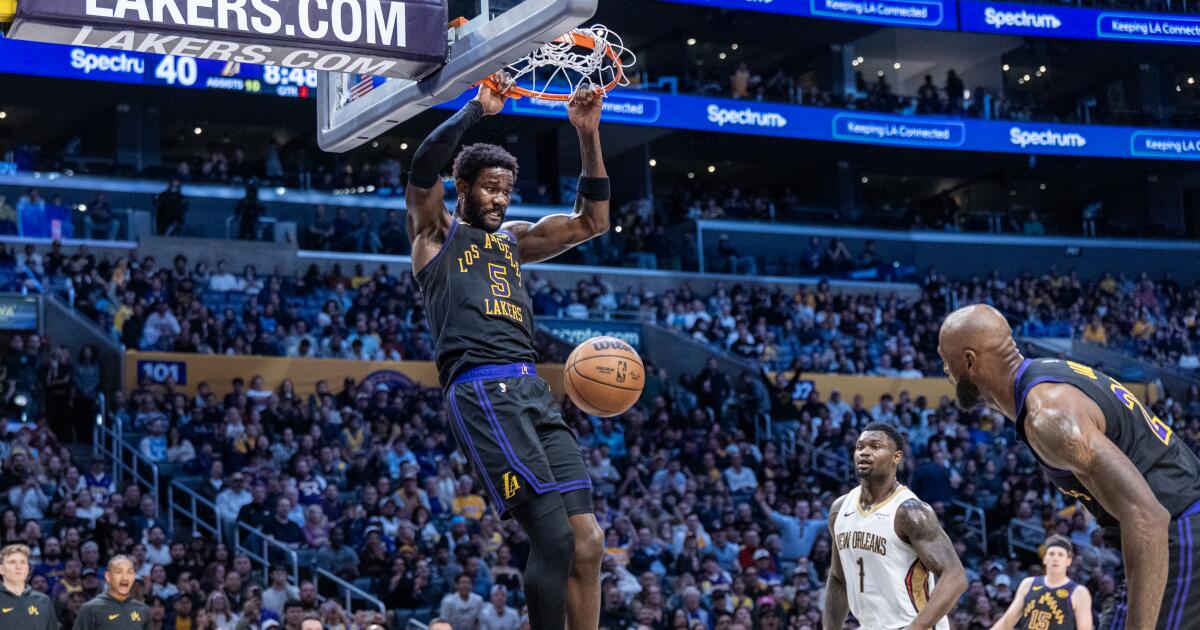
Lakers center Jaxson Hayes falls after Pelicans forward Zion Williamson commits an offensive foul as Lakers guard Austin Reaves watches at at Crypto.com Arena on Tuesday.
(Allen J. Schaben/Los Angeles Times)
Matching the physicality of Pelicans forwards Zion Williamson and Saddiq Bey was on the top of the Lakers’ scouting report. But the task is easier said than done.
Reaves admitted to being “terrified” of stepping in front of a driving Williamson to draw a charge. The 6-foot-6, 284-pound Pelicans forward is just as physical as he is athletic, creating a fearsome combination for defenders. Healthy for the first time in two seasons, Williamson led the Pelicans with 24 points on 10-for-18 shooting.
“We haven’t seen somebody like that in a long time, right?” Smart said. “[With] his ability. But [being] willing to put your body there, take a charge, take an elbow to the face, box him out, go vertical, is definitely something that you got to be willing to do, and not everybody’s willing to do it. And that’s the difference in the game.”
Center Jaxson Hayes was up to the task. He absorbed a Williamson elbow in the fourth quarter and ended up in the front row of the stands holding his jaw. But the knock was worth it for the offensive foul that helped maintain the Lakers’ 14-0 run that quickly erased the Pelicans’ eight-point lead. The scoring streak started immediately after Hayes subbed back into the game with 7:20 remaining after he scored on his first possession, cutting to the basket for a dunk off an assist from Doncic.
Hayes had eight points, six rebounds and two blocks, playing nearly 23 minutes off the bench in his biggest workload as a substitute since Jan. 20 against Denver. After playing with Hayes in New Orleans during the center’s first two years in the league, Redick lauded the seven-year pro’s improvement. Hayes is sinking touch shots around the rim now. He has improved his decision making in the pocket. After getting benched for his defensive lapses last season, Hayes has impressed coaches with his consistent ability to stay vertical while protecting the rim. And he still brings the same trademark athleticism that made him the eighth overall pick in 2019.
“He consistently injects energy into the group when he runs the floor, blocks a shot, or he gets those dunks,” Redick said.

Scams that aren’t illegal (but should be)

iPic movie theater chain files for bankruptcy

These 3 Disney movie songs, animated with sign language, are headed to Disney+

Bruce Johnston Retiring From The Beach Boys After 61 Years

Senate rejects war powers measure to withdraw forces from Iran

Florida High School Football Rankings: Top 25 teams – Oct. 21

Cleary's 21 help Le Moyne down Central Connecticut State 69-64 in OT

How old is Bo Nix? What to know about Oregon quarterback ahead of 2024 NFL Draft

99th annual Pony Swim held in Virginia

Indiana Members Credit Union announced as new anchor tenant at Bottleworks District

Sánchez defies Trump in political gamble as Madrid say no to war

Satellite images show Iran school strike hit more buildings than earlier reported

US submarine sinks Iranian warship by torpedo in a first since World War II

Which oil and gas facilities in the Gulf have been attacked?

Mojtaba Khamenei, son of former supreme leader, tipped to become Iran’s next head of state
-

 World7 days ago
Exclusive: DeepSeek withholds latest AI model from US chipmakers including Nvidia, sources say
-

 Massachusetts1 week ago
Mother and daughter injured in Taunton house explosion
-

 Wisconsin3 days ago
Setting sail on iceboats across a frozen lake in Wisconsin
-

 Denver, CO1 week ago
10 acres charred, 5 injured in Thornton grass fire, evacuation orders lifted
-

 Maryland4 days ago
AM showers Sunday in Maryland
-

 Louisiana1 week ago
Wildfire near Gum Swamp Road in Livingston Parish now under control; more than 200 acres burned
-

 Florida4 days ago
Florida man rescued after being stuck in shoulder-deep mud for days
-

 Oregon5 days ago
2026 OSAA Oregon Wrestling State Championship Results And Brackets – FloWrestling