Sports
Patt Morrison: As the world arrives in Paris for the Olympics, Paris food goes local. How can L.A. compete?


How do you say “locavore” en francais?
When Olympic athletes and members of the press sit down to dine on the bounty of France next month, some of what’s on their plates will have been grown and gardened and harvested — from underground garages to road medians to rooftops — in Paris.
Not every course of every meal, not by a long shot. Perhaps a microgreens or endive salad, with shitake mushrooms? Serving up 13 million Olympics meals and snacks, all exclusively Parisian-made, is beyond the reach of even this city’s cuisine miracle workers. And this bit of food bandwidth won’t be getting athlete-style scores or Michelin stars, but it will be enough to show the yield and reach of Paris’ ambitious “Capital Agricole” projects.
Edible Paris is one section you’ll find on the city’s long, ambitious enviro menu — a larger regreening of the City of Light into the City of Lighter Environmental Impact. Paris has begun banishing cars and car pollution from the city’s heart, plans to add almost 250 acres of green space and another 75 acres dedicated to urban agriculture — beehives, hops, fruit trees, vegetables, cultivated largely on public property.
When I was in Paris a while back, I made my way into the august French Renaissance-style city hall, the Hotel de Ville, and up to the office of Audrey Pulvar, the deputy mayor in charge of sustainable food and agriculture and the systems to make them possible.
I knew I’d come to the right place when I looked out the window beyond her desk and saw — a window box. Those weren’t flowers she was growing there; they were beets and tomatoes.
The ParisCulteurs project envisions a cultivated world city that cultivates more than flowers and fashion. Like any modern city, Paris’ early inhabitants raised their own food; the Romans, who called the place Lutetia, coaxed grapes and figs from the Gallic soil.
At Versailles, some 20 miles outside Paris, Queen Marie Antoinette had the Hameau, her little model farm with its working dairy. On the walls of the Paris suburb of Montreuil there once grew peaches of legendary richness, and a very few are still cultivated with the tenderness afforded to babies.
Yet for centuries, the best of France’s goods and goodies have floated upriver or flowed downhill for the care and feeding of Paris.
Pulvar’s projects are like the tines of a fork, several in number but working toward the same aims of nutrition and environmental responsibility. Paris already serves 30 million “collective catering” meals a year, she told me — to students, kids in daycare, city workers, the elderly and needy.
The AgriParis program that will be feeding athletes and journalists throughout the Games intends eventually to make all of that food organic and sustainable, and half of it produced within about 150 carbon-considerate miles of Paris. That sounds like a vast territory, but now it’s almost three times that.
Another tine on the French fork is the urban agriculture project to educate Parisian schoolchildren and their families about food — where it comes from and what it takes to bring it to their plates. (This reminded me of the time 10 years ago when I hung out with Jamie Oliver as he was trying to get the LAUSD on board with his good-food program. He found that some high schoolers could not identify basic food origins — honey comes from bears? Guacamole from green apples?)
The city of Paris owns a lot of land and a lot of buildings, and Pulvar’s projects welcome green-minded small businesses wanting to rent those spaces and grow and market their goods in civic spaces like roadway medians, abandoned parking lots and the rooftops of city-owned buildings and apartment complexes.
Paris still has empty acreage like the “petite ceinture,” or small belt, an abandoned 19th century railroad track that encircles Paris, and it’s being transformed into agricultural gardens. On old walls of a Paris that grew beyond them, beer brewers rent the vertical stretches for growing hops. A school rooftop is being dedicated for an aromatic garden of herbs, berries, vegetables and a solar dryer for teas. And an urban farm created atop the city’s Charonne reservoir grows and sells microgreens to locals, and teaches the green-minded how to grow them, too.
The Railway Farm, also on the small belt, is a community project that, with the blessings of the city, developed an award-winning enclave of homeless and student housing, agriculture and composting workshops, and crops of herbs, berries and vegetables — and the restaurant to serve them.
City of light, city of the 2024 Olympics, city of locally grown food.
(Wally Skalij / Los Angeles Times)
Parisians’ default verb may sometimes seem to be “grogner,” to grumble, but Pulvar thinks most ordinary Parisians are fine with the projects, especially the nonprofit initiatives.
“After COVID,” she told me, “many people realized they wanted their lives to be different. Often, they are people in business school who now have business degrees and who wanted to change their lives. A lot of women [do], especially, and it’s oftentimes led by neighborhood initiatives, groups who conceive of a project and decide to work on improving the lives of the people in their neighborhoods.”
At first, French farmers were skeptical, though. “They felt like they were being told they were not needed in the countryside anymore. That was not the case at all,” Pulvar said. “Everyone knows that we cannot feed Paris with city agriculture [alone]. We will always need the farmers outside of Paris.”
Now, what can L.A. — host of the next Summer Olympics in 2028 — possibly do to compete?
Confession: We can’t compete, not in the urban agriculture category. If our past performance as host of the 1984 Olympics is how we’d qualify, I don’t think we’d even make the team.
Not too much was made of what athletes were eating in 1984. The L.A. Olympic Organizing Committee put forth a “food vision” manifesto, promising a Southern California bounty of “fruit and vegetables in a variety and quantity like very few places in the world.”
There were a few stories about restaurants hoping for a tourist customer surge, and an Olympic Restaurant Ethics Committee was formed by a few restaurants to pledge good service and no price gouging.
The Times surveyed renowned chefs and found that beyond some red-white-and-blue-frosted desserts, and foodstuff arranged to suggest the Olympic rings — fruit, antipasti, onion rings — most weren’t bothering. Ken Frank, of the then-new-ish La Toque, said, “Just because I’m serving a five-course menu during the Olympics doesn’t mean I will call it a ‘pentathlon.’” (Since then, Frank’s restaurants have earned him a restaurateur’s gold medals: more than a dozen Michelin stars.)
Los Angeles Magazine’s deep dive into Olympic food turned up this: Despite the usual calorific dishes and never-expiring canned fruit cocktail, in 1984, some of the cuisine available round the clock to athletes at the nine Olympic Village cafeterias also stretched to “regional favorites: cheese enchiladas, gazpacho, and avocado soup” and dishes “still unfamiliar to most Americans in 1984: ceviche, tabbouleh, oriental vegetables and water chestnuts.” Also, radically, there were doggie bags.
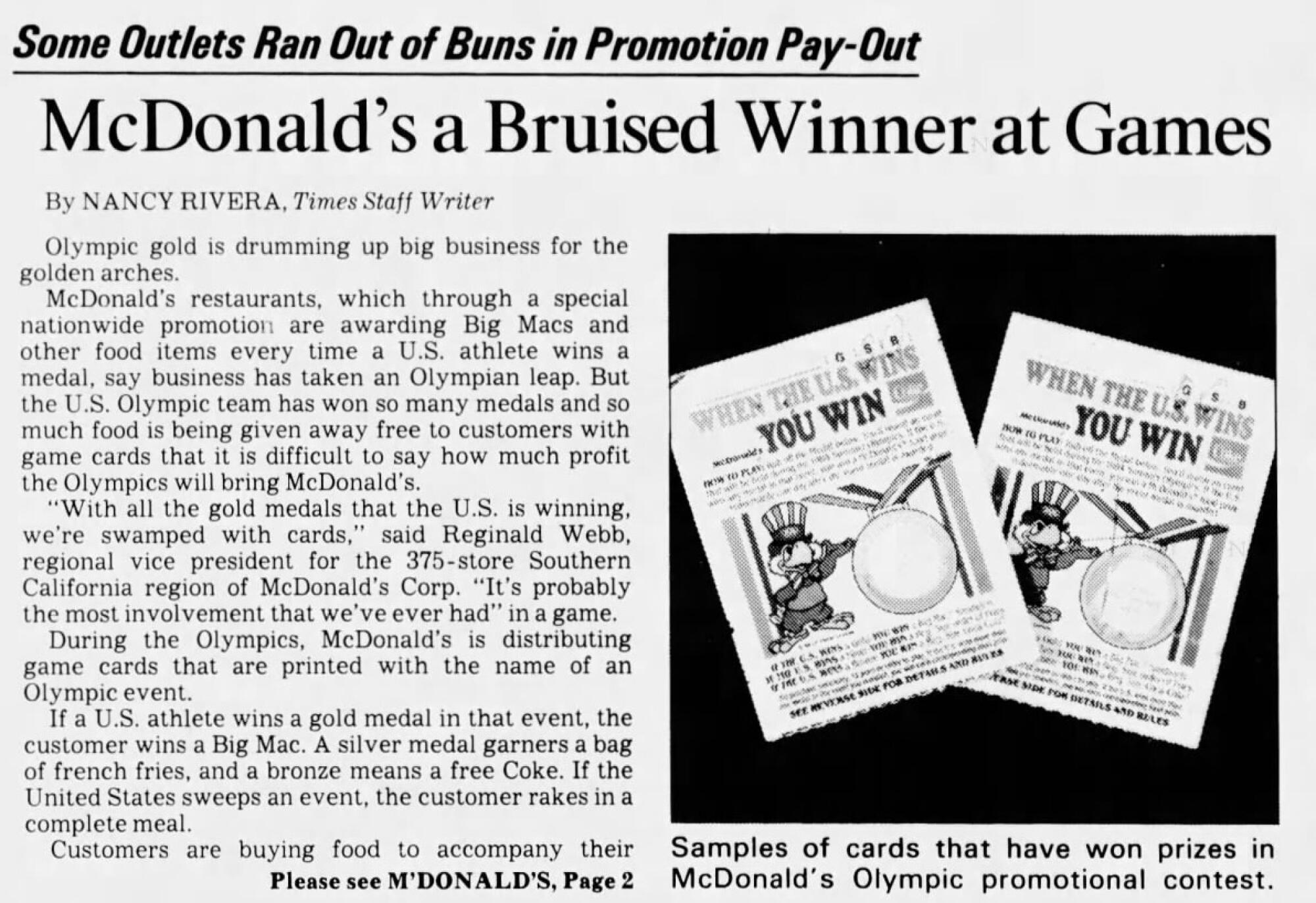
A clipping from The Times in August 1984 highlights the popularity and difficulty of an Olympics promotion put on by McDonald’s.
(Los Angeles Times archive / newspapers.com)
The best Olympics food story had nothing to do with what the athletes ate. McDonald’s promoted a game-card giveaway to customers, and for every card that matched up to an American athlete winning a medal, something on its menu — Cokes, fries, burgers — would be free.
McDonald’s hadn’t counted on the no-show-Commie effect of the Soviet boycott of the Games, so more Americans won medals in the Russians’ absence. A few franchises ran out of Big Mac buns. A McD’s regional VP told The Times back then that it was “the most successful” company games promotion, “but it’s also the most costly.”
And in 1932, when L.A. first landed the Summer Olympics, the L.A. Times’ “home services bureau” director offered some spirit-of-the-Games recipes: chicken curry for India — pretty daring then, no doubt -—and a “flag of all nations” ham, which turned out to be a pretty standard ham that was just ornamented with darling little flags from all the competing countries.
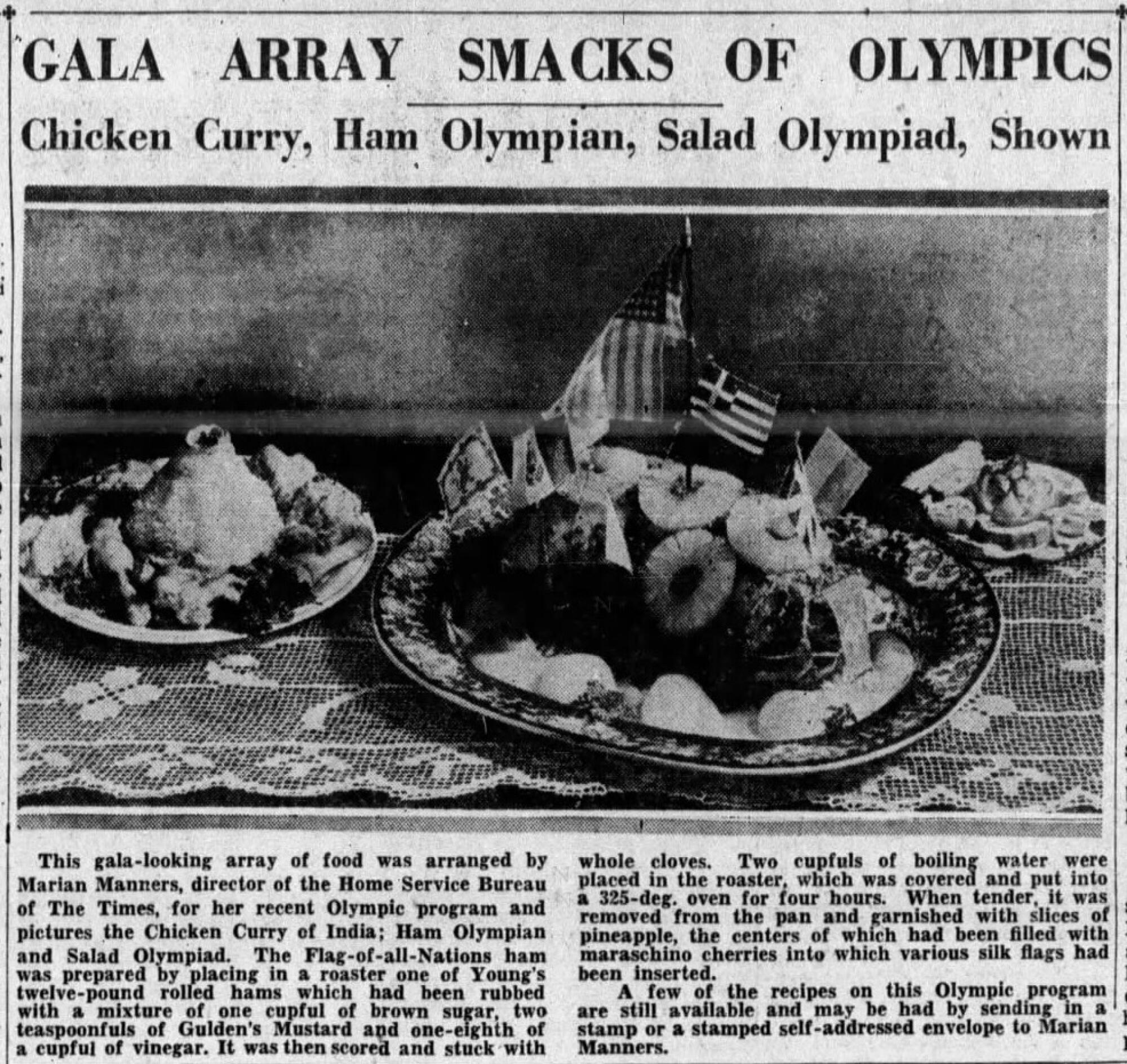
What makes this ham recipe “Olympian” — from an August 1932 edition of the Los Angeles Times about Olympic-themed food — seems to be mostly the flags.
(Los Angeles Times archive / newspapers.com)
We’ve long had a reputation as a cradle of health food culture. In the movie “Annie Hall,” Woody Allen aims his anti-L.A.-disdain at The Source, the pioneering health food restaurant on the Sunset Strip, by ordering “alfalfa sprouts and mashed yeast.” (The Source was operated by a kind of a culty guy who called himself Father Yod, but culty L.A. and culinary L.A. are ordinarily two different stories.)
Therefore, what we can’t match from Paris 2024, L.A. 2028 can contrast.
For every ounce of biotic-organic-supercleansing foodstuffs sold at Erewhon, we sell probably 10 pounds of the world’s most famous fast food. Most of the founding burger and taco empires were started up within maybe a hundred miles of L.A. City Hall. That’s what we should be peddling to the world’s greatest athletes: Welcome to L.A., and to all the basic food groups — salt, fat, sugar and guilty pleasure.
Go on! Have a burger! Have a doughnut! Taco trucks! Gas station sushi! Pho and poke bowls! Kosher burritos! Fatburgers and In-N-Out! Tommy’s hamburgers and Pink’s hot dogs! Fusion city, fusion food!
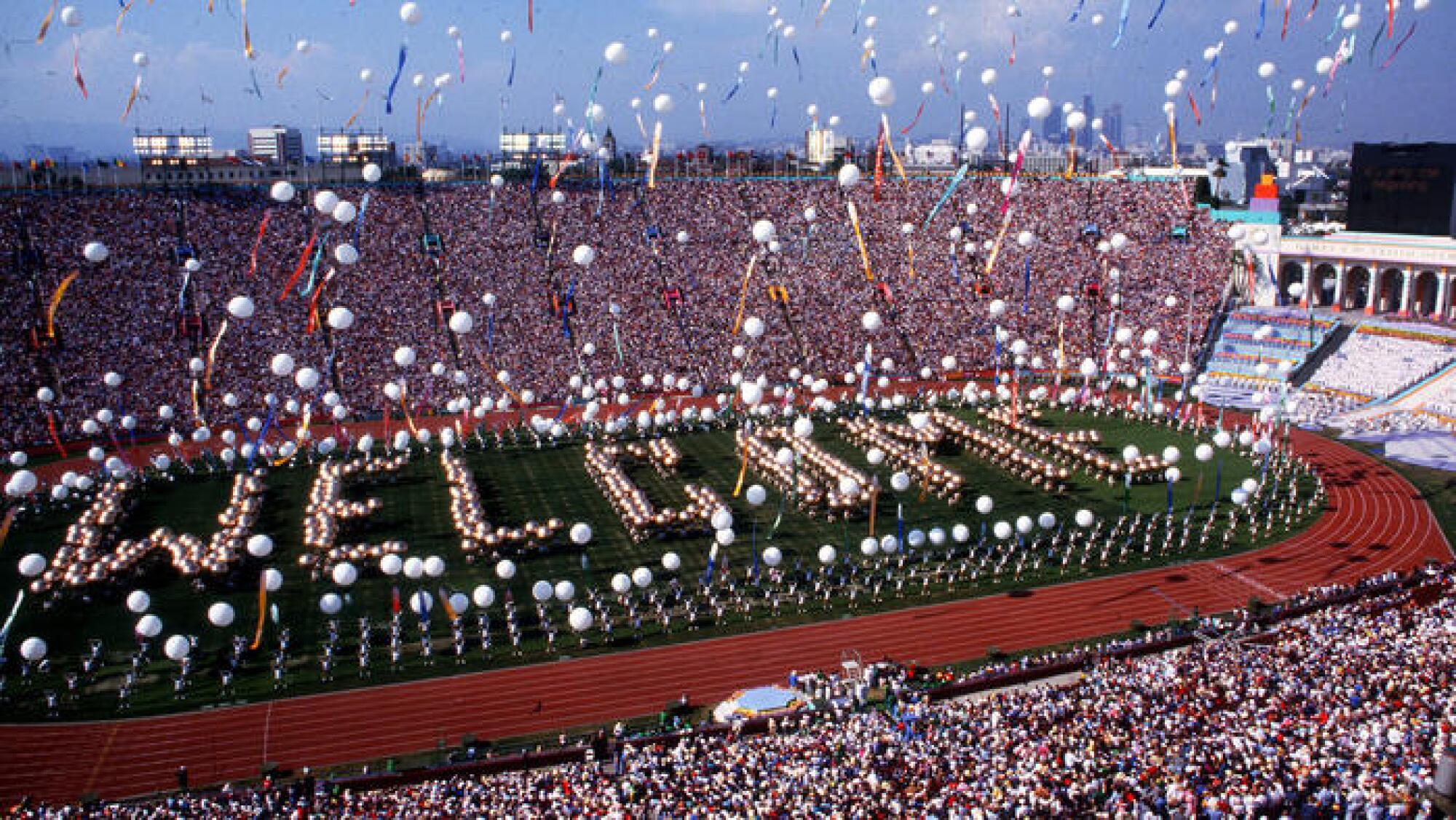
Welcome to L.A.! Enjoy the fast food (and the 1984 Olympics opening ceremony at the Coliseum)!
(Ken Hively / Los Angeles Times)
Perhaps only the Earl of Sandwich has done more for great fast food than Los Angeles.
We could give the athletes apps and maps to find some faves.
I envision social media accounts crammed with athletes’ selfies in front of Randy’s Doughnuts in Inglewood, an example of mimetic architecture — where the buildings look like the things they sell. (The Brown Derby was not mimetic because it didn’t sell derbies, but The Tamale in long-ago Montebello did sell tamales.)
And the ultimate pilgrimage: to the ground of the vanished Hinky Dink BBQ stand, the spot on old Route 66 at the border between Pasadena and Eagle Rock. About a hundred years ago, as the origin story goes, one of the boys in the Sternberger family may have scorched a burger and covered up the burn with a slab of cheese. Ladies and gentlemen, messieurs et mesdames, le cheeseburger.
Oh, and “locavore” in French? It’s “locavore.”

Explaining L.A. With Patt Morrison
Los Angeles is a complex place. In this weekly feature, Patt Morrison is explaining how it works, its history and its culture.

Sports
Jazz Chisholm explains why he still won’t wear a cup after fouling a pitch into his own groin

NEWYou can now listen to Fox News articles!
Men around the country are still wincing from the sight of New York Yankees second baseman Jazz Chisholm Jr. fouling a pitch straight into his own groin.
It was bad enough that Chisholm had to leave the game, and it left many wondering why he wasn’t wearing a cup to protect himself.
Well, now we have an answer.
ZERO BS. JUST DAKICH. TAKE THE DON’T @ ME PODCAST ON THE ROAD. DOWNLOAD NOW!
New York Yankees second baseman Jazz Chisholm Jr. took a brutal shot to the groin on Thursday night. (Wendell Cruz-Imagn Images)
Yankees beat writer Gary Philips shared some quotes from Chisholm explaining why he wasn’t a cup guy before taking a foul ball to the cojones, and why he isn’t going to be a cup guy moving forward.
WEEKS AFTER BULLFIGHTER SUFFERED PERFORATED RECTUM, ANOTHER WAS GORED IN GROIN AND REQUIRED EMERGENCY SURGERY
Chisholm said that the pain level was a “million,” and that, “If you ever got hit in the testicles, you would know.”
Most males reading this just nodded at that statement.
But Chisholm revealed that despite cups being mandatory in the minor leagues, he still skipped them and will continue to because he trusts his own defensive abilities.
“I’ve never worn a cup,” he said. “I’ve never been hit in the balls. That was just unlucky.”
Now, there are times when I wonder why men don’t wear cups all the time just for some peace of mind (I feel that way about helmets too). You wouldn’t regret not wearing a cup until the moment you’re at a cookout and a rogue volleyball puts you in shambles.
But I also like that Chisholm trusts himself to react and protect the boys. I’ve always said that a fairly significant part of a man’s life is devoted to protecting his lower anatomy.
You’re ever vigilant, trying to steer clear of anything that could leave you doubled over on the ground, and spouting off every expletive you know and several others you didn’t realize you knew.
Jazz Chisholm Jr. says he’ll rely on his defensive abilities instead of wearing a cup moving forward. (David Richard-Imagn Images)
Waist-high branches, table corners, projectiles, bicycle seats, even a pet jumping in your lap when you’re not ready.
CLICK HERE TO DOWNLOAD THE FOX NEWS APP
Chisholm is self-aware enough to know where his self-preservation reflexes stand, and I respect that.
But if he takes another foul ball to the lower area of his body, he might want to start rethinking that stance on cups.

There have been dozens of football transfers in Southern California during the offseason, but the one transfer who could make the greatest impact is running back AJ McBean, who announced he was leaving Mira Costa High for Gardena Serra.
McBean, who ran 10.55 seconds in the 100 meters this spring thanks to Mira Costa’s track program and his commitment to getting faster, joins a Serra offense that returns all five starters on the offensive line. He’s got the speed and strength to help the Cavaliers make up for not reaching the Southern Section playoffs last season out of the extremely competitive Mission League.
He’s been a long-time resident of Hermosa Beach, so what would motivate him to leave Mira Costa after recently making a commitment to Stanford? He apparently wants to prepare for college by being used in a more versatile role catching passes out of the backfield to show off his many skills. At least that’s what his family told coach Scott Altenberg. Mira Costa was changing its offense to better feature him, so it’s a tough loss for the Mustangs.
McBean will have to move to become eligible immediately.
Hope at Whittier
Former Garfield coach Lorenzo Hernandez, in his first season at Whittier, has already discovered a talent he can’t wait to develop. Offensive and defensive lineman Joseph Medina from the class of 2028 has made quite a first impression on Hernandez.
Medina didn’t play last season, “and in three months that we have been here, he is off the charts,” Hernandez said.
Hernandez calls him “a great technician and amazing leader.”
Agoura QB depth
Never has coach Dustin Croick of Agoura had more quality depth at quarterback than what he will have this season thanks to two newcomers.
Junior Kris Carranza has transferred from Sierra Canyon to Agoura and is a top candidate to start. The Chargers are also adding incoming freshman quarterback Emerson Andrews, whose father, David, played tight end at Ohio State and was a member of the 2002 national championship team. He is director of athletic performance for UCLA’s men’s basketball program. If anyone has a strength and conditioning question, submit it to Emerson, who knows someone.
Commitments rolling in
With college recruiters headed on vacation, lots of players decided to make commitments to make sure they have a “certain” destination. There’s also a new trend of players announcing on social media posts that they are “shutting down” their recruitment, which is supposed to mean their decision is final. Then how come others keep recruiting them? Because it’s never final in this era of NIL.
Quarterback Chris Fields, the City Section player of the year from Carson, committed to Georgetown. Offensive lineman Micah Butler from Hamilton committed to Sacramento State. Kicker Gabriel Goroyan of Westlake committed to Stanford. Defensive back Wesley Ace from Gardena Serra committed to San Jose State.
Man among boys
USC recruiters deserve praise for identifying the best in Southern California and pursuing them with great intensity. There’s no doubt that Damien safety Gavin Williams, a USC commit, will be the standard for excellence this coming season. He’s fast and strong and players who don’t adjust to his physical skills are in for a surprise.
Damien won the Chaminade seven-on-seven passing tournament on Saturday, beating Crespi in the final. On the first play, Williams caught a long touchdown pass, sprinting well past the defender who had no idea how fast he runs.
First-year coaches galore
It’s going to be fun tracking the progress of first-year football coaches this season because there are so many at well-known programs. The question of who will have the best record should be debated all summer.
Iggy Porchia became the latest new hire, replacing his mentor, the late Angelo Gasca, at Venice.
There should be a competition on which new private coach will have the best record and which new public school coach will have the best record. There’s so many candidates with new coaches at JSerra, Orange Lutheran, Servite, Los Alamitos, St. Francis, St. Bernard, Bishop Montgomery, Oaks Christian, Whittier Christian, Bishop Alemany, Muir, Pasadena, Long Beach Poly, Arroyo, North Hollywood, Sun Valley Poly and on it goes.
Transfer issues coming
It appears the Southern Section will be busy again this fall after last year’s eligibility scandal when it declared 19 transfer students ineligible at Bishop Montgomery, resulting in the varsity season being ended after one game and forcing the Archdiocese of Los Angeles to clean up what looked like a preventable mess.
This time it could be public schools facing scrutiny. The same rumors that started last summer about schools loading up on transfers are circulating again this summer. Principals who don’t act after multiple transfers seemingly out of nowhere start showing up to play football only have themselves to blame.
And schools that delay submitting transfer paperwork until the last minute thinking investigators will be too busy to spot an error don’t understand the process.
City Section commissioner Vicky Lagos has a policy that she immediately schedules a meeting with the administration, athletic director, coach and parents when one school receives multiple transfers to review paperwork. The Southern Section deployed AI last fall to help it catch parents submitting false information.
So prepare for more exciting times. It’s like a cat-and-mouse game. And don’t forget about the anonymous emails identifying parents not living at the official address they put on their transfer paperwork.

MLB faces DOJ investigation over Pride hats controversy
Major League Baseball is under a DOJ investigation following controversy over Pride-themed hats. The San Francisco Giants pitchers wrote Bible verses on rainbow caps, prompting an MLB warning and a DOJ statement questioning a ‘double standard’ for ‘Black Lives Matter’ patches versus religious inscriptions. This follows the York Revolution forfeiting a game due to players refusing Pride jerseys, highlighting free speech and religious liberty issues within sports.
NEWYou can now listen to Fox News articles!
I’m glad we didn’t take the run line yesterday in the baseball game. We had the under eight for the game between the White Sox and Tigers, and it ended 4-3. The Tigers did pull off the win, but as I mentioned, it wasn’t justified that Detroit should be -250, even with Tarik Skubal on the mound. Today, we shift to the Chicago National League team as the Cubs host the Blue Jays.
The Toronto Blue Jays are a team I’ve written about probably more than most squads in the league. That’s not a complaint or anything, it just happens that I see a lot of value in their games. Most of that is because when they are favorites, they aren’t big favorites given their 37-39 record and rash of injuries to their pitching staff. When they are dogs, they are usually pretty small pups, offering little value, but that means the opposing favorite isn’t too high of a price.
CLICK HERE FOR MORE OUTKICK SPORTS COVERAGE
Pete Crow-Armstrong #4 of the Chicago Cubs rounds the bases after hitting a solo home run in the eighth inning during the game between the Chicago Cubs and the St. Louis Cardinals at Busch Stadium on Saturday, May 30, 2026 in St. Louis, Missouri. (Photo by Ali Overstreet/MLB Photos via Getty Images) (Ali Overstreet/MLB Photos via Getty Images)
The Jays were blitzed by the Cubs yesterday, and they will need a strong start today from Patrick Corbin. The once highly touted hurler is just 2-3 with a 4.57 ERA and a 1.48 WHIP. He had a decent year with the Rangers, but seems to be struggling again, as he did in his time with the Nationals. Corbin is a little more reliable on the road, given that he has pitched 10 more innings and has allowed three fewer runs on the road than at home, leading to a 3.57 ERA. He hasn’t given the Blue Jays much lately, going just 11.2 innings in three starts and allowing 11 runs on 17 hits. Cubs hitters are very strong against him, batting .316 against him.
The Cubs are one of the more frustrating teams to watch this season. Perhaps that is me just saying that as a fan of the team, but they’ve had two 10-game winning streaks, and also a losing streak of 10 games. Since May 9, the team has gone 13-24. Sure, some of that can be attributed to injuries to their pitching staff — they have only two healthy starters from the beginning of the year. But, most of this needs to be placed on the hitting of the club. Nico Hoerner is batting .238, Ian Happ is at .228, and Dansby Swanson is a pathetic .177.
Toronto Blue Jays’ Ernie Clement hits a three-run home run during the third inning against the Baltimore Orioles in Toronto on June 6, 2026. (Frank Gunn/The Canadian Press)
Still, the Cubs broke out the bats yesterday, and Pete Crow-Armstrong looks like the five-tool player from the first half of last season. If they can get some pitching, maybe they will be the dominant team we saw earlier this year. Today’s starter is Colin Rea, who has not been very good this month. He has made three starts, allowed 19 hits, and 13 earned runs over 14.2 innings pitched. He has, however, been much better at home with a 3.03 ERA in five starts (six appearances). Blue Jays hitters haven’t seen much of him, but are hitting .176 against Rea in 17 at-bats.
There is a clear player prop to play in this one. However, the bad news is that he is not on the list of options, so you might need to request or find him in a different book other than DraftKings. Michael Conforto is 12-for-36 against Corbin with seven extra-base hits, including five homers. I’d play him at 2+ total bases and at one homer as long as you can get +200 or better for the bases, and +700 for the homer prop.
CLICK HERE TO DOWNLOAD THE FOX NEWS APP
Pete Crow-Armstrong #4 of the Chicago Cubs reacts after getting hit by a pitch in the eighth inning against the Chicago White Sox at Rate Field on May 17, 2026 in Chicago, Illinois. (Michael Hirschuber/Getty Images)
If you can’t find it, or they never post it (but I have to imagine they will give options once he is added to the lineup, and he absolutely should be, given his history), I still have a play. I’m taking the Cubs at -130 here. Rea isn’t the most reliable, but he should at least be decent here, and the Cubs will have the fresher bullpen. Give me the Cubs to win this one.
CLICK HERE FOR MORE SPORTS COVERAGE ON FOXNEWS.COM
For more sports betting information and plays, follow David on X/Twitter: @futureprez2024
-
 Lifestyle20 minutes ago
How actress Laverne Cox became the woman of her dreams (CT+) : Consider This from NPR
-

 Technology30 minutes ago
The Atlantic created a searchable database of the music used to train AI
-

 World35 minutes ago
Keir Starmer reportedly considering stepping down as PM and could announce timetable for departure
-

 Politics42 minutes ago
Pope Leo sends unmistakable message on immigrants during visit honoring America’s first saint
-

 Health45 minutes ago
Male breast cancer survivor shares warning after unexpected diagnosis
-

 Sports50 minutes ago
Jazz Chisholm explains why he still won’t wear a cup after fouling a pitch into his own groin
-

 Technology57 minutes ago
Travel mistake puts phone, laptop and streaming accounts at risk
-
 Business60 minutes ago
Tractor-trailer crosses center divider in Irwindale, killing 1 and injuring 30

