Sports
MLB offense is nearing all-time lows — hitters have theories: 'Pitching is out of control'


Here’s a thought that defines baseball in 2024: What if the whole sport suddenly turned into Bruce Bochy?
No, not Bruce Bochy, the future Hall of Fame manager. We’re talking about Bruce Bochy, the one-time roving backup catcher from the 1970s and ’80s.
We make this important observation because, as offense in MLB approaches historic lows these days, that Bruce Bochy comes to mind.
BATTING AVERAGE
2024 league AVG — .241
Bochy career AVG — .239
SLUGGING
2024 league SLUG — .390
Bochy career SLUG — .388
After stumbling upon this fascinating revelation, how could we not ask Bochy himself what he thinks this says about offense in 2024?
“I’d say the league is now seeing through my lens how hard hitting is!” the Rangers’ manager deadpanned, in that self-deprecating but dead-on way of his.
Well, isn’t that the truth? Perhaps you hadn’t noticed this trend. So take a look at the state of offense this season. It’s not a pretty picture. If baseball keeps up this pace, it would lead to …
• 39,404 hits — more than 1,400 fewer than last year.
• 21,078 runs — more than 1,300 fewer than last year.
• 5,079 home runs — almost 800 fewer than last year.
• 7,628 doubles — exactly 600 fewer than last year.
But let’s put that in better perspective. At this pace, we would also be heading toward …
• The fewest doubles in a season since before the 1993 expansion. That’s two expansions ago!
• The fewest homers since 2015, just before the baseball got noticeably livelier.
• The fewest hits per game (in a full season) since 1968.
• The lowest batting average on balls in play (.288) since 1992.
So here is what that means as you try to measure what a good offense or good hitter looks like in 2024:
The average hitter now has a Bochy-esque slash line of .241/.311/.390.
Only 25 hitters in the sport are on pace to hit 30 home runs. As recently as 2019, there were 58 of them.
The average lineup now gets just 8.1 hits per game. Yikes! We’ve seen only five full seasons worse than that in the modern era (1901-present) — and four of them were 1906-07-08-09! The other was 1968.
“I’d say the league is now seeing through my lens how hard hitting is!” said Bruce Bochy, pictured in 1987, the final season of his playing career. (Stephen Dunn / Getty Images)
Maybe it’s just early. Maybe it will change when the weather starts to sizzle. Maybe we’re making too much of a small sample. But you would have a hard time convincing most hitters of that.
“This league is so hard right now, man,” Mariners first baseman Ty France said. “Pitchers are throwing hard with command and have three fastballs now: sink; cut; fade. Everything.”
So are the hitters onto something here? Are pitchers really more unhittable than ever? Or is this about the array of unhittable, unpredictable stuff being designed in pitching labs all over baseball?
Or is it about the way defense is being played these days, especially in the outfield, where elite athletes, armed with more information than ever before, are playing deeper than ever and regularly snatching doubles out of the sky?
Or is it the baseball, the humidor, the bats or some other mysterious force that seems to be causing balls to fly differently in 2024 than they did as recently as last year?
Or is it possible it’s all of that — a powerful lineup of offense-depressing forces, all aligning in this moment, to drive the numbers toward historic lows?
It seems like the answer is yes, yes, yes and also yes. So we dug into what’s really happening, because, in the words of the Brewers’ Christian Yelich, “It’s all of that. It’s not just one thing.”
A moment of silence for the meatball
Should we start with technology? Sure. Let’s blame technology. The hitters definitely are.
“With the technology now,” Yelich said, “with the analytics and the high-speed cameras and the TrackMan data and all that stuff, you can tell, as a pitcher, if your pitches are good or bad, and how they work, and which kind of pitches you should throw in the biggest spots.”
Does that seem like anything new? Not to you, the reader, maybe. But to the hitters? They miss those days when hitting was about working their way into a hitter’s count and waiting for that meatball they knew was coming when a pitcher was desperate to get back into the count.
“I think in the past, guys would throw pitches that sucked, and they honestly didn’t know,” Yelich said. “Seriously. There would be no way for you to tell them otherwise, other than relaying info from your catcher to the pitcher that ‘I don’t really like this pitch. This one’s not working.’ So they wouldn’t know it wasn’t good or why it wasn’t good. So they’d still throw it all the time.”
But now, those days feel as ancient as when the fielders played with no gloves. Pitchers head into the pitching lab and see what works and what doesn’t. Then those meatball pitches get tossed right into the dumpster, never to return.
Either that or they get redesigned with shapes, angles and tunneling that make them more effective. That work is being done on every pitch thrown by every pitcher.
We don’t have a pitching lab in our house. But we do have access to Stuff+ — a metric that is publicly available and has been proliferating inside front offices across the game. So as those Stuff+ models improve in their ability to predict a pitch’s effectiveness, teams are employing them more than ever to ensure their pitchers are optimizing their pitch mixes.
“The pitchers are so much better,” the Blue Jays’ George Springer said. “Spin is at its all-time high. Velocity is at an all-time high. They’re throwing over 100 (mph), with 60 percent sliders. There’s never an ‘AB’ when you’re like, ‘I’m cool. This guy throws 92. I’m good.’ They just throw good pitches and really really good pitches now.”
You can see for yourself. Look at the slider-effectiveness leaderboard on FanGraphs for Stuff+ (created by Eno Sarris and Max Bay). It works on a scale of 100, with 100 being an average pitch. But the modern slider is now such a devastating pitch, 29 of the 30 teams have a Stuff+ of more than 100 — and seven teams are at 120 or higher. Whoa.
But what if that FanGraphs Stuff+ model didn’t readjust every year? What if it didn’t keep reclassifying the average pitch back to a grade of 100 every year, even though the unhittability of that pitch gets better every year?
Here is a graph, from Owen McGrattan at Pitching+, that shows how pitch quality has improved (in terms of expected run value allowed) just over the past three years; it also demonstrates how more and more teams are using virtually the same models to narrow the gap between clubs.

So do you feel sorry for the hitters yet? The pitchers don’t. We do.
“I’m just amazed now,” said the Cardinals’ Nolan Arenado, “by how guys that you’ve faced in the past, who would challenge you a certain way, don’t do that anymore. You face them now, and all of a sudden, they have more (velocity) in there. Or they have different types of pitches now. … Pitching right now is just out of control.”
How many pitches can one man throw?
Have we ever seen a pitcher who throws eight pitches before? Well, we have now. Behold the current repertoire of the Royals’ surprise ace, Seth Lugo.
1. Four-seam fastball
2. Two-seam fastball
3. Cut fastball
4. Slider
5. Sweeper
6. Curve
7. Changeup
8. Slurve
According to Statcast, Lugo threw “only” five pitches when he first arrived in the big leagues with the Mets in 2016. That number grew to six when he added a cutter in 2017. He eventually dropped the cutter, but last year in San Diego he incorporated a sweeper and slurve, swelling his pitch mix to seven. Then this year in Kansas City, he brought back the cutter, for pitch No. 8.
So we asked him why he rediscovered that cutter and keeps adding pitches.
“If this guy hammers four-seams and two-seams, what’s the chance he also handles cutters?” Lugo replied. “Slim. And if he’s covering all three fastballs, he won’t hit the breaking balls. Having all that mix and going pitch to pitch and swing to swing, I feel like I’m not predictable.”
Unpredictability is every pitcher’s goal. But here’s the part that’s triggering a volcanic eruption of exasperation from hitters everywhere: Seth Lugo isn’t the only one. In Toronto, Chris Bassitt also throws eight pitches. And Statcast tells us that the Braves’ Max Fried and the Padres’ Joe Musgrove have seven different pitches in their toolbox.
There are 15 more pitchers who throw six different pitches. And the group with five is way too long to mention. You should know that to get a pitch listed on this leaderboard, a pitcher must have used it at least 10 times this season. So this is a realistic depiction of the weaponry pitchers break out nightly.
And have you asked yourself why this is happening? It isn’t because pitchers these days love fiddling with different pitches, just for the cool factor. It’s all by design, literally.
We now live in an age where pitching coaches are pretty much inventing new pitches, shapes and ways of disguising them every few months in a pitching lab near you. Why? To drive hitters wacky, of course. How can those hitters guess what’s coming when that multiple-choice quiz they’re taking has so many different options?
“From a pitching standpoint, it is how do we create different looks?” Dodgers pitching coach Mark Prior told The Athletic’s Fabian Ardaya for a recent story about how guys in their organization are throwing more sinkers. “How do we create doubt in a hitter’s mind? So that it’s not so predictable?”
Well, if doubt is the goal, it’s working.
“These guys are unbelievable now,” Arenado said. “It just seems like guys have more in their repertoire now than ever before. I remember there used to be starters out there who you’d say, like, ‘OK, he’s a heavy sinkerballer.’ But now you face guys that are like, four-seamer, sinker, slider, change. They have two fastballs. They have a slider and a sweeper. And it just seems like they’re building this repertoire of different types of fastballs. I’m just amazed by what we see now.”
It’s those pitchers with two, three, or even four fastballs who are truly making hitters mumble. Imagine one of those smokeballs roaring toward you at 97 mph — and having no way to read the spin and guess which of four different ways it might move at the last second?
“Multiple fastballs is hard,” said Seattle’s Mitch Haniger, “because you can’t put the same swing on each fastball — and so often, you won’t know you had the wrong swing on it until too late.”

Seth Lugo, who has an eight-pitch arsenal, is among the American League leaders in ERA. (Jesse Johnson / USA Today)
As far back as 2021, Rangers offensive coordinator Donnie Ecker told us: “Multiple fastballs is a cheat code.” That, he said, was because they didn’t allow his hitters to “keyhole” a pitcher’s hardest offerings, or anticipate a certain shape on the fastest pitch they would see.
Do the hitters even want to know how hot the multiple-fastball craze has gotten? Since 2021, the number of pitchers with two primary fastballs has jumped 20 percent. And the number with three primary fastballs has jumped 39 percent. Pitchers are on pace to throw nearly 8,000 more sinkers and cutters this year than last year.
And how’s that working out? League batting average against those pitches has dropped 15 points (.292 to .277) in the past 15 years — and the total number of whiffs against sinkers and cutters is on pace to rise by more than 1,500 this season. But that doesn’t capture the biggest impact of those multiple fastballs. What they really do is make the four-seam fastball even more unhittable.
Batting average against four-seamers 15 years ago: .277
Batting average against four-seamers in 2024: .245
(Source: Baseball Savant / Statcast)
Any more questions?
Is it even possible to hit a double anymore?

Orioles outfielder Cedric Mullins makes a diving catch in April. (Mitchell Layton / Getty Images)
It was only a year ago that the league essentially sent a box of chocolates to hitters by finally reining in The Shift in infields across North America. Those hitters appreciate the gesture, of course. But now they have one more request:
How about reining in outfielders, too?
“I can tell you, from a hitter’s standpoint, that there are times where I’ve felt like there’s one big glove in the outfield,” the Brewers’ Rhys Hoskins said. “We’ve got guys out there now that run all over the place. Plus, they know where I’m going to hit it. I think that’s a big part of this.”
He couldn’t be more right. We don’t talk much about how outfield defense has evolved over the past few years. But it’s about time we did.
LEAGUEWIDE SLUG PCT ON BALLS TO THE OUTFIELD
2023 — .952
2024 — .892
(Source: Baseball Reference / Stathead)
An .892 slugging percentage might sound like it’s still impressive enough. But is it? As recently as 2019, the league slugged 1.011 on all balls hit to the outfield! And only once in the past 30 seasons (in the 2014 “dead-ball” mini-era) has leaguewide slugging been lower than it is so far this year.
So how does that play out on the field every day? MLB is on pace for 2,600 fewer extra-base hits this year than in 2019 — and nearly 1,000 fewer doubles. Does anyone miss those gappers? Hmmm, was that the sight of several hundred hitters raising their hands?
“It just seems like some of this has to do with where teams are positioning, especially the outfielders, for (robbing) extra-base hits,” the Cardinals’ Paul Goldschmidt said. “It seems like they’re always going where you’re squaring the ball up.
“I know we took away shifts,” he went on. “And that probably has helped, especially lefties. (Note: It has.) But on the whole, all 30 teams, if not close to all of them, just seem like they’re positioned where we’re all hitting the ball most of the time.”
It’s gotten so tough, Goldschmidt said, that hitters are almost resigned to watching their one-time extra-base hits disappear. Remember those days of yesteryear — by which we mean, like, 2022 — when they rocketed a ball toward the gap and then spiked their helmet at the shock of seeing another Andruw Jones disciple track it down? Now, they ask themselves: What’s the point?
“There’s just not a time now,” Goldschmidt said matter of factly, “when you say, ‘Oh, why is that guy standing there? I normally hit the ball there.’ You just don’t say that anymore.”
The Statcast data backs up that theory, by clearly showing that outfielders now play deeper than at any time since baseball started recording this data. Compared with 2015, the first year of tracking, center fielders set up 11 feet deeper on average. Left fielders: 5 feet deeper. Right fielders: 3 feet deeper.
Why? Because teams fear the double. So if a bloop single drops in there somewhere, they’ll live with that risk.
Plus, outfielders’ defensive skills are prioritized now more than ever before. You may have heard the grousing that OPS by outfielders this year has plunged to its lowest levels in the expansion era (1961-present). But is that a glitch or a trend? There’s growing sentiment that it’s merely a reflection of what teams value now.
“I think there’s more of an emphasis on defense in the game,” Yelich said, “because, once again, you can quantify that now, right? — and understand how big of an impact that is.”
None of this is a deep secret inside the sport, by the way. The league is well aware of how many extra-base hits are vanishing because of these profound changes in outfield defense. As far back as late 2022, Baseball Prospectus documented how these outfield alignments are working better than the infield shift ever did.
So the question is whether — or when — the league will view this as a serious enough problem to think about limiting how deep outfielders can play, the way it concluded last year it was time to limit where infielders could set up.
MLB did experiment with outfield depth limits a couple of years ago in the Florida Complex League. It went as far as drawing circles in the outfield to place boundaries on where the Rookie-ball outfielders could stand before the ball was hit.
Is it time to take that experiment to higher levels in the minors, just to see how it works? The league hasn’t shown much interest in that — yet. But one front office executive we spoke with said we’ve reached the point where it’s time … to do something.
“Balls in play in the outfield used to be among the most exciting plays in baseball — and now they’re one of the most boring,” the exec said, “because these guys just play so deep. So it’s either a little blooper that falls for a single, or it’s caught, or it’s a homer.”

Alec Bohm, who’s leading the majors in doubles, stands on second base after hitting one. Doubles are down across the league this year. (Eric Hartline / USA Today)
So what else could it be?
“Round up the usual suspects.”
— Claude Rains, in “Casablanca”
What’s good enough for Claude Rains is good enough for us. So what else could be stifling offense in 2024? Let’s round up the usual suspects.
IT MUST BE THE BASEBALL! Did we hear the annual grumbling that something is up with the latest batch of baseballs? Of course we did — but we get it. The scientific evidence is there. The ball has not been carrying this year the way it has in years past.
So far this season, according to Statcast, the average distance of a pulled “barrel” — the hardest-hit balls in this sport — was 4 feet shorter than last year, and 12 feet shorter than in 2018. That average distance of those pulled barrels (378 feet) was also the shortest of the Statcast era.
Slugging percentage on pulled barrels is down nearly 150 points from last year — and almost 400 points since 2017.
So is that enough evidence to ask questions? Why not? The sample now consists of more than 330,000 total batted balls and more than 2,000 pulled barrels. But does that mean the baseball itself is now “dead”? We couldn’t find evidence of that.
If the ball was “dead,” the drag coefficient data would be noticeably different, like it was in 2019 when home run records were broken. But the drag data is actually pretty normal. So let’s look at the other usual suspects.
IT MUST BE THE HUMIDOR! It’s not just a Coors Field thing anymore. Since 2022, baseball has required all 30 teams to store baseballs in a humidor. The idea is to have every ball used in a game stored under virtually the same conditions — namely, “average” humidity.
But that means different things in different climates. So you should know that the humidor can have different impacts in different parks and at different times of the year. And that has led to widespread confusion among players and staff about whether humidors help offense, hurt offense or even both — and about whether all teams are actually storing balls the same way.
So what’s the answer to those questions? Sorry. No idea. No publicly available humidor data is out there anywhere. So players will just have to keep wondering what that humidor is up to.
IT MUST BE THE BATS! One hitting coach we spoke with brought this up. He said all the velocity increases from pitchers are making hitters search for any possible way to increase bat speed. And that search has led some hitters to try using bats as light as 30 ounces, an almost unheard-of bat weight in modern times.
“Everybody’s throwing so hard, these guys think you’ve just got to touch the ball with the bat and it’ll go,” he said. “But I’m not sure that’s working.”
IT MUST BE THE WEATHER! When we first spotted those messy offensive numbers in late April, we decided to look the other way — because, well, April! In two-thirds of the country, it’s closer to skiing weather than baseball weather. So nothing to see here — yet.
But then came May, and … the weather? It got better. The offense? It got worse.
| MONTH | AVG | OPS | AVG TEMP |
|---|---|---|---|
|
MARCH/APRIL |
.240 |
.699 |
63.1 |
|
MAY |
.239 |
.695 |
69.6 |
(Source: STATS Perform)
Now in June, we should point out, the weather has finally warmed up — and so has offense.
| MONTH | AVG | OPS | AVG TEMP |
|---|---|---|---|
|
JUNE |
.246 |
.716 |
75.3 |
But the more we delved into the offensive data, the weather does not seem to explain it. The early-season month-by-month temperatures last season were actually colder, but the offensive numbers were higher. And according to FanGraphs, the number of games played at 70 degrees or warmer is going to be similar to last year. But check out how different the offense was under those conditions, at roughly the same stage:
| YEAR | AVG | OPS |
|---|---|---|
|
2023 |
.253 |
.742 |
|
2024 |
.246 |
.717 |
(Source: FanGraphs)
So it’s always fun to blame the weather — for pretty much everything. But is that it? We don’t see it. So …
Is it possible it’s just early?
OK, maybe we’re overreacting. Not just us, of course … but every hitter in the sport. Maybe this is the same stuff we say every year before summer really kicks in … and then the numbers all “normalize” during Hitting Weather.
Is offense clearly down compared to last year … or 2019, when the baseballs were flying like NASA projectiles? Absolutely. Down significantly.
But what about other years? Take 2022: That was the only other year since 2015 when offense declined in a significant way. So why don’t we compare 2024 and 2022, when baseball was emerging from the lockout and coming off an abbreviated spring?
We looked at the numbers through June 19 of both seasons. Turns out, they were incredibly similar.
| YEAR | AVG | SLUG | OPS |
|---|---|---|---|
|
2022 |
.311 |
.392 |
.703 |
|
2024 |
.311 |
.390 |
.702 |
Hits per game were identical: 8.1 per game. Runs per game were identical: 4.3 per game. Extra-base hits per game were identical: 2.8 per game. So how’d that season turn out?
Offense barely heated up with the summer. The final leaguewide slash line wound up at .243/.312/.395/.706. So there was just enough of an uptick that 2022 didn’t turn into a historically awful season. But …
It was still rough enough that the league needed to change the rules last year to get offense back to “normal.”
But what about this year? Are there any rule changes coming to rescue the hitters after this year? Doesn’t look like it. And remember, this downturn came despite the fact that last year’s rule changes were still doing what they do — limiting shifts, incentivizing base stealing and still largely working as intended. So …
Now what?

Don’t blink: Ryan Helsley, the Cardinals’ flame-throwing closer, delivers. (Jeff Curry / USA Today)
Right. Now what? After pitching took over the baseball earth in 1968, the league lowered the mound and restored balance in the sport. Well, this just in: Not this time.
The next wave of rule changes is probably years away. But the lethal combination of technology and supersonic velocity won’t be taking any vacations between now and then. So wherever the numbers land at the end of this season, what are we supposed to tell the hitters, other than … hang in there and try to steal a lot of bases?
“As an industry, we have to do something,” said the same executive who was quoted earlier. “It’s time. Things change fast. A year is a long time to wait. And teams continue to innovate a lot quicker on the pitching side than the hitting side. You could talk all day about hot pitching coaches and trends. But there are no hot hitting coaches. There’s nothing equivalent on the hitting side.
“So I don’t think what we’re seeing is anything new. It’s just moving faster than any efforts anyone has made to suppress it.”
If offense ever plummeted this far in football, the NFL would probably change 12 rules the next offseason. But it’s baseball. Change comes hard, and change is slow. So maybe the question we should be asking is not: Why is this happening? In truth, we already know that. No, what baseball should be asking itself is this:
Is this the kind of sport we want — where pitchers and defenses rule … and offenses just try to survive? How can that answer be yes?
“Offense is a huge part of the game,” Yelich said. “As a fan, you don’t want to come to the game and just watch guys get mowed down for nine straight innings. At the same time, I think it’s still possible — that you can still play offense. It just might not be how it used to be.”
So is offense dead? Not quite. But here’s our message for hitters everywhere: Good luck!
(Top photo of Christian Yelich after a strikeout: Stacy Revere / Getty Images)



Sports
World Cup referee, denied entry to U.S. because of suspected ties to terrorists, hailed in return to Somalia
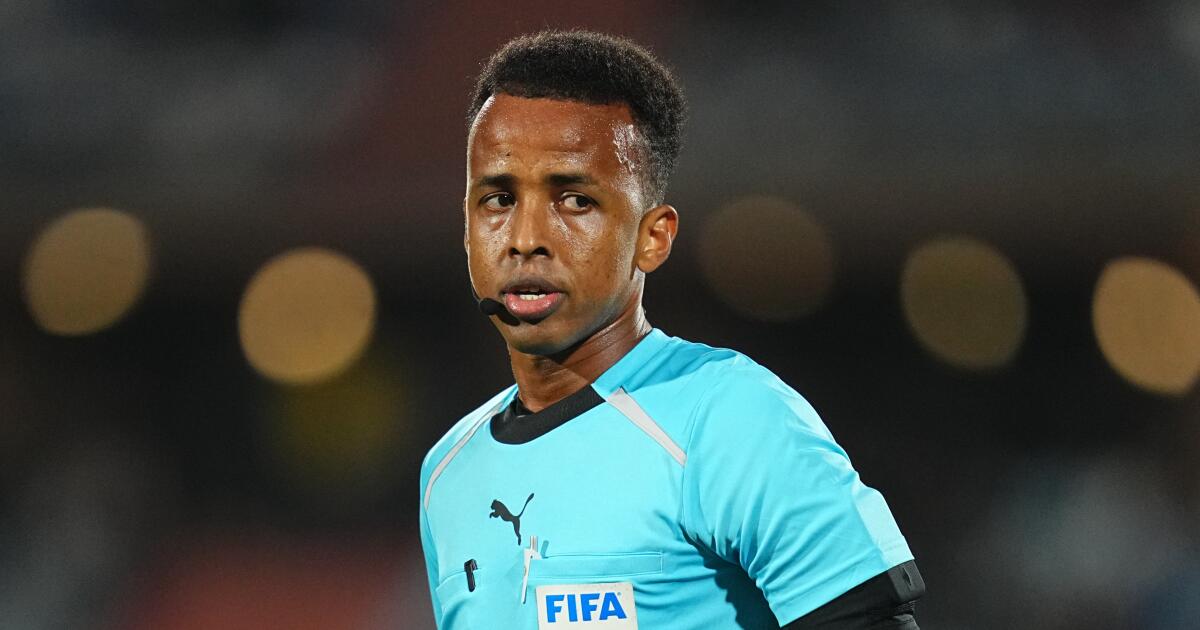
Somali referee Omar Abdulkadir Artan was denied entry into the United States for the World Cup after enduring an 11-hour interrogation in Miami, according to media reports. Andrew Giuliani, head of the White House Task Force on the World Cup, indicated Artan was suspected to having ties to a Somali militant group.
“We want to make sure we are not going to allow a soccer tournament to be the opportunity for terrorists to potentially get in the country or anybody who is actually talking to them,” Giuliani told the British Broadcasting Corporation.
The New York Times reported that Artan’s name is similar to that of a man identified as linked to Al Shabab, a group that has been the target of U.S. government sanctions.
“I am very, very disappointed,” Artan told the Times from Istanabul, where he stopped on his way back to Somalia. “I’m just simply a referee who’s trying to live his dream, the biggest dream of my life, to come to the World Cup.”
Safety was purportedly the concern with Artan, whose interrogation was conducted by the U.S. Customs and Border Protection.
“During processing, the traveler underwent additional inspection, a routine part of CBP’s inspection process when officers need to verify information or determine admissibility,” CBP said in a statement. “Following inspection, the traveler, a referee for the FIFA World Cup, was determined to be inadmissible due to vetting concerns and was denied entry.”
Somalia is on the U.S. list of banned countries for immigration, although exceptions can be made. Artan is considered one of the best referees in Africa, having officiated in the Somali national football league championship and at the African Cup of Nations.
“Despite the circumstances, I am in a positive mood and focused on the next challenges in my refereeing career,” Artan said in a statement. “I would like to thank FIFA and [the African federation] for all their support and I promise to keep my refereeing levels up as I concentrate on the future.”
Artan, Africa’s Referee of the Year in 2025, was greeted Wednesday at Aden Adde International Airport in Somalia by government officials and hundreds of well-wishers.
“I want to thank FIFA for supporting me all the way, and for Somali people also,” he told Al Jazeera. “So I am very grateful for FIFA and for CAF also. This is what I have to say.”
Sports
Jordan Staal’s two-goal night lifts Hurricanes past Golden Knights, evening Stanley Cup Final series

Tyler Reddick Makes History! Inside His 3-Peat and Historic Start to the Season
Fresh off his victory at Circuit of the Americas, Tyler Reddick joins Kevin Harvick on this week’s Victory Lap to break down his historic third consecutive NASCAR Cup Series win to open the 2026 season. Reddick discusses how he and 23XI Racing have built early-season momentum, what has clicked across the organization, and how the team has elevated its performance to championship level. He details his intense battle with road course standout Shane van Gisbergen at COTA, the strategy and execution that helped him secure the win, and what it means to become the first Cup driver to win the first three races of a season. Reddick also reflects on his viral 3-peat photo tribute to team owner Michael Jordan, the confidence inside the garage, and how this dominant start shapes expectations for the rest of the year.
NEWYou can now listen to Fox News articles!
The Carolina Hurricanes have evened up the Stanley Cup Final once more thanks to Jordan Staal’s two-goal night in Las Vegas to beat the Golden Knights in Game 4, 5-3.
The series now sits at 2-2 with Game 5 slated for a return back to Carolina’s Lenovo Center on Thursday to see who will have the edge in this pivotal clash on ice.
This game didn’t need overtime like the previous two, but it did need someone to break the 3-3 tie that went into the third period between these opponents.
Jordan Staal of the Carolina Hurricanes celebrates his power play goal with teammates against the Vegas Golden Knights during the first period of Game Four of the Stanley Cup Final at T-Mobile Arena in Las Vegas, Nev., on June 9, 2026. (Brian Babineau/NHLI via Getty Images)
With 13:39 left in Game 4, Shea Theodore made a disastrous turnover in the Golden Knights’ own zone, and Hurricanes star Seth Jarvis picked it off right in front of the net.
Luckily for Vegas, Carter Harter stopped Jarvis’ backhand, but the threat wasn’t averted just yet. Jarvis battled to get the puck back out in front, and it ended up trickling to the stick of Nikolaj Ehlers, who tried flipping it to Staal.
SETH JARVIS SCORES OVERTIME GAME-WINNER AS HURRICANES STORM BACK FROM 2-0 DEFICIT TO EVEN STANLEY CUP FINAL
Staal lost his edge on his skate, but that didn’t stop him from swatting a back-handed shot of his own toward the net. It just trickled past Hart, and Staal celebrated while still down on the ice. He became the first player in 44 years to score a goal in each of the first four games of the Stanley Cup Final.
With the way these games have been going, though, a one-goal lead was not safe. This time, however, the Hurricanes had the defense and timely saves by Brandon Bussi, who head coach Rod Brind’Amour went with over Frederik Anderson, and the decision paid off.
The Golden Knights took 20 shots on goal, with Bussi saving 7 in his first time on ice for Carolina in this series. And Ehlers sealed victory when he cleverly banked the puck out of his own zone with an empty net on the other end that walked into the net for the 5-3 win.
Jordan Staal of the Carolina Hurricanes scores a first-period goal against Carter Hart of the Vegas Golden Knights in Game Four of the 2026 Stanley Cup Final at T-Mobile Arena in Las Vegas, Nev., on June 9, 2026. (Bruce Bennett/Getty Images)
The Hurricanes came out roaring in the first period in this one as well, scoring three goals to the Golden Knights’ one by captain Mark Stone. Logan Stankoven notched his 11th of these playoffs just 1:06 into the game. Jackson Blake quickly followed on a goal assisted by Taylor Hall and Ehlers.
Then, Staal’s first goal of the game came 12:48 into the period on a power play. Shayne Gostisbehere ripped a shot on goal, and after Hart made the save, Staal was first to find the puck and a clear shot right in front of the goal.
With a 3-1 lead after the first 20 minutes, the Hurricanes had to feel good. But again, no lead is safe, and Vegas reminded them of that in the second period.
Logan Stankoven of the Carolina Hurricanes celebrates after scoring a first-period goal against the Vegas Golden Knights in Game Four of the 2026 Stanley Cup Final at T-Mobile Arena in Las Vegas, Nevada, on June 9, 2026. (Bruce Bennett/Getty Images)
CLICK HERE TO DOWNLOAD THE FOX NEWS APP
William Karlsson got Vegas closer with his third goal of the playoffs, while Brett Howden, adding to his case for the Conn Smythe Trophy, scored his 14th to tie it all up at three.
In the end, Staal’s heroics for the Hurricanes is why he has a “C” on his sweater.
Follow Fox News Digital’s sports coverage on X and subscribe to the Fox News Sports Huddle newsletter.

The first serious legal challenge to the House settlement will come courtesy of a USC freshman linebacker.
Talanoa Ili, a top-100 recruit in the Trojans’ vaunted 2026 class, joins Stanford quarterback Charlie Mirer as one of two lead plaintiffs in a class-action lawsuit that takes aim at the system implemented since the settlement ushered in a new era of direct payment from universities to athletes. The suit, which was filed Tuesday, accuses the NCAA, the Power Four conferences and the enforcement arm they created — the College Sports Commission — of participating in a “conspiracy” by creating a system of policies that have “direct anti-competitive effects, including the suppression of [name, image and likeness] compensation below competitive levels.”
Those policies, their attorneys argue, violate state laws in California that prohibit restrictions on NIL rights, as well as federal antitrust statutes. They’re seeking monetary damages, as well as an injunction that would upend the enforcement structure created to determine whether individual NIL deals over $2,500 meet criteria, including whether they have “a valid business purpose” or fall within a reasonable range of market value.
The clearinghouse, NIL Go, was created with the hope of eliminating an influx of booster-funded NIL deals that were basically direct payments from donors to the program. But since its inception, the system has been more restrictive and worked less efficiently than some schools and athletes might have hoped. As of last month, according to Yahoo Sports, more than $125 million worth of NIL compensation that had been promised to athletes had been rejected by the clearinghouse or was still under review.
In Ili’s case, the complaint states that he received a “substantial multi-year offer” from USC’s House of Victory collective in 2024 that led him to commit to the Trojans, only to have the offer disappear after approval of the House settlement.
“Absent the NIL Restrictions on Direct Pay NIL Compensation, Ili would have received more for his NIL rights than he now receives,” the complaint states. “The Agreement has thus injured Ili.”
Mirer, meanwhile, claims that he has received no NIL compensation from Stanford’s collective or revenue-sharing money from the university since 2024 as a result of the settlement.
Stanford quarterback Charlie Mirer during a game last season.
(Godofredo A. Vásquez / Associated Press)
“The [CSC agreement] has suppressed, deterred, and effectively terminated the economic relationships that had produced his prior NIL compensation,” the lawsuit says.
Even the plaintiffs in the House settlement, which created the CSC, are in the process of challenging the current system. On Wednesday, plaintiff attorney Jeffrey Kessler will argue in a hearing that school-affiliated businesses such as multimedia rights holders or corporate sponsors, should not be subject to the CSC’s rigorous criteria for NIL deals. That decision could also open the floodgates, with schools using those entities to circumvent the cap.
Two U.S. senators are hoping to pass legislation they believe would bring more stability to college athletics and thwart legal challenges. Ted Cruz (R-Texas) and Maria Cantwell (D-Texas) spoke with presidents and chancellors from the Big Ten Conference on Tuesday about a bipartisan bill, the Protect College Sports Act, which would codify some of the CSC’s policies into federal law.
-

 Technology5 minutes ago
Texas mom jailed over dirty water Facebook post
-
 Business8 minutes ago
Rivian begins deliveries of cheaper electric vehicles
-
 Entertainment13 minutes ago
Glen Walker is returning to broadcast news, months after being cut from KTLA
-
 Lifestyle20 minutes ago
A new L.A. Times feature: Now you can save our expert recs for your next adventure
-
 Politics23 minutes ago
Supporters cheer new L.A. County healthcare sales tax: ‘It’s a lifesaver’
-
 Science28 minutes ago
Why new dads shouldn’t panic about low testosterone
-
Sports35 minutes ago
World Cup referee, denied entry to U.S. because of suspected ties to terrorists, hailed in return to Somalia
-

 World43 minutes ago
US military chief Hegseth warns Cuba against acquiring military arms

