Sports
Joan Benoit Samuelson's 1984 Olympic marathon win was a game-changer for women's sports


As Joan Benoit Samuelson negotiated the hairpin turn into the Coliseum tunnel, ran past the USC locker room and onto the stadium’s red synthetic track for the final 400 meters of the 1984 Olympic marathon, her focus wasn’t only on finishing, but on finishing strong.
Women never had been allowed to run farther than 1,500 meters in the Olympics because the Games’ all-male guardians long harbored antiquated views of femininity and what the female body could do. If Samuelson struggled to the line, or worse yet dropped to the ground after crossing it, that would validate those views and set back for years the fight for gender equality in the Olympics.
“They might have taken the Olympic marathon off the schedule,” Samuelson said by phone two days before Thanksgiving. “This is an elite athlete struggling to finish a marathon. It never happened, thank goodness. But that could have changed the course of history for women’s marathoning.”
Actually, that race did change the course of history because nothing remained the same after a joyous Samuelson, wearing a wide smile and waving her white cap to the sold-out crowd, crossed the finish line. This year marked the 40th anniversary of that victory, and when the Olympics return to Los Angeles in four years, the Games will be different in many ways because of it.
Joan Benoit celebrates on the top step of the podium after winning gold in the women’s marathon at the L.A. Olympic Games on Aug. 5, 1984.
(Lenny Ignelzi / Associated Press)
Since 1984, the number of Summer Olympic events for women has nearly tripled, to 151, while last summer’s Paris Games was the first to reach gender parity, with women accounting for half of the 10,500 athletes in France. Fittingly the women’s marathon was given a place of honor on the calendar there, run as the final event of the track and field competition and one of the last medal events of the Games.
None of that seemed likely — or even possible — before Samuelson’s win.
“I sort of use marathoning as a way to storytell,” Samuelson said from her home in Maine. “And I tell people LA 84 and the first women’s Olympic marathon was certainly the biggest win of my life.”
It was life-changing for many other women as well.
Until 1960, the longest Olympic track race for women was 200 meters. The 1,500 meters was added in 1972, yet it wasn’t until the L.A. Games that the leaders of the International Olympic Committee, who had long cited rampant myths and dubious sports-medicine studies about the dangers of exercise for women, approved the addition of two distance races, the 3,000 meters and marathon.
Which isn’t to say women had never run long distances in the Olympics. At the first modern Games in Athens in 1896, a Greek woman named Stamata Revithi, denied a place on the starting line on race day, ran the course alone a day later, finishing in 5 hours and 30 minutes, an accomplishment witnesses confirmed in writing.
Her performance was better than at least seven of the 17 male runners, who didn’t complete the race. But she was barred from entering Panathenaic Stadium and her achievement was never recognized.
Eighty-eight years passed before a woman was allowed to run the Olympic marathon.
“There are men that are raised with resentment for women, except for their own mothers. That’s just a part of their nature,” Hall of Fame track coach Bob Larsen said. “A lot of good things have happened in the last couple of decades. Old men are passing away and opening doors [for] people who have a more modern understanding of what women are capable of.”

In between Revithi and Samuelson, women routinely were banned even from public races like the Boston Marathon, which didn’t allow females to run officially until 1972. Even then, women had to bring a doctor’s note declaring them fit to run, said Maggie Mertens, author of “Better, Faster, Farther: How Running Changed Everything We Know About Women.”
Seven years later Norway’s Grete Waitz became the first woman to break 2:30 in the marathon, running 2:27.32 in New York, a time that would have been good for second in the elite men’s race in Chicago that same day.
Because of that, Samuelson said she hardly was blazing a trail in L.A. Instead she was running in the wake of pioneers such as Kathrine Switzer, Bobbi Gibb and Waitz.
“I ran because there was an opportunity, not because I wanted to prove that women could run marathons,” said Samuelson, who still is running at 67. “Women had been proving themselves long before the ’84 Games.
“If anything, maybe my win inspired women to realize that if marathoning were a metaphor for life, anything in life is possible.”

Joan Benoit Samuelson receives a laurel wreath after winning the Boston Marathon in April 1983. At left, then-Lt. Gov. John Kerry.
(Associated Press)
Still, when Samuelson beat Waitz in Los Angeles, running in prime time during a race that was beamed to television viewers around the world, “that was the game-changer,” Switzer, the first woman to run Boston as an official competitor, told Mertens.
“When people saw it on television … they said, ‘Oh my God, women can do anything.’”
A barrier had fallen and there was no going back.
“You could make the argument that in women’s sports in general, we had to see, we had to have these women prove on the biggest stage possible that they were capable so that these gatekeepers would let women come in and play sports and be part of this world,” Mertens said. “I think it really did help burst open those ideas about what we could do and what we could see.”
As a result, the elite runners who have followed in Samuelson’s footsteps never have known a world in which women were barred from long-distance races.
“I grew up believing that women ran the marathon and that it wasn’t a big deal,” said Kara Goucher, a two-time Olympian and a world championship silver medalist who was 6 when Samuelson won in L.A. “I grew up seeing women run the marathon as the norm. That 100% is a credit to Joanie going out there on the world’s biggest stage and normalizing it.”
Paige Wood, a former U.S. marathon champion, said her high school coach was inspired to run marathons by Samuelson’s story and passed that inspiration on to her runners.
“She used her as an example of why we shouldn’t put any mental limitations on ourselves or shouldn’t let others tell us what we are capable of,” Wood said.
Wood was born in 1996 and remembers her mom, who was very athletic, saying that cheerleading was the only sport available to her in high school in the pre-Samuelson days.
“It’s undeniable, right? The courage she gave other women to start running and start competing,” Wood continued. “The trickle-down effect, it’s not even limited to running. It affected all sports and just made women less afraid to be athletic and try all different sports.”
A year after Samuelson’s victory, the U.S. women’s soccer team played its first game, although it was more than a decade before the WNBA, the country’s first professional women’s league. There are now leagues in six other sports, from ice hockey and lacrosse to rugby and volleyball, and female athletes like Caitlin Clark, Alex Morgan, Simone Biles and Katie Ledecky are household names.

Joan Benoit Samuelson, first women’s Olympics marathon winner, walks from the finish line after running in the 2019 Boston Marathon.
(Winslow Townson / Associated Press)
Last summer in Paris, Sifan Hassan won the women’s marathon in an Olympic-record 2:22.55 after taking bronze in both the 5,000 and 10,000 meters, events that weren’t even on the Olympic calendar when Samuelson won her race. Two months later Kenyan Ruth Chepng’etich became the first woman to run under 2:10 when she won the Chicago Marathon in 2:09:56, averaging 4:57 a mile.
Until 1970, two years before the Boston Marathon was opened to women, only one man had broken 2:10 in the race.
“It says so much about sport and the way that humans don’t quite know what we’re capable of until we do it,” Mertens said. “We’re going to keep pushing those goalposts back. We’ve come so far, and I think that’s more to do with just having the opportunities and know that there aren’t really limits.
“That’s the power of sports. These people are inspiring us; [they] help us see women as powerful athletes but also powerful in politics, as leaders.”
Did Samuelson make that happen? Or did she simply make it happen faster?
“You’d have to decide whether it was a huge defining moment or just a general wave of athletic events that made this possible,” Larsen said. “You know, the more times you put someone up at the plate, sooner or later somebody’s going to hit it out.
“Now it’s acceptable to have a woman running for president. So things are happening and it’s more acceptable to the general public. Was Joanie a big part of it? I would think so.”



NEWYou can now listen to Fox News articles!
CM Punk appeared on “Friday Night SmackDown” ready to take on any challenger that was ready to step to him after winning the Undisputed WWE Championship against Sami Zayn.
Punk entered the ring in Oklahoma City and called back to the “Monday Night Raw” after WrestleMania 42 when he told Cody Rhodes he’d be ready to deliver if a championship opportunity fell “out of the sky.”
COMPLETE PRO WRESTLING COVERAGE ON FOX NEWS DIGITAL
Cody Rhodes and CM Punk face off during SmackDown at Paycom Center in Oklahoma City, Okla. (Craig Ambrosio/WWE via Getty Images)
“When championship opportunities fall out of the sky, CM Punk catches them,” he said.
Punk named potential SmackDown superstars he’d think might come for the title, including Gunther, Finn Balor, Royce Keys, Damian Priest and Trick Williams. He even said that Zayn could come back around and get his rematch if he wanted. He didn’t mention Rhodes’ name, but the “American Nightmare” came out uncalled and marched his way down to the ring.
“I don’t think you and I can run away from each other anymore,” Punk told Rhodes.
Cody Rhodes looks on during SmackDown at Paycom Center in Oklahoma City, Okla., on July 10, 2026. (Craig Ambrosio/WWE via Getty Images)
Rhodes agreed and mentioned that Punk would want a match with him, just “say when.” It was a quick retort from Punk, who said, “when.” SmackDown general manager Nick Aldis, who was in the ring for the segment, booked the match for SummerSlam.
Punk will defend the Undisputed WWE Championship at SummerSlam, which takes place Aug. 1 and 2 at U.S. Bank Stadium in Minneapolis.
First, however, Punk and Rhodes will be involved in a tag team match at Saturday Night’s Main Event in New York City next week. Aldis made the match after Gunther demanded that Aldis put him in a match against Punk. Gunther was hoping it would be for the championship. Instead, Gunther will tag with Zayn.
Gunther didn’t take too kindly to that and attacked Aldis. Rhodes came back out to break up the calamity. He wanted to take on Gunther after the show went off air but Gunther walked away.
Gunther makes his entrance during SmackDown at Paycom Center in Oklahoma City, Okla., on July 10, 2026. (Rich Wade/WWE via Getty Images)
CLICK HERE TO DOWNLOAD THE FOX NEWS APP
Punk definitely has his hands full as he moves to SmackDown to become a fighting champion.
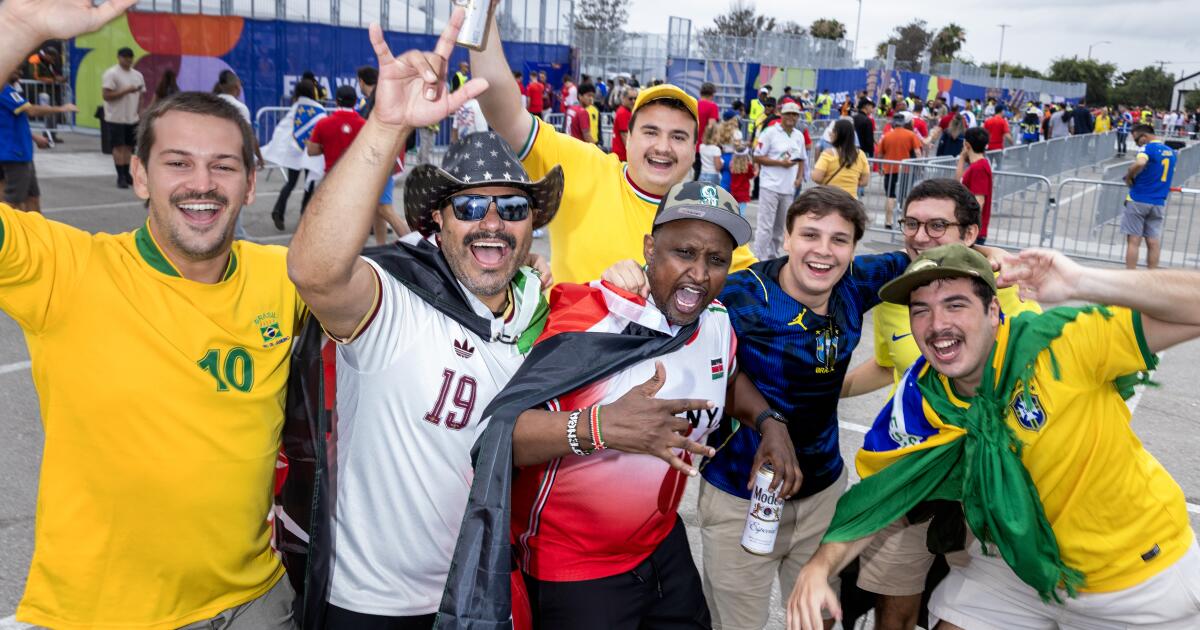
World Cup tourists are coming to L.A. for the soccer, but they’re staying for the $21 smoothies and Double-Doubles.
As the last Los Angeles FIFA World Cup event ended Friday, soccer fans were eating like locals and famous chains from the region were cashing in.
In the weeks that L.A. has hosted the World Cup, international soccer enthusiasts have flocked to big brands from the area, often in large groups wearing their countries’ jerseys.
It is a phenomenon seen at many of the host cities. In Dallas, giant gas station Buc-ee’s is the main attraction. For people visiting New Jersey, deli shops have been a hot ticket. In L.A., the place to be between matches was Erewhon.
Thirsty international sports fans gathered for pictures outside different Erewhons, wandered their aisles smiling, and, of course, picked up pricey smoothies.
While Erewhon would not comment on its business, mobility data company Arity, which uses phone data to track consumers, said Erewhon visits at the outlets around SoFi Stadium were quadruple what they were a week earlier on June 12, the day of the U.S. national soccer team’s opening match there.
Arity looked at what stores people visited within a 10-mile radius of SoFi that day and also found surges in visitors to nearby El Pollo Loco and Trader Joe’s.
Locals have spotted groups of people in Korea jerseys huddled together, trying to decide what to order at In-N-Out.
Some complained on social media that international tourists at Trader Joe’s were buying up all the mini canvas tote bags.
Soon after the Belgium vs. Spain quarterfinal ended Friday, the In-N-Out near SoFi had a long line of soccer fans stretching out the door in bright red and yellow and black jerseys and matching striped hats and scarves.
One of the workers said he had to explain “spread” and “animal style” to foreign football fans.
“I didn’t know this place existed,” a fan from Romania said while waiting in line.
Los Angeles and other cities and states that have hosted the event need the soccer fans to spend money to make the event worth all the time, effort and money it requires.
A rosy 2024 report projected the World Cup could bring more than $800 million to the L.A. region as 180,000 people converge on the area to sleep, eat and spend.
There were early concerns people weren’t turning up for the event because of the high ticket prices and the difficulty of obtaining visas for citizens of some countries.
However, at least for some L.A. hotels, there was a surge of last-minute visitors which pushed up occupancy and room rates.
While sports fans are not in the region to shop, they do make time for it.
World Cup customer spending is also apparent in beer sales. Andrew Heritage, the chief economist at the Beer Institute said beer purchases at entertainment and attractions in L.A. – outside of World Cup spaces – were up around 10% from normal.
“That tells me that fans in the L.A. area have decided to extend their stay and take in all the other things that the area has to offer, rather than just the match itself,” he said.
On social media, the purpose of these shoppers is clear: grab a quick souvenir or local specialty and take a selfie.
The data from Arity suggests that fans are very efficient when they spend at local spots, diving in, getting what they want and getting out as soon as possible, said Jeff Schlitt, a director at the company.
“Normally you’re there for an hour. They’re going to be there for 15, 18 minutes,” he said. “Why is that? Because they were purpose-driven shoppers.”
For some travelers, the more popular American chains aren’t unfamiliar. But some of the native L.A. fare still comes as a surprise.
As one Belgium-Spain matchgoer from the Netherlands stood taking a picture of the In-N-Out sign after the game, he said he’d never had a burger like the one he’d just tried.
“We only have McDonald’s and Burger King,” he said. “It’s way better.”

NEWYou can now listen to Fox News articles!
The face of baseball will not be at Tuesday’s All-Star Game.
Shohei Ohtani was scratched from his start on Friday as the Los Angeles Dodgers said he will also miss the Midsummer Classic with what the team called left knee irritation.
Ohtani, for obvious reasons, has become an All-Star Game fixture. He has earned the honor in each of the past five seasons and made his first start in 2021.
Starting pitcher Shohei Ohtani #17 of the Los Angeles Dodgers warms up before the MLB game against the Arizona Diamondbacks at Chase Field on June 03, 2026 in Phoenix, Arizona. (Photo by Christian Petersen/Getty Images) (Christian Petersen/Getty Images)
The two-way phenom is on his way to winning his fifth MVP award in his last six seasons as he is hitting .290 with a .939 OPS and pitching to a minuscule 1.79 ERA, the second-lowest in the sport among pitchers with 80-plus innings. His OPS is also the seventh-best mark in the league.
The Dodgers said Ohtani will be the team’s designated hitter up until the break, but he will “have some interventions on his knee to put him in the best position for the second half of the season.”
Ohtani dealt with knee issues earlier in the season.
It is certainly a big hit for the game as the other face of the sport, Aaron Judge, will miss the game due to a fractured rib that has kept him out since late May.
Shohei Ohtani #17 of the Los Angeles Dodgers gets ready in the on deck circle against the Arizona Diamondbacks at Chase Field on June 01, 2026 in Phoenix, Arizona. (Photo by Norm Hall/Getty Images) (Norm Hall/Getty Images)
DODGERS WILL AGAIN VISIT WHITE HOUSE TO CELEBRATE WORLD SERIES CHAMPIONSHIP, OFFICIAL SAYS
Ohtani hit 99 home runs combined in 2024 and 2025, leading the National League with a 1.025 OPS in that span. Ohtani did not pitch in 2024 after elbow surgery but returned to the bump last year and owned a 2.87 ERA and 11.9 K/9, a figure he also put up in 2022 that led the American League.
The “Japanese Babe Ruth” is the only player in MLB history to have 300-plus plate appearances and 40-plus innings in six separate seasons (Ruth only did it twice and never stole 50 bases), and he has more than excelled at both.
Shohei Ohtani pitches for the Los Angeles Dodgers against the San Francisco Giants at Dodger Stadium in Los Angeles, California, on May 13, 2026. (Gary A. Vasquez/Imagn Images)
CLICK HERE TO DOWNLOAD THE FOX NEWS APP
Ohtani is not hitting like he has in the past, but certainly the best pitching performance of his career will make up for it. He “only” has 20 homers and 56 RBI this season.
Follow Fox News Digital’s sports coverage on X, and subscribe to the Fox News Sports Huddle newsletter.
-

 Washington22 seconds ago
Chisholm’s homer keys 3-run 9th as the Yankees rally past Washington 5-3 – WTOP News
-

 Wisconsin3 minutes ago
Quiotepec en Wisconsin brings Oaxacan basketball fever to the Midwest
-

 West Virginia8 minutes ago
West Virginia DEP seeks details on Peoples Cartage fire cleanup, lawsuit filed on behalf of residents
-

 Wyoming15 minutes ago
Residents celebrate Wyoming Statehood Day by revealing their favorite thing about the Cowboy State
-
Crypto18 minutes ago
Trump’s crypto grift spins into its own industry
-

 Finance30 minutes ago
New changes to financial aid will be minor for UND students, bigger for loan borrowers in repayment
-

 Fitness33 minutes ago
The NHS has reignited the hybrid working debate – but WFH isn’t the health risk, this is
-

 Movie Reviews45 minutes ago
‘Only Beautiful Things to Look At’ Review: A Handsome but Muffled Portrait of State-Sanctioned Cruelty

