Sports
Inside the community creating the golf courses of their dreams — for a video game


They didn’t have much, but they could create. Money was tight for the family, so they built their own board games growing up in Saskatchewan, Canada. One year, Matthew Fehr’s father created his own little golf board game out of huge bristle boards with holes drawn in and different clubs tapered off. They rolled dice to see where the ball went, with sand traps and water hazards and trees along the way.
It lit a spark in Matthew. Sure, he liked golf as a game, but there was more pulling him in — he could create new worlds this way. Soon he was 7 years old drawing up golf courses on sheets of paper. In high school he discovered the website Golf Club Atlas and practically lived on what he called the “greatest resource ever.” He scoured through photo profiles of courses around the world, places he couldn’t go, and read through discussion boards on the best golf architects.
The world of golf architecture is exclusive. And expensive. One does not simply just jump into designing golf courses. So that was a dream Fehr had to put aside, settling for old-school computer games like Sid Meier’s SimGolf as he pursued a career as a chef.
“There has to be something out there that will allow me to build golf courses,” he thought.
Then, seven or so years ago, Fehr found an independent game called “The Golf Club.” It wasn’t very popular outside of the niche gaming world. It didn’t have licensing deals at the time like EA Sports did. But it did have a remarkably in-depth course designer tool.
He wasn’t a gamer nor was he particularly tech savvy, but this was his calling. He taught himself how to do the one thing he always wanted to do. The kid playing bristle board dice golf was designing golf courses. “It just blew my mind,” he said.
The game grew in popularity and was bought by gaming goliath 2K, which just released a new version — “PGA Tour 2K25”. Fehr — he’s better known by his tag, MattyfromCanada — is one of the most respected designers in an international community, so much so he’s been contracted by 2K to design official courses for each new version of the game. He is, no matter how you want to define it, a professional golf course architect, his courses put alongside Pebble Beach, Royal Portrush and Oakmont in the game.
“I’ve told my boss at work,” Fehr said, “my dream, if there’s ever even a chance I could ever design a golf course for real life, I will run out of the building and you will never see me again.”
He’s just one member of a fascinating world of obsession, a group of creatives that range from 15-year-old high schoolers to 70-year-old retirees spending their lives on message boards, Discord chats and YouTube streams to interact, create and discover the best courses in the game. Some can build a course in 10-20 hours. Others will sweat it out for more than 200 hours to create their masterpiece. Some courses are hyper realistic, forming homages to their favorite golden age architects. Others are fantastical, only possible in a video game world.
But over the last decade, these people have created a community. This summer, Fehr and a few others will fly to Scotland for a golf trip to play St. Andrews and North Berwick. Others meet up each year, taking turns hosting the others. Some were die-hard gamers. Some don’t touch a single other video game. Some turned this passion into jobs at golf architecture firms. Others got hired by gaming studios. But the story of this design world isn’t about any of that. It’s about getting to be who they always thought they were.
The montage launches with five minutes of clips of every course you wish you could play. There are heathland style tracks, and some sandbelt beauties. There are absurdist gems in the mountains with rocky creeks and tee shots into cliffs. There are stadium courses that look like TPC Sawgrass on steroids and parkland courses inspired by Augusta National.
Then the Twitch stream begins, and a soft-spoken Englishman in his 30s begins to speak. His name is Ben Page. Others know him as b101. Either way, “everybody wants to be like Ben,” one fellow designer said.
Today is the group stage draw for the World Cup of Design 2025. The average person will have no clue this ever happened. But for the 300 people who did watch, this is their Super Bowl. Forty of the best designers in the PGA 2K world will be drawn into eight groups to compete through a knockout style format to crown the best course of the year. That opening montage? Those were the previous six winners.
Page then welcomes his co-host for the draw.
“If you don’t recognize Andre, he once designed golf courses,” Page says in a dry tone.
“Once,” quips Andre Quenneville, another 30-something man with glasses and a light beard.
Quenneville, or CrazyCanuck, is something of the godfather of this community. He’s the Velvet Underground of 2K course design. Maybe not that many people actually watched his videos, but everyone who did felt compelled to become a designer.
But he’s more of a background figure now. Part of that is having children and a family. Much of it is becoming disillusioned or disappointed with recent editions of the game and its design tool. But the executives at HB Studios, the creators of “The Golf Club” that 2K Sports acquired in 2021, were smart enough to know that to get people back on board and excited with this newest game, they needed CrazyCanuck on board. They looped him in early to preview the new design tool, and suddenly he’s back. His excitement has others excited too.
Quenneville was far from the first to launch this community, but he ended up being the whole who brought in new audiences. He’s a teacher by trade, teaching high school math and science. Yeah, he golfed, but not too intensely. He didn’t know the design world. He’s not a huge gamer, either. But like Fehr and so many others, he had a fascination with courses and drew them out as a kid.
Then, in 2014, the first edition of “The Golf Club” came out. That game is a story of its own for another day. It was cool and new and anti-establishment, with gameplay that felt like golf — as frustrating as it was rewarding. But the big sell was the “Greg Norman Golf Course Designer,” a partnership with Norman’s design company that allowed the firm to render course proposals for potential clients. The tech initially was not very good, but improved quickly.
Quenneville’s first courses were “absolute garbage,” and there was nobody making videos explaining how to use it. They were all on their own.
But he had an idea. He went into forums and said, “Hey, if you post your courses here I’ll review them on YouTube.” Quenneville was far worse than the guys he was critiquing, but by reviewing these courses he could hone in and figure out how these people were making them. How’d they do that bunker lip? How’d they plant it that way? This was a decade ago, so the tools were far behind. “It was like the dark ages,” he joked, so the best designers were the ones discovering tricks to create visuals.
Quenneville becoming the primary “reviewer” coincided with the creation of a niche website called TGC Tours. See, the original games didn’t have any career mode or tour system, so a group of buddies created their own online league where people played the same courses and submitted their scores to the website. It grew and grew to where there are now thousands of members, with dozens of different tiers and tours and competitions. TGC Tours became as important as “The Golf Club” itself, enough so that later versions of the game have added an “online societies” mode where these created online tours were actually inside the game.
But possibly the most lasting element of TGC Tours is that it became the primary hub for designers to meet in the forums and talk. That’s where they shared courses, gave notes and tried to create ones good enough to be picked for the next TGC Tour season. It created community.
Quenneville got better at making his own courses. Much better. “Then I went on my teaching knowledge and said, ‘There’s an opportunity here for me to make some really simplistic, easy-to-start tutorials because there’s a massive hole in that.’”
Those videos gained popularity around 2019 as “The Golf Club” was on its third edition, but the COVID-19 pandemic unleashed a new wave. Suddenly everyone in the world was stuck at home, and wanted a hobby. Some of them found this game, and then they found Quenneville’s videos.
One of the people constantly commenting in those early streams was Page. He didn’t even have the game yet. A CrazyCanuck video popped into his feed and he was hooked, because unlike Quenneville, Page is a true golf architecture nerd through and through. In the description of his newest club, Ferncliff, he cites Myopia, Sleepy Hollow, Boston GC, Essex, Beau Desert and Ohoopee as inspirations.
But like Quenneville, Page is also an educator, teaching high school French and German in England’s midlands. He thinks that’s why he was able to pick it up so quickly. Within weeks, he was one of the better designers. The natural, if you will. By the time 2K Sports bought HB Studios and created “PGA Tour 2K21”, they were hiring Page as a designer.
“You’ll see a lot of people where they have command of the tools and can make everything look very pretty, but the golf is not very interesting, one dimensional,” Page said. “Or there’s the reverse where the golf is great but the visuals aren’t. Or, because it’s a video game, you have people almost trying to do too much and throw everything at one course because you can. It’s all about finding a balance.”
But the beauty of the community is the variance inside it, though it remains mostly male. What was once 10 top designers has become closer to 70.
There’s Page (@b101tgc), perhaps the top dog nowadays. He has a combination of visuals and architecture know-how many are trying to catch up to. And the teacher found his own niche creating tutorials that focus on taking designers from good to great.
There’s Adam Benjamin (@articfury1). He’s the elusive artist, hardly ever talking in the community but popping in out of nowhere to release a new course with spectacular, jaw-dropping visuals.
There’s Tanner Bronson (@DTannerBronson), a younger designer who turned his hobby into a job working at a golf architecture firm.
There’s Christian Andrade (@SleepyPanda_7), a former golf pro who found Quenneville’s videos, got really good at design and got hired by HB Studios as a senior level editor. He gets a lot of credit for taking the criticism of 2K23, looping in the design community and creating a design tool for 2K25 that has them all giddy.
But the cool part is the ways the designers have created their own world inside a world. They’ll have contests where you have to make a course as a specific designer. Or a certain era or region. Many have gotten in the habit of sending each other plots of land to adapt to and create inspiration.
Quenneville was on the first trip to Myrtle Beach organized by the TGC Tours founder. Now most of them go on a different trip each year. Quenneville has become so close with one designer that their wives hang out. Some people don’t even design courses anymore but still go on the trips as friends.
“Every time you’re just like, oh my god, is there any axe murderer in here? Who are these random guys?” Quenneville said. “But you’re so comfortable with them.”
“They are genuine friends,” Fehr said.
“You’re all golf geeks that have an extremely niche interest inside of an extremely niche interest,” Page said. “So people tend to want to chat about the same things.”
Yes, there is sometimes tension in the forums. Sometimes the fantastical designers and the realists disagree on judging results. Sometimes players don’t take criticism well, because it’s not exactly fun being told something you just spent 100 hours on isn’t very good. Sometimes the elite players and the elite designers go at it.
But overall, it’s a group of people who just want to create.
“Not too many people in the community are into it for how many plays you got,” Quenneville said. “It’s just the process, or being picked to host a tournament on TGC Tours is a cool experience, but for the most part people like sharing it with people in their community.”
There’s a question they all get asked most often, though. One this reporter of course asked as well. How long does it take to design a course?
None of them quite have their answer down, because it depends. Quenneville is the first to say he’s not the most detail obsessed, so in his prime he could make a pretty good course in 20 to 40 hours. Page’s simplest courses take that long, or he could take 200 hours. Fehr, yeah he’s going to be around 100 to 200 hours without a doubt. He’s hit 300 hours before over several months. He might spend a whole night mastering one bunker.
And all these guys have day jobs. At the peak of his obsession, Quenneville would be at the dinner table thinking about what hole he was going to work on, or wonder if he could take off work to finish a course. Now, he’s much more likely to put his kids to bed and spend an hour or two planing grass while listening to a podcast.
But Fehr took exception when asked about how much time he takes living in this community. Sure, he makes time to see his family. And yes, he does go see his friends in Saskatoon when he can. But there was something about the suggestion that his design world was him running away from the real world that didn’t sit right with him. Was his design life not as valid? Was living out some version of his dream not as substantial? He wasn’t avoiding his friends.
“These are my friends.”
(Illustration: Demetrius Robinson / The Athletic; Photos: Courtesy 2K)



Sports
‘Quad God’ Ilia Malinin avenges Olympic disappointment with backflip for third straight world title

NEWYou can now listen to Fox News articles!
It seems like Ilia Malinin, the “Quad God,” has done a nice job of moving on from his Olympic heartbreak.
Last month, the 21-year-old Team USA star was the overwhelming favorite to bring home the gold in the men’s free skate. But the unimaginable happened as he fell twice and dropped all the way to eighth place.
However, he has begun to avenge the loss and is now a three-time world champion.
Ilia Malinin from the United States competes during the men free skating at the Figure Skating World Championships in Prague, Czech Republic, Saturday, March 28, 2026. (AP Photo/Petr David Josek)
Malinin shouted and punched the air with relief after finishing a skate that showed he had achieved his desire to “move on” from the Olympics after days of being tormented by his mistakes.
Malinin scored 218.11 in the free skate for a total of 329.40, far ahead of silver medalist Yuma Kagiyama of Japan on 306.67. Another Japanese skater, Shun Sato, was third on 288.54.
Malinin was blunt about his Olympic performance when speaking to NBC afterward, saying simply, “I blew it,” and said it was a clear mental hurdle from start to finish.
“I just had so many thoughts and memories flood right before I got into my starting pose, and almost, I think, it maybe overwhelmed me a little bit. I’ve been through a lot in my life, a lot of bad and good experiences,” Malinin told reporters.
Gold medalist Ilia Malinin from the United States waves to spectators after the medal ceremony after the men’s free skating at the Figure Skating World Championships in Prague, Czech Republic, Saturday, March 28, 2026. (AP Photo/Petr David Josek)
LINDSEY VONN KEEPING RETURN TO SKIING ON TABLE DESPITE INJURIES: ‘I DON’T LIKE TO CLOSE THE DOOR ON ANYTHING’
“So, I just feel like it’s the pressure of especially being that Olympic gold medal hopeful. It was just something I can’t control now. The pressure of the Olympics, it’s really something different, and I think not a lot of people understand that. They only understand that from the inside and going into this competition, especially today, I felt really confident, really good,” he added. “But it really just went by so fast I did not have time to process.”
But with some pressure off, Malinin was able to show who he truly is on the ice.
Gold medalist, Ilia Malinin from the United States waves before the medal ceremony after the men’s free skating at the Figure Skating World Championships in Prague, Czech Republic, Saturday, March 28, 2026. (AP Photo/Petr David Josek)
Malinin becomes the first skater to win three consecutive men’s world titles since fellow American Nathan Chen, who achieved the feat in 2018, 2019 and 2021 after the 2020 event was canceled because of the COVID-19 pandemic.
Fox News’ Jackson Thompson and The Associated Press contributed to this report.
Follow Fox News Digital’s sports coverage on X, and subscribe to the Fox News Sports Huddle newsletter.
Sports
Ilia Malinin bounces back from Olympic nightmare to win third straight world figure skating title
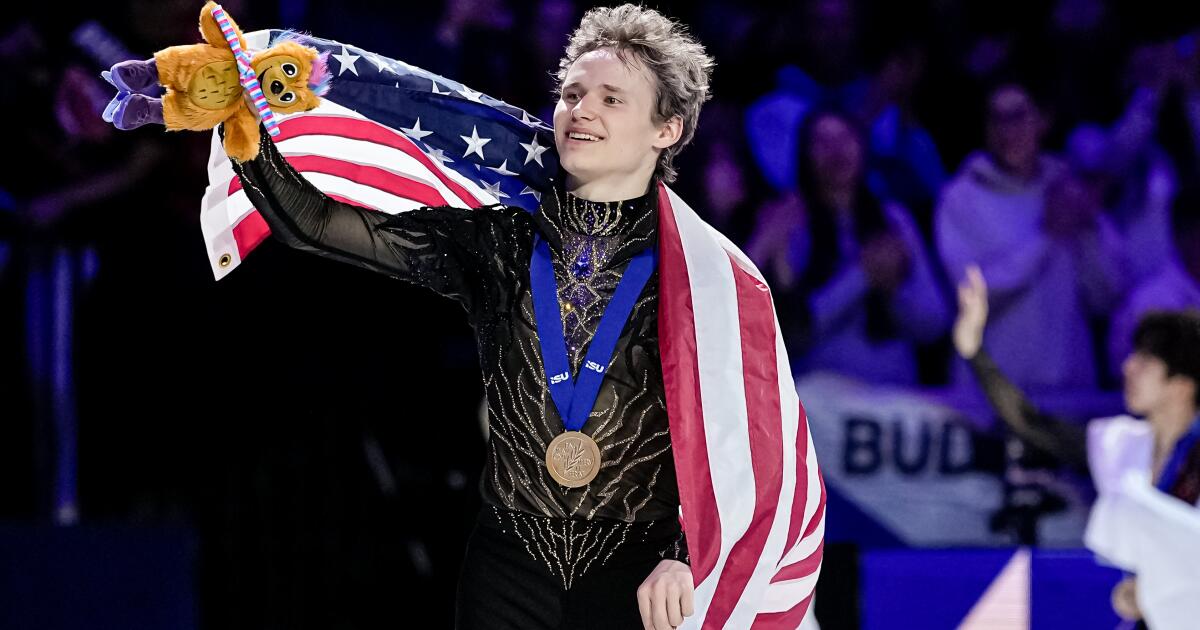
PRAGUE — Ilia Malinin is back on the top step of the podium.
Six weeks after a disastrous skate knocked the Olympic gold-medal favorite off the podium, the “quad god” reeled off one huge jump after another, and a backflip for good measure, to retain his world championship title for the third year running.
Malinin shouted and punched the air with relief after finishing a skate that showed he had achieved his desire to “move on” from the Olympics after days tormented by his mistakes.
He praised the crowd’s support, saying: “It was really challenging, really hard but with you guys I was able to make it through.” His aim, he added, had simply been to get through the free skate “in one piece.”
Skating last after leading the short program, just as he did in Milan, Malinin landed five high-scoring quadruple jumps but not his pioneering quad axel, a jump he didn’t attempt at the Olympics.
Malinin scored 218.11 in the free skate for a total 329.40, far ahead of silver medalist Yuma Kagiyama of Japan on 306.67. Another Japanese skater, Shun Sato, was third on 288.54.
Ilia Malinin performs a backflip during his free skate at the World Figure Skating Championships on Saturday in Prague.
(Petr David Josek / Associated Press)
Kagiyama beat his personal-best free skate score but still had to make do with a fourth career world championship silver in a career which includes four Olympic silvers and five total worlds medals, but no gold from either event. He still embraced Malinin after his skate and they jumped together in celebration.
In a showcase of top-level skating, there was no podium spot for France’s Adam Siao Him Fa, who had been in second after the short program but dropped to fifth overall after a fall. Estonia’s Aleksandr Selevko also fell dropped from third to sixth.
Malinin had no rematch with Mikhail Shaidorov, the skater from Kazakhstan who won the Olympic gold, because he opted against competing again this season.
That’s relatively common in figure skating for gold medal winners who face a rush of media and commercial opportunities after a grueling four-year Olympic buildup.
Malinin becomes the first skater to win three consecutive men’s world titles since fellow American Nathan Chen, who achieved the feat in 2018, 2019 and 2021 after the 2020 event was canceled because of the COVID-19 pandemic.
The last competition of the championships is the free dance portion of the ice dance event later Saturday. France’s Laurence Fournier Beaudry and Guillaume Cizeron are in the lead after Friday’s rhythm dance.

NEWYou can now listen to Fox News articles!
Tiger Woods was released from jail Friday night after he was arrested earlier in the day on a DUI charge following a car crash in Florida.
In a mugshot released hours after his arrest, Woods’ eyes appeared bloodshot, as he donned a blue polo inside the Martin County Jail in Florida.
Woods was seen leaving the jail in the passenger seat of a black SUV after his release on bail late Friday, according to The Associated Press.
Martin County Sheriff John Budensiek confirmed in a news conference that Woods was traveling at “a high rate of speed” when his vehicle collided with another car, resulting in his vehicle rolling over onto the driver’s side.
Tiger Woods was booked into Martin County, Florida, jail on March 27, 2026. (AP)
Authorities said Woods “exemplified signs of impairment.” He blew “triple-zeroes” for alcohol but refused a urine test.
“DUI investigators came to the scene here, and Mr. Woods did exemplify signs of impairment. They did several tests on him. Of course, he did explain the injuries and the surgeries that he had. We did take that into account, but they did do some in-depth roadside tests,” Budensiek added.
“We really weren’t suspicious of alcohol being involved in this case, and that proved to be true at the jail. … But when it came time for us to ask for a urinalysis test, he refused. And, so, he’s been charged with DUI, with property damage and refusal to submit to a lawful test.”
Woods was spotted on the phone after the crash, wearing navy blue shorts.
Woods was charged with DUI, property damage and refusal to submit to a test, all misdemeanor charges. No one was injured, authorities said. Woods was alone in the car and crawled out of the passenger door after the crash.
Tiger Woods was driven from the Martin County Jail after being arrested for driving under the influence following a car crash on March 27, 2026, in Stuart, Florida. (Joe Raedle/Getty Images)
VANESSA, KAI TRUMP TAKE IN TIGER WOODS’ RETURN TO GOLF AT TGL FINALS
“This could’ve been a lot worse,” Budensiek noted.
President Donald Trump commented on the arrest of his “very close friend.”
“I feel so badly. He’s got some difficulty,” Trump said. “There was an accident, and that’s all I know. Very close friend of mine. He’s an amazing person, an amazing man, but some difficulty.”
Woods has not commented on the arrest.
Tiger Woods was arrested on a DUI charge after getting into a car crash on Friday. (Associated Press)
Woods currently is dating Trump’s ex-daughter-in-law, Vanessa, whose daughter, Kai, is set to play college golf in Miami next week.
This is Woods’ second DUI arrest within the last decade. In 2017, he was taken into custody, also in Jupiter Island, after taking prescription drugs and being asleep behind the wheel of a running car at 3 a.m.
In 2021, he got into a wreck that resulted in serious leg injuries that kept him off the golf course for the entire year.
Golfer Tiger Woods stands by his overturned vehicle in Jupiter Island, Fla., Friday, March 27, 2026. (Jason Oteri/AP)
Woods made his return to competitive golf earlier this week in the TGL championship after rupturing his Achilles just before last year’s Masters (this year’s tournament is in less than two weeks). Woods has not appeared on the links since the 2024 PGA Championship, in which he missed the cut.
Follow Fox News Digital’s sports coverage on X, and subscribe to the Fox News Sports Huddle newsletter
‘Wait Wait’ for March 28, 2026: Live in Savannah with D.W. Moffett

Suno leans into customization with v5.5

Body found in search for missing American Airlines flight attendant in Colombia: mayor

Jeffries declines to break with indicted Democrat after ethics panel’s guilty verdict

Most Americans are doing one nightly activity that’s wrecking their sleep, expert says

Florida High School Football Rankings: Top 25 teams – Oct. 21

How old is Bo Nix? What to know about Oregon quarterback ahead of 2024 NFL Draft

Cleary's 21 help Le Moyne down Central Connecticut State 69-64 in OT

99th annual Pony Swim held in Virginia

Indiana Members Credit Union announced as new anchor tenant at Bottleworks District
Jeffries declines to break with indicted Democrat after ethics panel’s guilty verdict

Hundreds of thousands march through London in stand against the far right

2 students killed, 7 other people injured in Tennessee bus crash during school field trip

Dem senators dodge crucial question on illegal alien accused of killing Chicago college student

EU Parliament unblocks key political hurdle in digital euro talks
-

 Detroit, MI1 week ago
Drummer Brian Pastoria, longtime Detroit music advocate, dies at 68
-

 Movie Reviews1 week ago
‘Youth’ Twitter review: Ken Karunaas impresses audiences; Suraj Venjaramoodu adds charm; music wins praise | – The Times of India
-

 Sports1 week ago
IOC addresses execution of 19-year-old Iranian wrestler Saleh Mohammadi
-

 New Mexico6 days ago
Clovis shooting leaves one dead, four injured
-
 Business1 week ago
Disney’s new CEO says his focus is on storytelling and creativity
-

 Tennessee5 days ago
Tennessee Police Investigating Alleged Assault Involving ‘Reacher’ Star Alan Ritchson
-

 Technology6 days ago
YouTube job scam text: How to spot it fast
-

 Texas1 week ago
How to buy Houston vs. Texas A&M 2026 March Madness tickets