Sports
Inside Florida State’s historic fall from 13-0 to its worst showing in 50 years


Even with 40 minutes left in a lost season, Florida State still had hope. It flashed Saturday when defensive tackle Darrell Jackson Jr. powered past a blocker and bear-hugged Florida quarterback DJ Lagway inside the Gators’ 25. A Seminoles sack could help flip the field in a 7-0 game.
Instead, it was a 10-second encapsulation of Florida State’s worst season in 50 years.
A talented transfer failed to finish a play; Lagway spun out of Jackson’s arms. Another member of FSU’s $2 million defensive line, Patrick Payton, started celebrating a sack that did not happen. Linebacker Omar Graham Jr. stomped his feet and smacked his hands together in frustration after Lagway threw downfield for a first down. The rest of head coach Mike Norvell’s Seminoles did not or could not respond as a competitive game eventually turned into their seventh double-digit loss of the year. Finally, ridicule rained down at FSU’s Doak Campbell Stadium, with visiting fans chanting “D-J LAG-WAY” while the Seminoles staggered to another three-score rout by an in-state rival.
When Florida State’s 31-11 loss was over, one of the biggest collapses in college football history was complete.
The Seminoles’ nosedive from 13-1 and the brink of the College Football Playoff to 2-10 is the second-largest drop in wins ever. Only 2011-12 Southern Miss (which cratered from 12-2 in 2011 to 0-12 after a coaching change) was worse. Florida State joined 1954 Illinois and 1956 Notre Dame and Maryland as the lone teams to begin the season ranked in the top 10 of the AP poll and fail to win at least three games.
The Seminoles’ offense allowed the most sacks in the country and finished in the bottom six in scoring, rushing and completion percentage. Their defense forced the third-fewest turnovers in the nation, and their special teams were second-to-last in punt return average.
The descent is even more striking because there’s no obvious, extenuating cause. There’s no scandal to cite, no major unlucky breaks to blame. The coaching staff that won last year’s ACC championship with a third-string quarterback is the same one that lost to Duke for the first time in program history.
Instead, Florida State crumbled because of a combination of lingering issues that collected slowly and converged suddenly, according to interviews conducted by The Athletic with a dozen people in and around the program and across the sport. Almost all spoke on the condition of anonymity to provide candid responses. FSU did not make Norvell available for this story, and he did not return multiple requests for comment.
“Terrible” recruiting, according to a former staffer, and overconfident evaluating. High-profile quarterback misses because of NIL coffers. Misguided loyalty and a lost bidding war. A perception players were giving up, or at least lacking leadership skills. Under-the-surface problems that were too easy to overlook during the Seminoles’ steady, four-year climb from Norvell’s 3-6 start to his 19-game winning streak in 2022-23.
“High tide covers up ugly rocks,” FSU athletic director Michael Alford told The Athletic, “and low tide exposes them.”
High tide peaked a year ago this week when the Seminoles topped Louisville to win their first ACC title in nine years. Low tide began less than 13 hours later with the push that started a free fall.
GO DEEPER
FSU starts 0-2 despite NIL team budget of nearly $12 million
Where it all began: That Playoff snub
The historic stumble began with a historic snub.
Despite FSU’s 13-0 record in a Power 5 conference, the College Football Playoff selection committee nudged the 12-1 Alabama Crimson Tide ahead of the Seminoles for the fourth and final spot. The reason was controversial but defensible: Florida State was no longer one of the four best teams after star quarterback Jordan Travis broke his leg in Game 11.
When the FSU-less bracket was unveiled on ESPN, Norvell froze for three seconds. By the time he rose from his chair to say something, at least a dozen players had already stood up and started walking to the back of the room — or the exit.
“What happened had never, ever happened before in the history of college football, where you went undefeated at a big-name school and don’t make the Playoff,” a former staffer said. “They got the Playoff taken away, and haven’t recovered from that.”
That was obvious at the Orange Bowl, when Norvell acknowledged the raw disappointment “definitely affected” a roster with 20-plus opt-outs that lost 63-3 to Georgia. And in February, when one of last year’s captains, Fabien Lovett, admitted he doesn’t think he’ll ever fully get over the sting. And in April, when the school’s legal counsel stood in a Tallahassee courtroom during a hearing on FSU’s ongoing lawsuit against the ACC and referred to the Seminoles as “what should have been the national champions.” And in September, when receiver Kentron Poitier said the snub was something players still talked about occasionally.
But Florida State considers itself to be one of the sport’s premier brands — a three-time national champion with a strong pedigree and proud fan base. It was a program that should have been built to recover from any heartbreak or humiliation. There was no reason to think one devastating decision would plunge the Seminoles this far.
An established staff had plenty of time to stockpile or replenish talent from a fertile footprint. An NIL budget of about $12 million was big enough to fund a Playoff contender and retain some veterans. Florida State spent more than $1 million giving its 10 assistants proactive raises while keeping Norvell away from Alabama with a new, eight-year contract that made him one of the game’s highest-paid coaches.
“If this is a tailspin that started at 40,000 feet,” said a person affiliated with the team’s decision-making process, “you’ve had numerous opportunities to recover from it.”

Florida State won the ACC last season, but the joy would not last. The pain was just beginning. (Bob Donnan / USA Today)
A staff’s major weakness revealed after several years
“Here’s the storyline for Florida State,” a second former staffer said. “We were terrible in recruiting in 2020 and 2021.”
The complications from those classes — Norvell’s first two — lay deeper than mediocre rankings of 22nd and 23rd in the 247Sports Composite. Some of the early recruiting misses at the root of the problem stem from unfortunate circumstances: Norvell was FSU’s third coach in four seasons and inherited a program that was 18-20 over the previous three years. The pandemic hit three months into his tenure; COVID-19 restrictions hamstrung his staff’s ability to build relationships in a new state. And as the Seminoles rebuilt slowly through Norvell’s first two losing seasons, they couldn’t sell new-coach buzz, like Florida’s Billy Napier and Miami’s Mario Cristobal.
Those two classes were responsible for only seven regular starters this season. Of the 15 blue-chip (four- or five-star) prospects FSU signed those cycles, just five were still on the roster.
The misses created a void on the field and, crucially, in the locker room. Inevitable attrition meant Florida State needed new alphas after Travis, Jared Verse, Braden Fiske and Trey Benson headed to the NFL. But FSU’s roster had only 28 scholarship players who were on the team for at least three seasons.
“There was no one to pass that torch to,” said a source involved with the team’s roster management.
In the aftermath of the Playoff announcement, two of FSU’s most impactful 2020-21 signees, Payton and linebacker DJ Lundy, announced plans to enter the portal. Payton never followed through, and Lundy remained at FSU after decommitting from Colorado. But the fact that two veterans who were game captains this season openly considered leaving within two weeks of the ACC championship was a concerning sign about the program’s leadership. It wasn’t the last. One of FSU’s Orange Bowl captains, leading tackler Shyheim Brown, was suspended for the Memphis game due to a DUI arrest in the summer.
Norvell publicly acknowledged the team’s need for leadership in late September. In 2023, Florida State trailed in the second half against LSU, Clemson, Duke, Miami and Florida. Then the Seminoles outscored them by a combined 103-24.
“What happened in every one of those opportunities?” Norvell asked. “The real ones stood up, and some of those guys that are on this team right now were those guys.”
They, apparently, remained sitting down. A team that was No. 5 nationally in second-half scoring differential last season finished No. 119 this year.
Though Alford said he never saw a drop in effort or change in body language — before or after the CFP snub — some outsiders did. Fox analyst Urban Meyer accused the team of quitting, and multiple people close to the program suggested some players began tuning out coaches.
“There’s only so many times that message (a positive pep talk) can be delivered,” said the person affiliated with team’s decision-making process
The leadership concerns for one person briefed on the team’s roster construction began in the offseason when a veteran twice tried to organize workouts — the kind of voluntary work Travis spearheaded in previous summers. It went nowhere. “Nobody cared (or) wanted to come,” the person said.
And when the Seminoles could finally sell major success last cycle after back-to-back seasons with double-digit wins, they still underachieved. Months after finishing sixth in the final AP poll, Florida State had to cancel a junior day; coaches couldn’t get enough people to campus.
Florida State was among four teams that won at least 23 games in 2022-23 and didn’t change coaches last recruiting cycle. The other three programs’ 2024 classes finished first (Georgia), third (Oregon) and fifth (Ohio State) in the 247Sports Composite.
FSU was 12th.
The Seminoles would have finished higher but lost five-star defensive back KJ Bolden to Georgia on signing day. FSU got a late visit from the nation’s top recruit, receiver Jeremiah Smith, but couldn’t keep the south Florida native away from Ohio State. Smith set freshman receiving records in catches, touchdowns and yards for the No. 6 Buckeyes.
Those late misses are part of a troubling trend. FSU watched its top recruit decommit in 2021 (four-star linebacker Branden Jennings), 2022 (Heisman Trophy favorite Travis Hunter), 2023 (five-star Texas running back CJ Baxter) and 2024 (Bolden, one of Georgia’s top defensive backs). Hunter, like Bolden, was a signing day flip — the kind of 12th-hour battle Norvell has lost more than he’s won.
These were preventable issues. Norvell and most of his assistants arrived at FSU with little experience signing elite national prospects. Norvell’s first recruiting classes were the Seminoles’ four worst since 2007, according to the 247Sports Composite. In the five years before Norvell’s arrival, FSU signed nine five-star recruits. In Norvell’s first five classes, he signed one: receiver Hykeem Williams.
A former Norvell assistant said he’s “shocked that their high school recruiting was just so bad.”
And yet Norvell was largely loyal to his staff. Seven of his 10 assistants at the start of this season had been in those roles since Year 1. The retention made sense as his staff coached, evaluated and developed well enough to improve from three wins to five to 10 and, finally, perfection. But there was a trade-off.
“There’s an institutional lack of appreciation of the importance high school recruiting plays,” said a person affiliated with the team’s decision-making process.
The 2023 Seminoles were able to overcome it with elite transfers and an elite quarterback. The 2024 Seminoles had neither.

GO DEEPER
Transfer portal cautionary tales: What lessons can be learned from Florida State, others?
Live by the portal, die by the portal
Florida State made up for its early, unimpressive recruiting classes with a targeted strategy in the transfer portal.
The Seminoles’ 2022-23 transfer classes netted 14 players who started at least five games during the ACC title run. Of those 14 contributors, 12 were relatively proven commodities — veterans at lower levels looking for a fresh start or jump in competition.
Verse was an all-conference edge rusher at Albany whom the Seminoles discovered while watching film of an opponent (Syracuse) Verse had already played. He became a game-wrecker. All-ACC playmaker Keon Coleman was Michigan State’s top receiver in 2022. He papered over the weaknesses of a position group with too many misevaluated or undeveloped high school prospects. Others had great impact on the rebuild, like guards D’Mitri Emmanuel (Charlotte) and Casey Roddick (Colorado) and linebacker Tatum Bethune (UCF).
Florida State’s NIL approach — one of the first to prioritize talent retention and not just acquisition — ensured players like Verse and Bethune stayed for an extra season.
Last cycle, Florida State courted similarly established transfers, too. But when they failed to sign top targets like Kyle Kennard (a Nagurski Trophy finalist at South Carolina), Nic Scourton (one of the SEC’s most disruptive defensive linemen for Texas A&M) and Carter Smith (Indiana’s starting left tackle), the Seminoles had to pivot to the portal’s next tier. They veered further from production and more toward potential.
Six of their 17 transfers were coveted, top-110 national recruits in high school who signed with major programs (Georgia, Alabama) but totaled just four career collegiate starts. Another, receiver Malik Benson, was the nation’s top junior college recruit in 2023 but caught only one touchdown in his 14 games for Alabama.
If Seminoles staffers thought they could fix the talented prospects they unsuccessfully recruited previously, they were wrong. Bama’s backups, it turns out, were backups for a reason; the front office, a former staffer said, “went 1-for-17.”
“They completely failed,” said the source involved with the team’s roster management.
And the Seminoles couldn’t mask the issue because they no longer had a star quarterback.
“The missing piece in all of this was the development of Jordan Travis,” the second former staffer said. “He always gave us a chance to win a game, and then when you put the pieces around him, he became elite.”
Travis was a dual-threat star who could Houdini his way out of trouble. He’s the lone player who ranks in the top 10 on FSU’s all-time list in passing touchdowns (65) and rushing touchdowns (31). He accounted for five touchdowns against LSU, threw the game winner in overtime at Clemson and totaled two touchdowns (one rushing, one passing) in the five-minute, fourth-quarter span that beat Duke.
After Travis broke his leg against North Alabama last November, the Seminoles didn’t throw a touchdown pass in their final three games. Though Brock Glenn showed potential in winning the ACC championship, FSU needed immediate experience to supplement the three-star freshman. The three quarterbacks Norvell signed from 2020-22 had all either transferred or were in the process of transferring.
The Seminoles’ portal options were limited. Riley Leonard was already headed from Duke to Notre Dame. Will Howard was going from Kansas State to Ohio State.
“It wasn’t really who was available,” the second former staffer said. “It was who were the ones willing to listen.”
Two were willing enough to listen in person with mid-December visits: DJ Uiagalelei and Cam Ward. They were veteran passers from the Pac-12 — Uiagalelei from Oregon State, Ward from Washington State — with two major differences.
One was money. FSU, a former staffer said, “didn’t want to spend the money for Cam Ward,” who ended up commanding twice as much as Uiagalelei.
The other was ability — or, more accurately, stability. Ward had tremendous upside but tremendous risk. In two years at Washington State, he threw 16 interceptions and fumbled 23 times (10 lost), according to TruMedia. Uiagalelei — who defeated Norvell’s 2022 team on the road behind four total touchdowns — had a lower ceiling but a higher floor. Clemson and Oregon State went a combined 30-10 over his 40 starts.
Stability figured to be good enough for Florida State. Norvell said this spring that his offensive line had a chance to be the best and deepest of his five seasons and that the running backs could be just as good as the year before, despite losing the second back drafted (Benson). Combine those two factors, and the Seminoles wouldn’t need a quarterback to win games by himself. They needed someone who wouldn’t lose them.
FSU took Uiagalelei. Every assessment was wrong.
FSU’s rushing (2.85 yards per attempt) ranked third-to-last nationally with the program’s worst per-game average (89.92) since 1947.
Before injuring his hand against SMU, Uiagalelei had four touchdown passes, six interceptions and a pass efficiency rating (112.0) worse than any ACC starter. It took less than six full quarters for Florida State fans to call for his benching, chanting “We want Brock” in the home opener against Boston College.
“I don’t know where the delusion came from on their end,” said a second source briefed on the team’s roster construction. “There’s nothing in there (about Uiagalelei) — ‘Wow, I’m blown away.’”
Ward, however, has blown away the competition at FSU’s archrival, Miami. After deciding not to turn pro last offseason, Ward led the nation this regular season with 36 touchdown passes, elevated himself into the conversation to be the first quarterback drafted in April and put Miami in Playoff contention heading into last weekend.
In October, Ward’s Hurricanes beat FSU by 22 points — the Seminoles’ fourth-worst defeat in the rivalry’s past 60 meetings.

Jordan Travis’s broken leg would both end up keeping Florida State out of the Playoff and deepen the cracks in FSU’s foundation. (Morgan Tencza / USA Today)
What next for Mike Norvell?
Almost a year to the day after Norvell pounded a table at the ACC championship to promote his team’s Playoff push, he shook his head and shrugged his shoulders in Tallahassee while confronting the “disappointing ending to an awful season.”
In some ways, one led to the other. Norvell maximized the Seminoles’ 2023 window by adding and retaining game-ready talent to deploy around a standout quarterback.
“Last year was our all-in year,” the person affiliated with the team’s decision-making process said.
And when that still wasn’t enough, they were left with the fallout — an underdeveloped, un-jelled roster that lacked vocal leadership and was positioned to spiral with some help from a few uncontrollable factors.
Every FBS opponent FSU faced this year is bowl eligible; five (Notre Dame, SMU, Miami, Clemson and Memphis) ranked in this week’s Top 25. Last year’s Seminoles were healthy enough that four offensive linemen could start at least 10 games. Injuries forced this year’s team to use nine starting combinations in the first 10 games on one of the worst run-blocking teams in the nation. Agonizing defeats against Georgia Tech (field goal as time expired) and Memphis (incomplete Hail Mary at the buzzer) in the first three games kept FSU and its new lineup from generating any early momentum.
“We were unable to build any of that confidence that we needed to turn it around,” Alford said.
But Alford said he’s encouraged by the young talent Norvell has recruited and begun to develop, though the program must cultivate stronger leaders. He said revenue-sharing — schools paying players directly as soon as next year — can benefit the Seminoles, assuming it levels the playing field in a way NIL did not. Either way, a person briefed on FSU’s roster management said the Seminoles can’t afford to be cheap.
“You want to go back to 13-1?” that source said. “Pay the quarterback.”
Though the full financial strategies won’t become clearer until the transfer portal opens next week, FSU has already shown a willingness to spend its way back to success.
A day after FSU’s 49-point shellacking last month at Notre Dame, Florida State agreed to eat $8 million in buyouts to fire three assistants who had been with Norvell since Year 1: offensive coordinator Alex Atkins, defensive coordinator Adam Fuller and receivers coach Ron Dugans. Florida State has filled two of the openings by poaching a sitting Power 4 head coach (UCF’s Gus Malzahn) as OC and the highest-paid assistant in Nebraska history (Tony White) as DC.
The key remains Norvell. Alford said he could see and feel the defeats wearing on Norvell, but he also saw his coach remain energetic and unwavering.
Former staffers describe Norvell as demanding and organized with the mentality and ability to rebound. He already has. After an 0-4 start in 2021 led to doubts about his future at FSU, he won 28 of his next 34 games.
“I think this was probably just an anomaly of a year for them,” one former Norvell assistant said. “He’ll get it back.”
Even if the Seminoles wanted to fire Norvell — and Alford made it clear they did not — his buyout (north of $60 million) makes it virtually impossible; Texas A&M paying former Seminoles coach Jimbo Fisher $76 million to leave is an industry outlier. Instead, Norvell and the ’Noles must figure it out together.
“The reality now, with the way these contracts are structured, you’re all-in,” one Power 4 athletic director said. “I think the rev-sharing that is coming, you’re probably just gonna have to wear it.”
Norvell has said, repeatedly, that he takes full responsibility for an “absolutely unacceptable” autumn. After Saturday’s season-ending loss to Florida, he apologized to fans, players, alumni and the university for “what showed up throughout the course of the year.”
While Norvell has been vague about some of the layered elements that led to Florida State’s collapse, he has hinted at potential fixes. Recruiting and player relations would be “critical” considerations as he refilled his staff. Coaches, he said Saturday night, must make sure they “evaluate and find the right leaders,” which they’ve “done in spots.” Even relinquishing offensive play-calling duties — Norvell’s best skill — is an option if it helps the program as a whole.
For Alford, this shocking season was “the most extreme example of what a lot of programs are experiencing, especially in this volatile, competitive landscape.” Transient rosters and NIL war chests can cause program’s tides to rise quickly — and fall even faster, exposing whatever has been building under the surface.
“We can never take success for granted,” Alford said. “I have hope for the future, because this is Florida State.”
(Illustration: Dan Goldfarb / The Athletic; Photos: James Gilbert, Jacob Kupferman, Don Juan Moore/ Getty Images)



Sports
Golf star records lowest round in LPGA major history with astounding performance at Evian Championship

NEWYou can now listen to Fox News articles!
There are good days on the golf course, and then there is what Haeran Ryu just did on Saturday.
Ryu, 25, recorded the lowest round in LPGA major history on Saturday with an 11-under 60 at the Evian Championship. With the South Korean golfer’s historic round, she holds a three-stroke lead.
Ryu’s round comes just two weeks after winning her first major at the Women’s PGA Championship. On the 18th hole, Ryu left a 30-foot eagle putt a few inches short, and instead settled for a birdie.
CLICK HERE FOR MORE SPORTS COVERAGE ON FOXNEWS.COM
Haeran Ryu of South Korea reacts on the 18th green after the third round of The Amundi Evian Championship at Evian Resort Golf Club in Evian-les-Bains, France, on July 11, 2026. (Stuart Franklin/Getty Images)
She said after the round that she had no idea what she had done until she counted up her scorecard.
“But after the putt and I counted my score with my caddie,” she said. “Oh my God, it’s 11-under par today. It was so amazing. My caddie says, ‘Yep.’ I’m so happy right now.”
If Ryu had made the eagle putt on the 18th hole, she would have been just the second player to shoot a 59 in LPGA history.
ZERO BS. JUST DAKICH. TAKE THE DON’T @ ME PODCAST ON THE ROAD. DOWNLOAD NOW!
Haeran Ryu of South Korea celebrates a birdie on the 15th green during the third round of The Amundi Evian Championship at Evian Resort Golf Club on July 11, 2026, in Evian-les-Bains, France. (Stuart Franklin/Getty Images)
Her 60 broke the record for the lowest round in an LPGA major by one shot. Leona Maguire and Jeungeun Lee6 in 2021, and Hyo Joo Kim in 2014, each shot 61 at the Evian Championship, which was designated as an LPGA major in 2013.
The lowest round in a men’s major is 62, which is shared by four players — Branden Grace at Royal Birkdale in the 2017 British Open, Xander Schauffele and Rickie Fowler in the 2023 U.S. Open at Los Angeles Country Club, and Schauffele and Shane Lowry in the 2024 PGA Championship at Valhalla.
CLICK HERE TO DOWNLOAD THE FOX NEWS APP
Haeran Ryu of South Korea and Lottie Woad of England interact after their round on the 18th green during the third round of the Amundi Evian Championship at Evian Resort Golf Club in Evian-les-Bains, France, on July 11, 2026. (Stuart Franklin/Getty Images)
Ryu hopes her historic third round can help propel her to a second major win in three weeks.
“That is amazing, amazing dream,” Ryu said. “So I just want that one to come true, but we have one more day.”
The Associated Press contributed to this report.
Follow Fox News Digital’s sports coverage on X, and subscribe to the Fox News Sports Huddle newsletter.
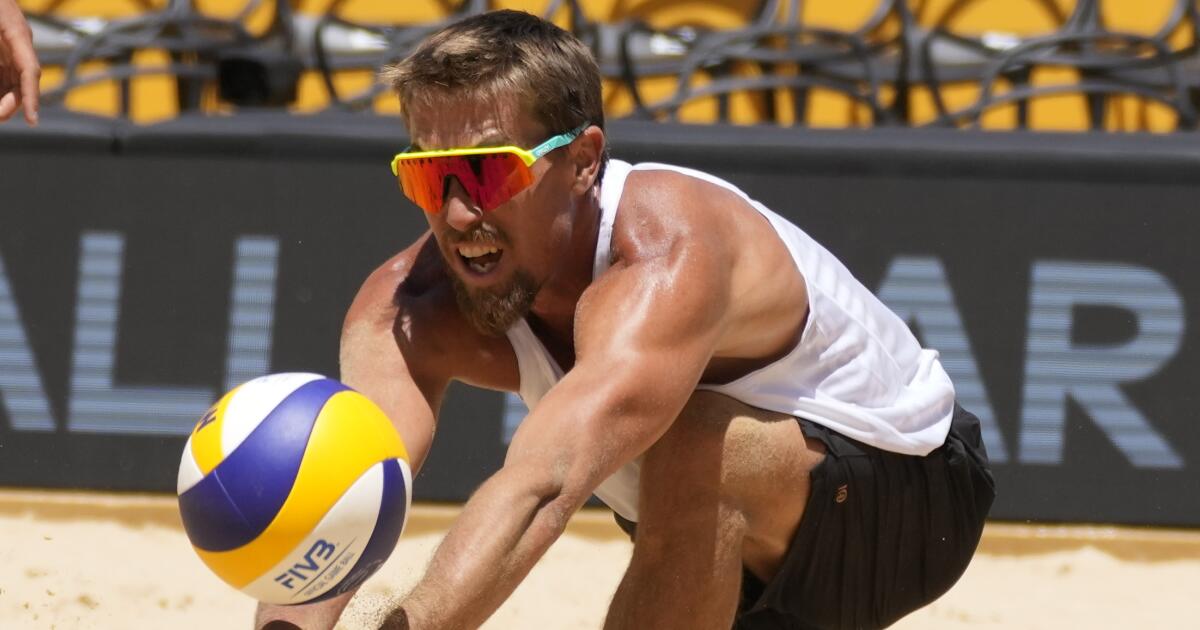
Taylor Crabb is no stranger to South California beaches. The Long Beach State alum returns home this weekend to compete in AVP League matches.
It marks the first time AVP will compete in Long Beach since 2020 and allows players to compete at the 2028 Olympics beach volleyball venue.
Crabb, 34, made his AVP debut in 2013 with his brother, Trevor, and advanced from the qualifier in Manhattan Beach before finishing 25th in his first tournament.
After years of competing with various different partners, Taylor Crabb and Andy Benesh have delivered the top performances this AVP season.
The following interview with Crabb has been edited for clarity and length.
Are you excited to compete in this weekend’s event at Long Beach?
Crabb: Very excited. A lot of my college teammates and part of the school have reached out, saying that they’re gonna come. So I’m excited to get a chance to play in front of them again.
When was the last time you were in Long Beach?
Crabb: I always try to go down there for alumni events or any big games they have. I went to UCLA against Long Beach last year, when it was No. 1 versus No. 2, so I always try to get down there and support them.
You missed out on the chance to compete in the 2020 Olympics because of COVID-19 restrictions and chose not to pursue a spot at the 2024 Olympics. Are you fired up to try to compete in the 2028 Olympics, knowing that Long Beach will host the competition?
Crabb: Yeah, it’s definitely an exciting time having the Olympics in Long Beach, and we kind of get to break it in this weekend. As you said, Tokyo didn’t go the way I wanted, but I’m going full force now. I have a great partner in Andy Benesh, who obviously went to the Paris Olympics, and if it weren’t for the Olympics being in Long Beach, and me getting a partner like Andy, I’m not even sure I’d be going for it, but because of those two things, I want to make the most of it.
You mentioned that if it wasn’t for a partner like Andy, you wouldn’t be going for it. What do you mean by that?
Crabb: I didn’t feel motivated by playing in all the international events, but now, I think, sitting out kind of lit the fire under me, and I’m really motivated now.
You’ve had different partners throughout your time. What other motivation does Andy give you?
Crabb: He’s been, in my mind, the top blocker for the U.S. the last four or five years. Seeing the professionalism he brings every day to practice, on and off the court, while traveling and when showing up to tournaments, it rubs off on you and that’s really motivating to see. And I just want to make him proud.
Why do you love volleyball?
Crabb: A lot of reasons, but it’s just a feeling I have when I’m out there on the court. It feels natural. It feels like home. I was born into a volleyball family. I had a volleyball in my hands my entire life, so I’ve always just enjoyed it.

NEWYou can now listen to Fox News articles!
CM Punk appeared on “Friday Night SmackDown” ready to take on any challenger that was ready to step to him after winning the Undisputed WWE Championship against Sami Zayn.
Punk entered the ring in Oklahoma City and called back to the “Monday Night Raw” after WrestleMania 42 when he told Cody Rhodes he’d be ready to deliver if a championship opportunity fell “out of the sky.”
COMPLETE PRO WRESTLING COVERAGE ON FOX NEWS DIGITAL
Cody Rhodes and CM Punk face off during SmackDown at Paycom Center in Oklahoma City, Okla. (Craig Ambrosio/WWE via Getty Images)
“When championship opportunities fall out of the sky, CM Punk catches them,” he said.
Punk named potential SmackDown superstars he’d think might come for the title, including Gunther, Finn Balor, Royce Keys, Damian Priest and Trick Williams. He even said that Zayn could come back around and get his rematch if he wanted. He didn’t mention Rhodes’ name, but the “American Nightmare” came out uncalled and marched his way down to the ring.
“I don’t think you and I can run away from each other anymore,” Punk told Rhodes.
Cody Rhodes looks on during SmackDown at Paycom Center in Oklahoma City, Okla., on July 10, 2026. (Craig Ambrosio/WWE via Getty Images)
Rhodes agreed and mentioned that Punk would want a match with him, just “say when.” It was a quick retort from Punk, who said, “when.” SmackDown general manager Nick Aldis, who was in the ring for the segment, booked the match for SummerSlam.
Punk will defend the Undisputed WWE Championship at SummerSlam, which takes place Aug. 1 and 2 at U.S. Bank Stadium in Minneapolis.
First, however, Punk and Rhodes will be involved in a tag team match at Saturday Night’s Main Event in New York City next week. Aldis made the match after Gunther demanded that Aldis put him in a match against Punk. Gunther was hoping it would be for the championship. Instead, Gunther will tag with Zayn.
Gunther didn’t take too kindly to that and attacked Aldis. Rhodes came back out to break up the calamity. He wanted to take on Gunther after the show went off air but Gunther walked away.
Gunther makes his entrance during SmackDown at Paycom Center in Oklahoma City, Okla., on July 10, 2026. (Rich Wade/WWE via Getty Images)
CLICK HERE TO DOWNLOAD THE FOX NEWS APP
Punk definitely has his hands full as he moves to SmackDown to become a fighting champion.
-

 Wyoming11 seconds ago
Wyoming health officials confirm second measles case, possible exposure at Grand Teton Park
-

 Crypto5 minutes ago
Ripple Swell 2026 Nears With Expanded Event Bringing Together Finance and XRP Ecosystem
-

 Finance11 minutes ago
Trump’s Financial Disclosure Revealed a $1.67 Million Micron Stock Stake | The Motley Fool
-

 Fitness15 minutes ago
Lawlor: It’s a fitness exercise, but there were lots of positives – Fleetwood Town Football Club
-

 Movie Reviews27 minutes ago
Unanswered//Butterfly: Sword Art Online Anime Film Review
-
World35 minutes ago
Iranians Bury Slain Leader Amid Renewed Fighting
-
 Lifestyle1 hour ago
Azar Nafisi on the movie adaptation of ‘Reading Lolita in Tehran’
-

 Technology1 hour ago
After years of teasing, the viral Nopia synth is ‘basically finished’

