Sports
How Mikel Arteta rebuilt Arsenal in his own image


At a dinner with his players, Arsenal manager Mikel Arteta secretly hired a team of professional pickpockets. The sleight-of-hand artists were tasked with going round the tables, pinching phones and wallets from an unwitting first-team squad.
At the end of the meal, Arteta stood up and asked them the team to empty their pockets. A number of players were missing valuable items. The idea was to teach his squad the importance of being ready, alert and prepared — at all times.
This kind of innovative thinking is typical of Arteta, who sees every occasion as an opportunity for learning and development. His influence is evident across every dimension of Arsenal. They have become a team built to his specifications, and a club moulded around his competitive spirit. His obsession with improvement has been infectious. It’s a mentality that has proliferated throughout the club.
The Arsenal manager is preparing to take charge of his fifth full season with Arsenal. The transformation since he took charge in 2019 has been dramatic. Although Arsenal take a collaborative approach to leadership, no single figure has been more impactful than Arteta.
This is likely to remain Arteta’s Arsenal for some time. The 42-year-old is expected to extend his contract beyond the coming season.
The Athletic looks at how Arteta has reshaped Arsenal, transforming the culture of the club and the fortunes of the team.
Structure
When Arteta arrived in 2019, he was initially given the title of head coach. After the departure of head of football Raul Sanllehi in August 2020, Arteta was promoted to the role of first-team manager.
Arsenal’s hierarchy had been in a state of perpetual flux since the departure of Arsene Wenger in 2018. Arteta’s promotion served as a significant statement: it consolidated his power and placed him at the heart of the club’s football affairs.
That process of evolution has continued. Arteta has not overseen this rebuild alone. The summer of 2020 also saw Tim Lewis added to the board. Now vice chair, Lewis has been a prominent supporter of Arteta and the bridge between the manager and the ownership. The leadership’s faith in Arteta sustained him through the difficult winter of 2020, and their patience has been rewarded.
Arteta’s productive relationship with Edu has been recognised with the Brazilian’s promotion to sporting director, giving him oversight of the women’s team and academy. Richard Garlick has been an integral part of the process, handling the fine details of negotiations and contract talks. This summer, Garlick stepped up to become the managing director, assuming the role vacated by chief executive officer Vinai Venkatesham. Garlick’s previous role as director of football operations is due to be filled by a new appointment soon.
Arteta’s relationship with Edu underpins a lot of what the club get right (Stuart MacFarlane/Arsenal FC via Getty Images)
This core team, under the oversight of Josh Kroenke and KSE, are the nucleus who have coalesced to overhaul the first-team squad.
Transfers
Arteta is heavily involved in Arsenal’s recruitment process — he and Edu have final sign-off on all first-team transfers.
Sometimes he is the driving force behind a deal. This summer’s £42million ($53.4m) acquisition of Riccardo Calafiori was one such example. Arteta’s powers of persuasion not only convinced Calafiori to come but they convinced Arsenal’s hierarchy to authorise the expenditure too.
The standard process is that Edu’s team of scouts and analysts will prepare a list of potential targets. Arteta will be supplied with video and data reports on each, which he will usually circulate among his coaching staff for feedback.
The main thing Arteta has brought to Arsenal’s recruitment process is clarity. When Arsenal have a positional need in the squad, Arteta provides clear direction on what attributes he is looking for. The manager brings his ‘non-negotiables’ to every aspect of the job — and when it comes to transfers, that insistence on specificity seems to work. When the parameters are clear, less mistakes are made.
Crucially, Arteta was also prepared to buy into the club’s strategy of recruiting young players. In the summer of 2021, Arsenal signed six players under the age of 23. That transfer window was arguably the true genesis of this project. Many managers might have been resistant to embracing youth, especially given the pressure and expectations Arteta faced. He was bold enough to take on the challenge, and the rewards have been evident.

Arteta is the driving force behind many of the deals Arsenal do, such as Calafiori (Stuart MacFarlane/Arsenal FC via Getty Images)
Arteta is also prepared to agitate for the signings he feels he needs. “He knows how to manage up as well as down,” says one Arsenal source, who has asked to remain anonymous for professional reasons. “If he really wants a player, he’ll go into the trenches to get a deal done. And he’s demanding. The team always comes first, but he knows what he wants and he’s prepared to dig in to get it.”
The overhaul of Arsenal’s squad has been dramatic. The recent sale of Emile Smith Rowe to Fulham means just three players remain from the squad Arteta inherited in 2019: Bukayo Saka, Gabriel Martinelli and Reiss Nelson.
And then there are 3 left from the squad Arteta inherited⌛️ https://t.co/3wvH902aML pic.twitter.com/wNi4MG42Fw
— 🇳🇴 kimmoFC (@kimmoFC) July 29, 2024
Performance
He might be called the club’s manager, but Arteta is first and foremost a coach. Consequently, he has made a considerable impact on the training ground.
Arteta played under Arsene Wenger, but his training is very different. “Up until his last few years, when it came to training, Arsene was a very much a ‘volume’ guy,” says one former employee. “They’d do long sessions without a lot of sprinting.
“Under Mikel, training is much more intense. That’s what we lacked for a long time.”
Arteta has not dramatically overhauled the medical and performance department. He inherited Shad Forsyth, a Wenger appointment, from Unai Emery. When Forsyth moved on, he promoted Tom Allen from within as head of sports science and performance.
Arteta persuaded club doctor Gary O’Driscoll to stay on in London for an extra three years before eventually losing him to Manchester United. He has been replaced by Dr Zafar Iqbal, who has experience with Liverpool, Crystal Palace and Tottenham.

Tom Allen is Arsenal’s head of sports science and performance (David Price/Arsenal FC via Getty Images)
While oversight of this department comes under Edu’s remit, Arteta has had an input. It’s striking that, when possible, Arsenal have tended to promote from within. Arsenal’s leadership value working with people who know and understand the club’s principles and can hit the ground running, rather than having to undergo an adaptation process. Bringing in bigger names from outside the club also carries a greater degree of risk — unorthodox, maverick methods tend to make for an awkward fit.
A major component in Arsenal’s impressive performance last season was their ability to keep key players such as Gabriel, William Saliba, Declan Rice, and Martin Odegaard on the field. That was partly down to managing their load in training, but it also owes something to their transfer strategy. Arteta and Edu place a huge emphasis on availability. “Look at all the players they’ve bought, people like Rice and Havertz,” says the source. “They’re a good age, but what else? There’s no injury history. That makes all the difference.”

William Saliba was one of only two outfield players in the entire Premier League to play every minute of every game in 2023-24 (Stuart MacFarlane/Arsenal FC via Getty Images)
Coaches
When Arteta was appointed in 2019, he was the youngest manager in the Premier League. Even heading into 2024-25, only five managers — Fabian Hurzeler, Kieran McKenna, Russell Martin, Andoni Iraola, and Gary O’Neil — are younger.
He also has one of the youngest coaching teams in the division. His primary assistant Albert Stuivenberg is 54, and goalkeeping coach Inaki Cana is 48.
Assistant coach Carlos Cuesta, however, is just 29. Coach and analyst Miguel Molina is 31; attacking phase coach Hussein Isa is 36. Set-piece specialist Nicolas Jover is the same age as Arteta (42).

(Left to right) Carlos Cuesta, Nicolas Jover and Albert Stuivenberg (Mario Hommes/DeFodi Images via Getty Images)
Some suggest that Arteta’s preference for younger coaching staff indicates that he does not want his authority challenged. Those who’ve worked closely with him say otherwise.
“I think we were all selected because we were not just ‘yes men’,” says Andreas Georgson. The Swede was Jover’s predecessor as set-piece coach and has recently joined Manchester United. “We all had a strong willingness to speak when we thought we had something to add.
“As a manager, you can make it really comfortable for yourself. Or you can get a group of qualified people that are willing to speak their minds — and that’s what Mikel did.
“There could be a bit of friction, there could be intense discussions, but the loyalty was always to the group, and Mikel always wanted the best idea to win.”
Arteta applied the same principle to his coaching staff as he did to the players: he focused on ability rather than age.
“I think sometimes in football there’s an over-belief in experience,” says Georgson. “I think Mikel looks first at the knowledge, the passion and the loyalty, rather than the CV. That’s where this group is extremely highly rated.”
Culture
Arguably Arteta’s greatest contribution to Arsenal has been to transform the club’s culture.
He has sought to reconnect the club to its identity. The training ground has been substantially redecorated — the walls adorned with iconic Arsenal images.
When the players leave the gym, they are met with huge images of the Emirates Stadium. The club motto, Victoria Concordia Crescit, is embossed on the canteen windows. A supersized picture of a smiling Arsene Wenger greets you at the entrance, with an accompanying quote from their legendary manager: “Here you have the opportunity to get out the greatness that is in each of you.”
It feels telling that it is during Arteta’s reign that Wenger has been welcomed back to the club as a visitor. Arteta has not run away from Arsenal’s glorious history. He has embraced it.

Wenger has returned to the Emirates as a guest in the Arteta era (Stuart MacFarlane/Arsenal FC via Getty Images)
From his first day, Arteta installed a set of standards that all players and staff had to abide by. Those who continually fell short were dispensed with. It led to high-profile exits for Mesut Ozil and Pierre-Emerick Aubameyang.
“Mikel had to win those battles,” says one former staff member. “Losing would have undermined his authority. Instead, it enhanced it.
“I think he liked Ozil, I think he liked Auba — as people. It wasn’t personal. It was about doing what’s best for the club, what’s best for the team. He’ll sacrifice anything for that.”
Another key change was transforming Arsenal into an ultra-competitive environment. “When I arrived in 2020, I think we still lacked a bit of that,” says Georgson. “That 100 per cent competitive mindset, for every action in training.
“One of the reasons we turned it around at Christmas was because the training environment became more competitive, more intense. We went from the main focus being tactical and technical, to using more emotions, energy, and motivation to make the mix a little bit more complete.”
Kieran Tierney witnessed the cultural revolution under Arteta first-hand and saw how the manager induced that competitive atmosphere.
“He would set you targets,” says Tierney. “Whether it is this amount of goals from set pieces until the end of the season, if you’re on course to do it, just wee things like that to motivate you.
“In training, everything is competitive. Races in the warm-up, passing drills had a competitive nature, whether it’s who is first to go round the circle without making a mistake. Everything has a winner and a loser.”

The team’s togetherness took them close to the Premier League title in 2023-24 (David Price/Arsenal FC via Getty Images)
“We play games in the hotel,” Aaron Ramsdale explained last year. “Sometimes it can be dodgeball, sometimes it can be spot the difference on the TV to get our brains working.”
Messaging is a key part of Arteta’s strategy. To help turn the team’s away form around, they began decorating dressing rooms with familiar images and keywords.
Typically, Arsenal stick three acronyms on the walls of the away dressing room:
IDENTITY (Intensity – Discipline – Enjoy – Non-negotiables – Trust – Improve – Team – You)
UNITY (Unique – Non-negotiables – Integrity – Tradition – You)
BASICS (Boxes – Attack – Shape – Intensity – Compete – Set pieces)
Contained within those keywords are the building blocks of Arteta’s managerial philosophy.
Arteta’s intensity can make him appear a stern figure, but he tries to inject fun when the schedule permits. The club regularly welcome players, staff and families for meals together. There have been team-building exercises including domino rallies and lemonade-making. During Arsenal’s title charge of 2022-23, the squad enjoyed a spa day and a trip to the Crystal Maze Live Experience.
The latter, of course, soon turned into another competitive experience. That is Arteta’s greatest accomplishment: balancing a positive, collaborative work environment with that competitive edge.
An example: in the spirit of community, Arteta introduced a Labrador to the training ground. She will regularly go home to stay overnight with staff or players, and has swiftly become a beloved figure at London Colney. That dog’s name? Win.

Win the dog has proved a popular addition (David Price/Arsenal FC via Getty Images)
Detail
Arteta’s attention to detail borders upon obsession. No stone is left unturned as he seeks to restore Arsenal to their former glories.
An example is changing the team’s training schedule to incorporate more sessions at the Emirates Stadium. Arteta believes that in doing so, the players gain a greater sense of ownership over their home ground.
In the course of a season, he will also shake up the travel schedule to keep his team on their toes. Last season, Arsenal travelled to Sheffield United on the day of the game, which granted the team more time with their families. They responded with an outstanding performance.

(Marc Atkins/Getty Images)
At an awards ceremony, Arteta expressed his desire for Arsenal’s players to be handed their prizes early in the night, to ensure the players could still get an early night.
Arteta has even expressed preferences over what kit Arsenal wear on a matchday. He had a particular preference for the black away kit of 2022-23, as he liked the intimidating image it helped create.
Stadium
Arsene Wenger built the Emirates Stadium; Mikel Arteta turned the lights on. It is his team who’ve ignited the new ground and made it feel like home.
Arteta has been central in rekindling that love affair between team and supporters. Part of that was building a team the fans could identify with, but Arteta also took more practical steps.
He has been very engaged in the club’s initiatives to improve the atmosphere at the ground. Arteta’s demands have been fed down to fan groups to help energise the crowd. Light shows, flags and even fire have been used to build a sense of occasion — all stemming from Arteta’s insistence the club do everything they can to turn the Emirates Stadium into a fortress.
It is a two-way relationship. Arteta has shown his appreciation for the fans’ efforts by displaying a framed photograph of Red Action’s ‘VAMOS’ banner in his office — and displaying a copy of the supporters’ ‘BELIEVE’ banner in the dressing room.

Arsenal won 15 of their 19 Premier League home games in 2023-24 (Alex Pantling/Getty Images)
Managing the manager
In his four and a half years with Arsenal, Arteta has not only sought to impact those around him. It has been a period of introspection and self-improvement too.
When Arteta arrived, he set a standard that players did not find easy to meet.
“The direction in his head was so clear from the beginning,” says Georgson. “But then I think both players and staff needed time to live up to the standards. Perhaps also he needed time to change the squad and have players who could meet those standards.”
“If the standards are really high and you feel it’s hard to reach them, that could be quite stressful. No one wants to let him down.
“But in bad times he was strong, he never changed direction. He got players who could thrive in that environment.
“And maybe he changed his rhetoric a little bit. Watching him now, I sense a slight change of tone or language.”

(Catherine Ivill – AMA/Getty Images)
Georgson has observed a softening in Arteta — one that has perhaps made him a more complete manager.
“I feel like he touches on more parts of the game. Of course, he’s still very deep into the tactical side, but he’s now also much more into the human, the emotional, the motivational side.
“We speak a lot about him being a winner in terms of being firm and tough and a fighter. But for me, being a winner is also being able to be self-reflective, take help from others to develop yourself.
“I think that’s a really undervalued strength of Mikel’s: that he’s constantly willing to question himself, listen to others, hear what he needs to improve, to become better. I’ve almost never heard anyone say that about him, but that is one of the traits that I think is very important for a world-class manager.
“Mikel is so determined that he’s going to be the best version of himself. He probably looked into his mirror and saw which areas he needed to improve, and then quickly made sure he had the people around him to help do that. That’s a very humble side of him that I don’t think he shows so much to the outside.”
At Arteta’s Arsenal, nobody is above reproach or criticism.
“He just wants to win,” says Georgson. “He doesn’t care if he has to dig deep into himself, or change staff or change players. It’s just about winning and making the biggest improvement possible.”
Additional reporting: Jordan Campbell, Tom Burrows
(Header: Getty; Adrian Dennis/AFP, David Price/Arsenal FC, Stuart MacFarlane/Arsenal FC; design: Dan Goldfarb)



NEWYou can now listen to Fox News articles!
CM Punk appeared on “Friday Night SmackDown” ready to take on any challenger that was ready to step to him after winning the Undisputed WWE Championship against Sami Zayn.
Punk entered the ring in Oklahoma City and called back to the “Monday Night Raw” after WrestleMania 42 when he told Cody Rhodes he’d be ready to deliver if a championship opportunity fell “out of the sky.”
COMPLETE PRO WRESTLING COVERAGE ON FOX NEWS DIGITAL
Cody Rhodes and CM Punk face off during SmackDown at Paycom Center in Oklahoma City, Okla. (Craig Ambrosio/WWE via Getty Images)
“When championship opportunities fall out of the sky, CM Punk catches them,” he said.
Punk named potential SmackDown superstars he’d think might come for the title, including Gunther, Finn Balor, Royce Keys, Damian Priest and Trick Williams. He even said that Zayn could come back around and get his rematch if he wanted. He didn’t mention Rhodes’ name, but the “American Nightmare” came out uncalled and marched his way down to the ring.
“I don’t think you and I can run away from each other anymore,” Punk told Rhodes.
Cody Rhodes looks on during SmackDown at Paycom Center in Oklahoma City, Okla., on July 10, 2026. (Craig Ambrosio/WWE via Getty Images)
Rhodes agreed and mentioned that Punk would want a match with him, just “say when.” It was a quick retort from Punk, who said, “when.” SmackDown general manager Nick Aldis, who was in the ring for the segment, booked the match for SummerSlam.
Punk will defend the Undisputed WWE Championship at SummerSlam, which takes place Aug. 1 and 2 at U.S. Bank Stadium in Minneapolis.
First, however, Punk and Rhodes will be involved in a tag team match at Saturday Night’s Main Event in New York City next week. Aldis made the match after Gunther demanded that Aldis put him in a match against Punk. Gunther was hoping it would be for the championship. Instead, Gunther will tag with Zayn.
Gunther didn’t take too kindly to that and attacked Aldis. Rhodes came back out to break up the calamity. He wanted to take on Gunther after the show went off air but Gunther walked away.
Gunther makes his entrance during SmackDown at Paycom Center in Oklahoma City, Okla., on July 10, 2026. (Rich Wade/WWE via Getty Images)
CLICK HERE TO DOWNLOAD THE FOX NEWS APP
Punk definitely has his hands full as he moves to SmackDown to become a fighting champion.
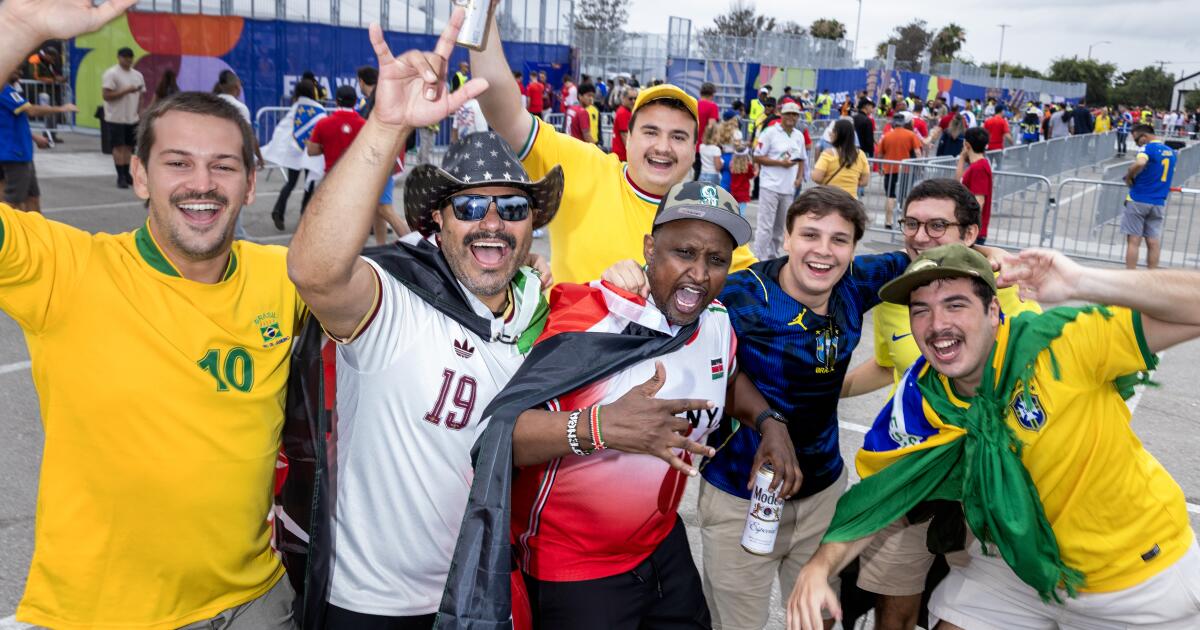
World Cup tourists are coming to L.A. for the soccer, but they’re staying for the $21 smoothies and Double-Doubles.
As the last Los Angeles FIFA World Cup event ended Friday, soccer fans were eating like locals and famous chains from the region were cashing in.
In the weeks that L.A. has hosted the World Cup, international soccer enthusiasts have flocked to big brands from the area, often in large groups wearing their countries’ jerseys.
It is a phenomenon seen at many of the host cities. In Dallas, giant gas station Buc-ee’s is the main attraction. For people visiting New Jersey, deli shops have been a hot ticket. In L.A., the place to be between matches was Erewhon.
Thirsty international sports fans gathered for pictures outside different Erewhons, wandered their aisles smiling, and, of course, picked up pricey smoothies.
While Erewhon would not comment on its business, mobility data company Arity, which uses phone data to track consumers, said Erewhon visits at the outlets around SoFi Stadium were quadruple what they were a week earlier on June 12, the day of the U.S. national soccer team’s opening match there.
Arity looked at what stores people visited within a 10-mile radius of SoFi that day and also found surges in visitors to nearby El Pollo Loco and Trader Joe’s.
Locals have spotted groups of people in Korea jerseys huddled together, trying to decide what to order at In-N-Out.
Some complained on social media that international tourists at Trader Joe’s were buying up all the mini canvas tote bags.
Soon after the Belgium vs. Spain quarterfinal ended Friday, the In-N-Out near SoFi had a long line of soccer fans stretching out the door in bright red and yellow and black jerseys and matching striped hats and scarves.
One of the workers said he had to explain “spread” and “animal style” to foreign football fans.
“I didn’t know this place existed,” a fan from Romania said while waiting in line.
Los Angeles and other cities and states that have hosted the event need the soccer fans to spend money to make the event worth all the time, effort and money it requires.
A rosy 2024 report projected the World Cup could bring more than $800 million to the L.A. region as 180,000 people converge on the area to sleep, eat and spend.
There were early concerns people weren’t turning up for the event because of the high ticket prices and the difficulty of obtaining visas for citizens of some countries.
However, at least for some L.A. hotels, there was a surge of last-minute visitors which pushed up occupancy and room rates.
While sports fans are not in the region to shop, they do make time for it.
World Cup customer spending is also apparent in beer sales. Andrew Heritage, the chief economist at the Beer Institute said beer purchases at entertainment and attractions in L.A. – outside of World Cup spaces – were up around 10% from normal.
“That tells me that fans in the L.A. area have decided to extend their stay and take in all the other things that the area has to offer, rather than just the match itself,” he said.
On social media, the purpose of these shoppers is clear: grab a quick souvenir or local specialty and take a selfie.
The data from Arity suggests that fans are very efficient when they spend at local spots, diving in, getting what they want and getting out as soon as possible, said Jeff Schlitt, a director at the company.
“Normally you’re there for an hour. They’re going to be there for 15, 18 minutes,” he said. “Why is that? Because they were purpose-driven shoppers.”
For some travelers, the more popular American chains aren’t unfamiliar. But some of the native L.A. fare still comes as a surprise.
As one Belgium-Spain matchgoer from the Netherlands stood taking a picture of the In-N-Out sign after the game, he said he’d never had a burger like the one he’d just tried.
“We only have McDonald’s and Burger King,” he said. “It’s way better.”

NEWYou can now listen to Fox News articles!
The face of baseball will not be at Tuesday’s All-Star Game.
Shohei Ohtani was scratched from his start on Friday as the Los Angeles Dodgers said he will also miss the Midsummer Classic with what the team called left knee irritation.
Ohtani, for obvious reasons, has become an All-Star Game fixture. He has earned the honor in each of the past five seasons and made his first start in 2021.
Starting pitcher Shohei Ohtani #17 of the Los Angeles Dodgers warms up before the MLB game against the Arizona Diamondbacks at Chase Field on June 03, 2026 in Phoenix, Arizona. (Photo by Christian Petersen/Getty Images) (Christian Petersen/Getty Images)
The two-way phenom is on his way to winning his fifth MVP award in his last six seasons as he is hitting .290 with a .939 OPS and pitching to a minuscule 1.79 ERA, the second-lowest in the sport among pitchers with 80-plus innings. His OPS is also the seventh-best mark in the league.
The Dodgers said Ohtani will be the team’s designated hitter up until the break, but he will “have some interventions on his knee to put him in the best position for the second half of the season.”
Ohtani dealt with knee issues earlier in the season.
It is certainly a big hit for the game as the other face of the sport, Aaron Judge, will miss the game due to a fractured rib that has kept him out since late May.
Shohei Ohtani #17 of the Los Angeles Dodgers gets ready in the on deck circle against the Arizona Diamondbacks at Chase Field on June 01, 2026 in Phoenix, Arizona. (Photo by Norm Hall/Getty Images) (Norm Hall/Getty Images)
DODGERS WILL AGAIN VISIT WHITE HOUSE TO CELEBRATE WORLD SERIES CHAMPIONSHIP, OFFICIAL SAYS
Ohtani hit 99 home runs combined in 2024 and 2025, leading the National League with a 1.025 OPS in that span. Ohtani did not pitch in 2024 after elbow surgery but returned to the bump last year and owned a 2.87 ERA and 11.9 K/9, a figure he also put up in 2022 that led the American League.
The “Japanese Babe Ruth” is the only player in MLB history to have 300-plus plate appearances and 40-plus innings in six separate seasons (Ruth only did it twice and never stole 50 bases), and he has more than excelled at both.
Shohei Ohtani pitches for the Los Angeles Dodgers against the San Francisco Giants at Dodger Stadium in Los Angeles, California, on May 13, 2026. (Gary A. Vasquez/Imagn Images)
CLICK HERE TO DOWNLOAD THE FOX NEWS APP
Ohtani is not hitting like he has in the past, but certainly the best pitching performance of his career will make up for it. He “only” has 20 homers and 56 RBI this season.
Follow Fox News Digital’s sports coverage on X, and subscribe to the Fox News Sports Huddle newsletter.
-

 News20 minutes ago
US congressman says he was detained by armed Israeli settlers in occupied West Bank
-

 Los Angeles, Ca2 hours ago
New details emerge in fatal stabbing of boy in El Monte
-

 Detroit, MI2 hours ago
1 dead, 1 injured after two-vehicle crash at Collingwood and Belleterre in Detroit
-

 San Francisco, CA2 hours ago
4 arrested, 3 cited after brawl following Giants vs. Rockies game at Oracle Park
-

 Dallas, TX2 hours ago
Mark Cuban takes legal action against Dallas Mavericks ownership over potential new arena deal
-

 Miami, FL2 hours ago
South Florida Dirt: A timeline of the Vacchi vs. Stern legal battle
-

 Boston, MA2 hours ago
Tall Ships begin historic Boston parade of sails
-

 Denver, CO3 hours ago
Lakers Proposed to Land Peyton Watson in Massive 9-Player Blockbuster Trade

