Sports
Inside Mohamed Salah’s contract saga: Lawyer’s concerns, Saudi interest – and a deal that pleases everyone


In the end, the news that Mohamed Salah will remain at Liverpool was delivered with a humorous tagline.
“More in than out,” read the message across the club’s social media pages at 8am on Friday, around 36 hours after reports in the forward’s homeland of Egypt first suggested he had agreed to extend his eight-year stay at Anfield.
It was a play on words, nodding to Salah’s comments in November when his future on Merseyside felt far more tenuous. The fact that he felt “more out than in” after scoring two crucial goals in a 3-2 come-from-behind win at Southampton that day was confirmation that the process of his contract negotiations has not exactly been smooth. Though Liverpool always felt confident a successful resolution would be reached, that scenario was not inevitable.
He’s staying. pic.twitter.com/AnhqQjUg7g
— Liverpool FC (@LFC) April 11, 2025
Now, however, the deal is done.
Salah has signed a two-year extension, with no breaks or release clauses, on terms very similar to the ones that almost certainly made him the second-highest-paid player in the Premier League behind Manchester City striker Erling Haaland. While his previous contract included a basic weekly salary of £350,000 ($480,000), when bonuses and performance-related incentives were taken into account, Salah’s package was worth far more. Including external commercial endorsements, some of which also had performance-related clauses, he earned up to £1million per week.
This new contract’s lucrative nature reflects Salah’s status and his ongoing excellence, even though he’ll turn 33 in June. After scoring 243 goals in 394 games, he is set to complete a decade’s service at Anfield.
Discussions on this latest deal have been a drawn-out process, rather than there being any breakthrough ‘moment’, and have taken nearly a year. The path has not been straightforward.
The Athletic has talked to figures with intimate knowledge of those negotiations, who spoke to us on condition of anonymity to protect relationships, to understand why they took so long, how both parties approached them and what ultimately clinched an agreement.
Ramy Abbas, the Colombian lawyer who is Salah’s long-time representative, does not like discussing sensitive matters on his phone. For him, it is convenient that services such as WhatsApp are banned from receiving or making calls in the United Arab Emirates, where he lives.
Though messages are permitted, hundreds of them are usually left unread on his accounts, many from potential commercial partners looking to work with his most famous client. A note on his WhatsApp profile warns: “Voice notes ignored. If you’re late, I will leave.”
Abbas is transactional, he likes efficiency and he prefers to meet in person.
When Liverpool signed Salah in the summer of 2017, their sporting director at the time, Michael Edwards, and chief scout Dave Fallows flew to Dubai out of respect for Abbas. They wanted to show him how keen they were to sign Salah from Roma.
Having arrived in the evening when it was already dark, they headed home to England a few hours later without ever taking their jumpers off. On that return journey, the pair joked they must be the only visitors to leave the Gulf resort without experiencing any sun on their backs.
— Ramy Abbas Issa (@RamyCol) July 1, 2022
That negotiation was relatively straightforward due to Salah’s enthusiasm for a return to the Premier League, where he felt he had much to prove having barely played during a previous spell with Chelsea.
When Liverpool’s new sporting director, Richard Hughes, picked up the phone to introduce himself to Abbas in July last year, however, there was much work to do.
Hughes had inherited significant challenges at Liverpool, starting with the recruitment of a manager/head coach to succeed Jurgen Klopp, who stepped down at the end of last season after almost nine years. Following the hiring of Feyenoord coach Arne Slot to fill that vacancy, Hughes moved on to player retention: as with Salah, there was only 11 months left on the contracts of the team’s captain, Virgil van Dijk, and his deputy, Trent Alexander-Arnold, the Liverpudlian local hero.
Alexander-Arnold’s case was different to the others in that he was in his mid-twenties, and had active interest from Real Madrid. Salah and Van Dijk were in their early thirties, and while still performing at an elite level, Liverpool were conscious that their previous contracts had been agreed when both were at the peak of their powers.
The mantra from Liverpool and the club’s owners at Fenway Sports Group (FSG) was the need to ignore the question of, ‘What looks like the right decision today?’, and rather frame it as, ‘What will look like the right decision in future?’.
Virgil van Dijk was also holding contract talks (Ryan Pierse/Getty Images)
That first conversation between Hughes and Abbas was brief and casual, with the sporting director promising that he would be in touch again soon to discuss Salah’s future. Like Edwards and Fallows had years earlier, Hughes would subsequently travel to Dubai to see Abbas, going twice before the end of 2024.
The first meeting, in late September, was held in the bar of one of the city’s quieter restaurants but the discussion was again short and informal until Hughes asked Abbas whether Salah wanted to stay at Liverpool. Abbas told him that he did, but the sporting director flew back to the UK with Abbas concerned the club might not be willing to maintain his client’s level of remuneration.
Abbas was impressed by Hughes but was left asking himself whether Liverpool valued Salah quite as much as they used to. He wondered whether the lack of commitment represented a hostile act.
As far as Salah was concerned, he was operating at the same level as the best players on the planet and showing no signs of slowing up, despite a disappointing end to last season after sustaining a hamstring injury at the Africa Cup of Nations in January 2024. The goals and assists were flowing.
Salah and Abbas understood the player’s salary would be in line with what he might achieve in the future but they wanted to sustain his position as one of world football’s best-paid players.
Liverpool, for their part, maintain that a pay cut was never on the agenda and that they always wanted to keep Salah. They had no issue with Salah pushing for the best possible terms and FSG had, after all, sanctioned lucrative deals for players — including Salah — worth the investment. They were also conscious of the need to try to find common ground with Abbas before tabling a formal offer.
There was also an acknowledgement, however, that any deal could not run counter to FSG’s sustainable financial model and had to be in the best interests of the club. For Liverpool’s owners, this principle could not be sacrificed, regardless of how valuable Salah was to the team’s chances of on-pitch success.

Richard Hughes, Liverpool’s sporting director (John Powell/Liverpool FC via Getty Images)
Salah thought the best years of his career were still to come.
Until Manchester City’s Rodri won it at age 28 last year, Ballon d’Or winners over the previous decade had all been in their early to mid-thirties and he wasn’t turning 33 until June 2025. Salah believed that his goals fuelling a successful Liverpool side would allow him to follow legends such as Lionel Messi, Cristiano Ronaldo, Luka Modric and Karim Benzema in winning that award, recognising the best footballer of the previous 12 months.
Hughes had travelled to that first meeting alone but Abbas wondered about Edwards’ involvement behind the scenes. Though he now officially worked for FSG, rather than the club, it was ultimately his responsibility to manage the budgets in the organisation’s football interests. Liverpool were not in financial distress. Though the club was expected to post a loss before tax for the 2023-24 season, it remained well within the limits for profit and sustainability rules (PSR) for the following campaign.
When Salah last renewed with Liverpool in July 2022, a deal that made him the highest-paid player in the club’s history, the contract was brokered and signed off by FSG president Mike Gordon. Julian Ward had succeeded Edwards as Liverpool’s sporting director but the meatier conversations were between Gordon and Abbas. That negotiation was a slog and Abbas and Salah both felt that the player’s future lay elsewhere just three weeks before an agreement was reached.
Abbas was unsure whether a resolution would have been found had Edwards led that process. He had brokered a complex package that was realistically achievable but, on a basic level, more lucrative than the figure suggested publicly. He was proud of the deal, realising that the club and their owners had extended themselves as far as they could to keep Salah, and even allowed the prestigious Harvard Business School in the United States to turn it into a case study.

Mohamed Salah signs his previous contract in 2022, along with Ramy Abbas (facing away from camera), and club officials Jonathan Bamber and Julian Ward (Nick Taylor/Liverpool FC via Getty Images)
The revelation that FSG had authorised a record-breaking deal to keep Liverpool’s star man meant it was more difficult for any of its critics to accuse it of being tight with money but it also suited the owners to keep the figures lower. If it was known that Salah was earning considerably more than some of his team-mates, there was a danger that Liverpool’s pay structure would spiral out of control.
FSG brought Edwards back into the organisation in March last year to try to re-establish a chain of command that existed at Liverpool before it became a manager-led operation under Klopp. The owners knew how ruthless Edwards could be. Yet beyond him and Hughes, Abbas could not shake the feeling that Gordon would also still be involved when it came to the final figures, if the negotiations ever got to that stage. FSG’s money was ultimately Gordon’s, and he would be the one signing off any deal.
In a second Dubai meeting between Abbas and Hughes in October, the conversation didn’t move on very far, with the lawyer concluding the discussion was light on meaningful content. It was his view that negotiations had not even really started. Abbas’ policy had always been to let the club make the first move, allowing him to see clearly how highly they valued his client. The lack of pace or urgency worried him.
Towards the end of November, Abbas did not know how much Liverpool were willing to pay Salah or how long they wanted him to stay. Though he was told there was an offer in the making, nothing happened. He was confident Liverpool would deliver on their promise eventually, but was increasingly beginning to think it would only be done to save face, allowing the club to claim they had tried to keep Salah — even though they knew the offer made to him would be rejected.
This explains why, on November 24, after he’d scored twice in the second half to inspire that win at Southampton, the player decided to speak to journalists about his future, telling them he was disappointed not to have received a new contract offer, before making his “more out than in” comments regarding the 2025-26 season.
Nothing that Salah says publicly is done without consideration. He is rarely impulsive and little is improvised. Initially, he planned to tell UK broadcaster Sky Sports about his frustrations but in the immediate post-match interview, he was not asked about his future. Outside the stadium, as he boarded the team bus, he asked print journalists whether they were willing to ask the difficult questions.
It was unusual to hear a player as private as Salah speak so openly. Yet on this occasion, he felt as though he was able to attack the situation because Abbas only represents him. Neither the player nor the lawyer had team-mates or other clients to think of at Liverpool.
Salah would subsequently receive criticism, notably from Sky Sports pundit Jamie Carragher, a former Liverpool defender, for speaking out. A comparison was drawn with Van Dijk, but Abbas had been told that the Dutchman had already received a contract offer while his client had not. Therefore, Salah had more of a reason to go public about his concerns.
Hughes had taken the view early on in the process that he had no desire to put anything relating to the contract talks in the public domain, reasoning that doing so would only cause issues for Salah (who he wanted to focus simply on scoring goals and winning games), new coach Slot or the team as a whole.
This often meant the club being subjected to ferocious criticism, particularly on social media, for seemingly allowing talks to drift and uncertainty to foment. A fan’s banner also appeared on the Kop during a match at Anfield, nodding to Salah’s ‘bow and arrow’ goal celebration, urging FSG: “He fires a bow, now give Mo his dough!”
Yet, for Hughes, it was deemed a price worth paying, even after the Southampton game when the temptation to become drawn into a public debate may have been acute. Following that banner’s advice would have been the antithesis of FSG’s principles.

A banner on the Kop encouraging FSG to finalise Salah’s new contract (Visionhaus/Getty Images)
Abbas was open-minded about the length of any new contract, despite some claims the issue was causing a dispute. If the offer was right, Salah was willing to extend his stay at Liverpool by only one year. Yet as November turned into December, both parties were not even at the numbers stage.
It was certainly in Liverpool’s interest to ensure Salah’s deal was the last one signed among the three players approaching free agency. If he were the first and his salary remained high, the representative of every other player at the club would have a figure to work from during their own contract negotiations. It was Abbas’ view that Salah was the star player and, just as Andriy Shevchenko (a striker) had earned more money than Paolo Maldini (a defender) at Milan decades earlier, so Salah deserved the more lucrative package.
With the focus swinging from Liverpool’s table-topping surge in the Premier League to Salah’s future after his words with reporters in Southampton, champions Manchester City were the team’s next opponents at Anfield the following Sunday — December 1. Earlier in the week, Abbas had flown into London’s Heathrow Airport, taking a meeting with a sponsor in Manchester before a night back in London, where he ate at one of his favourite Japanese restaurants. He travelled north again by train, arriving in Liverpool a few hours before kick-off and heading into a hospitality suite at the stadium without anyone from the media noticing him.
Though Hughes had contacted him about Salah’s comments the previous weekend, there was no summit with the sporting director. After watching the match, which Liverpool won 2-0, with Salah scoring the late clincher, Abbas flew back the next morning to Dubai via Manchester, no closer to knowing where his client’s future lay.
Abbas had earmarked the start of February as a cut-off point for any decision. That would leave a reasonable amount of time to try to find a resolution with Liverpool, or failing that, reach an agreement somewhere else.
Foreign clubs could not officially talk to Salah until January. Abbas was planning to spend the first month of 2025 broadening his client’s options but he knew that Salah’s priority was to re-sign with Liverpool. He was enjoying playing under Slot, and admired the head coach’s sense of superiority — he did not seem to mind embracing the expectations that fall upon the club.
Previously, Klopp liked to cast himself as the underdog but Slot was the opposite: Liverpool were a global superpower who should be winning trophies. Salah respected that attitude. Whereas Klopp had regularly complained about the demanding fixture schedule, Slot seemed to relish it. There were no excuses — it was all on the manager, the staff and the players to find solutions.
By Christmas, Liverpool were leading the Premier League by four points and also top of the reformatted Champions League table. Salah was convinced this was his and the club’s season of opportunity. Abbas, by comparison, believed success did not always lead to good sporting or business decisions. Win the league and it would be a much easier argument for Liverpool to then let Salah go, as the fan pressure might not be as significant.
This potentially left a curious dynamic: could it be true that the better Salah and Liverpool did, the weaker his chances of staying at Anfield beyond the summer of 2025 became? Salah wanted to play at the highest level for as long as possible. If Liverpool ended up winning the Premier League and Champions League, then anywhere else at that point was down as far as he was concerned.
At the turn of the year, this made the Saudi Pro League a low-probability destination. Though it was a league with mind-boggling resources, Saudi Arabia was also a developing country in football terms. Salah also loved living in England, where his family privacy was respected — he has a wife and two daughters who are well settled in the county of Cheshire, just south of Liverpool — and he could focus on his career. Would that be the same if he returned to the Middle East?
In the long-term, Abbas was interested in the United States but Major League Soccer did not make any approaches. While there was press speculation that Paris Saint-Germain were another option, in early January, the French club’s president Nasser Al-Khelaifi denied he was targeting the player.
By mid-January, the player’s sponsors were getting twitchy, keen to know where Salah’s future lay. Abbas did the maths about what a move to France would mean — Salah’s endorsements would take a serious hit because Ligue 1 does not have the same global visibility as the Premier League. This contributed to Abbas being more inclined towards a longer stay in England, preferably with Liverpool. Salah would not trash his legacy by joining a rival, which ruled out both Manchester City and neighbours United.
There was some intrigue about Chelsea, where he’d played for just over a year across 2014 and early 2015 and was considered a failure as he was first loaned to Fiorentina and fellow Italians Roma, then sold to the latter in August 2016. Salah felt as though he still had something to prove at Stamford Bridge, yet any deal to go back was reliant on Chelsea abandoning a transfer strategy that focuses on signing young players. Any move to another English club was also made more complicated by the fact none of them were legally allowed to negotiate with Salah until May.

Salah feels he has unfinished business with Chelsea (Richard Heathcote/Getty Images)
By the end of January, Salah had told his family that there was a chance they would have to uproot from their Cheshire home. For Abbas, there were now two clear options: stay at Liverpool, or, somewhat reluctantly, agree a deal with the only alternative that could satisfy his financial expectations.
That meant one of the Saudi Arabian clubs, most likely reigning champions Al Hilal in the capital, Riyadh, who had wanted him for their Club World Cup campaign this summer. Though Abbas had held talks with other clubs owned by the state Public Investment Fund (PIF), he was increasingly beginning to think that the interest in his client was a charm offensive by the country’s football powers to show how highly Salah was valued.
Abbas did not have an offer in writing but the numbers the Saudis were talking about would remove any concerns about sponsors and how they would react. His contacts in Saudi Arabia told him that if Salah wanted to move there, then an offer would come, though Abbas was mindful of what might happen if it became clear first that a new deal was not happening at Liverpool. Potentially, this would leave Salah exposed and suddenly he would be in a buyers’ market.
Of more significance, however, was what was happening closer to home.
By early December, Liverpool had finally made Salah an offer. Abbas’ fears were allayed and he considered it something to work from. He was happier now with the way things were going because of the regularity of the contact with the club.
Liverpool seemed more serious but Haaland’s nine-year contract at City, announced in the middle of January, had the potential to complicate things. What was he earning? Abbas understood that any deal for Salah would be much shorter but if Haaland was setting the rate for forwards, given Salah was outscoring him and playing for a team higher up the table, his wage ought to be competitive with what City were paying the Norwegian.
By now, speculation was reaching fever pitch, something Abbas found faintly amusing.
When it was suggested by local media on Merseyside at the end of January that he was flying in for talks, Abbas posted a picture on Instagram of the view from his home in Dubai.
Halfway across the world, Salah continued to hit landmarks: after scoring his 50th European goal for Liverpool on January 21 in a Champions League game against Lille, Slot spoke about his “elite mindset”. Back in Dubai, Abbas had dinner with his wife before watching that game at their apartment. Despite making progress, he and Liverpool remained some distance away from an agreement.
After January, however, Salah did his best to divert questions about his future.
In an interview with Sky, he insisted he did not know which club he was going to be playing for after this season, suggesting that if these were his final months at Liverpool, he did not want his memories of the period attached to any wrangling related to an impending exit. Instead, the focus would be on his and the club’s attempts to bring more trophies to Anfield.
The change of tactics was also a reflection of momentum shifting, with progress being made between Hughes and Abbas. On Valentine’s Day, Abbas was in a somewhat combative mood, posting on Instagram about too many social media users craving “attention and validation” from people they’ve never met, before switching to X, where he was rather more complimentary about Liverpool’s head coach, who he said was “excellent at his job” after taking the team seven points clear at the top of the Premier League.
Slot, meanwhile, was making it clear in interviews that he wanted Salah to stay, and the determination of the player to continue with Liverpool reflected the respect the Dutchman had gained during his debut season.

Arne Slot has struck up a good relationship with Salah (Alex Livesey/Getty Images)
Outside the club, many were baffled why all this was taking so long. Internally, Liverpool were relaxed about leaving any decision about Salah as late as possible.
They knew the retention of Salah would allow Liverpool to continue as the “destination club” they had become under Klopp, but they considered it smart practice to wait, as the team had settled into a rhythm, and this time gave Hughes and other club officials more of an opportunity to be sure the player was capable of maintaining his performances at age 33 and beyond.
The deal, when it was announced just before 8am on Friday UK time, involved images of Salah sitting on a throne beneath the Anfield floodlights at night. They had been taken the previous evening, when it was easier to get him in and out of the stadium without being seen.
For Liverpool, the announcement was a vindication of the work Hughes and Edwards have done behind the scenes, and of the impression made by Slot since his arrival last summer. The club feel the same will be true of Van Dijk, whose own two-year contract extension is also nearing confirmation.
Salah’s team-mates had long expected him to commit his future to Liverpool, not just because of his contribution this season, but because of the relationship he has struck up with Slot and how positive he has been about the head coach helping to elevate his game over course of this season. They have also been struck by how Salah has embraced the responsibility that comes with being part of the club’s leadership group and the support he gives to the younger players as a role model.
When the video was released on Friday morning, Abbas was back in Dubai. In some ways, dealing with him had been simple because only he acts on Salah’s behalf, and Salah is a footballer who does not have an entourage interfering in his affairs, unlike other players of his stature.
Abbas has no emotional connection as to where Salah plays his football — for him, it is simply a case of getting the best deal for his client, and he knows Liverpool are good for business.
But Salah was desperate to stay, as were his family. In the video released by LFCTV, he spoke about how his daughter Makkah was “the happiest one in the family” when he told the family he was staying because she didn’t want to move away from her school and friends.
Despite some difficulties, the dialogue between Abbas and Hughes was respectful, helping them extend a relationship that, until this point, has worked out handsomely for everyone.
Additional reporting: James Pearce
(Top photo: Carl Recine/Getty Images; design: Eamonn Dalton)



Sports
London descends into disorder as Morocco fans flood streets after World Cup elimination by France

NEWYou can now listen to Fox News articles!
Public unrest began in parts of London late Thursday night, and it appears Morocco’s exit from the 2026 FIFA World Cup at the hands of France is the reason.
France took down Morocco 2-0, eliminating the African country for the second consecutive tournament, this time in a quarterfinal match.
As a result, many feared Paris would erupt into riots, especially after the chaos that followed Paris Saint-Germain’s UEFA Champions League victory over Arsenal in May.
Instead, images and videos from Edgware Road in northwest London showed police clashing with large crowds as smoke billowed through the streets and debris littered the roadway.
A police vehicle is parked in a road as people from pro-Palestinian activist groups gather near the Edgware United Synagogue during a demonstration against the “Great Israeli Real Estate Event” organized by real-estate agency My Home in Israel, which markets property in Israeli settlements in the occupied West Bank, in London, Britain, June 14, 2026. (Toby Shepheard)
Riot police, equipped with shields and body armor, tried to contain the crowds as they clashed with people launching fireworks and throwing debris. One video also appeared to show an officer down.
KYLIAN MBAPPÉ, OUSMANE DEMBÉLÉ FIRE FRANCE INTO WORLD CUP SEMIFINALS WITH WIN OVER MOROCCO
It’s unknown what happened to the officer who was down on the asphalt or how he was injured.
Fans waved Moroccan flags in the middle of the streets, which held up traffic. Some even jumped on top of vehicles trying to get through the area.
Moroccan fans in the stands before a FIFA World Cup 2026 quarterfinal match between France and Morocco at Boston Stadium July 9, 2026, in Foxborough, Mass. (Richard Sellers/SportsphotoAllstar)
Similar scenes unfolded after Egypt’s World Cup exit, when Argentina rallied for a controversial 3-2 victory that featured several disputed officiating decisions.
Paris, on the other hand, looked more like a city celebrating than one on the brink of a riot. Supporters of both France and Morocco flooded the streets, slowing traffic in several parts of the city.
One video showed horns blasting from cars with French and Moroccan flags out the windows on the L’avenue des Champs-Élysées in Paris. Supporters on the side of the road, waving their own flags, joined in on the celebration.
France’s Kylian Mbappé scored his eighth goal of this World Cup, which ties him for the most with Argentina’s Lionel Messi. Ousmane Dembélé also scored in the second half for France in the 2-0 win over Morocco.
It’s the third straight semifinal appearance for France, while Morocco still made World Cup history despite the loss. After becoming the first African country to reach the quarterfinals and semifinals in World Cup history in 2022, Morocco added to that by becoming the first-ever African nation to reach more than one quarterfinal.
Moroccan fans react while attending a watch party for the World Cup round of 8 match between France and Morocco in Boston, Massachusetts, on July 9, 2026. (Joseph Prezioso/AFP)
CLICK HERE TO DOWNLOAD THE FOX NEWS APP
Morocco’s exit means there are no more African nations alive in the World Cup. France will be taking on the winner of Spain and Belgium, while England and Norway and Argentina and Switzerland face off in the quarterfinals.
Follow Fox News Digital’s sports coverage on X and subscribe to the Fox News Sports Huddle newsletter.
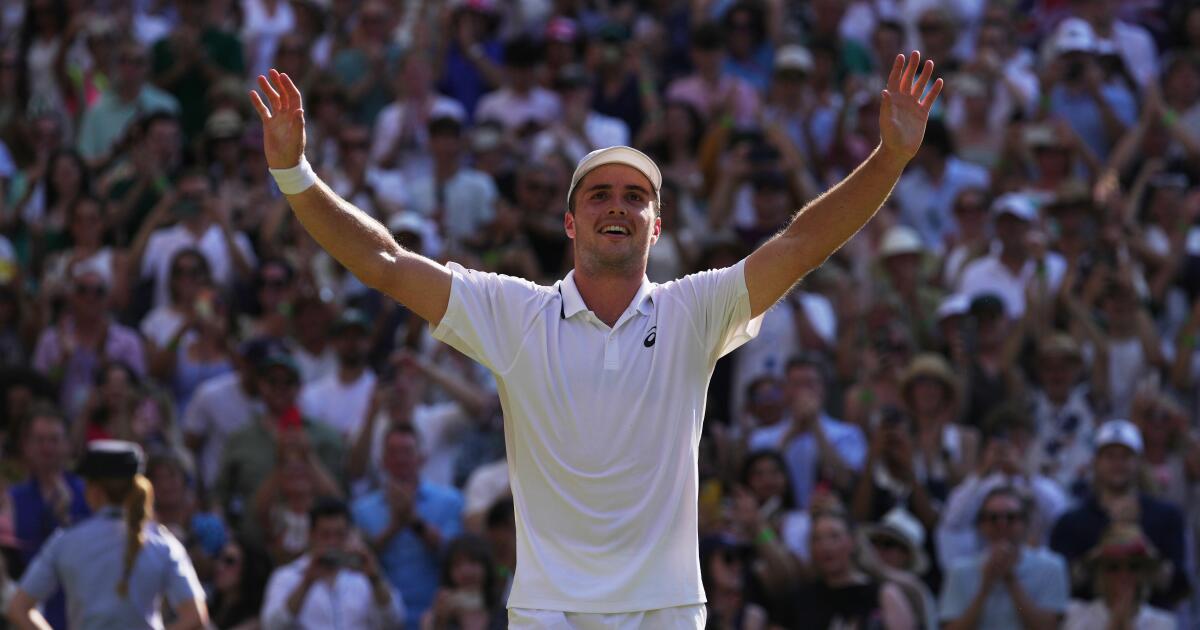
LONDON — A local boy sleeps in his own bed, plays in front of a king and queen and makes a Cinderella run to the Wimbledon semifinals. Sounds like a Hollywood script that might never see the silver screen.
But it’s no fairy tale — it’s Arthur Fery’s out-of-nowhere performance over the last 10 days.
Fery, a virtually unknown British wild card with a triple-digit ranking, has become the emotional heartbeat of Wimbledon while legitimately diverting some national attention from England’s World Cup quest.
The royal treatment at his matches across the All England Club has come in more ways than one.
Fery, who grew up five minutes from Wimbledon and is staying at home during the tournament, first played before grass-court king Roger Federer, Wimbledon’s eight-time singles champion, during Monday’s fourth-round victory. Two days later, he beat No. 9 seed and French Open runner-up Flavio Cobolli of Italy in the quarterfinals 6-4, 7-6 (4), 6-0 in front of Queen Camilla.
Ranked 114th, Fery had never reached the semifinals of an ATP Tour event, let alone a major, before his brief chat with the queen following the match.
“She just said, ‘Congratulations, keep going,’” 23-year-old Fery told reporters later. “I told her it was my birthday on Sunday, so it would be great to play the Wimbledon final on my birthday.”
That’s still a match away. To get there, Fery will have to get past one of the hottest players on tour: No. 2 seed Alexander Zverev, who is fresh off his first Grand Slam title at the French Open. Looming on the other side of the draw is a highly anticipated showdown between defending champion Jannik Sinner against 24-time major winner Novak Djokovic.
If Fery can continue his magical run to the end, he would become the first British wild card to win a Wimbledon title.
Arthur Fery reacts after defeating Flavio Cobolli in the Wimbledon quarterfinals on Wednesday.
(Maja Smiejkowska / Associated Press)
Born in France, Fery’s family moved to Wimbledon when he was an infant. His mother played professional tennis. He was a top British junior but chose to sharpen his game for three years in the U.S. collegiate system at Stanford, as many of his compatriots have done.
“I came out with a lot of hunger coming out of that, and I was ready to attack the pro circuit,” Fery said.
After struggling with bone bruising in his arm that limited him to playing mostly on the lower-tier Challenger circuit in recent years, Fery is finally healthy and playing consistently.
His path to the last four in London has been a masterclass in clutch come-from-behind performances. The Brit has stared down near-certain elimination in multiple matches, repeatedly breaking his opponents’ momentum with Houdini-like on-court acts.
At 5-foot-9, Fery possesses a skill set perfectly suited for low-bounding grass.
His compact strokes, low center of gravity, and elite movement allow him to hug the baseline, take time away from opponents, and confidently execute delicate volleys at the net, according to ESPN analyst Chris Eubanks.
“He defends well,” said Eubanks, a 2023 Wimbledon quarterfinalist. “He can scrap. He can claw. He can dig his way back into points. And when he ventures forward, he’s very, very comfortable at the net. This is a picture-perfect example of someone whose game is built for the surface.”
Still, it’s hard to fathom the multitude of milestones for Fery, who briefly reached the No. 1 ranking in college and earned 2023 Pac-12 Singles Player of the Year honors before leaving early to pursue a pro career.
He arrived at Wimbledon with just one main-draw victory at a major, a losing record as a professional, and only one previous ATP quarterfinal, at Queen’s Club last month. He’s now 11-8, won his first two five-set matches, and is the first British wild card to reach the Wimbledon men’s semifinals in the Open Era. The only other men’s wild-card semifinalist was Goran Ivanisevic, who won the title as a wild card in 2001.
Fery, who started the season ranked No. 185 and will climb to at least No. 36 after the tournament, said there were a “lot of first times” as he reflected on his unprecedented run. “First five-setter, longest match that I’ve ever played, first time breaking into the top 100, first second week in a slam, all at home, five minutes from where I grew up. It’s a great story for me,” he said.
The gap with his fellow semifinalists is understandably massive.

Entering Wimbledon, Djokovic, Sinner and Zverev’s combined records include 29 Grand Slam titles, 2,088 match wins and 155 tour-level titles. Fery was 6-8 in tour-level matches with zero titles.
But he has singlehandedly lifted the tournament for locals. With top hopes Jack Draper and Emma Raducanu withdrawing before the tournament and the rest of Britain’s singles prospects falling one by one — 18 men and women were eliminated by the third round — Fery became the nation’s last knight standing.
If his first name inevitably evokes Arthurian legend, Fery’s march through the draw gave Britain reason to believe again. No sword, no Round Table, just world-class shot-making, a lion’s heart and a Centre Court crowd thrilled to rally behind him.
“This is really quite something to see on home soil,” said Russell Fuller, the BBC’s tennis correspondent, who compared it with Raducanu’s stunning U.S. Open win in 2021 as a qualifier.
Fery earned every bit of it.
In the first round against Damir Dzumhur, Fery dropped the opening set and trailed by a break in the second before surging back. Against Zizou Bergs in the third round, he faced a 4-1 deficit with a double break in the fourth set, and again fell behind 4-1 in the fifth, before somehow surviving.
Then, stepping onto Centre Court for the first time against former top-10 stalwart Grigor Dimitrov of Bulgaria in the fourth round, Fery clawed out of a 2-sets-to-1 hole and a break down in the fourth set to clinch the victory in a fifth-set tiebreak.
“He carries himself with humility, but he’s a fierce competitor, and he’s got a ton of belief in himself,” said Stanford men’s coach and former top-60 player Paul Goldstein, who flew to England Tuesday to see his former charge compete against Cobolli.
While Fery attempts to outmaneuver Zverev on Friday, the other semifinal features a 2025 Wimbledon semifinal rematch between seven-time Wimbledon winner Djokovic and top-ranked Sinner, who defeated the Serb in straight sets on his way to the title. It’s also their second Grand Slam semifinal meeting in 2026. At January’s Australian Open on hard courts, Djokovic bested 24-year-old Sinner in five sets before falling to now-injured Carlos Alcaraz in the Melbourne final.

Arthur Fery hits a return during his Wimbledon quarterfinal win over Flavio Cobolli on Wednesday.
(Clive Brunskill / Getty Images)
Djokovic, 39, enters the match after surviving a grueling five-set, 5-hour-plus quarterfinal slugfest against No. 3 Félix Auger-Aliassime that concluded just minutes before Wimbledon’s 11 p.m. curfew. But the seventh-seeded Serb has a way of defying Father Time and he has had two days to recover on a surface where points are shorter and generally less taxing on the body.
Italy’s Sinner, who defeated Alcaraz in last year’s Wimbledon final, has been efficient if not at the level that saw him capture five consecutive titles before crashing out in the second round at the French Open. After a first-round scare here, the four-time Grand Slam champion has dominated opponents behind his improving serve, winning 80% of his first-serve points. He hasn’t dropped a set since the opening round. Sinner leads the head-to-head with Djokovic 6-5.
According to Eubanks, Djokovic must disrupt Sinner’s movement to break his rhythm, and take his chances.
“He’s got to play similar to how he played in Australia, where it was just all-out aggression,” Eubanks said.
For Sinner, he added: “His serve can be a neutralizing force for what Novak is going to try to do.”
On the other side of the ledger, Fery’s poise under pressure and deft use of the home crowd will be paramount to continue his surprise run against Germany’s Zverev, whom he called a “step up again” from his last five matches. Zverev, 29, is seeking his fifth major final and first at Wimbledon.
“I’m ready for it,” Fery said. “I have nothing to lose. I’m just going to go out there and … put my game on the court, do what I’ve done, believe in myself. We’ll see where that takes me.”
Home has never been closer to Centre Court. Nor has Arthur Fery ever been closer to tennis history.
Sports
Pirates star pitcher makes unfortunate history after being taken out in middle of perfect game bid

NEWYou can now listen to Fox News articles!
Jared Jones was flirting with Major League Baseball history on Wednesday night — he got it, but it was not what he originally envisioned.
The Pittsburgh Pirates pitcher retired the first 18 batters he faced, but he was taken out in the middle of his perfect game bid after six innings.
Now, the Pirates certainly have their reasons — the 24-year-old Jones hasn’t thrown more than 81 pitches in eight starts since returning May 20 after missing all of last season while undergoing ulnar collateral ligament internal brace surgery on May 21, 2025. He was yanked with 77 pitches and likely would have needed more than 100 pitches to record the 25th perfect game in MLB history.
Jared Jones of the Pittsburgh Pirates pitches during the first inning against the Atlanta Braves at PNC Park on July 8, 2026, in Pittsburgh, Pennsylvania. (Photo by Joe Sargent/Getty Images)
However, Jones left the game after getting zero run support, so when the Atlanta Braves tacked on three runs late for a 3-0 victory, Jones instead found himself in the wrong chapter of the history books.
According to Opta Stats, Jones became the first pitcher in the modern era (since 1920) to pitch at least six perfect innings and not record a win.
“It does suck. Something’s cool coming on, but I’m on what? My eighth start off of surgery? I completely understand it, and it is what it is,” Jones told reporters after the game.
Pittsburgh Pirates starting pitcher Jared Jones (17) makes his way to the field to warm up before pitching against the Atlanta Braves at PNC Park. (Charles LeClaire/Imagn Images)
JUSTIN VERLANDER ANNOUNCES HE WILL RETIRE AFTER THIS SEASON: ‘I’VE REALIZED THAT TIME HAS COME’
Jones said he didn’t entertain attempting to complete the perfect game.
“Not with the pitch count,” he said. “Not really ever expecting to go nine right now, so that was never in my head.”
Joey Bart, traded to the Braves from the Pirates on June 18, followed a double by Mike Yastrzemski with a 422-foot, two-run homer to left-center field off a slider from Dennis Santana. Drake Baldwin added an RBI single to center in the ninth for good measure.
It was the second time in less than a week that a pitcher was taken out of the game with a perfect bid through six innings — the Miami Marlins took Eury Perez out after seven innings in which he had 92 pitches. Perez, too, is in the midst of returning from injury and has surprisingly found himself right in the postseason mix.
He was pulled for Lake Bachar to start the eighth, and the Marlins allowed eight runs to the Athletics in the final two innings, but held on to win 9-8.
Jared Jones (17) of the Pittsburgh Pirates delivers a pitch during a MLB game against the Cincinnati Reds on June 27, 2026, at PNC Park in Pittsburgh, Pennsylvania. (Joe Robbins/Icon Sportswire via Getty Images)
CLICK HERE TO DOWNLOAD THE FOX NEWS APP
The Pirates are 4.0 games out of the final wild card spot, which is held by the Marlins.
The Associated Press contributed to this report.
Follow Fox News Digital’s sports coverage on X, and subscribe to the Fox News Sports Huddle newsletter.
-

 Technology8 minutes ago
Microsoft’s carbon emissions went up 25 percent last year
-

 World11 minutes ago
Jailed Catholic woman’s hunger strike highlights Iran religious persecution — US demands action
-

 Politics16 minutes ago
Israel shares intelligence warning Iran plotted new assassination attempt against Trump: report
-

 Health23 minutes ago
Parasitic infection causing ‘explosive’ stomach illness exceeds 1,000 cases in northern state
-

 Sports26 minutes ago
London descends into disorder as Morocco fans flood streets after World Cup elimination by France
-

 Technology31 minutes ago
Google turns old phones into cloud servers
-
 Business38 minutes ago
Waymo is starting robotaxi service in San Diego
-
 Entertainment41 minutes ago
‘Children of Blood and Bone’ author won’t see film after feud with star Amandla Stenberg

