Sports
Hernández: How Kei Kamara escaped Sierra Leone to star for LAFC

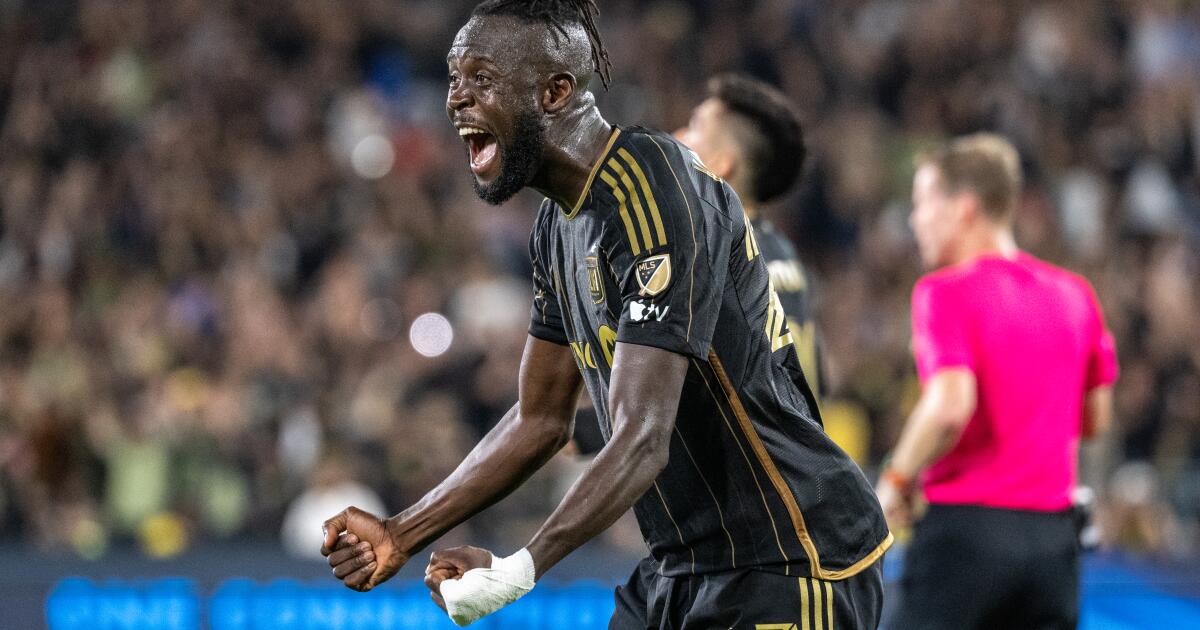
The explosion outside of his school. The vultures feasting on corpses in the streets. The water gushing into the boat that was ferrying him to safety.
The images of war remain with Kei Kamara to this day.
The LAFC striker pictures them whenever he shares the story of his childhood in Sierra Leone. He often sees them in his dreams.
“I get these nightmares,” Kamara said. “I’m always running. I’m always running from chaos.”
The memories continue to haunt the 39-year-old Kamara, but they also have convinced him of how fortunate he is.
So rather than be disenchanted with how he’s switched teams more than a dozen times in his career, he celebrates how someone has always wanted him.
So instead of complaining about how he played irregularly last year with the Chicago Fire, he points out how his diminished role allowed him to score a milestone goal this year while playing for his hometown team.
“I’m this kid who ran away from a civil war,” Kamara. “I should not be here.”
Here, in his 19th year in professional soccer.
Here, with a resume that includes a stop in the English Premier League.
Here, in second place all-time in career goals in Major League Soccer, one spot ahead of Landon Donovan.
A boy selling soft drinks that he carries overhead walks past a clinic taking care of Ebola patients in Kenema, part of war-torn Sierra Leone, in 2014.
(Youssouf Bah / Associated Press)
Kamara was living in the Sierra Leone town of Kenema when his mother won an immigration lottery that permitted her to move to the United States. He was left with an aunt, who was one of five wives in a polygamous family that included about three dozen children. Kamara considered them to be brothers and sisters, adding that he didn’t know what a cousin was at the time. They played soccer on the family compound’s courtyard or on the 6-foot-wide path between adjacent buildings on the property.
But their lives were about to be disrupted, as a civil war that broke out on the Liberian border moved into the cities.
Kamara was in school when he heard the explosion that changed everything. A grenade had detonated outside.
“I remember running out of school, running into this little alleyway,” he said. “Kids were falling down and we were jumping over each other. I’m getting close to home and I realize I left my brothers and sisters. So I had to turn back around and run through the crowd. They were sitting in class.
“I don’t think there was a calm time after that.”
Kenema became dangerous. Rebel forces swept the streets for potential child soldiers, and Kamara said two of his cousins were captured.
“We never got to see them again,” he said.
His family moved to Sierra Leone’s capital of Freetown, but the conflict followed them.
“When there were gunshots, we all ran in the house,” he said. “When it was done, you’d hear neighbors and people crying because they lost family members. You could see their bodies.”
A temporary cease-fire presented Kamara and some of his family members with a chance to escape. Before they could board a plane to Gambia, however, they had to cross the Sierra Leone River by boat.
“It’s built with wood, so there’s always water coming in,” Kamara said. “I remember there were people with buckets bailing the water out. I remember thinking, ‘We’re not going to make it out, we’re going to drown.’”
Kamara spent close to two years in Gambia, after which he and his relatives were granted asylum in the United States. He first set foot in this country on Oct. 26, 2000.
“I will never forget that day,” he said.
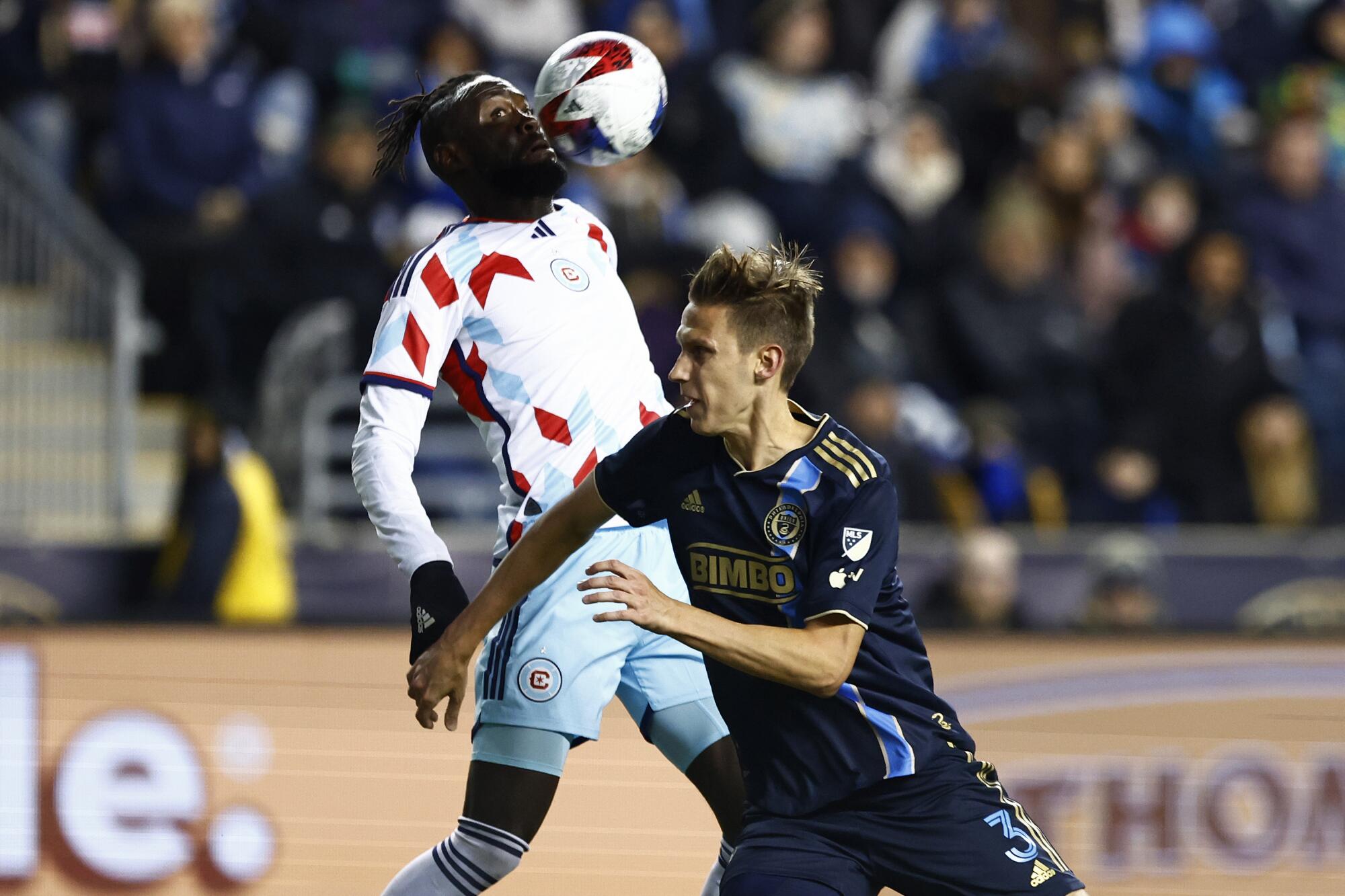
Kei Kamara heads the ball away from Union defender Jack Elliott while playing for the Chicago Fire in last season.
(Rich Schultz / Associated Press)
Kamara initially lived with an uncle in Maryland. The arrangement lasted only a couple of months, and Kamara moved across the country to be with his mother in Hawthorne.
“It wasn’t all peaches and cream,” Raphael Saye said.
Kamara’s and Saye’s mothers were close friends, and Saye’s mother often looked after Kamara when his mother worked nights as a waitress at the Normandie Casino. Kamara came to refer to Saye as his brother.
“He had to deal with being different at school,” Saye said. “Being African, he had an accent. His mannerisms were different.”
Kamara enrolled at Leuzinger High in Lawndale, where he crossed paths with future NBA players Dorell Wright and Russell Westbrook. Kamara found his place on the soccer field. Classmate Cristian Olvera insisted he try out for his youth club, the Manhattan Beach Hurricanes.
“After 10 minutes, I just remember saying, ‘Oh my goodness, we’ve struck gold.’ He just did things that were jaw-dropping,” said Hurricanes coach Bruce Myhre.
Because Kamara’s mother worked nights, Myhre joked, “I ended up being his chauffeur.”
Twice a week, Myhre picked up Kamara in his silver Nissan Pathfinder to drive him to practice in Manhattan Beach. He also drove him to games.
“That’s when I first started to find out his story,” Myhre said.
Myhre became a father figure to Kamara and made sure college coaches knew about him. One of them was Joe Flanagan, who at the time headed the program at Division II Cal State Dominguez Hills.
When Kamara was a high school senior, Flanagan ran into him at Dominguez Hills. Kamara had applied to the university and was on his way to Flanagan’s office to inform him that he wanted to play there.
“Kei was all over it,” Flanagan said.
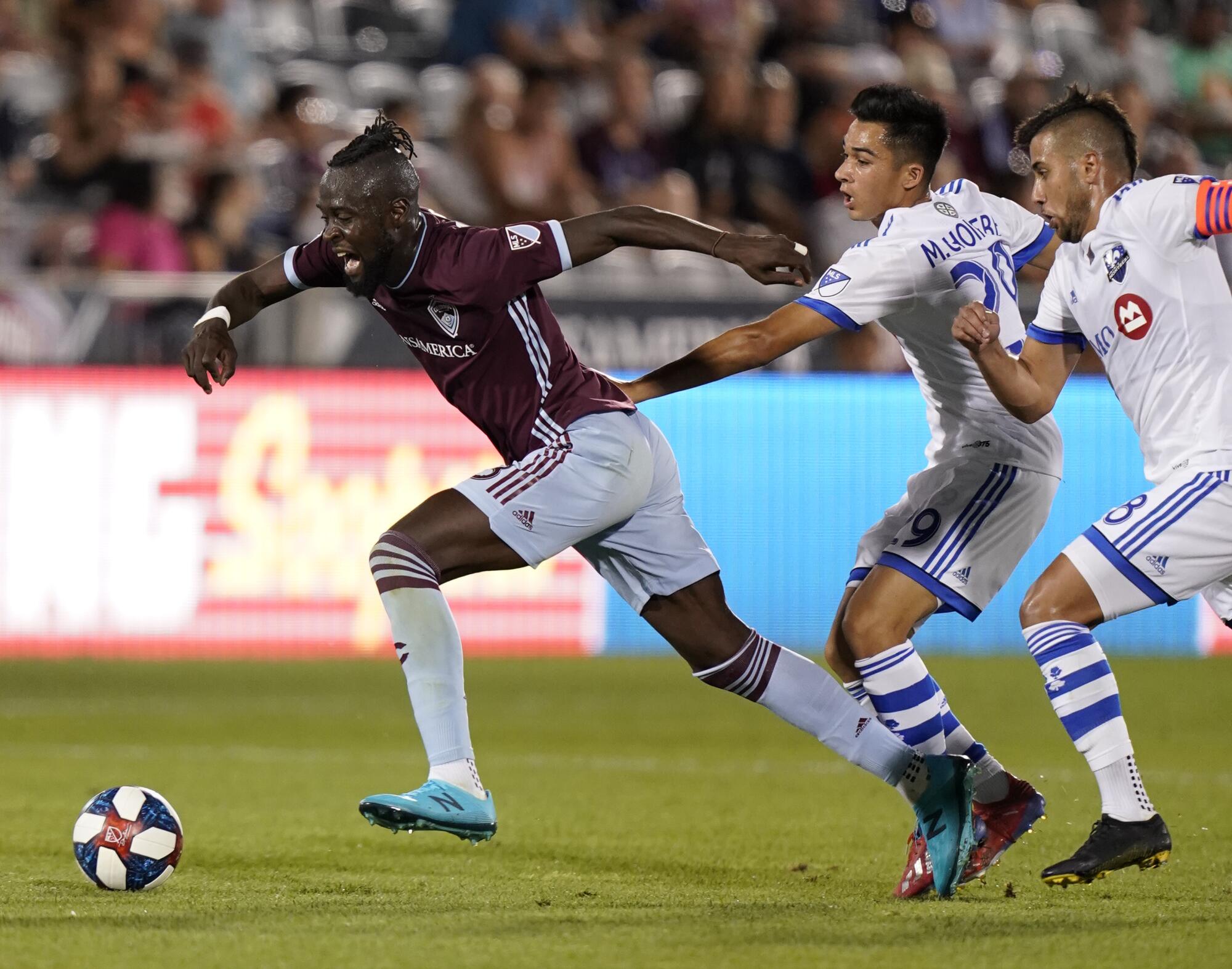
Kei Kamara bursts ahead of two defenders while playing for the Rapids in 2019.
(Jack Dempsey / Associated Press)
Kamara had a plan. The Galaxy’s new stadium was on the Dominguez Hills campus. Expansion team Chivas USA was about to join them as a tenant in what was then called the Home Depot Center.
“If I want to play pro, this is probably the best place to go,” Kamara recalled thinking at the time.
Kamara found work at the stadium. He erected the goals. He placed the corner flags. He set up the advertising boards that lined the field.
“He was the first one to get a job and we didn’t understand why,” said Saye, who also enrolled at Dominguez Hills.
Kamara made it a point to become acquainted with Galaxy players. He was soon on a first-name basis with then-Galaxy coach Sigi Schmid.
“I had my soccer shoes in the back of my car all the time,” Kamara said.
The memories elicited a chuckle from Flanagan.
“He was a go-getter,” Flanagan said.
In time, Galaxy players occasionally invited him to kick the ball around with them. After scoring 16 goals as a freshman and 15 as a sophomore, Kamara declared for the 2006 MLS draft.
He was selected with the ninth pick by the Columbus Crew. Schmid was the team’s coach.
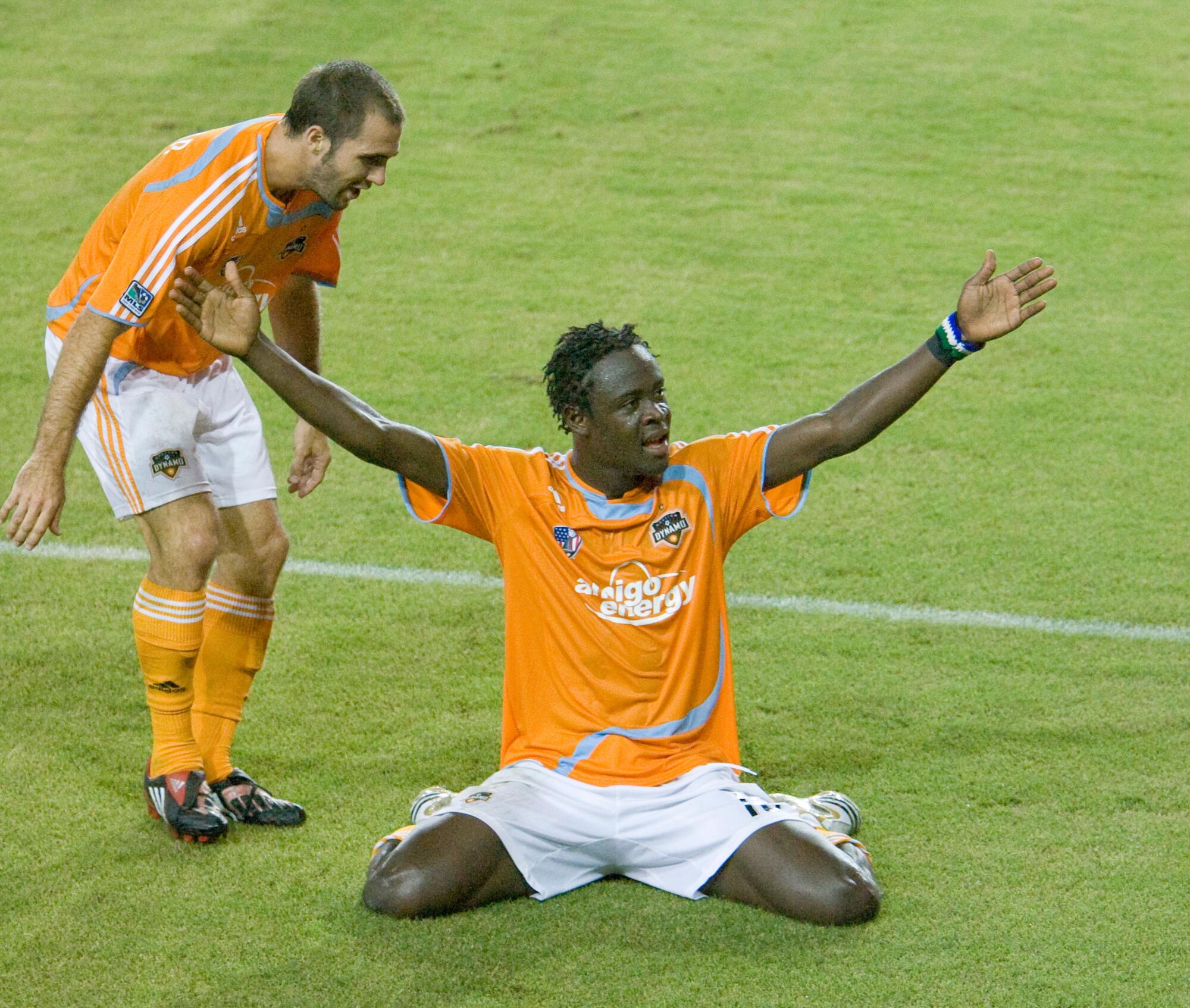
Kei Kamara slides on his knees after scoring his second goal for the Dynamo during a 2008 game against Chivas USA. At left is teammate Brian Mullan
(Steve Campbell / Associated Press)
Kamara has played for 11 MLS teams. He’s played in Finland. He’s also played in England, including half a season with Norwich City in the Premier League.
One of his most cherished memories was of playing at Old Trafford. Kamara had visited the stadium the previous year as a spectator.
“A few months later, I’m downstairs with Norwich City playing against Manchester United,” Kamara said. “I’m looking all the way up, like, ‘I was just sitting there in December and now I’m down here.’”
He has a similar sense of wonder when he reflects on how he ended up with LAFC. In March, he was back in Sierra Leone, doing work for his HeartShapedHands Foundation, which serves children in his homeland. Kamara represented the country 39 times before retiring from international soccer in 2022.
Just when he thought his club career might also be over, his agent called to inform him of LAFC’s interest. There was one caveat: He had to try out.
“I did it because it was LAFC,” Kamara said.
Kamara rushed home. He signed a few days later.
Three weeks ago, in a game against the San Jose Earthquakes at BMO Stadium, the 6-foot-3 Kamara scored the kind of goal he’d scored so many times before, soaring over a defender and heading the ball into the back of the net.
The goal was his second of the season and 146th of his MLS career. Donovan, the U.S. national team’s all-time co-leader in goals, retired with 145 goals in MLS.
Kamara scored his 147th two weeks later at the Rose Bowl against the Galaxy.
“There’s just something so beautifully serendipitous,” said Myhre, his youth coach.
Kamara offered a similar view.
“I think it was destined to happen now,” he said. “Because it could have happened last year in Chicago. And it could have happened on the road. And finally to happen here, at home, in front of friends and family, it’s a storybook that I couldn’t have dreamed of.”


NEWYou can now listen to Fox News articles!
Wyndham Clark reflected on winning what was his second U.S. Open with an emotional message filled with appreciation.
Clark went wire-to-wire at Shinnecock Hills to become the 24th player to win at least two U.S. Opens in their career after beating fellow American Sam Burns by one shot. The 32-year-old’s first U.S. Open title came in 2023 at Los Angeles Country Club, another one-shot victory, where he got the best of runner-up Rory McIlroy.
“I’m not sure I’ve found the words yet. If I’m being honest, last year wasn’t filled with many highs. There were a lot more questions than answers, a lot more frustration than celebration, and plenty of moments that tested my belief in myself,” Clark’s note on X began.
Wyndham Clark of the United States looks on after winning the 126th U.S. OPEN at Shinnecock Hills Golf Club on June 21, 2026, in Southampton, New York. (Cliff Hawkins/Getty Images)
WYNDHAM CLARK DOESN’T HAVE TO BE LOVED, BUT HE DOES HAVE TO BE RESPECTED AFTER US OPEN TRIUMPH AT SHINNECOCK
“This game can be incredibly humbling. It doesn’t owe you anything, and sometimes the only thing you can do is keep showing up and trust that the work will eventually pay off. That’s why this week means so much. To the fans, thank you for making this championship what it is. New York crowds are passionate, honest, and demanding. Whether you were pulling for me or not, you created an atmosphere I’ll never forget and pushed all of us to compete at our best.
“Thank you to the USGA, the members of Shinnecock Hills, the volunteers, and every person behind the scenes who made this week so special. This place is everything a U.S. Open should be, and I’m incredibly honored to have my name connected to it forever.
“To my team, family, friends, and sponsors, thank you for staying in my corner through the difficult stretches. Thank you for believing in me on the days when believing wasn’t easy. This trophy means more because of the road it took to get here. The setbacks, the doubts, and the hard days all make this moment that much sweeter. I’ll never forget this week, this place, and what it feels like to stand here as a two-time U.S. Open Champion. Forever grateful.”
CLICK HERE TO DOWNLOAD THE FOX NEWS APP
NEW YORK GOLF FANS DESERVE TO BE CALLED OUT, SAM BURNS HAS A GOOD CRY, WYNDHAM CLARK’S BEST SHOT AT SHINNECOCK
Wyndham Clark celebrates with his caddie, David Pelekoudas, on the 18th green during the final round of the 126th U.S. Open Championship at Shinnecock Hills Golf Club on June 21, 2026, in Southampton, New York. (Tracy Wilcox/PGA TOUR via Getty Images)
Clark was far from the fan favorite during Sunday’s final round at Shinnecock. The majority of fans on the Long Island, New York property appeared to be pulling against the Colorado native with countless shouts for his golf ball to find bunkers and minor roars after each of his five bogeys during the final round.
Wyndham Clark celebrates with his girlfriend Emily Tanner after winning the 126th U.S. Open Championship at Shinnecock Hills Golf Club. (Tracy Wilcox/PGA Tour)
CLICK HERE TO DOWNLOAD THE FOX NEWS APP
Clark made a pair of public mistakes during the 2025 PGA Tour season. During the final round of the 2025 PGA Championship, he threw his driver through an advertisement sign behind a tee box. A month later, after missing the cut at Oakmont in the 2025 U.S. Open, he ripped apart two lockers inside the clubhouse and was barred by the historic club in the following days.

SEATTLE — Jaysen Dickinson flew to Seattle from Vermont to cross an item off his lengthy bucket list.
“To see the World Cup and the U.S. play in the World Cup,” he said.
Kim Fletcher and her 17-year-old son Kelan caught a 5 a.m. flight from Sacramento last week for the same reason.
“It’s a must-do right now,” she said.
They weren’t alone. Tens of thousands of people poured into Seattle on Friday morning for the U.S. team’s group-stage game with Australia, turning the Emerald City into a sea of red, white and blue. Some had tickets, most did not.
United States’ Folarin Balogun celebrates the team’s first goal with fans during the game against Australia in Seattle on June 19, 2026.
(Lindsey Wasson / Associated Press)
But who needed a ticket? More than 66,000 people filled Lumen Field in Seattle’s SoDo district, but thousands more simply stood in the streets surrounding the stadium to soak up the energy.
“It’s electric,” said Fletcher, whose son wore an American flag as a cape beneath a tri-cornered colonial hat. Another man was dressed in overalls in star-spangled colors while one couple wore large and seemingly uncomfortable bald eagle heads, topped by red, white and blue cloth stovepipe hats.
“I’ve never seen anything like it,” said one fan, whose been attending sporting events in the city for more than seven decades.
If this World Cup has been marred by astronomical ticket prices and an opaque system for selling them, resulting in large swaths of vacant seats visible on telecasts from Guadalajara, Santa Clara and Miami Gardens, that hasn’t put a damper on the tournament in the Pacific Northwest. Los Angeles is far from the only city with World Cup fever.
The midday celebration on Friday engulfed — and overwhelmed — one of the country’s largest cities on what was supposed to be a workday.
A viewing party in historic Pioneer Square was packed so tightly it was hard to move. Along the city’s waterfront, hundreds of people paid $52 to stand on a barge and watch the game on a scoreboard-sized TV. Thousands more had scaled the steep cascading steps across the street, where they strained to watch for free.
“There were just people who wanted to be in the atmosphere. And that’s Seattle,” said Kasey Keller, a four-time World Cup goalkeeper for the U.S. from nearby Olympia, Wash.
“This,” agreed MLS commissioner Don Garber “is a soccer city.”
The first game in Seattle, also played on a weekday afternoon, drew a sellout crowd for Egypt-Belgium while in Vancouver, 35 miles north of the U.S. border, a 10-block stretch that knifes through the heart of the central business district has been turned over to a street party for the duration of the 39-day World Cup, snarling traffic and rerouting buses.

Fans of Belgium wait for the beginning of the World Cup Group G soccer game between Belgium and Egypt in Seattle on June 15, 2026.
(Lindsey Wasson / Associated Press)
Not that many folks were complaining.
Fans marched to last Thursday’s afternoon game with Qatar wearing Canadian flags draped over their shoulders and headdresses that sprouted small maple leafs. Thousands more watched on TV from bars and restaurants along Granville Street, where 15-foot-tall soccer players and giant soccer balls stand beneath miles of red and white streamers.
Even a strip club in the center of the fan zone got in on the action, draping the flags of Canada and nine other World Cup teams above its heavy wooden doors.
“It’s beautiful to see. The whole country showed up,” goalkeeper Maxime Crepeau said. “It’s beautiful. We were all one nation tonight.”
Crepeau and his teammates said they fed off that atmosphere in their victory over Qatar, giving Canada its first-ever World Cup win. Mauricio Pochettino, the Argentine-born U.S. coach, said the same thing about the Americans’ reception in Seattle.
“Even if I am not American I was emotional because the atmosphere was amazing, the fans were amazing,” he said. “The way they supported us and the way they celebrated victory, it was an amazing and perfect connection from the stands and the team.
“It makes us feel very proud because to connect with the people is what we wanted — here in Seattle, and the rest of the country.”

U.S. and Australia fans bump fists on their way to the stadium before their game in Seattle on June 19, 2026.
(Lindsey Wasson / Associated Press)
U.S. and Canadian soccer fans have come a long way since 1994, the last time North America played host to the World Cup. Keller remembers watching a group-stage game with a very confused man at a bar in Florida.
“There was a guy sitting next to me rooting for the wrong team,” he said. “‘Wait a minute. Ireland’s in white?’ It took him 30 minutes to figure out which team he wanted to root for.”
That hasn’t been a problem this summer. Three days before the U.S. game in Seattle some 500 fans, most wearing the blue-and-white striped jerseys of Argentina, filed onto a 322-foot cargo barge moored in Elliott Bay to watch their team play Algeria.
“Our city is really crushing it for the World Cup,” said Daniel Norberg, a recent transplant from Amsterdam. “We’ve been really impressed.
“It’s got a great vibe.”
The aging 53-year-old barge, which typically plies the waters of southeastern Alaska, was towed to Seattle by the RAVE Foundation, the charitable arm of Seattle’s two professional soccer teams, the Sounders and the Reign of the NWSL.
“Elliott Bay on Seattle’s waterfront, it just felt right. Because it is so very Seattle,” said Ashley Fosberg, the foundation’s executive director.
For the U.S. game, tens of thousands more packed the breathtakingly beautiful shoreline. Sitting on folding chairs and under portable awnings or standing on concrete steps and bridges, the crowd seemed to stretch from the water’s edge to the horizon. When the Americans took an early lead on an own goal from Australia, the crowd broke into a raucous cheer that gave way to chants of “USA! USA!”
A mile away, inside Lumen Field, the reaction to Alex Freeman’s goal at the end of the first half produced measurable earth movement, according to the Pacific Northwest Seismic Network. The players felt the shaking — and the support.
“It’s tough to put it into words,” forward Folarin Balogun said. “It’s extremely special. It gives us that last bit of motivation to just go out there and really go crazy.”
After the 2-0 win, a victory that sent the U.S. through to the knockout stage and opened up the possibility of a return to Seattle for the round of 16, the players took a victory lap around the field as the fans serenaded them with John Denver’s “Take Me Home, Country Roads,” overwhelming the version playing on the stadium sound system.
Seattle, the crowd told the players, was the place where they belonged.
“It was just incredible,” said captain Tim Ream, who teared up as he gathered with his teammates afterward. “It’s one of those moments where you’re like, ‘Is this real life?’”
Deputy Sports editor Ed Guzman contributed to this report.

NEWYou can now listen to Fox News articles!
In the biggest edition of the World Cup yet, there’s a good chance we’ll see more goals than ever before – and we’ve already witnessed some bangers and golazos.
Messi continues to do what he does best and make history. Kylian Mbappé and Erling Haaland are joining the fun. And we saw Germany score an eye-opening seven goals in its opener.
From own goals to how well a player hit a penalty kick and then the biggest rockets of the tournament, we will have you covered. We are here to let you know which are the best of the best.
Here’s every goal ranked.
1. Messi Stuns K.C. With Amazing Finish
On a night when Lionel Messi scored an astonishing three goals (his first-ever World Cup hat trick), the first one stood out the most.
Algeria gave Messi too much space in the middle of the field, and he made them pay. Argentina’s captain and superstar delivered a magical goal to open his account at the 2026 World Cup.
Messi picked up the ball in midfield and was able to turn toward the goal. He dribbled forward, put the ball on his left foot and put the ball in the top corner. It was a moment of magic from Messi, who had a goal ruled out for offside in the early minutes of the game.
Two more goals ensued, but this set up what would be an unforgettable night in Kansas City.
2. Mbappé Makes France History In Style
After tying the record for most goals in the history of France’s men’s team, Kylian Mbappé set the new mark in style.
Mbappé picked up possession after Michael Olise was fouled, but the referee played the advantage. From there, he unleashed a laser past Senegal keeper Édouard Mendy for a record-setting goal. It also put a ribbon on France’s win over a quality Senegal team.
3. Ayari’s Laser Gives Sweden A Lead
Sweden got on the board in the seventh minute in its World Cup opener through midfielder Yasin Ayari, who hammered home a shot from just outside the top of the 18-yard box. His first of two goals against Tunisia was a knuckleball that barely moved through the air. It went around the goalkeeper and into the back of the net.
4. Folarin Balogun Goes Top Bin vs. Paraguay
Balogun’s coming-out party was on June 12 at Los Angeles Stadium against Paraguay, and his second goal of the game for the USA was the cherry on top.
The AS Monaco striker delivered a dominant first-half performance, imposing his will on Paraguay’s defense. He had already scored when midfielder Malik Tillman put him through on goal. He fought off one defender, dribbled past another and then used his weaker left foot to place a shot perfectly in the top corner.
5. Muñoz Delivers Acrobatic Finish
Colombia dominated Uzbekistan for 39 minutes, but it needed a moment of brilliance to finally break through against a stingy defense.
Colombian star Luis Díaz played a great lofted pass down the field as right back Daniel Muñoz made a run into the Uzbekistan box. Muñoz, who plays for Crystal Palace, only needed one touch to use the momentum of the pass to carry it past Uzbekistan goalkeeper Utkir Yusupov.
6. Gio Reyna Caps Win With Trivela
The exclamation point at the end of the United States’ win over Paraguay came from Reyna, who put his impressive technique on display in the final minute of the match.
Reyna, a source of controversy at the 2022 World Cup, came on in the 82nd minute for Tillman. The USA was keeping the ball while seeing out the win over Paraguay when the ball moved up the field down the right wing. Alex Freeman gave the ball to Reyna for what was the 26th pass of the attack, and Gio hammered it home with the outside of his right foot.
7. Nmecha Combines With Wirtz For Brilliant Goal
The Germans opened their account quickly against Curaçao, to the surprise of no one. One of the best teams in the field facing the smallest country in the tournament was always going to be a mismatch, and it only took Germany six minutes to take the lead.
Midfielder Felix Nmecha picked up the ball just outside the 18-yard box on the left side of the field. He played a pass to star Florian Wirtz — among the top-25 players in our ranking of the World Cup’s 100 best — who pushed a slick pass back to Nmecha. The Borussia Dortmund man finished a clever one-two with a beautiful curling finish.
8. Hwang Equalizes In Style
South Korea controlled its opening match against Czechia but found itself behind in the second half after the Czechs took a first-half lead.
Hwang In-beom was all over the pitch in this match, but his equalizing goal truly stood out. He was played into the 18-yard box by PSG midfielder Kang-In Lee, then he stopped on a dime, put the ball on his right foot and chipped Czechia goalkeeper Matěj Kovář. It was a brilliant goal that the Koreans needed badly.
9. Mbappé Unleashes Left-Footed Golazo
Earlier on Monday, June 22, Lionel Messi scored twice to get to 18 World Cup goals, the most ever. It took Kylian Mbappé hours to respond.
Michael Olise teed up the France captain on the right wing, and Mbappé put the ball on his weaker foot and hit it brilliantly into the back of the net. It was Mbappé’s 15th World Cup goal, which signals he will not stop chasing Messi and maybe take over his lead one day.
10. A Poignant Goal For Canada
Canada’s fourth goal in its 6-0 win over Qatar proved to be emotional for all gathered in Vancouver as it occurred mere moments after Ismael Kone was carted off the field with a serious leg injury.
Nathan Saliba, who came on for Canada for Kone, took a bending free kick that landed just inside the woodwork past the Qatar keeper.
Instead of an usual celebration, Saliba held up the jersey of his teammate in what will be a lasting image of Canada’s World Cup run.
11. Vinícius Júnior Delivers Golazo vs. Morocco
The Real Madrid star came into this tournament knowing he needed to be at his best for Brazil. After Morocco took a first-half lead, he stepped up.
Vini Jr. picked up the ball near the touchline after a pass from midfielder Bruno Guimaraes. He cut inside onto his preferred right foot and nearly put the ball through the net with his finish.
12. What A Volley! Mahmić Buries Debut Goal
Ermin Mahmić wasted no time making his presence felt for Bosnia and Herzegovina, even with his team down a player and down multiple goals.
Moments after coming into the game, the substitute slammed a volley past Swiss keeper Gregor Kobel, who had punched the ball right into Mahmić’s wheelhouse. Even in Bosnia’s eventual loss, this was one of the game’s best moments.
13. Ashour’s Thunderous Strike Puts Egypt Ahead
Egypt entered its first game of the tournament against Belgium as a big underdog, but it got off to an early lead through a fantastic strike from Emam Ashour.
Ashour, who plays for Al Ahly SC in Egypt, got a pass from birthday boy and Egypt captain Mohamed Salah about 25 yards from goal. Then, he unleashed a powerful strike that went past world-class goalkeeper Thibaut Courtois.
14. Baturina Equalizes In Style vs. England
After falling behind because of a Harry Kane penalty, Croatia grew into its matchup against England very well and was rewarded. A long ball was played forward to Petar Sucic, who laid the ball off to Martin Baturina.
Baturina delivered a great strike that England goalkeeper Jordan Pickford could only get a hand to.
15. Cape Verde’s First-Ever World Cup Goal
Uruguay conceded a free kick at least 30 yards from goal, and it didn’t seem like Kevin Pina was going to take aim at goal from that distance. Instead, Uruguay only put two players in the wall, which separated and let Pina’s shot go straight through into the back of the net.
It was a shocking moment in Miami but a brilliant hit from Pina.
16. Jordan Shocks Austria With Fantastic Goal
Austria midfielder Xavier Schlager lost the ball in midfield, and Jordan immediately began a counterattack. Noor Al-Rawabdeh fed winger Ali Iyad Olwan on the left wing, and he dribbled the ball 50 yards into the 18-yard box before curling a fantastic goal into the far post.
It was a fantastic way for Jordan to score its first-ever World Cup goal.
17. Saibari Runs Through Brazil’s Defense
Morocco delivered a brilliant goal to open the scoring in its star-studded matchup with Brazil.
Real Madrid playmaker Brahim Diaz picked the ball up and found Ismael Saibari in between Brazil center backs Gabriel and Marquinhos, two of the best defenders in world soccer. With his first touch, the Moroccan striker lifted the ball over Alisson, one of the best goalkeepers in the world, for a brilliantly executed opening goal.
18. Messi. Hat Trick. Greatness.
The goal is quintessential Messi – collecting at the top of the box, a quick shift to the left and letting it rip – but its significance is what stands out.
Messi doesn’t have many more “firsts” in him, but this goal gave him three on the night for his first hat trick at the World Cup. With 16 goals in his sixth appearance at the tournament, he tied Germany legend Miroslav Klose for the most ever scored at the men’s World Cup.
19. Nakamura Equalizes Against The Dutch
Down 1-0 after Virgil van Dijk gave the Netherlands a lead, Keito Nakamura stepped up with a massive goal for Japan.
And what a hit it was. Nakamura picked up the ball just inside the 18-yard box, got it under control and then unleashed an impressive right-footed hit to beat Dutch goalkeeper Bart Verbruggen. The most impressive part was that Nakamura’s momentum was going away from goal when he struck the ball.
20. Messi Makes World Cup History
After missing a penalty in the ninth minute against Austria, it looked like it might not be Messi’s day. He only needed one goal to pass Miroslav Klose and become the World Cup’s all-time-leading goalscorer.
Instead, about 30 minutes later, he delivered a classic Messi goal. Facundo Medina was on the left wing and played a low cross near the penalty box. Messi was right there, ready to pounce, and unleashed a fantastic left-footed shot that beat Austrian goalkeeper Alexander Schlager.
21. Ayari Scores His Second Banger vs. Tunisia
Yasin Ayari, have a day. The Brighton midfielder and Swedish national star delivered two goals, the second of which got commentator Maurice Edu to proclaim, “Bangers only.”
Ayari could have represented Tunisia internationally, as his father is from the country. What an occasion for him to score twice.
22. Ueda Delivers Banger Against Tunisia
Tunisia didn’t stand much of a chance on Saturday night against Japan, especially if Ayase Ueda is going to score goals like he did.
Ueda delivered a cracker from outside the box that gave Tunisian goalkeeper Aymen Dahmen no chance.
23. Manzambi Buries Close-Range Volley
Coming on as a second-half sub for Switzerland, Johan Manzambi broke open what felt like a stalemate with a brilliant finish.
Swiss midfielder Rubén Vargas looped the ball across the net that a Bosnian defender attempted to clear out via a header. Instead, the ball falls right in front of Manzambi, who twists his body past his marker and slams it past an outstretched Nikola Vasilj.
24. Cunha Goes Off-Balance To Bag A Brace
Cunha’s second goal against Haiti once again set up Vinícius Júnior, this time on a counter-attack. The Real Madrid star sprinted down the pitch with the ball at his feet to then slide a pass to the Manchester United playmaker, who initially took a wide touch. But Cunha found the narrow angle and slammed it into the roof of the net as he tumbled onto the pitch.
25. Summerville Finishes Great Run With Curling Finish
Cyrienco Summerville is likely on the move this summer after West Ham United were relegated from the Premier League. His price tag will have gone up after his goal against Japan.
Ryan Gravenberch found Summerville on the right wing, and he cut in on his weaker left foot and unleashed a curling effort that beat Japan goalkeeper Zion Suzuki. It was a fantastic effort that gave the Netherlands a lead that wouldn’t last.
26. Elanga Clips It Home For Sweden
Down four goals to the Netherlands, at least Anthony Elanga gave Sweden a brief lifeline. Alexander Isak slipped a wonderful throughball into Elanga from the halfway line. The Newcastle United playmaker raced down the pitch and finished it off with shot past Dutch keeper Bart Verbruggen.
27. Schmid Drills Austria Into Lead
Austria took an impressive lead against Jordan in its first match after a wonderful strike from Romano Schmid.
Austria kept possession impressively before midfielder Xavier Schlager teed up Schmid from just inside 25 yards out. He delivered a wonderful strike into the top corner, which gave Jordan goalkeeper Yazeed Yazeed Abulaila no chance.
28. Mbaye Puts French Defender On The Floor
Ibrahim Mbaye gave Senegal hope in stoppage time against France with a great run down the right wing, which ended with France left back Theo Hernández on the floor.
Mbaye drove at Hernández and cut right so quickly that the defender fell to the ground. From there, he unleashed a powerful finish past France goalkeeper Mike Maignan, who assumed the shot was going toward his far post. Mbaye is only 18 years old and played for PSG in France.
29. Saibari Scores On Absolute Strike vs. Scotland
It didn’t take Morocco long to secure the lead against Scotland. Just 70 seconds into the match, Ismael Saibari scored on an impressive strike to give Morocco a 1-0 lead in the second minute.
30. Salah Gives Egypt Late Lead
Mohamed Salah picked up the ball on the right wing about 45 yards from goal and could not be stopped. The Liverpool legend, who will be leaving the club this summer, drove toward the 18-yard box and played a 1-2 with Mostafa Ziko, the scorer of Egypt’s first goal. Salah got the ball back and finished very well past New Zealand goalkeeper Max Crocombe to give Egypt a crucial lead.
31. Paraguay Hits Early vs. Türkiye
Türkiye entered its matchup against Paraguay in need of a good start. The Turks needed a win after losing to Australia in their opening match and with their next game coming against the United States.
Instead, Matias Galarza finished a great move from Paraguay and finished well in the bottom corner from 25 yards out. It was a great finish and shocker to open a crucial game for both sides. It was the fastest goal scored at the World Cup.
32. Rashford Stays Calm vs. Croatia
Two substitutes combined for England for its fourth goal against Croatia. Bukayo Saka seized possession on the right wing and saw Marcus Rashford in acres of space on the left wing. Rashford was composed and faked a shot with his left foot to put it on his favored right.
From there, the finish was inevitable.
33. Metcalfe Sends Socceroos Into Frenzy
Australia’s second goal over Türkiye sealed what will be one of the most notable upsets of the summer.
Late in the second half, İsmail Yüksek turned it over in midfield with dire consequences. Connor Metcalfe retrieved it for Australia and ran to the edge of the box, where he shot low and hard inside the bottom right corner to beat keeper Uğurcan Çakır.
34. Mbappé Scores Off Amazing Olise Pass
Kylian Mbappé made history during France’s World Cup opener against Senegal after getting on the end of a brilliant pass from Michael Olise.
Mbappé tied Olivier Giroud for the most goals ever for France’s men’s national team. Olise picked up the ball on the right wing, put it on his favored left foot and played a brilliant ball through to Mbappé. From there, France’s captain finished very cleverly past Senegal goalkeeper Édouard Mendy.
35. Messi’s Persistence Pays Off
After breaking the record for most goals at a men’s World Cup, Messi didn’t take long to add to it.
In stoppage time, Messi picked up the ball on the right wing and started a counterattack for Argentina. He picked the ball up again, dribbled around one defender and had a shot saved. He kept going, though, and hammered home his fifth goal of the tournament.
36. Kane Scores On Stunning Header
Croatia had just equalized against England. Step forward, Harry Kane.
Declan Rice played an out-swinging corner kick in from the right wing right to the penalty spot. From there, Kane met the ball brilliantly and delivered a stinging header past Croatian goalkeeper Dominik Livakovic. It was Kane’s second goal of the game and an important one to potentially give England the lead late in the first half, although it didn’t lead at halftime.
37. Australia Hits On Counter vs. Türkiye
Nestory Irankunda was played in down the left wing by midfielder Paul Okon-Engstler. The Watford attacker cut inside and finished past goalkeeper Uğurcan Çakır very nicely. It was a smooth counter-attack and great finish from Irankunda, who showed great composure in front of goal.
It was a great moment for Australia, which took one step toward a big upset win over the Turks, who are the favorites in Group D along with the USA.
38. Barcola’s Deft Finish Doubles France’s Lead
Not long after Mbappé converted his one-on-one chance against Senegal, Bradley Barcola did the same.
Barcola was played through on goal by midfielder Adrien Rabiot, and the PSG playmaker composed himself very well to chip Mendy in the Senegal goal.
39. Gakpo Drills It In Dutch Rout
The second of Cody Gakpo’s brace in the big win over Sweden was the best of the Dutch’s four-goal performance. The Liverpool winger showed his ability to create space when he took a touch inside from Summerville’s pass and then drilled into the bottom corner.
40. Yamal Scores First World Cup Goal
Spain dominated the first half against Saudi Arabia, and it was the star teenager who got La Roja going.
Lamine Yamal, who was ranked as our No. 1 player in the World Cup entering the tournament, got on the end of a cross from Mikel Oyarzabal and tucked home the finish. It concluded a great move from Spain, which looked more like itself against the Saudis after not scoring against Curaçao.
41. Haaland’s First Of Two Goals Against Senegal
Erling Haaland’s first of two goals against Senegal started with Martin Odegaard, who led Norway on a counter-attack with Haaland to his left. Bearing down on the penalty area. The Arsenal captain slid a beautiful ball through the lines and past a sliding Kalidou Koulibaly for Haaland, who slipped while dispatching his powerful finish high past the outstretched hand of Édouard Mendy.
42. Sarr Scores In Stoppage Time
Senegal’s Ismaïla Sarr bagged a brace against Norway, including this stoppage time score.
Moussa Niakhate whipped a curling cross into the area, which Kristoffer Ajer tried to head away, but he failed to connect. That misjudgment opened up a pocket of space behind him for Jackson, who latched onto the ball and provided a brilliant, first-time square pass to Ismaila Sarr for a close-range finish.
43. Jiménez Gets His World Cup Goal
Raúl Jiménez entered the World Cup ranked third all-time in goals for the Mexican national team, but he had never scored on the biggest stage. That changed against South Africa.
Mexico winger Roberto Alvarado delivered a fantastic cross to the far post that put the ball on a platter for Jiménez, who headed home to give El Tri a 2-0 lead. It was a wonderful moment at Mexico City Stadium for Mexico’s most reliable player in recent memory.
44. Musa Scores Against England
Croatia trailed England just seconds before the halftime whistle when it got its second equalizer of the game.
Midfielder Mario Pasalic played a lofted pass to Ivan Perišić in the England 18-yard box. He headed it down to Petar Musa, who plays for FC Dallas in MLS and buried his shot at the home of the Dallas Cowboys.
45. Japan Runs Rampant With Great Team Move
Japan impressed in its opening match against the Netherlands, and it continued to do so with some impressive soccer against Tunisia.
Striker Ayase Ueda had two goals and an assist, and the second goal came in impressive fashion. He headed home after a wonderful team goal that saw the Japanese go up 4-0.
46. Isak Hits Tunisia On The Counter
Arsenal striker Viktor Gyokeres fed Liverpool’s Alexander Isak in what could prove to be a lethal combination during the World Cup. Isak cut inside from the left wing and doubled Sweden’s lead against Tunisia.
Tunisia goalkeeper Abdelmouhib Chamakh will think he could have done better with the shot, but Isak’s quickness and ability were on full display.
47. Czechia Scores Without Using Its Feet
Everyone knew that Czechia was going to be a tough team to defend on set pieces, but no one thought it would score its first goal of the tournament on a throw-in.
Fullback Vladimir Coufal delivered an impressive toss toward the six-yard box, where captain Ladislav Krejčí rose highest to give the Czechs a lead. South Korea had been in control of the ball and the game up to that point, so it came as a shock. Unfortunately for Czechia, though, it could not maintain the lead.
48. Undav Breaks Through For Germany
Deniz Undav got the needed equalizer against the Ivory Coast when he made the run from deep to volley into the goal off Amiri’s cross into the penalty area. A well-timed finish for one of the World Cup’s rising stars.
49. Balogun Opens His World Cup Account
Balogun’s best goal in the USA’s opening win against Paraguay was his second, but his first was nothing to scoff at.
The striker finished a great move by the Americans, which started with a pass from left-back Antonee “Jedi” Robinson that played Christian Pulisic in behind the Paraguayan defense. Balogun delayed his run to create space, and Pulisic found him at the penalty spot for an emphatic finish.
50. Havertz’s Chip vs. Curaçao Seals 7-1 Win
Curaçao coughs it up in the midfield and German playmaker Deniz Undav pokes a through-ball to a racing Kai Havertz, who deftly chips it past beleaguered keeper Eloy Room for Germany’s final act of that game. In the end, it was two goals at opposite ends of the highest-scoring game for the Arsenal star.
51. Dutch Captain Heads Home
Virgil van Dijk is one of the best defenders in the world, and his quality is often on display at both ends of the field. In the Netherlands’ game against Japan, he showed it in attack to open the scoring.
The Liverpool star was at the end of a cross from club teammate Ryan Gravenberch to deliver a header at the far post for the first Dutch goal. It was especially impressive because van Dijk was moving away from where the cross was coming from.
52. Bellingham Given Too Much Space vs. Croatia
England midfielder Jude Bellingham was played a long ball down the right wing, and he was never challenged before scoring his first goal of the tournament.
Elliot Anderson played the long ball to Bellingham, who had a Croatian defender in front of him. That player chose to cover the middle of the field in case the Real Madrid man opted for a pass. He didn’t, though. Bellingham carried the ball all the way into the box, where he didn’t hit the ball cleanly – but it didn’t matter.
53. Dembéle’s First World Cup Goal
54. Ghana Finds Stoppage-Time Winner
Substitute Brandon Thomas-Asante burst down the left wing and skipped past a defender. He dribbled into the 18-yard box and played a low cross into the path of 20-year-old midfielder Caleb Yirenkyi. He tapped in one of the easier finishes he’ll ever have.
It was a great moment in a game that looked destined to finish 0-0.
55. Curaçao’s First Ever World Cup Goal – Against Germany!
History for the Caribbean squad! German defender Nico Schlotterbeck tried to clear the ball in his defensive 18-yard box, but the ball only went as far as Curaçao striker Jurgen Locadia. From there, Livano Comenencia picked it up and made World Cup history.
The shot took a deflection off Germany captain Joshua Kimmich, but it was a magical moment in Arlington. The crowd went wild as the smallest nation ever to compete at a World Cup showed it’s there to compete.
56. Ito Finishes One-On-One vs. Keeper
Junya Ito was put through by Japan striker Ayase Ueda, who finished with two goals and an assist in the win over Tunisia. It was a clever flick that put winger Junya Ito through on goal, and Ito made no mistake with his strike.
57. Just Scores Second vs. Iran
For the second time, Elijah Just gave New Zealand the lead.
Just drove toward the 18-yard box and played a pass to Chris Wood, who got him the ball back. Then, Just finished strongly. It was a great move that gave New Zealand its second of the game.
58. Simple And Sweet For Vinícius Jr.
Brazil got its third against Haiti when Luis Paqueta caught the backline sleeping, which allowed Vinícius Jr to slip behind and charge toward the 18-yard box. He found himself one-on-one with Haiti keeper Johny Placide and knocked a simple curler into the far corner.
59. Canobbio Finishes Smooth Uruguayan Attack
Manuel Ugarte picked up the ball in midfield and found Maxi Araújo making a run into the 18-yard box on the left wing. Araújo headed the ball to the center of the six-yard box, where Agustín Canobbio slotted home right under Cape Verde goalkeeper Vozinha. It was Uruguay’s second goal in eight minutes to give it a lead entering halftime.
60. Quiñones Scores Tournament’s First Goal
The goal that opened the tournament.
Mexico’s Julián Quiñones was the Saudi Pro League’s leading goalscorer this past season, and he kept his prolific record going against South Africa. Midfielder Érik Lira found the attacker around the penalty spot, which is a dangerous place for a goalscorer like Quiñones. Mexico never looked back from there.
61. Musiala Slides A Smooth One
Against Curaçao, Germany right back Joshua Kimmich found Bayern Munich teammate Jamal Musiala in a perfect position and played a pass to the midfielder. Musiala picked it up and netted a beautiful goal in the back-left corner, past diving goalkeeper Eloy Room.
This was Musiala’s first World Cup goal ever, but his 10th overall for Germany in 43 appearances at the time.
62. Larin Rescues Canada
Canada dominated play against Bosnia and Herzegovina in its World Cup, but the co-hosts found themselves behind after a well-executed corner. Then, on came Cyle Larin.
The 31-year-old former No. 1 overall pick in the MLS SuperDraft was making his 91st appearance for Canada. He picked up the ball from fellow substitute Promise David, and he hit his shot well enough that it took a deflection to deliver a fantastic moment in Vancouver. Canada came away from a strong performance with at least its first World Cup point ever.
63. Diallo Wins It For Ivory Coast
Ecuador only gave up five goals in 18 games during World Cup qualifying, so breaking through against that defense was always going to be a difficult task.
It took almost 90 minutes, but Ivory Coast did it. Center back Wilfied Singo made an impressive run down the right wing and played a ball toward the top of the 18-yard box. It found Diallo, who slotted his shot just inside the post for the win.
64. Mohebi Heads Home Impressively
Ramin Rezaeian had a great game against New Zealand in Iran’s World Cup opener. He scored the first goal and then delivered a fantastic cross for the second.
The ball came in from the right wing and found Mohammad Mohebi, who headed home very well to tie the game at 2.
65. Messi Slots In His Second Of The Opener
Lionel Messi continued to put on a show in Kansas City when he nabbed his second goal of the night by doing what he does best – finding himself in the best spot at the right time.
Alexis Mac Allister took aim at the goal from outside the box, only to see Algeria’s Luca Zidane parry the shot right toward Messi, who knocks in the ball past the keeper into the bottom corner.
66. Oyarzabal Finishes Clever Spanish Move
Mikel Oyarzabal is going to be a key player for Spain this summer, and his two goals and assist in the first half against Saudi Arabia were a good start for his tournament after the reigning European champions were shut out against Curaçao.
Left back Marc Cucurella was played a cross at the far post. He played the ball with his first touch to midfielder Dani Olmo, who headed it to the far post. From there, Oyarzabal had one of the easier finishes he’ll ever have.
67. Neves Heads Home Brilliantly
Portugal got on the board early thanks to its 21-year-old midfield dynamo. João Neves got on the end of a cross from Chelsea winger Pedro Neto and sent it impressively into the far corner. It gave Portugal a lead that only lasted about 30 minutes against DR Congo.
68. Wood Sets Up Just For New Zealand Opener
New Zealand is the lowest-ranked team in the World Cup at 85th in the FIFA Rankings. Naturally, it opened the scoring in its first match.
Striker Chris Wood got the ball in the 18-yard box and gave a slight touch to winger Elijah Just. The 26-year-old, who plays for Motherwell in the Scottish Premier League, controlled the ball very well and set himself up for a quick finish.
69. Hussein Heads Home For Iraq
Iraq equalized against Norway with a well-constructed move down the left wing. Midfielder Amir Al-Ammari was played into the 18-yard box and played a great left-footed cross toward the penalty spot. From there, Ayman Hussein headed home for his 27th international goal.
70. Undav’s Brace Completes Comeback
A superb effort in stoppage time for Germany’s win over the Ivory Coast. Felix Nmecha picks out Deniz Undav with a powerful pass through traffic and Undav uses his first touch to fire it past keeper Yahia Fofana.
71. Vargas Sweeps It In For A Clean Finish
A well-executed play created by Breel Embolo who turns just enough off his defender to feed the ball to Rubén Vargas. A cool clinical finish glides into the net to give Switzerland a second goal in its win over Bosnia.
72. A Team-Effort Exchange For Czechia
Czechia got on the scoreboard early its second group-stage match on a goal that caught South Africa’s defense off guard.
Adam Hložek motored to the corner to chase down the long throw, and delivered the ball to the edge of the 18-yard box. Michal Sadílek and Alexandr Sojka exchanged passes to cross up South Africa’s defenders before Sadilek delivered a low shot and into the net.
73. Bosnia Executes Flawless Corner
Canada started its World Cup opener well, creating chances and controlling play against Bosnia and Herzegovina. All of that was undone by a well-executed corner kick, though.
Sead Kolašinac got on the end of a corner kick at the near post and flicked it on into the six-yard box, where striker Jovo Lukić was perfectly placed to head home the game’s opening goal. It wasn’t flashy, but it was an impressive goal that did not involve the ball touching the ground following the corner kick.
74. Undav’s Sweet Sixth For Germany
Deniz Undav scored the SIXTH goal for Germany in its 7-1 blowout win over Curaçao. With the game already in hand, the tempo took on a training session feel. In this buildup, Joshua Kimmich lays the ball to Undav, who finds himself right in front of the net. The youngster gets enough power on it to drill the ball past three defenders on the line.
75. Jonathan David Plucks From The Sky
On his way to a hat trick against Qatar, Canada’s Jonathan David banked his first with a nifty volley off an attempt by Tajon Buchanan that deflected off a defender. David latched onto it as the ball came down. No question there.
76. Schlotterbeck Rises Highest To Head Home
After failing to clear the ball before Curaçao’s opening goal, Schlotterback made a strong impact on the other end of the pitch.
The German defender from Borussia Dortmund’s run and leap was found by Nathaniel Brown’s corner kick, and his header found the back of the net. The goal restored Germany’s lead over Curaçao, which looked like it might be on the verge of a shocking result with its first-ever World Cup goal.
77. Haaland Scores His Second Against Senegal
Erling Haaland secured his second brace in consecutive World Cup matches against Senegal.
Haaland’s second against Senegal came as he calmly guided a side-footed volley from the penalty spot past a diving Édouard Mendy. Patrick Berg picked up the assist after he won possession inside the penalty area, capitalizing after Kalidou Koulibaly lost his footing following a heavy touch to set up Haaland.
78. Sarr Cuts The Deficit Against Norway
Ismaïla Sarr’s second World Cup goal cut the deficit and provided life back into a trailing Senegal against Norway.
Idrissa Gueye delivered a pass to Sadio Mané, who received it with his back to goal 20 yards out. With a deft first touch, Mané flipped the ball over the top of the defense into the path of Ismaila Sarr. Racing onto the pass ahead of David Møller Wolfe, the winger used his strength to hold off the full back before drawing Ørjan Nyland off his line and scooping a finish past the goalkeeper just as he went to ground.
79. Trézéguet Gets Salah An Assist
Trézéguet gave Mo Salah his first World Cup assist and Egypt a huge third goal. Salah played in a corner from the left wing, and Trézéguet finished very well at the near post.
80. ‘Good Night’ For Summerville
A clinical run and finish for Crysencio Summerville, who gathers the ball deep in Sweden’s territory and then brilliantly places the ball into the bottom-left corner.
81. DR Congo’s First-Ever World Cup Goal
After Portugal opened the scoring with a header, DR Congo answered a half hour later.
After playing a short corner, Arthur Masuaku delivered a high left-footed cross toward the far post. Newcastle attacker Yoane Wissa leaped highest and beat Portugal keeper Diogo Costa. It was a great moment that showed DR Congo is at this tournament to compete.
82. Tim Payne Sets Up Surman
World Cup sensation Tim Payne got in on the action early in New Zealand’s game on Sunday against Egypt. He picked up the ball on the left wing and swung in a perfect cross that found the head of Finn Surman, who thumped home an impressive finish.
83. Egypt Equalizes
After that New Zealand goal, Egypt was on the attack, looking for an equalizer. It found that goal when Mohamed Hany’s cross was headed home by Mostafa Ziko. New Zealand goalkeeper Max Crocombe got a hand to it but couldn’t keep the thumping header out.
84. Colombia Header For A Third Goal
The third Colombia goal featured a great header but was all about the work that went into it from Cucho Hernández. He fought for the ball on the right wing and won the ball after falling to the ground.
From there, he delivered a great cross to the far post, where Jaminton Campaz headed home to seal Colombia’s win.
85. Gakpo Delivers A Tap-In
A total-team effort here as Crysencio Summerville delivered a deft pass into Denzel Dumfries, whose delivery across allows Cody Gakpo has the simplest of tap-ins at the back post.
86. Cunha Scraps In Goal For Brazil
Matheus Cunha got Brazil rolling against Haiti with a close-range goal and his first in World Cup action.
Vinícius Júnior got the play going when he dribbled into the box and then curled in a shot that Haiti keeper Johny Placide spilled to Cunha, who blasted the ball into the net.
87. Haaland Scores First World Cup Goal
Norway got on the board in its World Cup opener against Iraq, and it was exactly who you’d expect. Erling Haaland met a cross from left back David Møller Wolfe at the far post and tapped in.
The goal gave Haaland 55 goals in 51 appearances for Norway, which is an unbelievable record at the international level.
88. Kamada Taps In For Opener
Japan took control immediately against Tunisia, with Keito Nakamura making a run to the touchline and playing a low ball into the box. Kamada, who plays for Crystal Palace, tapped in and gave Japan an early lead.
89. Gyokeres Finishes Emphatically
Gyokeres assisted Isak’s goal in the first half of Sweden’s matchup against Tunisia, and they swapped roles in the second half.
After Sweden won possession in its attacking third, Isak dribbled the ball forward before a touch put it right into Gyokeres’ path. From there, a goal was inevitable.
90. Kamada Unknowingly Scores
Daichi Kamada scored a huge goal to make it 2-2 in Japan’s game against the Netherlands, but he did not know much about it.
Japan had a corner kick in the 89th minute that found the head of defender Koki Ogawa, who headed it downward toward goal. The ball immediately bounced off Kamada’s head and found the back of the net, which gave the Crystal Palace midfielder his first World Cup goal.
91. Paraguay Gets On The Board vs. USA
Paraguay was dominated on Friday night in Los Angeles, but it did have a nice second-half move that resulted in its first World Cup goal since 2010.
Paraguay got possession after U.S. defender Chris Richards couldn’t win a long ball. Playmaker Julio Enciso picked up possession and played Mauricio through on goal, and he delivered a composed finish past USA’s goalkeeper Matt Freese.
92. Norway’s Pedersen Hits Paydirt
Marcus Pedersen pushes himself into the area before firing a shot that bounces through Senegal keeper Edouard Mendy and ends up in the roof of the net!
93. Oh Completes South Korea’s Comeback
After Hwang’s moment of brilliance got South Korea on the board, Oh Hyeon-gyu used sheer willpower to win the game.
Oh came into the game in the 69th minute in place of Son Heung-min, who is Korea’s all-time-leading goalscorer. It was a bold decision that paid off. Hwang added to his goal earlier in the half with a great pass from the left wing that found Oh in the middle for a crucial finish that ultimately gave Korea the win.
94. Undav’s Nifty Move Gives Brown His First Goal
The build-up was better than the actual goal in Germany’s fifth against Curaçao. Deniz Undav uses a crafty back-heel pass to Nathaniel Brown, with the German-American defender having slipped behind the backline and guiding it into the far corner. A quick VAR check and Germany kept the momentum going.
95. Brobbey Initiates His Goal
Brian Brobbey put in the work for his first goal against Sweden. He first wins an aerial ball, lays it off to Tijjani Reijnders, who quickly moves it wide to Cody Gakpo on the left. The ball is sent into the for Brobbey to side-foot into the net.
96. McGinn Scores Via Deflection
Scotland’s first World Cup goal since 1998 wasn’t exactly a beauty.
Winger Ben Gannon-Doak played a cross into the box that was cleared toward the top of the 18-yard box, where McGinn picked up possession. He did not strike his left-footed shot very cleanly, but he fortunately got a massive deflection before nestling in the back of the net. They all count the same, so Scotland won’t care how the goal came.
97. David Taps In Contest Ball
Jonathan David’s second goal of his hat-trick performance was a definite fox-in-the-box effort.
Canada’s Cyle Larin forced Qatar keeper Mahmud Abunada into a stunning save at the near post. But Canada’s striker is there to finish it off into an empty net.
98. Ivory Coast Stuns Germany
Ivory Coast put Germany on the backfoot for the first time at the 2026 FIFA World Cup when Franck Kessié pounced on the rebound and slotted a shot into the back of the net. Wonderkid Yan Diomande had an impact on the goal as his cross sliced through Germany’s defense.
99. Tunisia Heads Home
Tunisia got on the board against Sweden with a well-executed cross and header in the first half. Burnley midfielder Hannibal Mejbri swung in a ball from the right wing that center back Omar Rekik headed home.
100. Svanberg Scores Seconds After Subbing In
Matthias Svanberg scored on his first touch of the game after coming on as a substitute against Tunisia.
A free kick was played in and flicked on by Isak. Svanberg pounced and scored within 30 seconds of coming on.
101. Al-Rashdan Puts Jordan Ahead
Jordan’s second ever goal in the FIFA World Cup came from Nizar Al-Rashdan, who gave them their first lead of the tournament against Algeria.
The World Cup debutants put themselves ahead after Musa Al-Tamari carried the ball down the flank before cutting it back towards Mahmoud Al-Mardi. Following a missed kick from Mousa Tamari, the ball fell perfectly into the path of Nizar Al-Rashdan, who drilled a first-time effort into the bottom corner.
102. Switzerland’s Manzambi Bags a Brace
Some nifty passing against a tired defense sees Switzerland’s Johan Manzambi become the youngest sub ever to score twice in a World Cup game.
Granit Xhaka connected with Rubén Vargas, who then cuts the ball back for Manzambi. The 20-year-old finds himself with plenty of space and just enough time for the finish.
102. Larin In the Right Place For Canada
The first in Canada’s six-goal win over Canada began when Jonathan David puts some heat on a ball from outside the penalty. Qatar keeper Mahmud Abunada gets his gloves on it but the ball bounces right toward Cyle Larin, who prods it in from close range.
103. Uruguay Finally Breaks Through
Uruguay was knocking on the door the entire second half against Saudi Arabia. Finally, in the 80th minute, the two-time World Cup champions broke through.
Striker Federico Vinas unleashed a shot right at Saudi Arabia goalkeeper Mohammed Al Owais. It was saved right into the path of Maxi Araujo, who slotted home with his left foot to tie the game.
104. Double Dutch For Brobbey
Brian Brobbey’s second goal on the day against Sweden saw him stretch out to get enough of his boot on the ball and push it past the keeper. A lovely first-time cross to from Denzel Dumfries to set it up.
105. Saudi Arabia Gets On The Board
Saudi Arabia took a surprising lead over Uruguay off a corner kick. Abdulhamid headed a shot right at Uruguay goalkeeper Fernando Muslera, who parried the shot right into the path of Abdulelah Al Amri. He tapped home and gave Saudi Arabia the lead.
106. Østigård Heads Home Norway’s Third Goal
Leo Østigård had been on the field for a couple of minutes when he scored Norway’s third goal against Iraq. Martin Odegaard played in a corner kick from the right wing, and Østigård headed home from about four yards out.
107. Muslera Blunder Gives Cape Verde Goal
A long ball was played down the right wing toward Uruguay goalkeeper Fernando Muslera, who had multiple defenders near where he attempted to clear the ball. Instead, he whiffed and gifted the ball to Cape Verde attacker Hélio Varela, who controlled the ball with his chest and shot the ball into the net before it hit the ground.
108. David Completes Hat Trick
His third and final goal in Canada’s 6-0 win over Qatar, Jonathan David was able to control the ball after it landed at his feet following David Saliba’s attempt. David swiveled around and booted it past the keeper.
109. Araújo Taps Home Equalizer – With His Head
Rodrigo Bentancur’s header went off the post and went right at Maxi Araújo, who tapped in an equalizer against Cape Verde.
110. Kessié Smashes Goal Past Neuer
Yan Diomande flashed some brilliance with a cross to Amad Diallo, whose effort is somehow blocked by Germany’s Nathaniel Brown, before the ball falls to Franck Kessié, who makes no mistake and fires it past Manuel Neuer.
111. Iran Equalizes Against New Zealand
Iran tied its game against New Zealand at 1-1. Right back Ramin Rezaeian found possession after a scrappy sequence and finished past goalkeeper Max Crocombe for the finish.
112. Oyarzabal Catches Saudi Arabia Sleeping
Saudi Arabia entered its game against Spain with a low margin of error. Naturally, it gifted the reigning European champions their second goal.
A ball was played into the box by Dani Olmo and was flicked on by Aymeric Laporte. As a Saudi defender tried to clear the ball, Oyarzabal pounced for his first goal of the tournament.
113. Haaland Pounces On Goalkeeping Blunder
Iraq equalized 10 minutes after Haaland’s first goal, and then it gifted the Norway superstar his second goal of the game.
Iraq defender Zaid Tahseen played a weak pass back to goalkeeper Jalal Hassan, who overestimated how hard the pass was played. Instead of the ball making it to his feet, Haaland pounced and tapped in to give Norway another lead.
114. Qatar’s Shocking Equalizer On An Own-Goal
Switzerland was in control on Saturday afternoon against Qatar. The Swiss had 26 shots to Qatar’s six and had 68% of the ball, and they led for 77 minutes of game time.
Then, an unfortunate mishap by Swiss defender Miro Muheim provided a surprising equalizer for Qatar. Left back Homam Elamin delivered a great cross to the back post as Qatar captain Boualem Khoukhi put pressure on Muheim, who unbelievably headed the ball past Switzerland goalkeeper Gregory Kubel. Qatar was thrilled with the tie, and Switzerland was left shell-shocked for not winning a game it had dominated.
115. Díaz Opens World Cup Account
Luis Díaz was played through down the left wing with Colombia on the counterattack and in need of a goal after Uzbekistan’s ugly equalizer. It wasn’t the smoothest finish, but Uzbekistan goalkeeper Utkir Yusupuv couldn’t do much with it. The keeper will think he should have done better as he watched the ball trickle in.
116. Uzbekistan’s First World Cup Goal
Substitute Dostonbek Khamdamov was sent a cross at the far post and was able to put a shot on frame while moving away from goal. He put a shot on goal that deflected off Colombia goalkeeper Camilo Vargas and hit the post. The ball then went up in the air to the far post, where Abbosbek Fayzullayev headed home.
117. VAR Gives Freeman Goal vs. Australia
For a few moments, it appeared USA defender Alex Freeman’s third international goal wouldn’t count.
In the 43rd minute of the USA’s Group D match against Australia, Freeman was able to connect on a header following a deflection on a set piece. It was initially ruled that Freeman was offside, disallowing the goal. However, a VAR check determined that Freeman was onside before heading the ball in the net, giving him the goal and the USA a 2-0 lead.
118. Romo Pounces On Botched Save
That was a tough break for South Korea keeper Kim Seung-gyu, who gifted Mexico the goal that helped the co-hosts clinch the group in Guadalajara.
It started when Mexico’s Raul Jimenez nodded the ball up into the air inside the box. That prompted Kim to come off his line to collect the ball, but he ended up coughing it up over the back of Lee Gi-hyuk. Luis Romo was there to chip it into the empty net.
119. Too Easy For Mbappé
If you ever needed to know the definition of “When Turning Out The Back Goes Wrong,” just refer to this play. You can’t gift a team like France with someone like Kylian Mbappé roaming something like this.
120. Embolo Slots Home Penalty
Embolo did his job on the penalty kick that gave Switzerland a golden chance to score its opening goal. Qatar goalkeeper Mahmud Abunada dove the wrong way, and Embolo calmly slotted the penalty well to his left.
121. A Clutch Penalty Saves South Africa
Deep into the game against Czechia, South Africa’s Teboho Mokoena knocks in the ball from the penalty spot with a whipping shot into the bottom-left corner, sending keeper Mateji Kovar the wrong way. A confident attempt for Mokoena who helped South Africa rescue a point.
122. Havertz Nails His PK
Germany’s Kai Havertz made the most of stoppage time before the half against Curaçao. About two minutes into extra time, a Curaçao trip opened the door for the PK, which Havertz planted perfectly in the back of the net, giving Germany a 3-1 halftime lead.
123. Arnautović Scores Late Penalty vs. Jordan
Austria was awarded a penalty deep into second-half stoppage time, and its all-time-leading goalscorer stepped up. Marko Arnautović slotted the penalty home for his 48th career international goal.
124. Xhaka’s PK Caps Off Swiss Rout
The final act in Switzerland’s 4-1 rout of Bosnia and Herzegovina in a game that saw five goals in a span of 16 minutes. A foul in the 18-yard box deep into stoppage time gave the Swiss the penalty. Instead of Johan Manzambi getting a chance at a hat trick, it was team captain Granit Xhaka who converted the shot.
125. Paraguay’s Own Goal Gives USA The Lead
The first own goal of the tournament isn’t ranked last on this list because of the play that caused it.
Christian Pulisic was unplayable in the first half for the USA against Paraguay. For the game’s opening goal, he dribbled past two defenders and then found a pass around two more to Weston McKennie. The midfielder then tried to lay it off to Folarin Balogun, but the ball instead went off Paraguay midfielder Damián Bobadilla.
126. Cucurella Volley Forces Own Goal
Marc Cucurella’s volley was saved, but it was saved onto a defender and went right into the Saudi Arabian net.
127. USA’s Balogun Causes Own Goal vs. Australia
After scoring twice in the USA’s opening win over Paraguay, Folarin Balogun helped create another goal in the opening minutes of its match against Australia.
As Balogun attacked, he delivered a cross as he neared the net. His pass to Ricardo Pepi was intercepted by Australia’s Cameron Burgess in front of the net. However, Burgess wasn’t able to gain full control of the ball, directing it into his own net to give the USA a 1-0 lead in the 11th minute.
128. Lukaku Forces Own Goal
Romelu Lukaku came on and was in the thick of the action right away.
Belgium midfielder Youri Tielemans played right back Thomas Meunier in down the right wing. Meunier played a low cross into the box toward Lukaku, whose presence was enough to force Egypt defender Mohamed Hany to put the ball into his own net.
129. Jordan OG Gives Austria The Lead
Austria just had a goal chalked off due to a handball that was spotted by VAR. Not long after, Marcel Sabitzer whipped in a corner kick that was headed into the Jordan goal by Yazan Abu Al-Arab. It wasn’t spectacular, but Austria will take it.
130. Qatar Gives Up Own Goal In Loss to Canada
It wasn’t Qatar’s day in Vancouver and giving up an own-goal against Canada didn’t help matters.
Jacob Shaffelburg takes an attempt inside the box on a first-time volley. It looks to be heading wide of the upright but gets diverted by Mohamed Al Mannai into his team’s net.
131. Hussein Gives Norway An Own Goal
Earlier in the match against Norway, Aymen Hussein’s goal had canceled out Erling Haaland’s opener. But in the closing moments of the game, he gifted one back to the Norwegians when it mistakenly bounced off his chest while trying to clear out a cross.

132. Kane Scores Penalty On Second Attempt
Harry Kane was a lucky boy against Croatia. After Noni Madueke won a penalty, Kane stepped up and had his first attempt saved by Croatian goalkeeper Dominik Livakovic. Unfortunately for Croatia, VAR reviewed Livakovic’s positioning and determined both of his feet were off the goal line.
With that, Kane was allowed to retake the penalty and scored to give the Three Lions a lead. Needing two bites at the apple to score is not ideal.
-

 New Hampshire2 minutes ago
Three seriously injured in head-on crash on I-293 in Hooksett, N.H. – The Boston Globe
-

 New Jersey2 minutes ago
Cothren Helping Build a More Inclusive Hockey Community | FEATURE | New Jersey Devils
-

 New Mexico10 minutes ago
Bear Fire Update for June 23, 2026
-

 North Dakota20 minutes ago
Timothy Paul Ganyo
-

 Ohio25 minutes ago
GALLERY: Photos of former Ohio State football coach Jim Tressel
-

 Oklahoma32 minutes ago
OHP remembers K-9 for protecting countless lives during career
-

 Oregon35 minutes ago
Fireworks on sale in Oregon until July 6
-

 Pennsylvania40 minutes ago
Pennsylvania company builds goals for US Soccer, FIFA World Cup matches

