Sports
Getting to the core of why NFL players love Pilates


Dexter Lawrence’s ability to make an entrance on opposing offenses often grants the New York Giants defensive lineman the final say.
Just go back to when he effectively ended the Giants’ wild-card win over the Minnesota Vikings by hitting quarterback Kirk Cousins on New York’s final defensive play of the game. Feeling the pressure of an onrushing lineman, Cousins threw the ball well short of a first down. Lawrence’s seven pressures, four QB hits, three hurries and six tackles (one for loss) helped the Giants to their first playoff win since 2012. But it was one of Lawrence’s numerous midgame quips that pointed to what was aiding the monstrous season and upcoming payday for the now two-time Pro Bowler.
“That Pilates be getting me right,” shouted Lawrence to teammate Leonard Williams.
“For real?” Wiliams responded in high-pitched disbelief.
Is the 6-foot-4, 340-pound All-Pro QB hunter seriously contorting his body in classes that evolved into a workout favored by New York City ballerinas?
“A lot of core work so that helps with my lower back,” Lawrence says. “Just flexibility and strengthening different areas.”
You may laugh, but NFL players of all shapes and sizes will do whatever it takes to be the best. The NFL has a long history of players using ballet and other forms of dance to differentiate their workouts from what goes on in the weight room and on the football field.
Pilates, which players have utilized for years now, is gaining devoted practitioners in part because of an explosion of social media video posts featuring their sweating and shaking workouts.
“I voluntarily go to go shake like a leaf and hold myself in these extremely challenging tough positions,” Dolphins linebacker Jaelan Phillips says. “It makes your body stronger but also makes your mind and soul and spirit stronger. I really leave Pilates with a glow.”
The Dolphins’ Jaelan Phillips touts the mind-body connection of Pilates training. (Charlotte Carroll / The Athletic)
One of those glowing days comes during a June one-on-one session at Fuerza Pilates in Studio City, Calif. For mere seconds, Phillips lies on his back. Those clock ticks aren’t a respite. Instead, they’re the in-between for Phillips’ next action.
Arms extended above his shoulders, Phillips grips one of the bars of the Cadillac — a trapeze table and to some a medieval torture-like bench overflowing with springs and straps hanging from a steel canopy. But for those in Pilates, it’s just another piece of equipment that can offer teachers, like Fuerza’s founder Nicky Lal, more variety.
As Phillips bends his knees into a tabletop position, Lal directs the 6-foot-5, 263-pounder to roll himself up and extend his legs out. Phillips then performs the task backward, slowly inching his lower back toward the table until his head briefly touches.
Again.
Phillips rolls up with Lal once more offering support for his feet as she directs him to sink his waist and pull his chest higher. All through the movements, Phillips maintains a steady inhale and exhale necessary for the practice.
“If you take that to the field, if you take that to really anything, (such as) anxiety, breathing can alleviate that,” Phillips says. “So Pilates is just like a microcosm of a lot of things that you can apply to real life that are beneficial for your health and wellness.”
Phillips suffered a groin injury in his first NFL training camp and hip flexor injuries throughout his 2021 rookie season. But his confidence in Pilates has blossomed since he started incorporating it into his workout regimen. The Dolphins bring in Jackie Bachor, who offers in-house Pilates sessions on Tuesdays during the season (player off days). Looking for ways to optimize his performance, Phillips started going weekly and he estimates about 10 of his teammates participate as well.
“As a football player, we’re so used to being big and strong and dominating in what we do,” Phillips says. “So … stepping out of your comfort zone to do something you’re not good at can be kind of daunting. And so doing Pilates the first time, it’s kind of embarrassing, right? You’re sitting there shaking, you’re trying to hold yourself.”
Phillips hasn’t dealt with hip flexor or groin issues since his rookie season, and he credits the deep core muscle work of Pilates for injury prevention. It has also given him a competitive edge — not only by productively utilizing his Tuesdays, but also by exposing his physical deficiencies.
“When you do something like Pilates, you can’t hide,” Phillips says.
But this offseason was different. Phillips suffered a torn Achilles tendon in late November. It’s the first lower-body injury that’s kept him out an extended period of time. After surgery, he couldn’t walk for three months. He calls rehab a “learning experience.”
Part of that process, before rejoining the Dolphins on the Physically Unable to Perform list to start training camp, included spending a month this summer in Los Angeles. He underwent physical therapy, chiropractic work, soft-tissue massage along with his usual workouts. He also incorporated Pilates for the first time during an offseason and connected with Lal through former UCLA teammates.
On the June afternoon that Phillips walked into Lal’s studio, Packers defensive tackle Kenny Clark had just finished a session. Clark, entering his ninth NFL season, would sign his third Packers contract valued at $64 million this summer. The three-time Pro Bowler has missed just one game over the past three seasons.
“You don’t really see a lot of men or bigger guys doing Pilates,” says Clark, who was initially skeptical of the exercise after being introduced by former Titans and Raiders linebacker Jayon Brown. “It was one of those things, like ‘I ain’t going to do it.’
“And then here I am.”
Clark has been working with Lal — who trains between 50-65 athlete clients, including NBA players — for three years. The Packers have had a reformer machine available to players for a number of years, and Lal works with Clark on his in-season off-days. There’s a mix of virtual sessions and a packed schedule during offseasons as her new studio (with high ceilings and longer reformers for taller, broader bodies) fills with visiting clients. Each session is customized, and often starts with a series of questions: Did a player just get off a plane? What workout are they on? How are they feeling?

Longtime NFL linebacker Anthony Barr works with Pilates instructor Nicky Lal. (Charlotte Carroll / The Athletic)
The morning Phillips arrives, he’s already completed physical therapy and conditioning, so their session is focused on active stretching. Phillips spends most of the class on the Cadillac apparatus, receiving hands-on instruction and frequent check-ins from Lal.
“I’m not trying to make my clients shake,” Lal says. “I’m not trying to push them to a limit that they’re going to break. My goal is to make them feel better and rejuvenated once they leave.
“I try to create a lot of different movements that they don’t get in the gym and in their workouts with their teams.”
As Phillips’ class winds down, he’s stretching out over a barrel — another piece of equipment — when the studio door opens and Chicago Bears center Coleman Shelton walks in.
While Lal specializes in athlete clients, she’s not the only instructor who’s taken on professional football players.
One of the first players Kristen Wolf trained at her Chicago studio was former Bears and Jets running back Matt Forte. Wolf has since moved her Superior Pilates studio up to Lake Forest, Ill., just a quick drive from Bears headquarters. Word of mouth did the rest.
“When they do it, they’re like, ‘Oh my gosh, I need this,’” Wolf says.
Sessions are tailored to each person and she currently trains around 10 to 15 players, including current Bears like offensive lineman Teven Jenkins, running back Khalil Herbert, defensive back Josh Blackwell and defensive back Elijah Hicks.
“Because they’re athletes, they really get it, the importance of it and yet they have the best attitudes and discipline and sense of humor,” Wolf says. “It’s great for recovery, mobility, prevention, and obviously, the core. A lot of them think they have strong core muscles but in Pilates, it teaches you to work those muscles around your spine, so it strengthens their backs, and then it helps them to be stronger all over.”
Players across the league, from San Francisco 49ers running back Christian McCaffrey, who trains with Lal, to the Giants’ stalwart left tackle Andrew Thomas, have tried it. The 6-foot-5, 315-pound Thomas did Pilates for the first time this offseason. “A lot of times we get put in compromised positions just because of the nature of going backwards (as an offensive lineman),” he says. “So I think Pilates just helps with your flexibility and your core strength and it helps you sit down rushers and be athletic on the field.”
Even Thomas’ coach, Brian Daboll, has discovered the benefits. Daboll started this summer because of a conversation over dinner with a friend who owns a Pilates studio in Wyckoff, N.J. Twenty sessions later, Daboll says, “I’m more flexible. I am stronger and I just generally feel better.”
When it comes to the perception of Pilates and the evolution of its birth as an exercise for men created by Joseph Pilates, Wolf and Kansas City area instructor Kahley Schiller are excited to see it back to including men.
“It has that perception, that it’s a girl thing or that it’s (for) dancers,” Schiller says. But players that she trains, like Kansas City Chiefs defensive tackle Tershawn Wharton and defensive ends George Karlaftis and Charles Omenihu, are embracing it and changing perceptions, she says.
And Phillips is more than happy to spread the gospel.
“I feel like … people are starting to understand that it’s like a hard workout,” Phillips says. “It’s more normalized for NFL guys and guys in general to be doing it. But a lot of people would rather just lift and stretch than do Pilates. I try to put everyone on Pilates if I can.”
Five-time Pro Bowl guard Trai Turner is one of those people who listened. After trying Pilates with the Dolphins linebacker just the week prior, Turner is back for his third class, a private session with Lal. Since Turner is working his way back from a torn quad suffered last training camp and is new to the exercise, there’s careful attention to how his 6-foot-3, 320-pound body responds. In one sequence on the Cadillac, Turner started with both feet in straps but he took one foot out to ease the strain. But Lal said that will change over time as he acclimates to the movements. In these early sessions, it’s about making clients comfortable.

Trai Turner is new to Pilates, but he’s quickly becoming a convert. (Charlotte Carroll / The Athletic)
Like those that have come before him, Turner expected a good stretching session, but: “It’s like, damn, I didn’t lift 1,000 pounds. I didn’t run a million sprints, but she put me on this table and made me hold this pose for three seconds, and I’m feeling it three days later.”
For the 31-year-old, the sessions have been a “good introduction back into (his) body being nimble and able to take the beating that comes with football.” It’s also something he wished he’d discovered earlier in his career.
“I’m doing this to help aid me in football, but I’m also doing this to help aid me in life in general,” Turner says. “So that when I wake up in the morning, my knees don’t hurt. ’Cause now if my knees hurt, that messes with my physical. My physical bothering me in turn messes with my mental. Now my emotions are messed up. It can turn into a downward spiral.
“I’m just an advocate for myself, older guys and younger guys that even though we are taking care of the physical, make sure you take care of the mental. And this is part of taking care of the mental.”
The mental. The physical. Injury rehab. Core strengthening. There are lots of reasons players are drawn to Pilates … and then keep coming back for more.
And sure enough, just before Turner heads out the door and strides into the Los Angeles sunshine, he schedules another session.
(Illustration: Dan Goldfarb / The Athletic. Photos: Charlotte Carroll / The Athletic)



NEWYou can now listen to Fox News articles!
Tiger Woods was released from jail Friday night after he was arrested earlier in the day on a DUI charge following a car crash in Florida.
In a mugshot released hours after his arrest, Woods’ eyes appeared bloodshot, as he donned a blue polo inside the Martin County Jail in Florida.
Woods was seen leaving the jail in the passenger seat of a black SUV after his release on bail late Friday, according to The Associated Press.
Martin County Sheriff John Budensiek confirmed in a news conference that Woods was traveling at “a high rate of speed” when his vehicle collided with another car, resulting in his vehicle rolling over onto the driver’s side.
Tiger Woods was booked into Martin County, Florida, jail on March 27, 2026. (AP)
Authorities said Woods “exemplified signs of impairment.” He blew “triple-zeroes” for alcohol but refused a urine test.
“DUI investigators came to the scene here, and Mr. Woods did exemplify signs of impairment. They did several tests on him. Of course, he did explain the injuries and the surgeries that he had. We did take that into account, but they did do some in-depth roadside tests,” Budensiek added.
“We really weren’t suspicious of alcohol being involved in this case, and that proved to be true at the jail. … But when it came time for us to ask for a urinalysis test, he refused. And, so, he’s been charged with DUI, with property damage and refusal to submit to a lawful test.”
Woods was spotted on the phone after the crash, wearing navy blue shorts.
Woods was charged with DUI, property damage and refusal to submit to a test, all misdemeanor charges. No one was injured, authorities said. Woods was alone in the car and crawled out of the passenger door after the crash.
Tiger Woods was driven from the Martin County Jail after being arrested for driving under the influence following a car crash on March 27, 2026, in Stuart, Florida. (Joe Raedle/Getty Images)
VANESSA, KAI TRUMP TAKE IN TIGER WOODS’ RETURN TO GOLF AT TGL FINALS
“This could’ve been a lot worse,” Budensiek noted.
President Donald Trump commented on the arrest of his “very close friend.”
“I feel so badly. He’s got some difficulty,” Trump said. “There was an accident, and that’s all I know. Very close friend of mine. He’s an amazing person, an amazing man, but some difficulty.”
Woods has not commented on the arrest.
Tiger Woods was arrested on a DUI charge after getting into a car crash on Friday. (Associated Press)
Woods currently is dating Trump’s ex-daughter-in-law, Vanessa, whose daughter, Kai, is set to play college golf in Miami next week.
This is Woods’ second DUI arrest within the last decade. In 2017, he was taken into custody, also in Jupiter Island, after taking prescription drugs and being asleep behind the wheel of a running car at 3 a.m.
In 2021, he got into a wreck that resulted in serious leg injuries that kept him off the golf course for the entire year.
Golfer Tiger Woods stands by his overturned vehicle in Jupiter Island, Fla., Friday, March 27, 2026. (Jason Oteri/AP)
Woods made his return to competitive golf earlier this week in the TGL championship after rupturing his Achilles just before last year’s Masters (this year’s tournament is in less than two weeks). Woods has not appeared on the links since the 2024 PGA Championship, in which he missed the cut.
Follow Fox News Digital’s sports coverage on X, and subscribe to the Fox News Sports Huddle newsletter
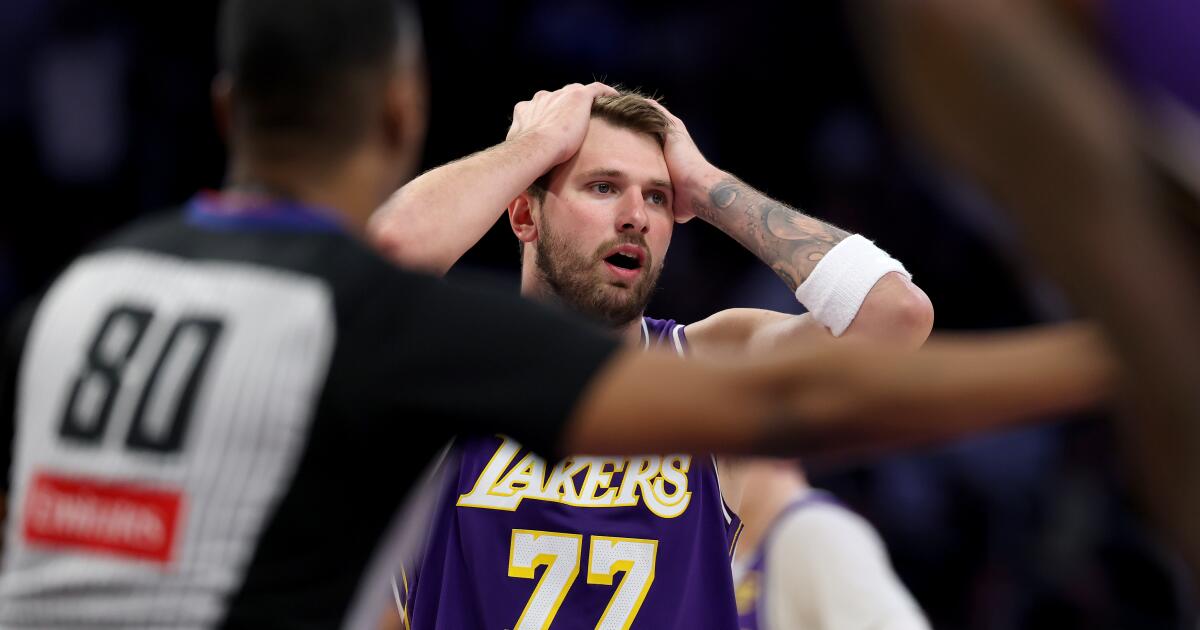
For the second time in less than a week, Luka Doncic faces a one-game suspension because of technical foul accumulation.
Only a week after Doncic’s 16th technical foul was rescinded by the NBA, the Lakers superstar picked up another one in a 116-99 win over the Brooklyn Nets on Friday and is in line to miss the Lakers’ next game against the Washington Wizards on Monday.
In the third quarter with the Lakers trailing by one against the lowly Nets (17-57), Doncic was called for an offensive foul against Nic Claxton as the Lakers (48-26) were trying to inbound the ball after a dunk by Ziaire Williams. After the Lakers turnover, Williams and Doncic appeared to exchange words with Doncic pushing Williams aside with one hand. Williams then flailed his arms behind him and slapped Doncic in the throat.
“He was yelling in my face three times,” said Doncic, who finished with 41 points, eight rebounds and three assists in the win. “I just wanted to get out of there. … I didn’t even talk. I just wanted to get out of there. And they said I pushed. My push was exaggerated, which was obviously not [the case].”
Both were assessed technical fouls with 5:12 remaining in the third quarter, and Williams’ hit was reviewed for a possible flagrant, although it was not upgraded.
The NBA requires players to sit out for one game without pay after their 16th technical foul of the season. But Doncic avoided that fate after the NBA rescinded the foul that would have forced him to the bench for a critical road game last week. Lakers coach JJ Redick said the Lakers will try to appeal Doncic’s latest foul but he did not see what happened on the play.
Last week, Doncic avoided a suspension after the NBA rescinded the foul that would have forced him to the bench for a critical road game against the Eastern Conference-leading Detroit Pistons. Doncic is slated to miss Monday’s game against the Wizards, who have lost 17 of their last 18 games and have the third-worst record in the Eastern Conference (17-56).
Lakers star Luka Doncic reacts to a referee’s call during the second half Friday against the Brooklyn Nets at Crypto.com Arena.
(Allen J. Schaben / Los Angeles Times)
Doncic picked up his first 16th technical foul last week against the Orlando Magic after getting into an argument with Orlando forward Goga Bitadze. Doncic claimed Bitadze directed a vulgar comment about Doncic’s family in Serbian toward the Lakers star guard. Bitadze refuted the story, saying it was actually Doncic who said the curse word out loud first and that he was only repeating what he heard.
The NBA rescinded both fouls upon review the following day.
Doncic, the NBA’s leading scorer, has scored 30 points or more in 12 consecutive games, the longest such streak in his career. He has 43 30-point games this season, tying Elgin Baylor and Jerry West for sixth-most in a season by a Lakers player. He has scored 40 points or more in the last 12 games.
Against the Nets, Austin Reaves finished with 26 points, eight rebounds and five assists and LeBron James had 14 points, eight assists and six rebounds.
Before the game, Redick said the Nets game would be like playing on the road since the Lakers had spent almost two weeks away from Crypto.com Arena and had returned home in the wee hours of Thursday morning from Indianapolis.

Lakers guard Austin Reaves celebrates after shooting a three-pointer against the Nets in the second half Friday.
(Allen J. Schaben / Los Angeles Times)
The challenge was to find the energy to play, which wasn’t a problem for Doncic, who had 24 points in the first half. Doncic was nine for 15 from the field in the first half and four for six from three-point range in 20 minutes. He finished shooting 15 for 25 from the field as the Lakers shot 54% from the floor. They shot 44% (11 for 25) from three-point range.
That the Lakers were facing a Nets team with the second-worst record in the NBA didn’t matter.
That the Lakers were facing a Nets team had lost nine of its last 10 games didn’t matter.
That the Lakers were facing a Nets team that’s last in the league in scoring (106.3 points per game) didn’t matter.
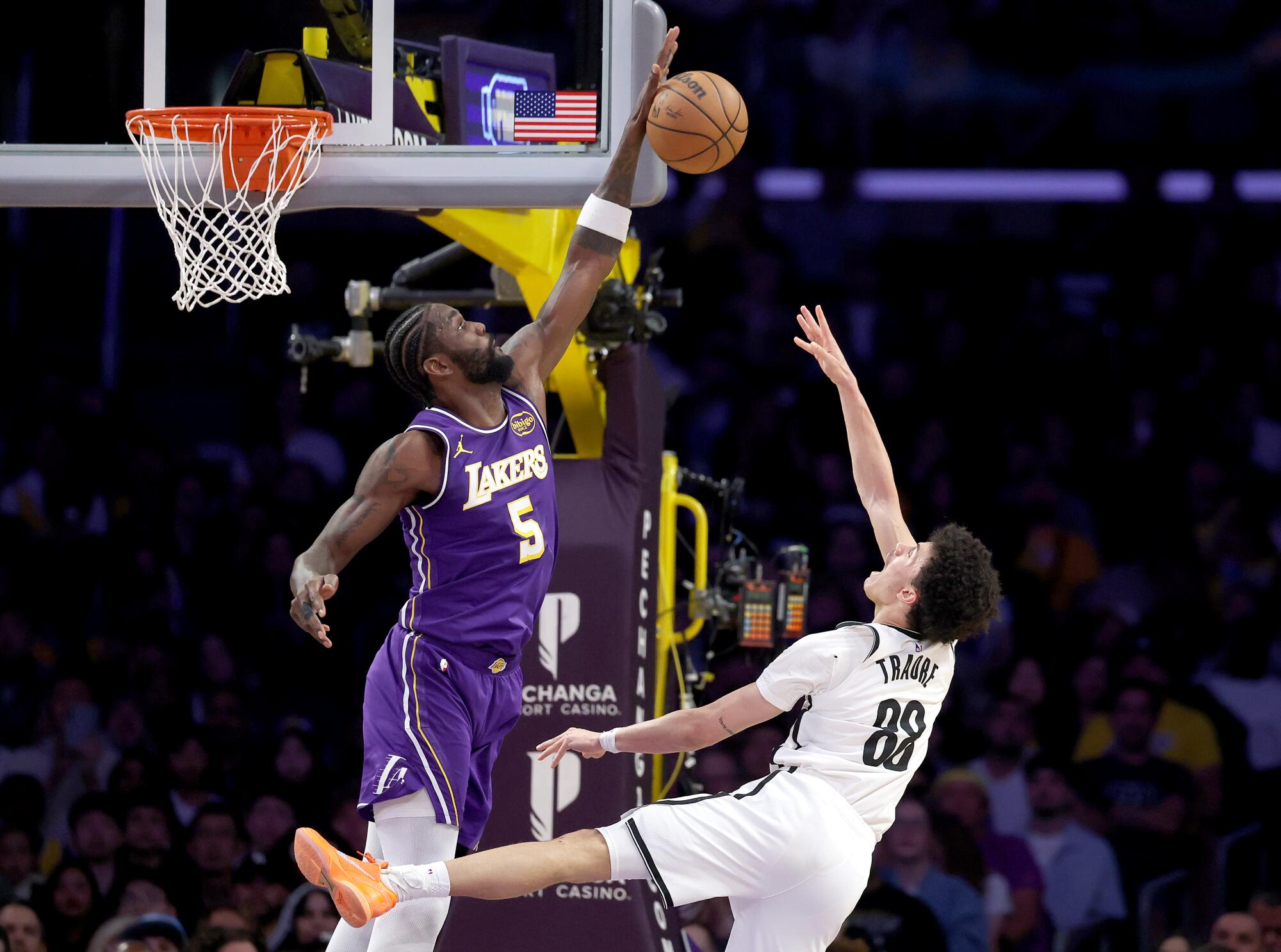
Lakers center Deandre Ayton, left, blocks a shot by Brooklyn Nets guard Nolan Traore in the first half Friday.
(Allen J. Schaben / Los Angeles Times)
What mattered to the Lakers was finding a way to win as the regular season winds down.
“I felt like we were a step slow,” Redick said. “And I told the guys at halftime, ‘This is our seventh game of the road trip. Anytime you come back, there’s a day in between, that’s just you’re in another city until you can get adjusted to the time zone and you get a couple days break.’ So the next two [off] days will be good for us.”
Notes: Lakers broadcast analyst Stu Lantz missed Friday night’s game against the Nets because of health issues. Derek Fisher, who won five NBA titles with the Lakers, took over Lantz’s role for the game. Public address announcer Lawrence Tanter also missed the game because of a health matter. Jason Barquero filled in for Lantz. “The entire Lakers organization is wishing Lawrence all the best in his recovery, and we look forward to welcoming him back soon,” the team said in a statement.


NEWYou can now listen to Fox News articles!
Tiger Woods was involved in a car crash on Jupiter Island in Florida on Friday, according to multiple reports.
The Martin County Sheriff’s Office told ESPN that the crash happened on Jupiter Island. Woods’ condition was not immediately known.
Woods competed in the TGL championship earlier this week with his girlfriend, Vanessa Trump, and her daughter, Kai, in the stands. It was his return to competitive golf after rupturing his Achilles last year, just ahead of the Masters.
Tiger Woods of Jupiter Links Golf Club looks on before the match against the Los Angeles Golf Club at SoFi Center on March 23, 2026, in Palm Beach Gardens, Florida. (Adam Glanzman/TGL/TGL Golf via Getty Images)
The 15-time major winner, five of which have come at Augusta, was noncommittal about playing at this year’s Masters. President Donald Trump said on “The Five” on Thursday that he would be at Augusta but not play.
Woods has had trouble behind the wheel in the past. In 2021, he got into a wreck that resulted in serious leg injuries that kept him off the golf course for months.
This is a breaking story. Check back for more updates.

First Submarine Named After Massachusetts Joins the Navy Fleet

No. 6 Minnesota-Duluth 3, No. 10 Penn State 1: Goalied

Mother, her 2 daughters among 5 killed in collision between train and van
Missouri Lottery Mega Millions, Pick 3 winning numbers for March 27, 2026
Montana Lottery Mega Millions, Big Sky Bonus results for March 27, 2026

Florida High School Football Rankings: Top 25 teams – Oct. 21

How old is Bo Nix? What to know about Oregon quarterback ahead of 2024 NFL Draft

Cleary's 21 help Le Moyne down Central Connecticut State 69-64 in OT

99th annual Pony Swim held in Virginia

Indiana Members Credit Union announced as new anchor tenant at Bottleworks District

Dem senators dodge crucial question on illegal alien accused of killing Chicago college student

EU Parliament unblocks key political hurdle in digital euro talks

Man arrested in plot to firebomb Palestinian activist’s home after undercover op

WATCH: Senate hearing goes silent after Angel Father confronts top Dem over daughter’s death

US diplomat Marco Rubio denounces settler violence, tolls in Hormuz strait
-

 Detroit, MI1 week ago
Drummer Brian Pastoria, longtime Detroit music advocate, dies at 68
-

 Movie Reviews1 week ago
‘Youth’ Twitter review: Ken Karunaas impresses audiences; Suraj Venjaramoodu adds charm; music wins praise | – The Times of India
-

 Sports7 days ago
IOC addresses execution of 19-year-old Iranian wrestler Saleh Mohammadi
-

 New Mexico6 days ago
Clovis shooting leaves one dead, four injured
-
 Business1 week ago
Disney’s new CEO says his focus is on storytelling and creativity
-

 Technology6 days ago
YouTube job scam text: How to spot it fast
-

 Tennessee5 days ago
Tennessee Police Investigating Alleged Assault Involving ‘Reacher’ Star Alan Ritchson
-

 Texas1 week ago
How to buy Houston vs. Texas A&M 2026 March Madness tickets