Sports
Column: Reparations for Chavez Ravine families? Not so fast, say some descendants

Larry Herrera-Cabrera’s email to me in May was as polite as it was challenging.
He reached out shortly after The Times editorial board wrote about proposed state legislation that would attempt to right the wrong of Chavez Ravine.
Sponsored by Assemblymember Wendy Carrillo, the bill would require the city of Los Angeles to erect a monument to the families, most of them Latino, who were pushed out in the 1950s to make way for Dodger Stadium. The city would also have to create a task force to study reparations for the “large, long-lasting disparities” faced by those families and their descendants.
Bemoaning what happened in Chavez Ravine is part of the modern L.A. gospel. I’ve read essays by former residents decrying what happened, read books and seen plays and documentaries that captured their plight and enjoyed Ry Cooder’s 2005 concept album, “Chávez Ravine,” which gathered Chicano music legends — Little Willie G, Lalo Guerrero, Ersi Arviz and Don Totsi, among others — to sing about the sordid saga from beginning to end.
That’s why I found Herrera-Cabrera’s email so fascinating.
“My wife and I are both descendants of three families that lived in Chavez Ravine up to 1950,” he began. “Despite the legislative findings in [Carrillo’s bill], and fables on the Internet and elsewhere, our families were neither left destitute, nor were they bitter about moving.”
He went on to offer an alternative narrative I had never considered — one where Chavez Ravine families took the money the city gave them, bought homes elsewhere and went on with their lives. Where descendants feel insulted at the insinuation in Carrillo’s bill that they need help. Herrera-Cabrera’s note added nuance to a tale long considered an open-and-shut, black-and-white case of municipal racism.
Priscilla Leiva, professor of Chicana/o and Latina/o studies at Loyola Marymount University, has spoken with Herrera-Cabrera as part of “Chavez Ravine: An Unfinished Story,” a multidisciplinary project she’s leading with former resident Carol Jacques that includes hundreds of photos and dozens of oral histories. She wasn’t surprised that I was, well, surprised.
“Latino narratives are always flattened, but especially with [the Chavez Ravine] population, because the displacement was so egregious,” Leiva said.
The public long ago stopped paying attention to “what happened before and what happened after,” she noted, which means “a lot of people don’t want to recognize or acknowledge any nuance.”
I visited Herrera-Cabrera and his wife, Katherine, at their spacious San Juan Capistrano home earlier this month. It’s nestled on a hill resembling the neighborhoods where their parents grew up, except this is upper-middle-class suburbia instead of the “poor man’s Shangri-La,” as a photographer famously described Chavez Ravine and as Cooder titled a song.
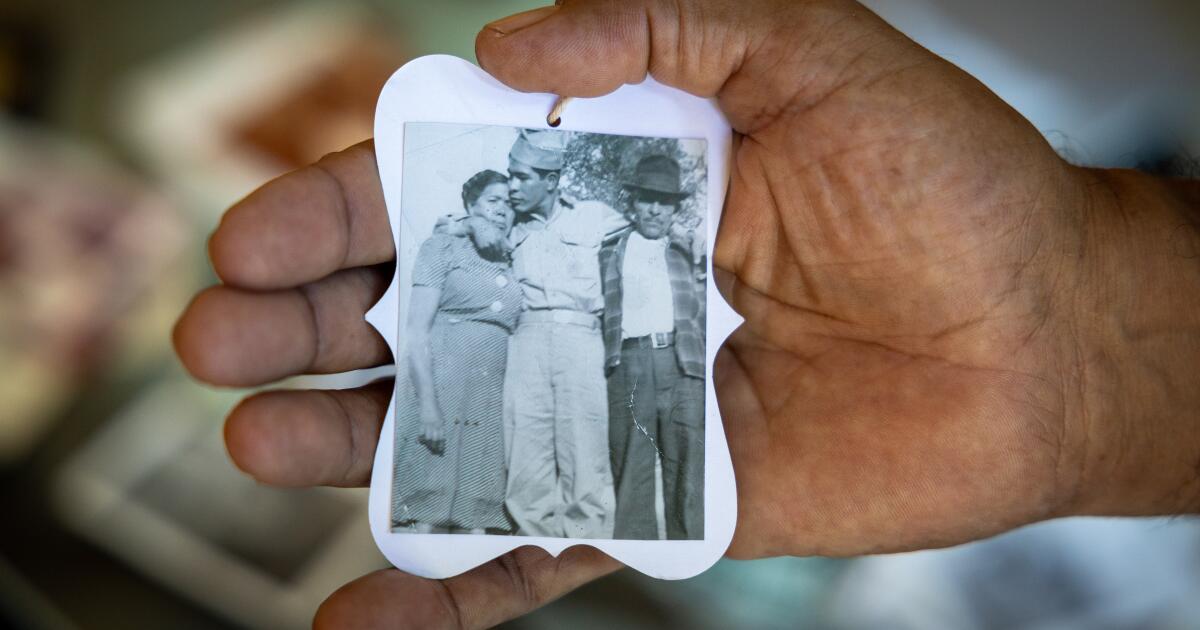
Larry Herrera-Cabrera, shown holding a photo of his Uncle Henry, killed in combat during World War II.
(Allen J. Schaben / Los Angeles Times)
In Herrera-Cabrera’s study, a Biden-Harris sticker was wedged above a photo of his late mother Sally, alongside photos of his biological father and maternal uncles in their World War II uniforms. He described his decades in city and county government as a “progressive bureaucrat,” proudly remembering how he stood up to racist politicos in Santa Barbara County in the 1980s and officiated same-sex marriages as Long Beach city clerk after the Supreme Court legalized them in 2013, two years before he retired.
“Having that connection to [helping] the community was really important to me,” he said as we stood over a kitchen table to look at family photos shot around Chavez Ravine in the 1940s. Three of his maternal uncles in Army uniforms around their mother at a park. His mother and her sisters, wearing sunglasses and bobby soxer skirts and sweaters. A group of unidentified young pachucos.
“Our family’s history gave us strength,” the 71-year-old continued. He’s tall, with bright eyes that make his glasses shine even more. “I know they suffered hardship. Things don’t always work out, but you gotta keep pushing.”
His grandparents used the money from the city of L.A. to buy a home in nearby Lincoln Heights, where Herrera-Cabrera was born in 1952. Nine years later, his mother and stepfather moved to Rosemead but frequently visited his Uncle Joe in Solano Canyon at the base of Dodger Stadium, where some Chavez Ravine families had relocated. City officials had promised them a spot in a public housing project to be built over their bulldozed homes. The stadium went up instead.
“In the early days, you could sit on a hill and watch the games for free,” Herrera-Cabrera said. He and his family sometimes went to games, but he preferred playing with cousins outside Uncle Joe’s house while their elders listened to the game on the radio and reminisced about Chavez Ravine. “They spoke fondly of those days. No one complained about having to move.”
He can’t remember when he learned of the prevailing narrative casting the Chavez Ravine families as pitiable, but he “didn’t care for it.” Nor did Katherine, who eventually joined us in the kitchen.
“Who wants to admit that they’re downtrodden?” she said before referencing the Arechiga family, one of the last holdouts in Chavez Ravine before L.A. County sheriff’s deputies forcibly evicted them. They had lived at their condemned home without paying property taxes for years, according to newspaper accounts at the time.
“Now they come back saying they want reparations?” she said.
“[Chavez Ravine] is more than just the photos of people being dragged out,” Larry Herrera-Cabrera added, referring to the infamous 1959 photo of four L.A. County sheriff’s deputies dragging a member of the Arechiga clan from her home. “It’s their accomplishments.”
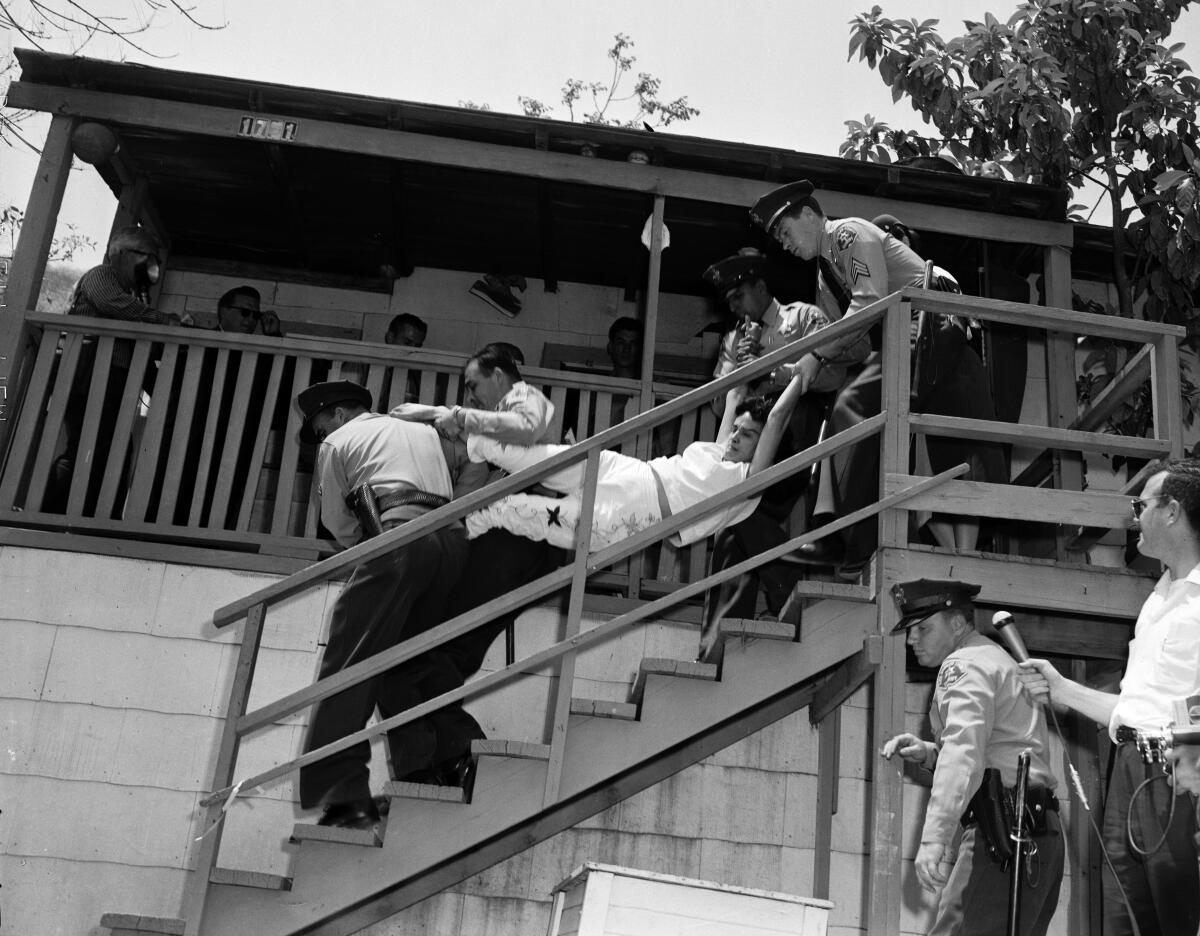
Aurora Vargas is carried by Los Angeles County sheriff’s deputies in 1959 after her family refused to leave their house in Chavez Ravine.
(Hugh Arnott / Los Angeles Times Archive/UCLA)
His perspective about what Chavez Ravine should mean changed in 2019, after a trip to the Ardennes American Cemetery in Belgium to fulfill a promise to his mother. There lies the grave of his maternal uncle, Henry Rivas, an Army private who died in the Battle of Hürtgen Forest at 19. Between them, Larry and Katherine have at least a dozen relatives who served in World War II.
“To think they thought that fascism was worse than what they faced at home was telling,” she said.
“And then they returned and became successful,” Larry added. “I had one uncle who worked in aerospace, and my Uncle Joe worked in the post office. Another uncle opened a restaurant. My dad Domingo did construction. My Uncle Ted — Teodoro — he started a men’s fashion line.”
Last year for the first time, the couple attended an annual reunion of Chavez Ravine families who call themselves Los Desterrados (The Uprooted). There, Larry displayed poster boards of his uncles’ World War II service.
“If I could talk to Wendy [Carrillo], I’d tell her those stories,” he proclaimed. “To me, they were successes. That’s part of the story. As difficult as it was, they still prospered.”
He sent a letter to the state Senate opposing Carrillo’s bill, which is being considered by a Senate appropriations committee, describing it as “hypothetical” and bad policy.
“If people were truly ripped off, that’s one thing. But why would I, as a descendant, be entitled to anything?” he said.
“The bill says people were left destitute,” Katherine said. “Who?”
Vincent Montalvo is a co-founder of Buried Under the Blue, a nonprofit that has long pushed for an apology from the Dodgers and reparations from L.A. County and city while urging people not to use the term “Chavez Ravine” for the neighborhoods of Bishop, La Loma and Palo Verde that were bulldozed to make way for Dodger Stadium.
But they had nothing to do with Carrillo’s bill, which he said he “85% agrees with.” His group also wants three community centers to be built and named after Bishop, La Loma and Palo Verde. The land should be given back to the Gabrieleño Band of Mission Indians, Kizh Nation, and all the parties involved in the displacement should issue a public apology, according to Buried Under the Blue.
Montalvo, who grew up in Echo Park and whose grandparents owned a home in Palo Verde, said former residents have accused him “of wanting a handout.”
“These things hurt,” he said. “But the older generation couldn’t even talk about what happened for forever. But I’ve told them, ‘With respect, you guys do what you’re going to do, and we’re going to do what we’re going to do. And some of you are going to jump back on the wagon, and that’s OK.’ ”
Carrillo, whose district includes Dodger Stadium, told me, “I’ve learned that when advancing policy ideas, some will say it goes too far, while others may say it doesn’t go far enough. But ultimately, we move the needle toward justice, and we try to do as much good for as many people as possible.”
On the criticism that her bill casts Chavez Ravine families as perpetual victims, the Assembly member was more straightforward: “There are no victims, but there are survivors.”
Larry agrees with her and Montalvo on one thing: a monument. But he wants it to focus on the good of his elders, as much as the bad that happened to them.
“My family wasn’t dragged out of Chavez Ravine. Most families weren’t. Like my Uncle Joe would say, let it go like water off a duck’s back.”
He teared up.
“If there were reparations, well, bring them back,” he said, referring to his uncles. “Bring back their stories. I didn’t suffer. It should be about what they did. That is Chavez Ravine’s legacy.”

Sports
London descends into disorder as Morocco fans flood streets after World Cup elimination by France

NEWYou can now listen to Fox News articles!
Public unrest began in parts of London late Thursday night, and it appears Morocco’s exit from the 2026 FIFA World Cup at the hands of France is the reason.
France took down Morocco 2-0, eliminating the African country for the second consecutive tournament, this time in a quarterfinal match.
As a result, many feared Paris would erupt into riots, especially after the chaos that followed Paris Saint-Germain’s UEFA Champions League victory over Arsenal in May.
Instead, images and videos from Edgware Road in northwest London showed police clashing with large crowds as smoke billowed through the streets and debris littered the roadway.
A police vehicle is parked in a road as people from pro-Palestinian activist groups gather near the Edgware United Synagogue during a demonstration against the “Great Israeli Real Estate Event” organized by real-estate agency My Home in Israel, which markets property in Israeli settlements in the occupied West Bank, in London, Britain, June 14, 2026. (Toby Shepheard)
Riot police, equipped with shields and body armor, tried to contain the crowds as they clashed with people launching fireworks and throwing debris. One video also appeared to show an officer down.
KYLIAN MBAPPÉ, OUSMANE DEMBÉLÉ FIRE FRANCE INTO WORLD CUP SEMIFINALS WITH WIN OVER MOROCCO
It’s unknown what happened to the officer who was down on the asphalt or how he was injured.
Fans waved Moroccan flags in the middle of the streets, which held up traffic. Some even jumped on top of vehicles trying to get through the area.
Moroccan fans in the stands before a FIFA World Cup 2026 quarterfinal match between France and Morocco at Boston Stadium July 9, 2026, in Foxborough, Mass. (Richard Sellers/SportsphotoAllstar)
Similar scenes unfolded after Egypt’s World Cup exit, when Argentina rallied for a controversial 3-2 victory that featured several disputed officiating decisions.
Paris, on the other hand, looked more like a city celebrating than one on the brink of a riot. Supporters of both France and Morocco flooded the streets, slowing traffic in several parts of the city.
One video showed horns blasting from cars with French and Moroccan flags out the windows on the L’avenue des Champs-Élysées in Paris. Supporters on the side of the road, waving their own flags, joined in on the celebration.
France’s Kylian Mbappé scored his eighth goal of this World Cup, which ties him for the most with Argentina’s Lionel Messi. Ousmane Dembélé also scored in the second half for France in the 2-0 win over Morocco.
It’s the third straight semifinal appearance for France, while Morocco still made World Cup history despite the loss. After becoming the first African country to reach the quarterfinals and semifinals in World Cup history in 2022, Morocco added to that by becoming the first-ever African nation to reach more than one quarterfinal.
Moroccan fans react while attending a watch party for the World Cup round of 8 match between France and Morocco in Boston, Massachusetts, on July 9, 2026. (Joseph Prezioso/AFP)
CLICK HERE TO DOWNLOAD THE FOX NEWS APP
Morocco’s exit means there are no more African nations alive in the World Cup. France will be taking on the winner of Spain and Belgium, while England and Norway and Argentina and Switzerland face off in the quarterfinals.
Follow Fox News Digital’s sports coverage on X and subscribe to the Fox News Sports Huddle newsletter.

LONDON — A local boy sleeps in his own bed, plays in front of a king and queen and makes a Cinderella run to the Wimbledon semifinals. Sounds like a Hollywood script that might never see the silver screen.
But it’s no fairy tale — it’s Arthur Fery’s out-of-nowhere performance over the last 10 days.
Fery, a virtually unknown British wild card with a triple-digit ranking, has become the emotional heartbeat of Wimbledon while legitimately diverting some national attention from England’s World Cup quest.
The royal treatment at his matches across the All England Club has come in more ways than one.
Fery, who grew up five minutes from Wimbledon and is staying at home during the tournament, first played before grass-court king Roger Federer, Wimbledon’s eight-time singles champion, during Monday’s fourth-round victory. Two days later, he beat No. 9 seed and French Open runner-up Flavio Cobolli of Italy in the quarterfinals 6-4, 7-6 (4), 6-0 in front of Queen Camilla.
Ranked 114th, Fery had never reached the semifinals of an ATP Tour event, let alone a major, before his brief chat with the queen following the match.
“She just said, ‘Congratulations, keep going,’” 23-year-old Fery told reporters later. “I told her it was my birthday on Sunday, so it would be great to play the Wimbledon final on my birthday.”
That’s still a match away. To get there, Fery will have to get past one of the hottest players on tour: No. 2 seed Alexander Zverev, who is fresh off his first Grand Slam title at the French Open. Looming on the other side of the draw is a highly anticipated showdown between defending champion Jannik Sinner against 24-time major winner Novak Djokovic.
If Fery can continue his magical run to the end, he would become the first British wild card to win a Wimbledon title.
Arthur Fery reacts after defeating Flavio Cobolli in the Wimbledon quarterfinals on Wednesday.
(Maja Smiejkowska / Associated Press)
Born in France, Fery’s family moved to Wimbledon when he was an infant. His mother played professional tennis. He was a top British junior but chose to sharpen his game for three years in the U.S. collegiate system at Stanford, as many of his compatriots have done.
“I came out with a lot of hunger coming out of that, and I was ready to attack the pro circuit,” Fery said.
After struggling with bone bruising in his arm that limited him to playing mostly on the lower-tier Challenger circuit in recent years, Fery is finally healthy and playing consistently.
His path to the last four in London has been a masterclass in clutch come-from-behind performances. The Brit has stared down near-certain elimination in multiple matches, repeatedly breaking his opponents’ momentum with Houdini-like on-court acts.
At 5-foot-9, Fery possesses a skill set perfectly suited for low-bounding grass.
His compact strokes, low center of gravity, and elite movement allow him to hug the baseline, take time away from opponents, and confidently execute delicate volleys at the net, according to ESPN analyst Chris Eubanks.
“He defends well,” said Eubanks, a 2023 Wimbledon quarterfinalist. “He can scrap. He can claw. He can dig his way back into points. And when he ventures forward, he’s very, very comfortable at the net. This is a picture-perfect example of someone whose game is built for the surface.”
Still, it’s hard to fathom the multitude of milestones for Fery, who briefly reached the No. 1 ranking in college and earned 2023 Pac-12 Singles Player of the Year honors before leaving early to pursue a pro career.
He arrived at Wimbledon with just one main-draw victory at a major, a losing record as a professional, and only one previous ATP quarterfinal, at Queen’s Club last month. He’s now 11-8, won his first two five-set matches, and is the first British wild card to reach the Wimbledon men’s semifinals in the Open Era. The only other men’s wild-card semifinalist was Goran Ivanisevic, who won the title as a wild card in 2001.
Fery, who started the season ranked No. 185 and will climb to at least No. 36 after the tournament, said there were a “lot of first times” as he reflected on his unprecedented run. “First five-setter, longest match that I’ve ever played, first time breaking into the top 100, first second week in a slam, all at home, five minutes from where I grew up. It’s a great story for me,” he said.
The gap with his fellow semifinalists is understandably massive.

Entering Wimbledon, Djokovic, Sinner and Zverev’s combined records include 29 Grand Slam titles, 2,088 match wins and 155 tour-level titles. Fery was 6-8 in tour-level matches with zero titles.
But he has singlehandedly lifted the tournament for locals. With top hopes Jack Draper and Emma Raducanu withdrawing before the tournament and the rest of Britain’s singles prospects falling one by one — 18 men and women were eliminated by the third round — Fery became the nation’s last knight standing.
If his first name inevitably evokes Arthurian legend, Fery’s march through the draw gave Britain reason to believe again. No sword, no Round Table, just world-class shot-making, a lion’s heart and a Centre Court crowd thrilled to rally behind him.
“This is really quite something to see on home soil,” said Russell Fuller, the BBC’s tennis correspondent, who compared it with Raducanu’s stunning U.S. Open win in 2021 as a qualifier.
Fery earned every bit of it.
In the first round against Damir Dzumhur, Fery dropped the opening set and trailed by a break in the second before surging back. Against Zizou Bergs in the third round, he faced a 4-1 deficit with a double break in the fourth set, and again fell behind 4-1 in the fifth, before somehow surviving.
Then, stepping onto Centre Court for the first time against former top-10 stalwart Grigor Dimitrov of Bulgaria in the fourth round, Fery clawed out of a 2-sets-to-1 hole and a break down in the fourth set to clinch the victory in a fifth-set tiebreak.
“He carries himself with humility, but he’s a fierce competitor, and he’s got a ton of belief in himself,” said Stanford men’s coach and former top-60 player Paul Goldstein, who flew to England Tuesday to see his former charge compete against Cobolli.
While Fery attempts to outmaneuver Zverev on Friday, the other semifinal features a 2025 Wimbledon semifinal rematch between seven-time Wimbledon winner Djokovic and top-ranked Sinner, who defeated the Serb in straight sets on his way to the title. It’s also their second Grand Slam semifinal meeting in 2026. At January’s Australian Open on hard courts, Djokovic bested 24-year-old Sinner in five sets before falling to now-injured Carlos Alcaraz in the Melbourne final.

Arthur Fery hits a return during his Wimbledon quarterfinal win over Flavio Cobolli on Wednesday.
(Clive Brunskill / Getty Images)
Djokovic, 39, enters the match after surviving a grueling five-set, 5-hour-plus quarterfinal slugfest against No. 3 Félix Auger-Aliassime that concluded just minutes before Wimbledon’s 11 p.m. curfew. But the seventh-seeded Serb has a way of defying Father Time and he has had two days to recover on a surface where points are shorter and generally less taxing on the body.
Italy’s Sinner, who defeated Alcaraz in last year’s Wimbledon final, has been efficient if not at the level that saw him capture five consecutive titles before crashing out in the second round at the French Open. After a first-round scare here, the four-time Grand Slam champion has dominated opponents behind his improving serve, winning 80% of his first-serve points. He hasn’t dropped a set since the opening round. Sinner leads the head-to-head with Djokovic 6-5.
According to Eubanks, Djokovic must disrupt Sinner’s movement to break his rhythm, and take his chances.
“He’s got to play similar to how he played in Australia, where it was just all-out aggression,” Eubanks said.
For Sinner, he added: “His serve can be a neutralizing force for what Novak is going to try to do.”
On the other side of the ledger, Fery’s poise under pressure and deft use of the home crowd will be paramount to continue his surprise run against Germany’s Zverev, whom he called a “step up again” from his last five matches. Zverev, 29, is seeking his fifth major final and first at Wimbledon.
“I’m ready for it,” Fery said. “I have nothing to lose. I’m just going to go out there and … put my game on the court, do what I’ve done, believe in myself. We’ll see where that takes me.”
Home has never been closer to Centre Court. Nor has Arthur Fery ever been closer to tennis history.
Sports
Pirates star pitcher makes unfortunate history after being taken out in middle of perfect game bid

NEWYou can now listen to Fox News articles!
Jared Jones was flirting with Major League Baseball history on Wednesday night — he got it, but it was not what he originally envisioned.
The Pittsburgh Pirates pitcher retired the first 18 batters he faced, but he was taken out in the middle of his perfect game bid after six innings.
Now, the Pirates certainly have their reasons — the 24-year-old Jones hasn’t thrown more than 81 pitches in eight starts since returning May 20 after missing all of last season while undergoing ulnar collateral ligament internal brace surgery on May 21, 2025. He was yanked with 77 pitches and likely would have needed more than 100 pitches to record the 25th perfect game in MLB history.
Jared Jones of the Pittsburgh Pirates pitches during the first inning against the Atlanta Braves at PNC Park on July 8, 2026, in Pittsburgh, Pennsylvania. (Photo by Joe Sargent/Getty Images)
However, Jones left the game after getting zero run support, so when the Atlanta Braves tacked on three runs late for a 3-0 victory, Jones instead found himself in the wrong chapter of the history books.
According to Opta Stats, Jones became the first pitcher in the modern era (since 1920) to pitch at least six perfect innings and not record a win.
“It does suck. Something’s cool coming on, but I’m on what? My eighth start off of surgery? I completely understand it, and it is what it is,” Jones told reporters after the game.
Pittsburgh Pirates starting pitcher Jared Jones (17) makes his way to the field to warm up before pitching against the Atlanta Braves at PNC Park. (Charles LeClaire/Imagn Images)
JUSTIN VERLANDER ANNOUNCES HE WILL RETIRE AFTER THIS SEASON: ‘I’VE REALIZED THAT TIME HAS COME’
Jones said he didn’t entertain attempting to complete the perfect game.
“Not with the pitch count,” he said. “Not really ever expecting to go nine right now, so that was never in my head.”
Joey Bart, traded to the Braves from the Pirates on June 18, followed a double by Mike Yastrzemski with a 422-foot, two-run homer to left-center field off a slider from Dennis Santana. Drake Baldwin added an RBI single to center in the ninth for good measure.
It was the second time in less than a week that a pitcher was taken out of the game with a perfect bid through six innings — the Miami Marlins took Eury Perez out after seven innings in which he had 92 pitches. Perez, too, is in the midst of returning from injury and has surprisingly found himself right in the postseason mix.
He was pulled for Lake Bachar to start the eighth, and the Marlins allowed eight runs to the Athletics in the final two innings, but held on to win 9-8.
Jared Jones (17) of the Pittsburgh Pirates delivers a pitch during a MLB game against the Cincinnati Reds on June 27, 2026, at PNC Park in Pittsburgh, Pennsylvania. (Joe Robbins/Icon Sportswire via Getty Images)
CLICK HERE TO DOWNLOAD THE FOX NEWS APP
The Pirates are 4.0 games out of the final wild card spot, which is held by the Marlins.
The Associated Press contributed to this report.
Follow Fox News Digital’s sports coverage on X, and subscribe to the Fox News Sports Huddle newsletter.
-

 World57 seconds ago
Does more World Cup history beckon for Norway? England stand in their way
-
 News28 minutes ago
Waymo called the cops on teen riders, raising privacy concerns
-

 Los Angeles, Ca2 hours ago
O.C. police prep for beach, theme park ‘takeovers’ promoted on social media
-

 Detroit, MI2 hours ago
Detroit city leaders to DHS: Stop ICE pursuits which endanger the community
-

 San Francisco, CA2 hours ago
SF Supervisor Jackie Fielder hosts listening session after medical leave
-

 Dallas, TX2 hours ago
The Stewpot artists find healing, purpose and income through art in Dallas
-

 Miami, FL3 hours ago
Can Jason Marshall push for a starting spot – The Splash Zone 7/10/26
-

 Boston, MA3 hours ago
Police investigating shooting in Downtown Crossing – Boston News, Weather, Sports | WHDH 7News

