Sports
Can American men's gymnastics team give a waning U.S. sport a boost in Paris?


Follow our Olympics coverage from the Paris Games.
When John Roethlisberger was an undergraduate at the University of Minnesota, he and his gymnastics teammates vanned to meets at Iowa, at Iowa State, at UW Oshkosh and Wisconsin. Every year, they’d fly to Michigan, where they’d compete against the Wolverines on a Friday night and head to Michigan State on a Sunday.
Of those teams, only Michigan continues to sponsor the sport today. This is not breaking news. The decline of men’s gymnastics has been both ongoing and relentless, a death-by-a-thousand-paper-cuts slashing that has pushed it to near extinction. Only 12 Division-I universities now sponsor men’s teams, none do at the D2 level and just three in D3. All of 319 men competed in NCAA gymnastics this past season.
The danger of real elimination, though, has never been more real than it is now. With payouts to athletes about to come due from a recent House settlement, athletic departments are looking to pinch pennies. Sport elimination remains a real threat and, with so few viable teams and athletes already, men’s gymnastics is ripe for the picking.
Yet the college system still serves as the direct feeder for international competition. In Paris, the United States is fielding its strongest men’s Olympics team in decades, with legitimate aspirations to make a team podium for the first time in 16 years. All five men headed to Paris come via the college route — Asher Hong and Frederick Richard remain in college, at Stanford and Michigan, respectively. Paul Juda wrapped up his eligibility with the Wolverines this year and Brody Malone with the Cardinal a year ago. Pommel horse specialist Stephen Nedoroscik lost his senior season at Penn State to COVID-19.
USA Gymnastics desperately needs the college system. But can the USA gymnasts, with a successful run at Paris, help save college gymnastics?
“This team could do a lot. They are the tip of the spear,” says Roethlisberger, a three-time Olympian who remains outraged at his alma mater’s decision to eliminate gymnastics in 2020. “We have athletes who can absolutely win medals, but will they be the darlings of these Olympics? Probably not.
“We are on the precipice of catastrophic change in college sports. So who is going to stand up and say, ‘I’m going to show the world how this can actually work?’ Our athletes can do a lot, but they can’t do it alone.”
Thom Glielmi used to scam money off his pals, taking $10 bets that he couldn’t flip off whatever he could find — the roof of a garage, for example. He did it largely for the thrill, but then he spied the gymnastics equipment at Lincoln-Way Central High School in Illinois and realized he could put his flipping to good use. He ditched baseball, signed up for gymnastics and found himself a life. A former gymnast at Southern Illinois, Glielmi is now in Year 22 at Stanford, where this year he led the Cardinal to its seventh national championship.
“If my high school didn’t have gymnastics, I’m not sure what would have become of me,” Glielmi says.
It’s the same question he asks when he hits the recruiting trail now: What’s to become of the boys who want to compete? In 1982, around the time Glielmi was flipping his way through Lincoln-Way, more than 75 colleges and universities sponsored men’s gymnastics, and in 1984 one of them — UCLA — supplied three members of the United States team that captured Olympic gold. A decade later, the Bruins program was eliminated. By 2002, only 21 teams remained at the collegiate level.
The initial culprit — or at least the easy blame — was Title IX. Forget that Title IX didn’t make a whole lot of sense as a counterargument — gymnastics, unlike, say, football, offers a women’s equivalent — but athletic directors, looking for easy fixes to federal equivalency regulations, slashed the sport in big numbers in the late ’80s and early ’90s.
COVID brought another wave, and now men’s gymnastics has fewer NCAA teams than water polo.
“So many guys, I just feel terrible for them,” Glielmi says. “The competition is so high, and there’s just nowhere for some of these athletes to go.”
American star Fred Richard celebrates after his horizontal bar routine Saturday during the Olympic qualification round. (Loic Venance / AFP via Getty Images)
No surprise, then, that as the college opportunities dry up, so too does the interest. Men’s gymnastics always has fought an uphill battle. Roethlisberger came to his sport naturally. His father, Fred, was a 1968 Olympian and spent three decades as the head coach at Minnesota; his big sister, Marie, was a 1984 Olympian. He also knows he is the exception. Roethlisberger speaks regularly at awards dinners and camps and often opens with a favorite joke. He describes the giddy joy of a delivery room, where a newly proud papa grabs his infant son and declares, “I finally got my gymnast!” He laughs at his gallows humor.
“It’s the truth,” he says. “Those are the norms of our society. Most little girls try gymnastics at some point. They dream about bows in their hair and sparkles on their leotards. Little boys dream about playing football, baseball or basketball.”
There are, in truth, plenty of ancillary things at play here. Societal norms indeed feed popularity. “You can see more cornhole on TV now than men’s gymnastics,” Roethlisberger says. Even physiology has a role. “You have to be strong (to do this sport),” says Gina Pongetti, a physical therapist and owner of MedGym, who has worked in gymnastics for more than 20 years, “and many of them aren’t right away, so they get frustrated and quit.”
But largely it is the intersection of opportunity and cash. Roethlisberger has a summer camp, Flipfest, in Tennessee that attracts 400 kids on average per week. Fifteen percent of them are boys, a minority but still a solid number. The Tennessee Secondary School Association does not sponsor boys gymnastics, and, according to the most recent National Federation of High Schools participation report, not a single of its member high schools in Tennessee offers it.
In fact, only 100 do nationwide, with just 986 high school-aged boys competing. So, are colleges no longer funding gymnastics because there are no gymnasts to fund, or are there fewer gymnasts because there’s nowhere to go? Most people associated with the sport believe it’s the latter. Gymnastics is not cheap. A conservative estimate for competitive gymnastics runs $500 per month.
Yet the return on that investment is opportunity at just 15 schools — and only 6.3 scholarships available at each school.
“There’s an understandable quid pro quo,” Pongetti says. “The dollars and the time put into the gym, that turns into the college scholarship opportunity, but what if there’s no college scholarship or even opportunity to compete?”
Roethlisberger is in the thick of it. He has three boys. They’re enrolled in gymnastics, not just because their dad loves it but because he truly believes that its combination of strength and balance offers the best foundation for any sport. But he also knows that there could be a tipping point.
“They can love it all day long,” he says. “But then you start to look around and say, ‘Well, there’s nowhere to go. How about we try baseball or lacrosse?’”
Glielmi considers the number being tossed around as the likely sum necessary to fund athletes’ payments post-House settlement — $22 million. “That’s 22 gymnastics teams,” he says with a sigh. He’s not wrong. Men’s gymnastics is not a departmental money maker, which makes it an easy sport to slash. A glance at the NCAA reports filed by Penn State, Ohio State, Illinois and Oklahoma show deficits ranging from $600,000 to $1.9 million. It also, however, does not cost much, especially at places that have viable women’s programs and available practice gyms. The expenses at those same schools average around $1.3 million.
But the dearth of teams offering the sport combined with the need to shave spending puts men’s gymnastics in a vulnerable position.
“The less programs that stay, the easier it is to follow suit and chop,” says Pongetti. “It’s a dangerous, dangerous, domino effect.”
By and large, athletic directors have not been historically creative when faced with similar crises. Minnesota cut its men’s team in 2020 — per the NCAA report, it saved the school $748,167 in expenses. Administrators stood their ground even after the alumni rallied to offer to fund everything except coaching salaries and gym space. Instead, the alums, along with head coach Mike Burns, funded a club sport that this year included a roster of 25 that went on to win the club national title. Since 2021, the school provided gym space rent-free but in May announced it was reappropriating Cooke Hall to use for the diving team. The gymnasts have nowhere to go.
“This is the Titanic attempting to turn around in the Suez Canal,” Roethlisberger says. “Athletes are going to get paid from the school, so what are we going to do about it? There are ways. Engage the alumni. Huddle up. But what athletic director is going to stand up and say, ‘Here’s the new model?’ Who is going to be bold enough to do that?”
That it falls largely to the colleges is part of the problem. In many other countries, sports are government-funded. Here, many of the national governing bodies offer little if anything in the way of financial support, and rely instead on the college system as the feeder program. Fourteen U.S. teams headed to Paris, including men’s gymnastics, are made up entirely of NCAA athletes. More than 100 members of the track and field contingent come from the NCAA ranks, and 44 for swimming.

Minnesota’s program carries on with alumni support. Shane Wiskus, here at the 2021 NCAA championships, was a Tokyo Olympian. (Carlos Gonzalez / NCAA Photos via Getty Images)
But there is no real reciprocity between the NCAA and the NGBs. A think tank commissioned by the U.S. Olympic and Paralympic Committee post-pandemic suggested such a partnership, and the two groups have discussed aligning forces. Nothing concrete yet has come out of it.
Men’s gymnastics is not entirely blameless. NCAA women’s gymnastics is growing. NIL opportunities have made staying in college more appealing to Olympic gymnasts — Team USA members Sunisa Lee, Jade Carey and Jordan Chiles all went to college — and their participation has helped raise the sport’s profile. The ACC and SEC Networks regularly broadcast meets and ABC aired the NCAA championship. The decision to stick to the more familiar scoring system — a 10 is perfect — has helped keep viewers engaged, as well as entertained. The men, on the other hand, use the open-scoring system, where a combination of difficulty and execution results in a final score.
There is ample evidence of interest. Richard has 670,000 TikTok followers and 310,000 more on Instagram. More than 50,000 follow Malone’s Insta account.
“We hear all the time that there’s a great product here,” Glielmi says. “We just haven’t put it together. If we can manage all of that and stay true to the sport, make it easier to understand, we’ve got a better chance of people sticking around.”
Which is where this men’s team comes in.
Americans love nothing more than winning, and the lack of medals has hurt men’s relevance. This team has the stuff to change that. After the Tokyo Olympics, the United States made a concerted effort to up the difficulty in its routines. At the 2020 Games, the U.S. started a full 6.5 points behind its competition because its sets weren’t properly stacked. Now they stand just two points behind Japan and 3.6 behind China, well within striking distance of the podium.
In Saturday’s qualification round, the U.S. qualified fifth for the team all-around. The final is Monday.
Along with his social media following, Richard brings legit hardware to Paris. He is only the fourth American man to medal in the all-around at the world championships — he won a bronze — and the first in a decade to medal in more than two world events. Malone, an Olympian in 2020, is back after a gruesome leg injury. He has a good shot at medaling on the high bar. Pommel horse specialist Nedoroscik is the 2021 world champion in that event.
Maybe more than anything, they understand their mission.
“That is my passion, and that is all of our responsibility — growing the sport,” says Richard. “All of the medals, the success, that’s what this is about. We grew up giving everything to gymnastics, and we want kids growing up to have way more colleges to select from, to be blessed with what they deserve.”

GO DEEPER
Fred Richard, after lifetime of handstands, is built to burst onto Olympics scene
(Top photo of gymnast Paul Juda during U.S. Olympic trials: Elsa / Getty Images)



NEWYou can now listen to Fox News articles!
CM Punk appeared on “Friday Night SmackDown” ready to take on any challenger that was ready to step to him after winning the Undisputed WWE Championship against Sami Zayn.
Punk entered the ring in Oklahoma City and called back to the “Monday Night Raw” after WrestleMania 42 when he told Cody Rhodes he’d be ready to deliver if a championship opportunity fell “out of the sky.”
COMPLETE PRO WRESTLING COVERAGE ON FOX NEWS DIGITAL
Cody Rhodes and CM Punk face off during SmackDown at Paycom Center in Oklahoma City, Okla. (Craig Ambrosio/WWE via Getty Images)
“When championship opportunities fall out of the sky, CM Punk catches them,” he said.
Punk named potential SmackDown superstars he’d think might come for the title, including Gunther, Finn Balor, Royce Keys, Damian Priest and Trick Williams. He even said that Zayn could come back around and get his rematch if he wanted. He didn’t mention Rhodes’ name, but the “American Nightmare” came out uncalled and marched his way down to the ring.
“I don’t think you and I can run away from each other anymore,” Punk told Rhodes.
Cody Rhodes looks on during SmackDown at Paycom Center in Oklahoma City, Okla., on July 10, 2026. (Craig Ambrosio/WWE via Getty Images)
Rhodes agreed and mentioned that Punk would want a match with him, just “say when.” It was a quick retort from Punk, who said, “when.” SmackDown general manager Nick Aldis, who was in the ring for the segment, booked the match for SummerSlam.
Punk will defend the Undisputed WWE Championship at SummerSlam, which takes place Aug. 1 and 2 at U.S. Bank Stadium in Minneapolis.
First, however, Punk and Rhodes will be involved in a tag team match at Saturday Night’s Main Event in New York City next week. Aldis made the match after Gunther demanded that Aldis put him in a match against Punk. Gunther was hoping it would be for the championship. Instead, Gunther will tag with Zayn.
Gunther didn’t take too kindly to that and attacked Aldis. Rhodes came back out to break up the calamity. He wanted to take on Gunther after the show went off air but Gunther walked away.
Gunther makes his entrance during SmackDown at Paycom Center in Oklahoma City, Okla., on July 10, 2026. (Rich Wade/WWE via Getty Images)
CLICK HERE TO DOWNLOAD THE FOX NEWS APP
Punk definitely has his hands full as he moves to SmackDown to become a fighting champion.
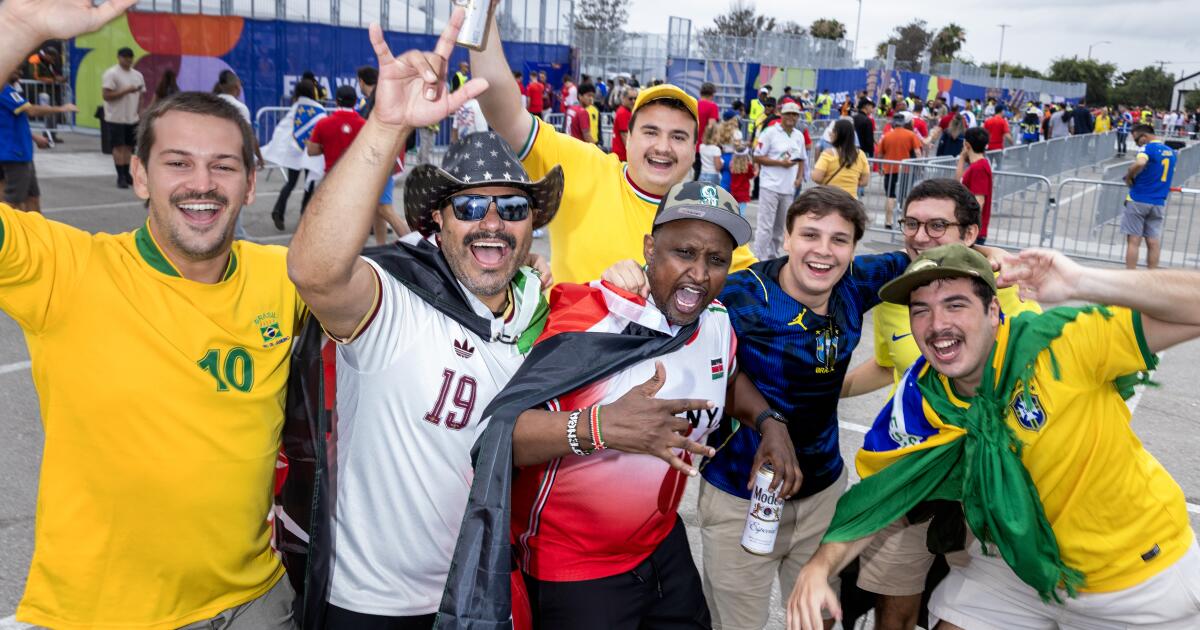
World Cup tourists are coming to L.A. for the soccer, but they’re staying for the $21 smoothies and Double-Doubles.
As the last Los Angeles FIFA World Cup event ended Friday, soccer fans were eating like locals and famous chains from the region were cashing in.
In the weeks that L.A. has hosted the World Cup, international soccer enthusiasts have flocked to big brands from the area, often in large groups wearing their countries’ jerseys.
It is a phenomenon seen at many of the host cities. In Dallas, giant gas station Buc-ee’s is the main attraction. For people visiting New Jersey, deli shops have been a hot ticket. In L.A., the place to be between matches was Erewhon.
Thirsty international sports fans gathered for pictures outside different Erewhons, wandered their aisles smiling, and, of course, picked up pricey smoothies.
While Erewhon would not comment on its business, mobility data company Arity, which uses phone data to track consumers, said Erewhon visits at the outlets around SoFi Stadium were quadruple what they were a week earlier on June 12, the day of the U.S. national soccer team’s opening match there.
Arity looked at what stores people visited within a 10-mile radius of SoFi that day and also found surges in visitors to nearby El Pollo Loco and Trader Joe’s.
Locals have spotted groups of people in Korea jerseys huddled together, trying to decide what to order at In-N-Out.
Some complained on social media that international tourists at Trader Joe’s were buying up all the mini canvas tote bags.
Soon after the Belgium vs. Spain quarterfinal ended Friday, the In-N-Out near SoFi had a long line of soccer fans stretching out the door in bright red and yellow and black jerseys and matching striped hats and scarves.
One of the workers said he had to explain “spread” and “animal style” to foreign football fans.
“I didn’t know this place existed,” a fan from Romania said while waiting in line.
Los Angeles and other cities and states that have hosted the event need the soccer fans to spend money to make the event worth all the time, effort and money it requires.
A rosy 2024 report projected the World Cup could bring more than $800 million to the L.A. region as 180,000 people converge on the area to sleep, eat and spend.
There were early concerns people weren’t turning up for the event because of the high ticket prices and the difficulty of obtaining visas for citizens of some countries.
However, at least for some L.A. hotels, there was a surge of last-minute visitors which pushed up occupancy and room rates.
While sports fans are not in the region to shop, they do make time for it.
World Cup customer spending is also apparent in beer sales. Andrew Heritage, the chief economist at the Beer Institute said beer purchases at entertainment and attractions in L.A. – outside of World Cup spaces – were up around 10% from normal.
“That tells me that fans in the L.A. area have decided to extend their stay and take in all the other things that the area has to offer, rather than just the match itself,” he said.
On social media, the purpose of these shoppers is clear: grab a quick souvenir or local specialty and take a selfie.
The data from Arity suggests that fans are very efficient when they spend at local spots, diving in, getting what they want and getting out as soon as possible, said Jeff Schlitt, a director at the company.
“Normally you’re there for an hour. They’re going to be there for 15, 18 minutes,” he said. “Why is that? Because they were purpose-driven shoppers.”
For some travelers, the more popular American chains aren’t unfamiliar. But some of the native L.A. fare still comes as a surprise.
As one Belgium-Spain matchgoer from the Netherlands stood taking a picture of the In-N-Out sign after the game, he said he’d never had a burger like the one he’d just tried.
“We only have McDonald’s and Burger King,” he said. “It’s way better.”

NEWYou can now listen to Fox News articles!
The face of baseball will not be at Tuesday’s All-Star Game.
Shohei Ohtani was scratched from his start on Friday as the Los Angeles Dodgers said he will also miss the Midsummer Classic with what the team called left knee irritation.
Ohtani, for obvious reasons, has become an All-Star Game fixture. He has earned the honor in each of the past five seasons and made his first start in 2021.
Starting pitcher Shohei Ohtani #17 of the Los Angeles Dodgers warms up before the MLB game against the Arizona Diamondbacks at Chase Field on June 03, 2026 in Phoenix, Arizona. (Photo by Christian Petersen/Getty Images) (Christian Petersen/Getty Images)
The two-way phenom is on his way to winning his fifth MVP award in his last six seasons as he is hitting .290 with a .939 OPS and pitching to a minuscule 1.79 ERA, the second-lowest in the sport among pitchers with 80-plus innings. His OPS is also the seventh-best mark in the league.
The Dodgers said Ohtani will be the team’s designated hitter up until the break, but he will “have some interventions on his knee to put him in the best position for the second half of the season.”
Ohtani dealt with knee issues earlier in the season.
It is certainly a big hit for the game as the other face of the sport, Aaron Judge, will miss the game due to a fractured rib that has kept him out since late May.
Shohei Ohtani #17 of the Los Angeles Dodgers gets ready in the on deck circle against the Arizona Diamondbacks at Chase Field on June 01, 2026 in Phoenix, Arizona. (Photo by Norm Hall/Getty Images) (Norm Hall/Getty Images)
DODGERS WILL AGAIN VISIT WHITE HOUSE TO CELEBRATE WORLD SERIES CHAMPIONSHIP, OFFICIAL SAYS
Ohtani hit 99 home runs combined in 2024 and 2025, leading the National League with a 1.025 OPS in that span. Ohtani did not pitch in 2024 after elbow surgery but returned to the bump last year and owned a 2.87 ERA and 11.9 K/9, a figure he also put up in 2022 that led the American League.
The “Japanese Babe Ruth” is the only player in MLB history to have 300-plus plate appearances and 40-plus innings in six separate seasons (Ruth only did it twice and never stole 50 bases), and he has more than excelled at both.
Shohei Ohtani pitches for the Los Angeles Dodgers against the San Francisco Giants at Dodger Stadium in Los Angeles, California, on May 13, 2026. (Gary A. Vasquez/Imagn Images)
CLICK HERE TO DOWNLOAD THE FOX NEWS APP
Ohtani is not hitting like he has in the past, but certainly the best pitching performance of his career will make up for it. He “only” has 20 homers and 56 RBI this season.
Follow Fox News Digital’s sports coverage on X, and subscribe to the Fox News Sports Huddle newsletter.
-

 Louisiana4 minutes ago
Louisiana judge admits to misconduct; is suspended without pay for rest of term
-

 Maine11 minutes ago
As Democrats pick up the pieces after Graham Platner, many wonder: how did this happen?
-

 Maryland12 minutes ago
Afternoon Summertime Storms Across Maryland Today
-

 Michigan19 minutes ago
117th annual Race to Mackinac takes off from Chicago’s Monroe Harbor
-

 Massachusetts26 minutes ago
Officials ID man and woman killed in Route 6 crash in Dartmouth
-

 Minnesota29 minutes ago
Minnesota weather: Warm Saturday with hotter days ahead
-

 Mississippi34 minutes ago
Tracking Mississippi State baseball players, signees picked in 2026 MLB Draft
-

 Missouri41 minutes ago
Missouri pushes for more nuclear energy to power the future

