Sports
After winning one title since John Wooden, how much blue is left in UCLA's blood?


Grainy game footage and yellowed newspaper clippings confer UCLA’s standing as college basketball royalty, the team’s status as a blue blood rooted in the success of a coach who retired nearly 50 years ago.
John Wooden’s 10 national championships in a 12-year span are more than any other program has won in its history. On the flip side, the Bruins have won just one championship since Wooden’s departure, Jim Harrick’s 1995 team preventing the school from going 0 for the last half century.
UCLA’s Ed O’Bannon celebrates after the Bruins won the 1995 national championship game.
(Associated Press)
North Carolina, the fellow blue blood that the Bruins will face Saturday afternoon at Madison Square Garden in the CBS Sports Classic, has won five of its six titles since 1982. By comparison, the bulk of UCLA’s success can feel like something accomplished on peach baskets.
As the years pass, those banners hanging inside Pauley Pavilion fade like the memories of those championships. UCLA has gone 30 years without a title while 10 teams have added multiple banners to their collection over that same span. Has the fundamental power structure of the sport changed? Might the Bruins be on the verge of ceding their hallowed status, their blood no longer the deepest shade of blue?
“Hell no,” Marques Johnson, a member of Wooden’s final national championship team in 1975, said this week. “I just don’t think you give up that spot in terms of the prestige and elite-level claim that you deserve based on historically what you’ve done as a program.”

A blue blood, in Johnson’s view, is more of a historic honor than a contemporaneous one, belonging to teams that dominated the sport when it was gaining a foothold in the nation’s consciousness more than 50 years ago. Once you’re in, Johnson said, you never give up membership.
Historical references go back many decades, a 1951 story in the Cincinnati Enquirer describing Xavier’s early season losses as having come against teams listed in “college basketball’s blue blood directory.” The term has long become a favorite of broadcasters even if it was never one that Wooden used, according to Gary Cunningham, who played for the legendary coach before becoming one of his early successors.
Johnson’s bonafide blue bloods — UCLA, Kentucky, North Carolina, Duke and Kansas — largely jibe with the list of the most decorated programs. Kentucky’s eight national championships rank second behind UCLA, followed by North Carolina and Connecticut (six each), Duke and Indiana (five each) and Kansas (four).
While Indiana won titles in 1940 and 1953, the Hoosiers are more widely associated with their success under coach Bobby Knight, who won three more championships in the 1970s and ‘80s. Johnson puts Indiana in his second tier of elite teams.
“We’ve got to slide them in there,” Johnson said, “because they were a little bit late to the party, not exactly nouveau riche but around and dominant long enough where they definitely need to be talked about in the same breath.”

Connecticut guard Tristen Newton celebrates after their win against San Diego State to clinch a national championship on April 3, 2023.
(Brynn Anderson / Associated Press)
Who does Johnson consider nouveau riche? He listed UConn and Gonzaga, teams that have enjoyed wild success the last few decades but haven’t won enough historically to be considered classic blue bloods. Gonzaga continues to seek its first title, having lost in the championship game in 2017 and 2021.
UCLA’s run of 10 titles from 1964 to 1975 puts the Bruins in a standalone category, according to Johnson.
“That’s something,” Johnson said, “that will never ever be duplicated by any school in history for a number of reasons, as we know — NIL and one-and-dones and all that.”
Even though Duke has won all of its titles since 1991, Johnson said the Blue Devils qualify as a blue blood based on their having been a top team long before that, reaching Final Fours in 1963, 1964 and 1978.
Jay Bilas, a center for the Blue Devils as the team was establishing itself as a national power under coach Mike Krzyzewski in the mid-1980s, said his definition of blue blood mirrors that of the Supreme Court when it comes to obscenity.
“I can’t define it,” BIlas said, “but I know it when I see it.”

A blue blood, as far as Bilas is concerned, combines sustained high-level success with a tradition of championships. Bilas agreed with Johnson’s characterization of UCLA, Kentucky, North Carolina, Kansas and Duke as no-brainers but added UConn as a top-five school based on the Huskies’ recent run that has six championships since 1999 and back-to-back titles the last two seasons under coach Danny Hurley.
“Nobody’s been better than UConn the last 25 years,” said Bilas, now a veteran analyst for ESPN.
Part of the fun in discussions of who qualifies as a blue blood is that there’s rarely consensus.
Bilas said he considered Michigan State, which won titles in 1979 and 2000 and has made eight additional Final Four appearances, a blue blood but understood not everyone agreed — including Spartans coach Tom Izzo.
“Oddly enough,” Bilas said, “Izzo would say no and I used to argue with him and say, ‘No, you’re a blue blood’ and he’d be like, ‘Nah, I’m not sure we’ve achieved that.’ ”
UCLA remains firmly entrenched as a blue blood despite its recent lack of titles, Bilas said, because of its three consecutive Final Fours under coach Ben Howland from 2006-08 and another appearance under coach Mick Cronin in 2021.
“It’s kind of hard to go against UCLA winning 10 out of 12 and they’re not a blue blood,” Bilas said. “Now, even though UCLA hasn’t really sustained the same sort of dominance, they haven’t fallen off a cliff, either. It’s just when your standard is to win 10 out of 12, nothing looks quite as good. So UCLA is in there and they’re probably top five.”
One of the biggest questions in parsing blue bloods is where is the cutoff line? Do schools like Louisville and Villanova, with multiple championships, belong? What about Syracuse, which won just one title but enjoyed a decades-long run of success under coach Jim Boeheim?

UCLA coach John Wooden and his players celebrate with their trophy after defeating Duke to win the 1964 national title in Kansas City, Mo.
(ASSOCIATED PRESS)
“To me,” Bilas said, “blue blood is more of a feeling than a recognized moniker that we hand out like, ‘OK, here are our blue bloods’ and ‘Hey, you’re almost a blue blood, another few years and you’ll get in.’ There’s no arbiter for that, but it’s an interesting barroom question.”
Cronin said he considered a blue blood to be defined by the public’s perception of who’s supposed to be good, listing the New York Yankees, Dallas Cowboys and Dodgers based on their success when most adults were growing up.
“These teams are historically good teams and have won titles and competed at a high level, so there’s a connotation with a certain program whether it’s college football or basketball, whether it’s the NBA or whatever,” Cronin said. “Who are the blue bloods in the NBA? You would say [Boston] Celtics, Lakers. And then really, that stems from the ‘80s, but we would say that because that’s what we all [knew as children.]”
But perception can differ from reality, Cronin said, given downturns by those same teams. UCLA and North Carolina are trying to rebound from recent struggles — the Bruins posted a losing record last season and the Tar Heels failed to make the NCAA tournament two years ago. Both have learned that being considered a blue blood doesn’t put extra points on the scoreboard.
Along those lines, Cronin said, he’d rather be a big boy — a team with the most money — than a blue blood.
“All you’ve got to do is look at who’s getting what recruits,” Cronin said. “Look, you’re talking about certain kids, they’re going to the highest bidder now — 90% of these kids in basketball and football. I’d rather be a big boy than a blue blood in this era because the big boy’s got the advantage.”

Sports
Golf star records lowest round in LPGA major history with astounding performance at Evian Championship

NEWYou can now listen to Fox News articles!
There are good days on the golf course, and then there is what Haeran Ryu just did on Saturday.
Ryu, 25, recorded the lowest round in LPGA major history on Saturday with an 11-under 60 at the Evian Championship. With the South Korean golfer’s historic round, she holds a three-stroke lead.
Ryu’s round comes just two weeks after winning her first major at the Women’s PGA Championship. On the 18th hole, Ryu left a 30-foot eagle putt a few inches short, and instead settled for a birdie.
CLICK HERE FOR MORE SPORTS COVERAGE ON FOXNEWS.COM
Haeran Ryu of South Korea reacts on the 18th green after the third round of The Amundi Evian Championship at Evian Resort Golf Club in Evian-les-Bains, France, on July 11, 2026. (Stuart Franklin/Getty Images)
She said after the round that she had no idea what she had done until she counted up her scorecard.
“But after the putt and I counted my score with my caddie,” she said. “Oh my God, it’s 11-under par today. It was so amazing. My caddie says, ‘Yep.’ I’m so happy right now.”
If Ryu had made the eagle putt on the 18th hole, she would have been just the second player to shoot a 59 in LPGA history.
ZERO BS. JUST DAKICH. TAKE THE DON’T @ ME PODCAST ON THE ROAD. DOWNLOAD NOW!
Haeran Ryu of South Korea celebrates a birdie on the 15th green during the third round of The Amundi Evian Championship at Evian Resort Golf Club on July 11, 2026, in Evian-les-Bains, France. (Stuart Franklin/Getty Images)
Her 60 broke the record for the lowest round in an LPGA major by one shot. Leona Maguire and Jeungeun Lee6 in 2021, and Hyo Joo Kim in 2014, each shot 61 at the Evian Championship, which was designated as an LPGA major in 2013.
The lowest round in a men’s major is 62, which is shared by four players — Branden Grace at Royal Birkdale in the 2017 British Open, Xander Schauffele and Rickie Fowler in the 2023 U.S. Open at Los Angeles Country Club, and Schauffele and Shane Lowry in the 2024 PGA Championship at Valhalla.
CLICK HERE TO DOWNLOAD THE FOX NEWS APP
Haeran Ryu of South Korea and Lottie Woad of England interact after their round on the 18th green during the third round of the Amundi Evian Championship at Evian Resort Golf Club in Evian-les-Bains, France, on July 11, 2026. (Stuart Franklin/Getty Images)
Ryu hopes her historic third round can help propel her to a second major win in three weeks.
“That is amazing, amazing dream,” Ryu said. “So I just want that one to come true, but we have one more day.”
The Associated Press contributed to this report.
Follow Fox News Digital’s sports coverage on X, and subscribe to the Fox News Sports Huddle newsletter.
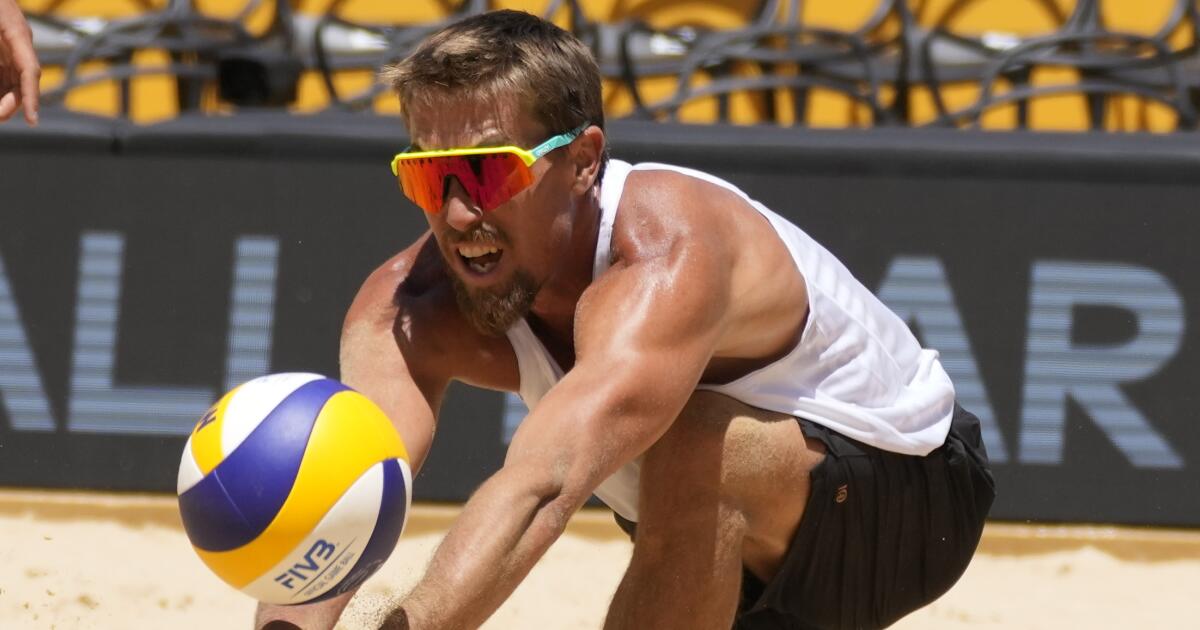
Taylor Crabb is no stranger to South California beaches. The Long Beach State alum returns home this weekend to compete in AVP League matches.
It marks the first time AVP will compete in Long Beach since 2020 and allows players to compete at the 2028 Olympics beach volleyball venue.
Crabb, 34, made his AVP debut in 2013 with his brother, Trevor, and advanced from the qualifier in Manhattan Beach before finishing 25th in his first tournament.
After years of competing with various different partners, Taylor Crabb and Andy Benesh have delivered the top performances this AVP season.
The following interview with Crabb has been edited for clarity and length.
Are you excited to compete in this weekend’s event at Long Beach?
Crabb: Very excited. A lot of my college teammates and part of the school have reached out, saying that they’re gonna come. So I’m excited to get a chance to play in front of them again.
When was the last time you were in Long Beach?
Crabb: I always try to go down there for alumni events or any big games they have. I went to UCLA against Long Beach last year, when it was No. 1 versus No. 2, so I always try to get down there and support them.
You missed out on the chance to compete in the 2020 Olympics because of COVID-19 restrictions and chose not to pursue a spot at the 2024 Olympics. Are you fired up to try to compete in the 2028 Olympics, knowing that Long Beach will host the competition?
Crabb: Yeah, it’s definitely an exciting time having the Olympics in Long Beach, and we kind of get to break it in this weekend. As you said, Tokyo didn’t go the way I wanted, but I’m going full force now. I have a great partner in Andy Benesh, who obviously went to the Paris Olympics, and if it weren’t for the Olympics being in Long Beach, and me getting a partner like Andy, I’m not even sure I’d be going for it, but because of those two things, I want to make the most of it.
You mentioned that if it wasn’t for a partner like Andy, you wouldn’t be going for it. What do you mean by that?
Crabb: I didn’t feel motivated by playing in all the international events, but now, I think, sitting out kind of lit the fire under me, and I’m really motivated now.
You’ve had different partners throughout your time. What other motivation does Andy give you?
Crabb: He’s been, in my mind, the top blocker for the U.S. the last four or five years. Seeing the professionalism he brings every day to practice, on and off the court, while traveling and when showing up to tournaments, it rubs off on you and that’s really motivating to see. And I just want to make him proud.
Why do you love volleyball?
Crabb: A lot of reasons, but it’s just a feeling I have when I’m out there on the court. It feels natural. It feels like home. I was born into a volleyball family. I had a volleyball in my hands my entire life, so I’ve always just enjoyed it.

NEWYou can now listen to Fox News articles!
CM Punk appeared on “Friday Night SmackDown” ready to take on any challenger that was ready to step to him after winning the Undisputed WWE Championship against Sami Zayn.
Punk entered the ring in Oklahoma City and called back to the “Monday Night Raw” after WrestleMania 42 when he told Cody Rhodes he’d be ready to deliver if a championship opportunity fell “out of the sky.”
COMPLETE PRO WRESTLING COVERAGE ON FOX NEWS DIGITAL
Cody Rhodes and CM Punk face off during SmackDown at Paycom Center in Oklahoma City, Okla. (Craig Ambrosio/WWE via Getty Images)
“When championship opportunities fall out of the sky, CM Punk catches them,” he said.
Punk named potential SmackDown superstars he’d think might come for the title, including Gunther, Finn Balor, Royce Keys, Damian Priest and Trick Williams. He even said that Zayn could come back around and get his rematch if he wanted. He didn’t mention Rhodes’ name, but the “American Nightmare” came out uncalled and marched his way down to the ring.
“I don’t think you and I can run away from each other anymore,” Punk told Rhodes.
Cody Rhodes looks on during SmackDown at Paycom Center in Oklahoma City, Okla., on July 10, 2026. (Craig Ambrosio/WWE via Getty Images)
Rhodes agreed and mentioned that Punk would want a match with him, just “say when.” It was a quick retort from Punk, who said, “when.” SmackDown general manager Nick Aldis, who was in the ring for the segment, booked the match for SummerSlam.
Punk will defend the Undisputed WWE Championship at SummerSlam, which takes place Aug. 1 and 2 at U.S. Bank Stadium in Minneapolis.
First, however, Punk and Rhodes will be involved in a tag team match at Saturday Night’s Main Event in New York City next week. Aldis made the match after Gunther demanded that Aldis put him in a match against Punk. Gunther was hoping it would be for the championship. Instead, Gunther will tag with Zayn.
Gunther didn’t take too kindly to that and attacked Aldis. Rhodes came back out to break up the calamity. He wanted to take on Gunther after the show went off air but Gunther walked away.
Gunther makes his entrance during SmackDown at Paycom Center in Oklahoma City, Okla., on July 10, 2026. (Rich Wade/WWE via Getty Images)
CLICK HERE TO DOWNLOAD THE FOX NEWS APP
Punk definitely has his hands full as he moves to SmackDown to become a fighting champion.
-

 Missouri3 minutes ago
One dead, hundreds rescued in devastating Missouri flooding – UPI.com
-
 Montana6 minutes ago
Montana Folk Festival brings heat along with music, food, and art
-

 Nebraska11 minutes ago
Nebraska redshirt sophomore Carson Jasa picked by Chicago Cubs in third round of MLB Draft
-

 New Hampshire21 minutes ago
Gilmanton Iron Works Man Accused Of Possessing Guns, Hundreds Of Grams Of Fentanyl In Hooksett, Manchester
-

 New Jersey33 minutes ago
Ex-NJ GOP aide accused of staging slashing attack shows off horrific scars — and mystery man — in new snap
-

 New Mexico36 minutes ago
New Mexico AG Wants to Know Where Epstein Records Are
-
North Carolina36 minutes ago
UNC shortstop selected in first round of MLB Draft by Red Sox; list of NC players drafted
-
North Dakota48 minutes ago
The Crookston Masonic Lodge and Order of the Eastern Star present a donation check to Honor Flight of North Dakota and Minnesota


