Southwest
Parents and students need school choice, not religious bigotry

NEWYou can now listen to Fox News articles!
Politicians across the nation claim they want a world-class education system that ensures every child receives the education they deserve.
How we get there is the source of debate. Despite spending hundreds of billions of dollars in recent decades on our public education system, we have very little to show. According to the Organization for Economic Cooperation and Development (OECD), the U.S. hovers near the middle of the pack internationally in standardized test scores even as other countries have advanced. One report said, “The U.S. struggled the most in math, where 15-year-olds in 29 other countries had higher average scores than Americans.”
This is unacceptable. And while there are a variety of reasons for our education stagnation, we believe that one answer is to provide families more choice, including private, religious schools.
AHEAD OF KEY SUPREME COURT ARGUMENTS, HERE’S WHICH STATES HAVE PASSED SCHOOL CHOICE MEASURES
Parents in Oklahoma have been fighting for more education freedom for decades. One way Oklahoma responded was by expanding access for new and innovative charter schools as alternatives for parents seeking a better education for their children, including offerings such as a French-immersion school.
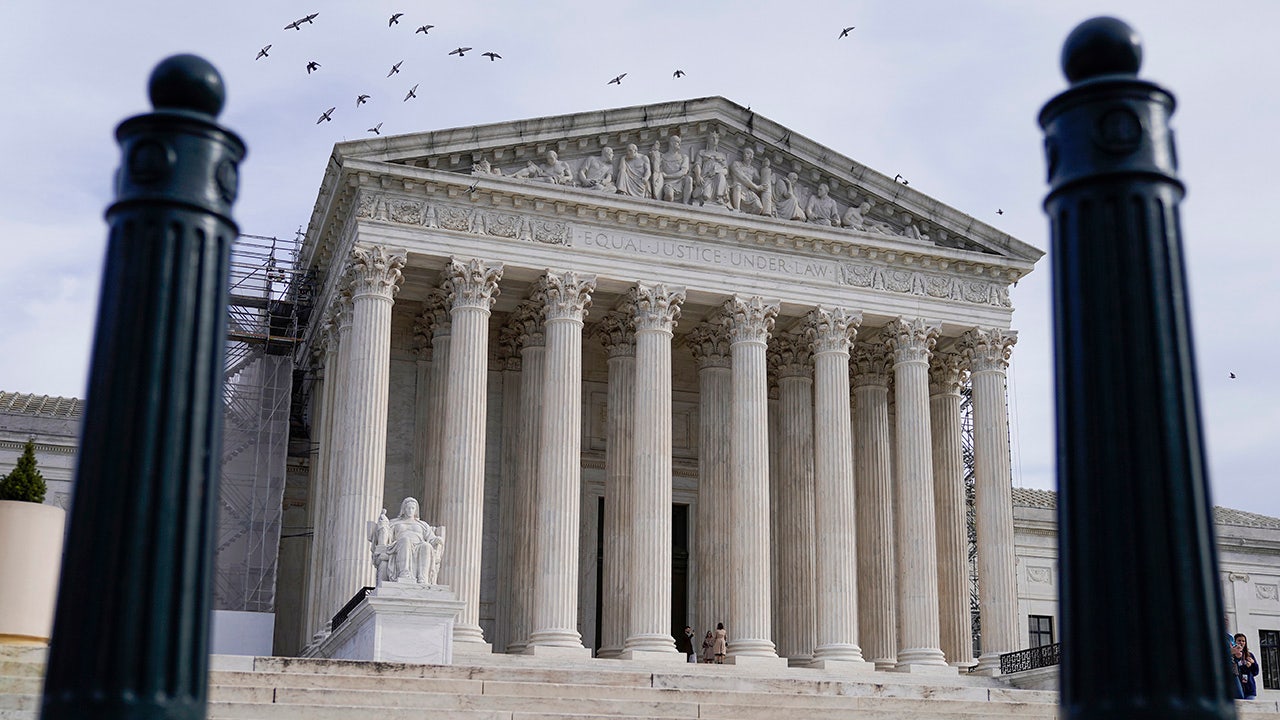
The U.S. Supreme Court will decide if Oklahoma can let a Catholic school join its charter program. What will the court have to say? FILE: The court is seen on Nov. 15, 2023, in Washington. (AP Photo/Mariam Zuhaib, File)
But Oklahoma’s choice is under attack once again at the United States Supreme Court.
In Oklahoma, we have been battling two different lawsuits trying to destroy faith-based options for parents to choose. The ACLU, Freedom from Religion Foundation and others filed the first suit. Shockingly, the attorney general of Oklahoma, Gentner Drummond, filed the second.
The aim of both suits is to prevent the Statewide Charter School Board and our Oklahoma Department of Education from treating St. Isidore of Seville Catholic Virtual School the same as every other applicant who applies to be a charter school simply because it is faith-based. The U.S. Supreme Court will soon hear arguments in the case.
Oklahoma is rural. To ensure parents in rural areas have expanded choices, virtual options are available. We believe in Oklahoma that parents are best positioned to determine the educational needs of their own children and that the Oklahoma Department of Education should give parents as many options as possible to meet a diverse array of needs. Some parents may choose their local school, some parents may choose a brick-and-mortar charter school in their area, some parents may prefer a virtual approach.
St. Isidore applied to be one of those options. They met all the academic criteria we require in Oklahoma to be a qualified option for parents. However, the ACLU and Attorney General Drummond objected, claiming that the state must discriminate against St. Isidore because it is Catholic.
Supporters of school choice responded that we are simply trying to expand options for parents, and we are not allowed to violate the Free Exercise Clause of the United States Constitution.
In fact, we felt bound by prior U.S. Supreme Court decisions prohibiting this kind of religious bigotry in educational choices, including Carson v. Makin, a recent case won by the Institute for Justice and First Liberty Institute against the state of Maine for doing precisely what Drummond is demanding be done here – engaging in religious bigotry against a faith-based educational option.
The argument, advanced by the ACLU and Drummond, is that religious bigotry is enshrined in the Oklahoma Constitution because it has two provisions that work together to prohibit government resources from aiding a faith-based educational program.
These provisions are sometimes called “little Blaine Amendments,” because they harken back to efforts by Senator James Blaine from Maine in the late 19th Century to ensure that no public funds would go to Catholic schools but rather would be reserved to the more Protestant-friendly public schools.
CLICK HERE FOR MORE FOX NEWS OPINION
This effort to ban Catholic schools from receiving any aid is a “doctrine, born of bigotry,” according to Justices Clarence Thomas and Samuel Alito. It is this bigotry that the ACLU and Drummond are attempting to continue, and it is this bigotry that we intend to end in Oklahoma.
For decades, politicians and activists pointed fingers at each other, each trying to blame another for the educational ills of our home state. Almost every solution offered sounds different and promising, but they usually have the same thing in common – they are government-led solutions.
We are trying to do something different in Oklahoma. We are trying to empower parents to decide for their families and force schools to compete for parents in an open market system. Some parents would like a faith-based option.
St. Isidore applied to be one of those options. They met all the academic criteria we require in Oklahoma to be a qualified option for parents. However, the ACLU and Attorney General Drummond objected, claiming that the state must discriminate against St. Isidore because it is Catholic.
Excluding that option in the name of 19th century religious bigotry is just another political agenda driving education policy.
Instead of fighting against parents and telling them that government officials know what is best for their children, we should instead listen to them. There is hope that the Supreme Court will give us this chance, a chance to take power away from government bureaucrats and give it back to the people.
Ryan Walters, Oklahoma’s state superintendent of public instruction since 2023, is a former high school history teacher and education reform advocate committed to parental empowerment and conservative policy initiatives in public education. Hiram Sasser is executive general counsel for First Liberty Institute, a nonprofit law firm dedicated to defending religious freedom for all.
CLICK HERE TO READ MORE FROM HIRAM SASSER
CLICK HERE TO READ MORE FROM RYAN WALTERS
Read the full article from Here


A man wanted for a deadly road rage shooting in Los Angeles was arrested and extradited from Mexico after fleeing the U.S. in 2024.
The suspect was identified as Christian Rojas, 21, of Bellflower, according to the California Highway Patrol.
Authorities had been searching for him since the deadly incident on October 10, 2024.
Rojas and a second suspect, Joshua Rojas Sr., 47, of Downey, were driving on the northbound 5 Freeway in Boyle Heights around 4 p.m. when they became involved in an altercation with another driver that escalated into a shooting.
-

Video obtained exclusively by KTLA shows the terrifying moment a road rage suspect opened fire the driver of another car on the 5 Freeway in Los Angeles, fatally wounding him and seriously injuring a passenger, on Oct. 10, 2024. (Credit: @hugoboss01) -
Video obtained exclusively by KTLA shows the terrifying moment a road rage suspect opened fire the driver of another car on the 5 Freeway in Los Angeles, fatally wounding him and seriously injuring a passenger, on Oct. 10, 2024. (Credit: @hugoboss01) -
Video obtained exclusively by KTLA shows the terrifying moment a road rage suspect opened fire the driver of another car on the 5 Freeway in Los Angeles, fatally wounding him and seriously injuring a passenger, on Oct. 10, 2024. The alleged gunman is circled. (Credit: @hugoboss01) -
Video obtained exclusively by KTLA shows the terrifying moment a road rage suspect opened fire the driver of another car on the 5 Freeway in Los Angeles, fatally wounding him and seriously injuring a passenger, on Oct. 10, 2024. (Credit: @hugoboss01) -
Video obtained exclusively by KTLA shows the terrifying moment a road rage suspect opened fire the driver of another car on the 5 Freeway in Los Angeles, fatally wounding him and seriously injuring a passenger, on Oct. 10, 2024. (Credit: @hugoboss01) -
Christian Rojas, 21, of Bellflower, was arrested and extradited to the U.S. from Mexico on June 2, 2026, in connection with a deadly road rage shooting in Los Angeles. (California Highway Patrol)


Video of the tense confrontation showed the suspects, who were driving a Dodge Durango SUV, opening fire on two men in a Cadillac sedan.
The shooting forced the victim to pull over abruptly. That’s when a suspect ran up to the Cadillac, opened the passenger-side door and fired several shots at close range.
In a panic, the Cadillac driver tried to escape by making a sudden U-turn and driving against oncoming traffic. He eventually crashed head-on into several vehicles.
The suspects ditched their SUV and fled toward a freeway exit on foot. The Cadillac driver was left with serious injuries and his passenger was killed. Their identities were not released.
The incident caused a miles-long backup that left thousands of motorists stranded on the freeway for hours and authorities worked to clear the scene.
Following an extensive investigation, detectives identified the two men as the suspects involved.
Joshua Rojas Sr. was arrested in San Bernardino on October 22, 2024, on a murder charge. He remains in custody awaiting trial.
Meanwhile, Christian Rojas had fled the U.S. and was hiding in Mexico, detectives said. A $4.3 million bail warrant was issued for his arrest.
“Through a coordinated international effort, investigators determined that Rojas was living in Palomo de Arriba, Mexico,” CHP officials said. “The U.S. Marshals Service worked with Mexican state police to locate and arrest him on the outstanding warrant.”
On June 2, 2026, Christian was arrested and extradited to the U.S. to face a murder charge.
“This arrest demonstrates that time and distance will not shield violent offenders from justice,” said CHP Southern Division Chief Chris Margaris. “For nearly two years, our detectives remained relentless in their pursuit of those responsible for this senseless act of violence. Through exceptional collaboration with the United States Marshals Service and our law enforcement partners in Mexico, we located and apprehended this suspect and brought him back to face the charges. We remain committed to protecting the public, supporting victims and their families, and holding violent criminals accountable wherever they may try to hide.”

The northbound 405 Freeway will remain closed for several hours near Los Angeles International Airport after a police pursuit ended with officers opening fire Friday morning. Unconfirmed reports indicated the incident began with a robbery at a 7-Eleven store, which ended with Los Angeles Police Department officers pursuing the suspect in a Kia. The chase […]

The victim in a bizarre and deadly stabbing in Tarzana has been identified as 81-year-old character actor James Handy, best known for a recent role in Tom Cruise’s “Top Gun: Maverick.” The stabbing happened around 9:30 a.m. Wednesday in the 19200 block of Erwin Street in the West Valley area. Officers responded after receiving a […]
-

 Montana3 minutes ago
Same Stars by Montana Joanna: Review | Illustrate Magazine
-

 Nebraska10 minutes ago
Southeast Nebraska assault report leads to child porn discovery
-

 Nevada13 minutes ago
Missing person alert canceled after North Las Vegas man found dead
-

 New Hampshire18 minutes ago
Manchester Man Indicted On Pembroke Child Assault Charges: Merrimack County Superior Court Roundup
-

 New Jersey25 minutes ago
Robots? Podcasts? See inside North Jersey Girl Scouts’ new Dream Lab
-

 New Mexico28 minutes ago
New Mexico Highland University fires president
-

 North Carolina34 minutes ago
Fire Crews Contain Woods Fire Near Brown Farm Road
-

 North Dakota41 minutes ago
State launches new system to improve farming data

