Southwest
MIKE DAVIS: Driving a stake through 2020 election lawfare

NEWYou can now listen to Fox News articles!
The 2020 election ended six years ago. Yet, two power-hungry Democrat attorneys general up for re-election next year, Kris Mayes of Arizona and Josh Kaul of Wisconsin, persist in their lawfare against Trump supporters who lawfully challenged the election. These disgraceful cases must end immediately.
President Trump and many supporters found numerous discrepancies with the 2020 election. They challenged the results in several closely-contested states. The First Amendment and the Electoral Count Act of 1887 permitted such challenges — just like Democrats challenged Republican presidential wins in 1968, 2000, 2004 and 2016. Leftists maliciously alleged that the challengers submitted “fake electors” as part of the effort to overturn certified results in these states.
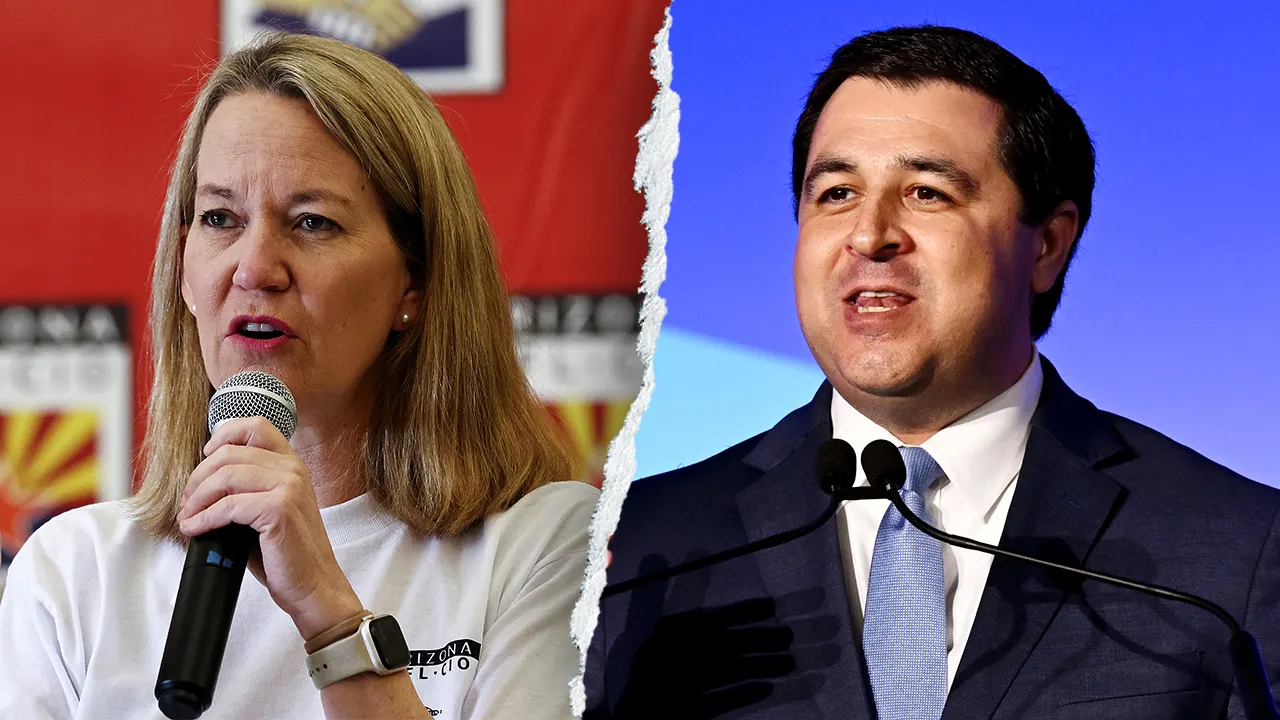
Arizona Attorney General Kris Mayes and Wisconsin Attorney General Josh Kaul weigh next steps in their 2020 fake elector prosecutions. (Mario Tama/Daniel Boczarski/Getty Images for Democratic Party of Wisconsin)
This is utter nonsense. No one was duped by the intent of these alternate electors. Rudy Giuliani didn’t have the “real” electors tied up in his trunk while sending in the “fake” electors.
The slates of electors submitted were alternate electors in the event that, on Jan. 6, 2021, Congress sustained objections to the certification of electors in the contested states.
SOCIAL MEDIA ERUPTS AS RESURFACED AG JAMES POSTS COME BACK TO HAUNT HER: ‘NO ONE IS ABOVE THE LAW’
In 2022, Democrat Mayes defeated Republican Abraham Hamadeh by less than 300 votes to become attorney general of Arizona. She immediately started pursuing illegal lawfare against Trump supporters. Mark Brnovich, the previous attorney general, took no action against those who had disputed the 2020 election, because he recognized that they had committed no crimes. Mayes didn’t care and sought indictments against the eleven Arizona alternate electors and seven other defendants, including Mike Roman, President Trump’s campaign head of operations on election day.
Former Mayor of New York Rudy Giuliani speaks during a news conference outside the federal courthouse in Washington, Dec. 15, 2023. (Jose Luis Magana, File/The Associated Press)
A Maricopa County trial court correctly threw out the indictment and ordered Mayes to seek a new one. Mayes had not provided the grand jury with the full text of the Electoral Count Act, a complicated and arcane statute that has direct bearing on the case. If the statute permitted the defendants’ actions, the state cannot sustain its case. Federal election law preempts state law with respect to federal elections. The statute was so complex that Congress amended it a few years ago through the Electoral Count Reform Act.
Mayes scurried to the Arizona Court of Appeals. That court wisely declined to hear her appeal. Now, she has petitioned the Arizona Supreme Court for review. The justices should follow the sage lead of the appellate court and decline to hear Mayes’ appeal.
JONATHAN TURLEY: FANI WILLIS’ CASE AGAINST TRUMP COLLAPSES UNDER ITS OWN INSANITY
Mayes is the same prosecutor who threatened to investigate President Trump for a supposed death threat against former Rep. Liz Cheney — a Trump-deranged RINO — during a campaign rally in Phoenix. Trump, of course, made no such threat, and Mayes abandoned her stunt shortly after the president’s resounding victory last November.
Wisconsin also suffers from a partisan Democrat attorney general seeking re-election. In 2024, nearly four years after the conclusion of the 2020 election, Kaul, a radical leftist like Mayes, obtained indictments against three defendants, including Roman and two of Trump’s attorneys.
The facts were the same as in Arizona, except that Kaul did not charge the 10 Wisconsin alternate electors. The defendants are now facing a preliminary hearing in Dane County, a leftist bastion home to the state capital and the ultra-liberal University of Wisconsin-Madison, where they are hard-pressed to find a fair and impartial jury.
MIKE DAVIS: AFTER TRUMP CASE COLLAPSES, TIME FOR FANI WILLIS TO LAWYER UP
A preliminary hearing is scheduled for Dec. 15. One defendant has sought to disqualify Judge John Hyland, alleging that a retired judge named Frank Remington wrote the opinion denying a defense motion to dismiss. The recusal motion included support from a Georgetown expert who concluded that, based on writing styles, Remington had written the opinion. Hyland denied the motion to recuse and asserted that he had written the opinion.
President Donald Trump speaks during a Cabinet meeting at the White House, Tuesday, Dec. 2, 2025, in Washington, with Secretary of State Marco Rubio, left, and War Secretary Pete Hegseth. (Julia Demaree Nikhinson/AP Photo)
Regardless of how the preliminary hearing goes, the case should end. Kaul brought the charges, after the facts were known for four years, in the middle of the 2024 election, in which Wisconsin was a pivotal swing state. We cannot criminalize politics.
There was another prosecutorial embarrassment who brought charges against a slew of defendants over the 2020 election in Georgia: Fulton County District Attorney Fani Willis. Her case got derailed when it became public, thanks to Roman’s attorney Ashleigh Merchant, that Willis was having an affair with one of the special prosecutors she had hired, Nathan Wade, who received nearly $700,000 courtesy of the taxpayers of Fulton County. Wade spent much of it on Willis, treating her to lavish global trips. The lovers claimed Willis had reimbursed Wade, but there was no corroborating evidence. Georgia courts disqualified Willis, and a special prosecutor who replaced her dismissed the case earlier this month.
CLICK HERE TO DOWNLOAD THE FOX NEWS APP
Lawfare Democrats failed to lock up, bankrupt, or defeat Trump electorally. They are trying to get one last pound of flesh from some of the president’s former aides and supporters. If Mayes and Kaul do not follow the Georgia special prosecutor’s stellar example and drop their sham cases, the courts in Arizona and Wisconsin should.
The Justice Department also should pursue charges against these affronts to the legal profession for conspiracy to violate the civil rights of these lawfare victims under 18 U.S.C. § 241. After all, as we heard so much during the lawfare campaign against President Trump, no one is above the law.
Read the full article from Here



A 48-year-old man who led law enforcement on a dangerous pursuit lasting more than an hour is in custody in connection with the shooting deaths of a man and a woman at an upscale Pomona apartment complex Thursday, police announced.
Officers with the Pomona Police Department responded to the Monterey Station Apartments, located at 180 E. Monterey Ave., near North Garey Avenue, just before 3:30 p.m. on reports of a shooting, according to a department news release.
Police, along with responding Los Angeles County firefighters, found the two victims in a fourth-floor apartment.
Paramedics immediately began life-saving measures, but both victims were ultimately declared dead at the scene, investigators said.
Neighbors told KTLA’s Mary Beth McDade that the suspected shooter, Robert Galtman of Pomona, shot his girlfriend and another resident of the apartment complex.
“He shot the girl, that was the girlfriend,” one woman, a resident of the building who did not want to give her name, told KTLA. “I know them because he had tried to hit on me and told me the situation that she was beating him up and that she cheated on him with this guy, the one that was killed.”
Authorities were searching Galtman, who was believed to be in dark-colored sedan that fled the apartments northbound on Towne Avenue near Holt Avenue.
Just before 5 p.m., officers with the California Highway Patrol spotted his vehicle traveling northbound on the 5 Freeway, officials confirmed to KTLA. When officers attempted a traffic stop, he failed to yield and led authorities on a high-speed pursuit that lasted more than an hour.
During the pursuit, he made a U-turn on the freeway and headed southbound before exiting in Castaic and taking Lake Hughes Road through the hills toward the Antelope Valley.
Sky5 was over the dangerous chase as Galtman was seen tossing unknown items from the vehicle, including some type of liquid, swerving dangerously onto the shoulder and refusing to stop as at least four CHP units followed closely behind.
He initially dodged several spike strips deployed by officers, at one point driving on the shoulder in Lancaster before clipping one of the strips with the vehicle’s left side, causing both tires to deflate.
Still refusing to stop, Galtman continued at about 30 mph until a CHP officer accelerated and performed a PIT maneuver that spun the vehicle and disabled it.
He was quickly surrounded by officers with guns drawn but did not immediately comply.
Following law enforcement commands, Galtman exited the vehicle, surrendered and was taken into custody.
The identities of the two victims are being withheld pending notification of next of kin.
Authorities have not released a motive in the deadly shooting. The investigation is ongoing, and anyone with information is asked to contact the Pomona Police Department’s Detective Bureau at 909-620-2085.

A stand-up comedian is set to face criminal charges in the first case filed by the Los Angeles County District Attorney’s newly created Business Tax Fraud Unit, officials announced Thursday.
According to the Los Angeles County District Attorney’s Office, the defendant is comedian and actor Carlos Mencia. District Attorney Nathan Hochman is scheduled to announce the charges during a 2 p.m. news conference at the Hall of Justice in downtown Los Angeles.
Officials have not yet disclosed the nature of the charges.
The prosecution marks the first case brought by the Business Tax Fraud Unit, a specialized division created under Hochman’s administration to investigate and prosecute tax-related crimes involving businesses.
Mencia, whose real name is Ned Arnel Mencia, rose to fame through his stand-up comedy career and as the host of the Comedy Central series Mind of Mencia.
The comedian has previously faced tax-related issues. In 2021, reports indicated that the Internal Revenue Service filed liens against three properties he owned in Georgia over more than $1 million in unpaid federal income taxes.
The District Attorney’s Office said Thursday’s announcement will be streamed live on its social media platforms.
No additional information about the case was immediately available Thursday morning.
KTLA will update this story following the district attorney’s announcement.

Multiple people were arrested after local and federal law enforcement agents descended upon L.A.’s MacArthur Park to carry out a nighttime narcotics enforcement operation.
Officers from the Los Angeles Police Department and the Drug Enforcement Administration (DEA) descended on the park at around 9 p.m.
Among the personnel who arrived at the scene was First Assistant U.S. Attorney Bill Essayli, who joined authorities in overseeing the operation.
In a statement, LAPD said officers were “assisting our federal partners in a joint narcotics enforcement operation in the MacArthur Park area. This operation is focused solely on drug-related criminal activity. There is no connection to immigration enforcement.”
More than 100 law enforcement members were involved, including around 60 DEA agents and 55 LAPD officers. As officers converged on the park, many people were seen running away.
Six people were eventually taken into custody for felony drug charges.
Officials told KTLA’s Jillian Smukler that they intentionally waited until nightfall after frustrated business owners said that most of the visible drug activity occurred at night, following previous raids that took place much earlier in the day.
“We’ve been hearing that a lot of stuff has been moving to later in the day, so that’s why we’re coming out later in full force to show them that this is not a joke,” said Anthony Chrysanthis, a DEA spokesperson. “We are taking the park back for the people. This will happen. It’s going to take time, but it will happen.”
DEA agents are supporting LAPD efforts as part of a long-term strategy to eradicate a troubling increase in drug activity at MacArthur Park.
Authorities had targeted the park multiple times in the past for narcotics-related operations.
The latest incident occurred on June 4 as officers carried out a mission named “Operation Free MacArthur Park,” which involved serving arrest and search warrants in the area surrounding the park. Thirteen people were arrested for various offenses and officers recovered drug paraphernalia during the operation.
L.A. County District Attorney Nathan Hochman said at the time that authorities were targeting the demand side of the drug trade, going after small-time drug dealers and the drug addicts who are using every day.
“I refuse to allow MacArthur Park to be a cemetery, and that’s what it’s been,” Hochman said. “Because we’ve had individual after individual after individual die of drug overdoses, so much so that the local fire department spends much more time trying to revive people with Narcan who are on death’s door than they do putting out fires in this area.”
Authorities told KTLA they will maintain a presence at the park and work to eliminate all drug activity, allowing the park to be a safe place for residents and visitors.
“We remain committed to keeping our communities safe and informed as this operation continues,” LAPD said.
-

 Movie Reviews8 minutes ago
‘Maa Inti Bangaram’ Movie Review: Samantha Rocks, Writing Suffers
-

 World21 minutes ago
US tells ASML it is concerned China may have top chip tool, Bloomberg News reports
-

 News23 minutes ago
San Francisco Film Patrons Are Found Dead on Side of Highway
-

 Politics29 minutes ago
Video: Reflecting Pool Turns Green, Paint Peels After Renovation
-

 Health43 minutes ago
New At-Home DNA Test Reveals if GLP-1 Weight-Loss Drugs Will Work for You
-
 Lifestyle59 minutes ago
What does freedom actually look like? : It’s Been a Minute
-

 Technology1 hour ago
Barret Zoph is out at OpenAI again after just five months
-

 World1 hour ago
Iran hardliner behind US deal warns Tehran won’t honor agreement if Trump fails to deliver

