Washington, D.C
Washington DC Rises As A Tech Hub, Helped Along By The She-Economy


WASHINGTON, DC- OCTOBER 17: The Martin Lurther King, Jr. Memorial is seen in the trees turning fall … [+]
The knock against Washington DC as a tech hub has always been that it was too much of a government town: risk-averse, slow-moving, not worried enough about the bottom line.
But a lot has changed in the last 15 years, since people started trying to seed the culture of technology innovation outside Silicon Valley. Washington DC got a lot richer, for one thing.
Four of the 10 wealthiest counties in the country are in the DC metro area, as are the two very wealthiest – Falls Church and Loudon.
And the government itself became less and more powerful: The democracy grew weaker and the regulatory system in the hands of big companies that have captured much of it grew stronger. I took a look at my home-town ecosystem as part of a series looking at legacy cities and other second-tier markets.
Today, there is a tech hub growing in Washington, D.C., fueled by the wealth of the suburbs and partly built around that new government system. Pitchbook recently ranked the city 5th among startups, ahead of Austin and Seattle (and behind Silicon Valley, New York, Los Angles and Boston). Washington D.C. tech unicorns include ID.me and and Rebellion Defense (a military software provider), Pitchbook notes.
K Street Capital, which includes a $15 million venture fund and a $25 million fund of funds, invested in ID.me. Paige Soya, K Street’s managing partner, was a founder herself before beginning a career as an investor. There’s a lively debate now about whether DC is a “tier-one” city, she said. Whether it is or not, it’s on the rise, she notes.
“Government is increasingly a player in all these spaces,” she said. Part of K Street’s value proposition is helping small companies and startups gain a foothold in regulated industries where a giant may dominate the space and regulators’ attention. National security, finance and public affairs are three industries where a presence in DC or a connection to the city is a huge advantage.
Increased Role of Government An Opportunity For Some
Paige Soya, managing partner of K Street Capital
A recent fintech pitch event packed a room in the International Square with informed-sounding investors listening to pitches about companies including Wellthi, founded by Fonta Gilliam. The company embeds content and social connectivity inside existing banks’ apps and advertises partnerships with Zendesk, Sutton Bank and Visa on its web site.
Selena Strandburg, founder of The Know, an enterprise software company that supplies the public affairs teams at big companies understand how to respond to global news events, came to Washington, D.C. in 2019 to work on a company that worked on civic involvement. It led to The Know, which she founded in 2022. It’s raised more than $1 million and has a team of four.
Anecdotal evidence suggests that women are playing more of a role in Washington, D.C. than in other tech hubs, perhaps part of the she-economy that Mimi Montgomery of Axios wrote about last spring. Overall, the world of venture-backed tech companies remains shockingly dominated by men, with less than 3% of venture capital going to companies founded by women. (That number hasn’t budged in decades, and is about the same in the United States and Europe.). Women entrepreneurs and venture capitalists still face deep-seated cultural biases that have proven difficult to dislodge. If you needed more evidence of this, consider that women entrepreneurs who raise money from women venture capitalists have a harder time getting following rounds. As other industries are, venture capital is increasingly dominated by large firms that set the rules of the road: most of those are in turn dominated by a culture that heavily favors male leadership styles.
But The Statistics Don’t Tell The Whole Story
Though the statistics reflect the largest deals, which almost always involve male-founded companies, I see women in technology moving forward, mostly ignoring the obstacles and creating their own successes and definitions of success. For instance, women entrepreneurs are more likely to get funding if they say they are operating social enterprises – Wellthi identifies itself as one. Strandburg said she was motivated to become an entrepreneur after she noticed how much easier it was to make an impact in the world through companies.
And women continue to invest in other women.
At K Street Capital, about 25% of the investors are women, Soya said. About 35-40% of the companies it invests in across the company are women-led. “For some reason, DC has a more egalitarian culture,” Soya said.
Strandburg echoed that assessment, and said in her industry – public affairs and communications – she has found it to be an advantage to be a woman. “I have deep empathy for executives who make very challenging decisions impact thousands of employees’ lives,” she said. “Starting with empathy helps me solve the problems that literally keep customers up at night.”
Though, there are still parts of the DC tech scene that are almost entirely male-dominated, including national security. Mollie Breen, founder of Perygee, The company supplies no-code tools that help companies automate processes, including in the IT and security fields. Breen, a mathematician who worked at the NSA, said she is rarely the only woman in the room when founders or others from her industry. “But there are usually only a couple of us,” she said.

Our site’s security protections triggered a block. If you
think this was in error, email us at
[email protected]. Please include how you got to this webpage and the
Cloudflare Ray ID located at the bottom of the page.
Cloudflare Ray ID: a125c701ea927623
Back to The Atlantic

(NEWS FROM THE STATES) – Visitors from across the United States traveled to the National Mall Thursday for the opening day of the Great American State Fair, a days-long event that is part of President Donald Trump’s Freedom 250 celebration of the nation’s semiquincentennial.
States and territories showed off cultural and agricultural exports at exhibits stretching nearly a mile. Attendees snapped photos on the small Grand Ole Opry stage in the Tennessee booth, kids tried putt-putt at Indiana’s miniature golf course and cowboys rode horses at Montana’s rodeo.
A 110-foot Ferris wheel slowly turned at the center of the freshly manicured lawn, framing the Washington Monument and the U.S. Capitol in the distance on either side. Nearby stood a model of Trump’s controversial “triumphal arch.”
People collected swag from each state — drawstring bags from Ohio, stickers from South Dakota, snacks from Tennessee — and could receive a stamp on state fair passports.

The fair is part of the larger Freedom 250 programming and kicked off Wednesday night with a rally on the mall featuring a speech from the president that closely resembled his remarks along the 2024 presidential campaign trail. The festivities will continue over Independence Day, when Trump will deliver a second speech followed by what is promised to be an impressive fireworks display.
The president will visit North and South Dakota as part of his Freedom 250 tour for the opening of the Teddy Roosevelt presidential library and Independence Day eve fireworks above Mount Rushmore.

Freedom 250 then extends into August with a high school athletic competition in Washington, D.C., dubbed the “Patriot Games” and a Freedom 250 INDYCAR race around the National Mall.
The administration’s celebration is separate from the America250 commission, created by Congress a decade ago, and which has its own nationwide programming this year.
From Lake Erie to the Ohio River
Ohio Gov. Mike DeWine and first lady Fran DeWine greeted guests in Ohio’s pavilion. The couple posed for photos in front of a map of the Buckeye State.
“We wanted to see on the wall all the different things, from Lake Erie to the Ohio River, all the different fun things you can do in Ohio,” the Republican governor said, adding the state has local celebrations and initiatives planned for the 250th anniversary, including “Movies in Ohio” for community showings of films that feature the state.

Ohio’s first lady showcased a children’s literacy exhibit on the opposite wall and touted the roughly 427,000 participants in the state’s partnership with the Dolly Parton Imagination Library, a program that mails free children’s books monthly to households with kids under age 5.
“We’ve mailed out 27 million books. We know that a child’s brain is 80% developed by age 3, so we want to get them those books early,” she said.
Reflecting on America’s milestone birthday, the governor said, “We’re always a work in progress, Ohio’s a work in progress, this country is a work in progress.”
“I think you know the thing we need to keep in mind, all of us, is there’s some essential core principles that we all believe in. … We may disagree about different policies, but the core principles are the same,” he said.
Cartwheels on the lawn
People from various states walked from exhibit to exhibit, while stopped in the nation’s capital during road trip vacations.
Tanya Geders, 43, of St. Louis, Missouri, did a cartwheel in the mall lawn, trying to persuade her son to join in. The family stopped at the state fair on their way to Virginia Beach.
“We’re like, well, if we go to the ocean, we can go to D.C. and what a better time to be here than the 250th anniversary,” Geders said.

Robyn Toman, 71, of Severn, Maryland, escorted her 12-year-old grandson Miles to meet DeWine and grab a photo with the governor.
Toman said she remembers the country’s bicentennial.
“I was a kid about his age, and I came in 1976. I said, ‘We’re gonna go, let’s go down to D.C. for a couple days and see this,’” she said.
“We’ve enjoyed it. We went over to the archives yesterday, and saw the Constitution, and the Declaration of Independence, and the Bill of Rights. And, oh, that was so nice, that was fantastic.”
Not all states are there. A spokesperson for Washington state’s lieutenant governor’s office told States Newsroom the administration declined to join because of “the costs to the state associated with participating.”According to news reports, Connecticut, Massachusetts, North Carolina, Oregon, Pennsylvania, Rhode Island and Vermont did not contribute exhibits, though many are still represented by flags outside the individual booths.The state officials did not immediately respond to States Newsroom for confirmation.
All states that reportedly did not participate, with the exception of Vermont, are Democratic-led.
See a spelling or grammatical error in our story? Please click here to report it.
Do you have a photo or video of a breaking news story? Send it to us here with a brief description.
Copyright 2026 KOTA. All rights reserved.
Washington, D.C
DC reaches settlement with man detained while protesting troops with Darth Vader song

The District of Columbia has reached a settlement agreement for an undisclosed amount of money with a resident who claims police illegally detained him for following an Ohio National Guard patrol while playing Darth Vader’s theme song from “Star Wars” on his phone — an act of protest against the Trump administration’s federal law-enforcement surge in the nation’s capital.
A court filing late Thursday says the plaintiff, Sam O’Hara, will drop his lawsuit’s claims against the District and four Metropolitan Police Department officers within three business days of receiving the settlement payment. The filing doesn’t specify a dollar amount for the deal between the district and O’Hara, who is represented by the American Civil Liberties Union of the District of Columbia.
In an email on Friday, an ACLU spokesperson referred to the settlement’s financial terms as “a significant amount” that O’Hara “is pleased with” but said they aren’t disclosing the dollar figure to protect his privacy. A spokesperson for D.C. Attorney General Brian Schwalb’s office declined to comment on the settlement.
O’Hara’s agreement with the district doesn’t resolve his related claims against an Ohio National Guard member. Attorneys for the Guard member, Sgt. Devon Beck, have asked a judge to dismiss O’Hara’s claims against him.
“He was there because that was his assigned duty,” Beck’s lawyers wrote. “This was not an accidental encounter or a one-time disagreement on a public sidewalk.”
An earlier court filing, in February, said O’Hara had reached a settlement agreement “in principle” with the district. In response, a judge agreed to suspend the case while they negotiated terms.
O’Hara sued the district last October, claiming police officers violated his First Amendment rights to free speech and his Fourth Amendment rights against unreasonable seizures and excessive force.
The ominous orchestral music of “The Imperial March” from Star Wars movies was the soundtrack for O’Hara’s peaceful protests against President Donald Trump’s ongoing deployment of Guard members in Washington. Millions of TikTok users have viewed O’Hara’s videos of his interactions with troops, according to his lawsuit.
A series of major events tied to the nation’s 250th anniversary celebrations promise to bring big crowds and heightened security. On the News4 Rundown: That security is likely to include more National Guard troops as a new report says there’s a limit to their impact on safety in D.C.
O’Hara, an artist who works in the hospitality industry, says he didn’t interfere with the Guard troops during their Sept. 11, 2025, encounter on a public street. One of the troops summoned Metropolitan Police Department officers, who stopped O’Hara and kept him handcuffed for 15 to 20 minutes before releasing him without charges, according to the lawsuit.
“The law might have tolerated government conduct of this sort a long time ago in a galaxy far, far away. But in the here and now, the First Amendment bars government officials from shutting down peaceful protests,” the suit says.
Trump, a Republican, issued an executive order declaring a crime emergency in Washington last August. Within weeks, hundreds of Guard troops and federal agents were helping police patrol the city. The surge inflamed tensions with residents of the heavily Democratic district. Hundreds of Guard members remain deployed in the district nearly a year later, with no clear end in sight.
-
 Lifestyle1 minute ago
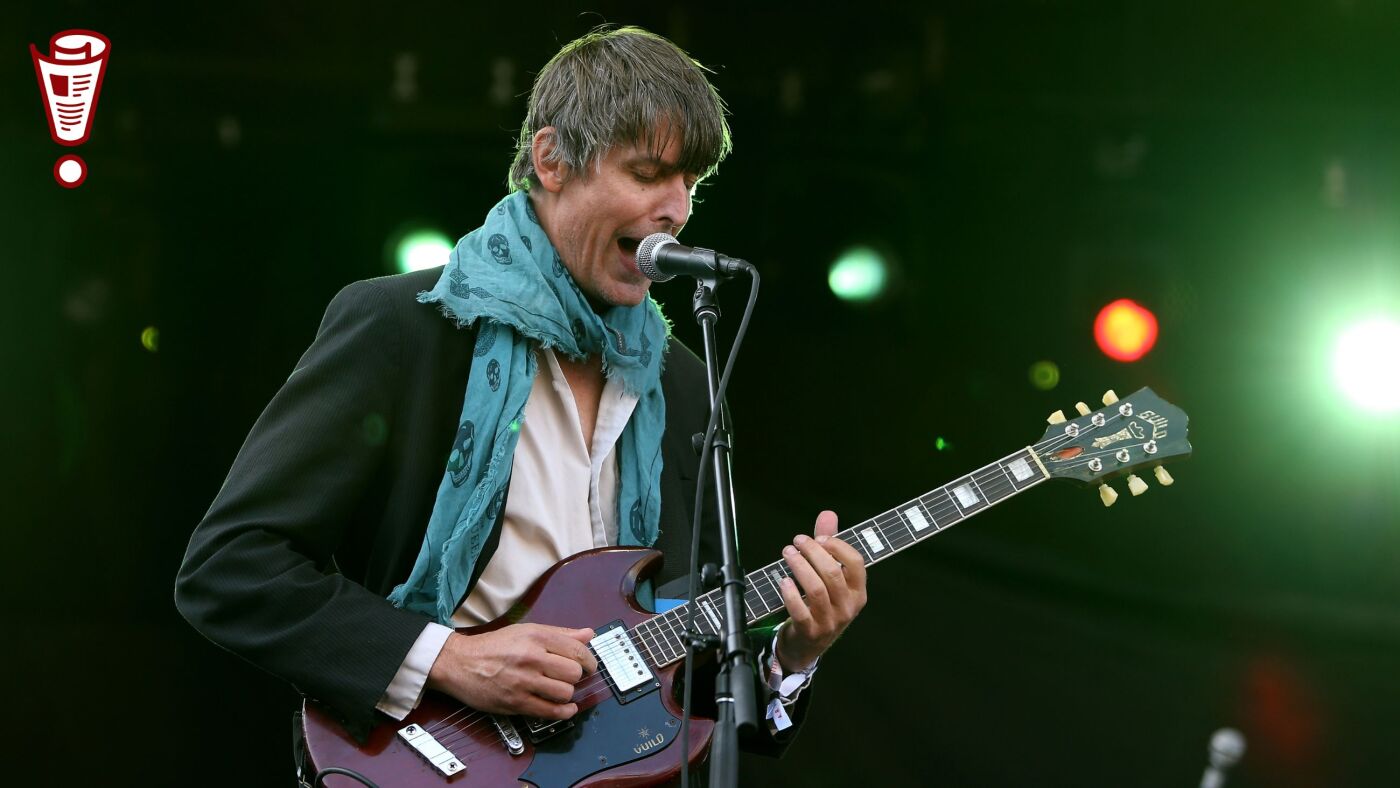
‘Wait Wait’ for June 27, 2026: With Not My Job guest Stephen Malkmus
-

 Technology11 minutes ago
Margaret Atwood says the problem with AI is ‘garbage in, garbage out’
-

 World16 minutes ago
Gulf countries strongly condemn Iran’s drone attack on Bahrain as rising tensions threaten MOU
-

 Politics23 minutes ago
Jeffries welcomes Democratic Socialists into the fold as critics warn party is revealing ‘exactly who it is’
-

 Health26 minutes ago
These leafy greens could help protect your lungs, study suggests
-

 Sports31 minutes ago
Knicks hand Mamdani-backed candidate cease and desist letter for using team’s logo in campaign: report
-

 Technology38 minutes ago
Empty envelopes in your mailbox? Do not scan that code
-
 Business41 minutes ago
Truck parking lot plans near Port of Los Angeles spark backlash among residents

