Washington, D.C
Fact Check Team: Iran conflict revives Washington fight over who can authorize US force


WASHINGTON (TNND) — As the war in Iran intensifies across the Middle East, a constitutional battle is unfolding in Washington over a fundamental question: Who has the authority to declare war, Congress or the president?
The debate focuses on the War Powers Resolution, a 1973 law designed to prevent years-long military conflicts without congressional approval. Lawmakers passed the measure in the aftermath of the Vietnam War to reclaim authority they believed had drifted too far toward the executive branch.
What Is the War Powers Resolution?
The War Powers Resolution was intended to put limits on a president’s ability to send U.S. troops into combat without Congress signing off.
Under the law, a president can deploy forces into hostilities only if Congress has formally declared war, passed a specific authorization for the use of military force, or the U.S. has been attacked.
The resolution also sets strict deadlines.
The president must notify Congress within 48 hours of introducing U.S. forces into hostilities. From there, a 60-day clock begins. If Congress does not approve the military action within that time, troops must be withdrawn — though the law allows an additional 30-day wind-down period.
Some argue the law was crafted to prevent “never-ending wars.” While others say presidents from both parties have routinely stretched and sidestepped its requirements.
WASHINGTON, DC – JANUARY 14: Sen. Cory Booker (D-NJ) visits with Senate pages in the basement of the U.S. Capitol Police ahead of a vote on January 14, 2026 in Washington, DC. Republicans voted to block a Venezuela war powers resolution after receiving assurances from President Donald Trump and Secretary of State Marco Rubio of no U.S. forces remaining in Venezuela and pledges for congressional involvement in major future operations. (Photo by Chip Somodevilla/Getty Images)
What Does the Constitution Say?
The War Powers Resolution is rooted directly in the U.S. Constitution.
Article I, Section 8 gives Congress — not the president — the power “to declare War.”
Article II, Section 2 names the president as Commander-in-Chief of the Army and Navy.
In simple terms, Congress decides whether the country goes to war. The president directs the military once it is engaged.
The framers intentionally split that authority. Their goal was to avoid concentrating too much war-making power in one person — likely a reaction to the monarchy they had just broken away from.
But how that balance plays out in real time is often a legal and political fight. At times, disputes over war powers have reached the courts, though Congress and the executive branch frequently resolve them through political pressure rather than judicial rulings.
A Pattern of Stretching the War Powers Resolution
Essentially, every president since 1973 has pushed the boundaries of the War Powers Resolution rather than fully complying with its original intent. As the Council on Foreign Relations explains, the resolution was designed to “provide presidents with the leeway to respond to attacks or other emergencies” but also to **require termination of combat after 60 to 90 days unless Congress authorizes continuation.”
For example:
- Ronald Reagan ordered the U.S. invasion of Grenada in 1983 without prior congressional authorization, later reporting to Congress in a manner “consistent with” the resolution.
- Bill Clinton directed the 1999 NATO air campaign in Kosovo after congressional authorization efforts failed, continuing U.S. engagement beyond the WPR’s typical 60-day reporting window.
- Barack Obama oversaw U.S. participation in the 2011 Libya campaign, arguing that limited strikes did not trigger the full force of the WPR’s time limits.
In more recent years, Donald Trump’s administration has once again brought these issues to the forefront.
War Powers Arguments from the White House
The Trump administration’s principal legal rationale has centered on two points:
Short-term strikes or limited military actions do not always trigger the full 60-day clock under the War Powers Resolution, especially when described as defensive, limited in scope, or tied to national security emergencies rather than prolonged hostilities. In some cases, the White House relies on prior Authorizations for Use of Military Force (AUMFs) or other statutory authorities rather than seeking new congressional approval.
Current Public Opinion on Iran Strikes
Public opinion reflects significant skepticism about the current U.S. military engagement with Iran. A recent Reuters/Ipsos poll found that just 27% of Americans support the recent U.S. and allied strikes on Iran, while 43% disapprove and 29% remain uncertain.
Another national poll conducted by SSRS for CNN found that nearly 60% of U.S. citizens disapprove of the military actions, and a similar share said that President Trump should seek Congressional authorization for further action.
Beyond polling, internal deliberations in Congress have already begun. Both Democratic and Republican lawmakers have pushed for votes on war powers resolutions that would seek to limit or require authorization for further military action against Iran. Past attempts to pass similar restraints have failed, reflecting deep partisan divisions and the complexities of enforcing the War Powers Resolution.

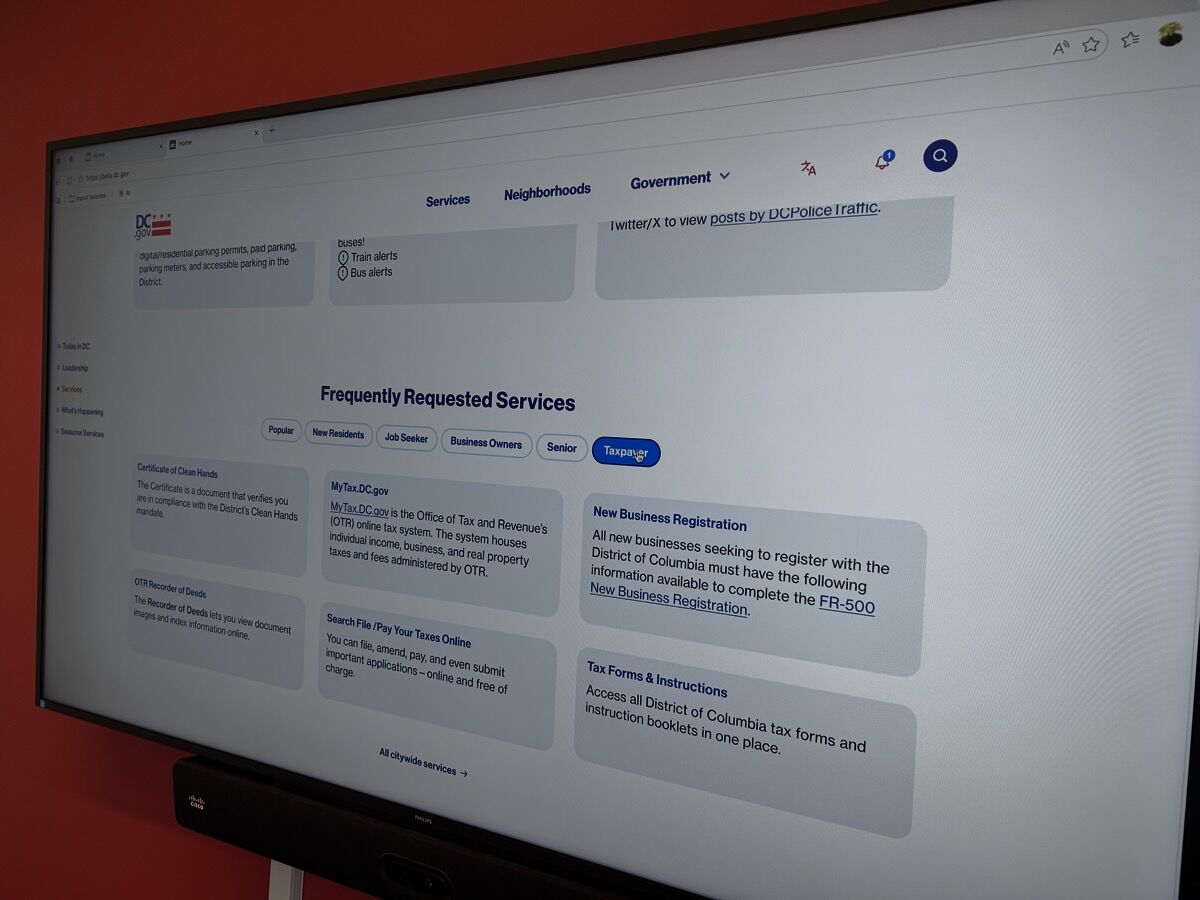
The overhaul is the first in more than a decade and comes in response to feedback that it’s hard to find information on the current site without being efficient at using Google or other search tools.

The D.C. government’s website is getting a complete revamp, a step city leaders hope will make it easier for residents, visitors and business owners to access the help they need.
The District unveiled a beta version of the new DC.gov — beta.dc.gov — and plans to have the redesigned site ready to launch before the end of the year.
The website’s overhaul is the first in more than a decade. It comes in response to feedback that it’s hard to find information on the current site without being efficient at using Google or other search tools.
“This website, it’s really going to eliminate the alphabet soup that you have to remember every day,” said Stephen Miller, the District’s chief technology officer. “So, do you need to know that it’s DPW that’s picking up your trash, or you just need to know that it’s dc.gov?”
The site is built on Drupal 11, which the city said has stronger built-in security features. It includes an integrated calendar and sections for seasonal government services.
Popular searches, based on site traffic data, will also be featured prominently on the main page.
“It’s going to show you, here’s popular services today, based on being a resident, based on being a new resident, based on being a job seeker, based on being a business owner, or based on just being a general resident of the city,” Miller said.
The project cost about $500,000 in dedicated funds.
“We’re setting this up so that you can just go in, say, ‘My trash was missed,’ and it’s going to tell you exactly how to fix that problem,” Miller said.
D.C.’s Office of the Chief Technology Officer is collecting feedback. Residents can leave comments on the beta site and at events at Haynes Senior Wellness Center and Eastern Market, among others, in the coming weeks.
An artificial intelligence-powered search tool, built using Google’s AI technology, will be included on the new DC.gov site after its official launch.
The District, Miller said, is “trying to clean up our content, because what we want to make sure is when we put AI into this site, it’s giving you the right information.”
“We see a lot of future use with AI,” Miller said. “I’d love to get to a point where it’s, ‘Hey Siri, renew my driver’s license,’ and we’ve laid out the foundation for something like that to happen in the future.”
Get breaking news and daily headlines delivered to your email inbox by signing up here.
© 2026 WTOP. All Rights Reserved. This website is not intended for users located within the European Economic Area.

A 16-day state fair is among the biggest attractions of the country’s 250th celebration in Washington DC. The Great American State Fair, which features attractions from each of the 50 states, runs from 25 June to 10 July across the National Mall from the US Capitol to the Washington Monument.
The BBC asked visitors why it was important for them to attend the fair.
Video by Meiying Wu
Produced by Madeline Gerber
Washington, D.C
Great American State Fair opens Thursday on National Mall. See hours and security info

The Great American State Fair, celebrating the United States’ 250th birthday, opens Thursday, bringing a Ferris wheel, special exhibits and road closures to the National Mall.
D.C. residents and visitors may have seen a Ferris wheel towering 110 feet over the fairgrounds. It’s free to ride, and it’s the first-ever Ferris wheel to be on the National Mall, a Talley Amusements spokesperson said on social media.
Visitors will also find exhibits representing all 56 states and territories, fair organizers Freedom 250 said, although some states decided not to sponsor programming, several media outlets reported. Metro will showcase its newest and oldest railcars at the fair.
Expect road closures and Metrobus detours into July.
Great American State Fair hours
The Great American State Fair is free and opens to the public at 10 a.m. Thursday. It runs daily through July 10. Each day has a theme, including Make America Health Again (MAHA) Mondays and Military & Veterans Appreciation Day on Sunday, June 28.
Fair hours will be 10 a.m. to 9 p.m. Sunday to Wednesday, 10 a.m. to 11 p.m. Thursday to Saturday.
Fairgrounds will be open 10 a.m. to midnight on July 4, when President Donald Trump promised “the largest pyrotechnics display in the history of the world.”
Great American State Fair security: bag policy and prohibited items
Visitors must go through security at the gates on either 12th or 7th street.
“To enhance security screening and expedite entry into the event venue, all attendees will be required to follow the Clear Bag Policy,” the event’s website says. Bags are subject to inspection.
Bag policy: Each guest may bring one clear, see-through bag that does not exceed 12″ x 6″ x 12″. A small clutch purse not exceeding 10″ x 6″ x 2″ is also permitted. Anyone accompanying a child 6 or under can bring one diaper bag.
Prohibited items: Aerosols (including bug spray and sunscreen), animals, backpacks, food, water bottles, umbrellas, balls, drink tumblers, drones, glass and metal containers, packages, selfie sticks, sign supports, toy guns and weapons of any kind, including firearms, are among prohibited items. See a full list on the event’s website.
Driving and walking anywhere near the National Mall is drastically different as it’s being transformed for the state fair. News4’s Mauricio Casillas reports.
How to get to the Great American State Fair
Organizers recommend you take public transit or ride share. Nearby Metro stations include Federal Triangle and Smithsonian on the Blue, Orange and Silver lines; Archives on the Green and Yellow Lines; and Gallery Places on the Green, Yellow and Red lines.
You can use Metro’s Trip Planner tool or apps like Google Maps to get directions.
“All ride-share services (Uber, Lyft, taxi, etc.) must use the designated Ride-Share Pick-Up & Drop-Off areas. Locations will be updated and communicated at a later time,” the event’s website said on Thursday morning.
President Trump kicked off fair after artists dropped out
Trump formally kicked off the celebrations on Wednesday night with a rally that included a series of flyovers by stealth bombers, military bands and Lee Greenwood singing “God Bless the USA.”
“There has never been anything like the United States of America, and together we are making it bigger and better and stronger and far more exceptional than ever before,” Trump said.
Trump announced he would headline the event after several musicians pulled out of the event’s concert series. Some artists have said they were misled about the event’s theme and want to avoid political controversy.
The event is organized by Freedom 250, a public-private partnership created by Trump that labels itself as a nonpartisan nonprofit organization, NBC News reported.
The fair is just the latest event drawing crowds downtown, prompting extra security and road closures. It follows the UFC fight, problems with the Reflecting Pool and the debut of a FIFA World Cup fan zone.
In August, the Freedom 250 Grand Prix will send cars speeding at 190 mph through D.C.
Subscribe to The Weekend Scene, our free newsletter about events, experiences and adventures for you and for your family around the DMV.
-
 Lifestyle14 seconds ago
‘Supergirl’ has a solid hero but could use a better villain : Pop Culture Happy Hour
-

 Technology10 minutes ago
Of course Meta thinks gambling is the future
-

 World15 minutes ago
Death toll from Venezuela earthquakes rises to at least 589, with thousands reported missing
-

 Politics22 minutes ago
McCarthy says Trump will use ‘everything he can’ to force Senate action on SAVE America Act
-

 Health25 minutes ago
Switching from cigarettes to vapes linked to higher risk of major eye diseases, large study finds
-

 Sports30 minutes ago
2026 World Cup Odds: Which Nations are Favored to Reach Semifinals?
-

 Technology37 minutes ago
World Cup ticket scams target desperate fans
-
Business40 minutes ago
Snap sued by parents of girl who was raped by man she met on Snapchat


