Washington, D.C
CHERRY BLOSSOM COUNTDOWN: Peak Bloom prediction drops Thursday


WASHINGTON (7News) — The nation’s capital is just about ready to be transformed into a breathtaking pastel landscape of cherry trees in bloom. The famed blossoms around the Tidal Basin are not only a symbol of spring’s arrival, but also of a long-standing friendship — a gift of more than 3,000 trees from Tokyo, Japan, to the United States in 1912.
So what is considered “Peak Bloom”?
The National Park Service (NPS) defines peak bloom as the time when at least 70% of the Yoshino cherry trees around the Tidal Basin have opened their blossoms. This is the period when the blossoms appear most full and spectacular and most ideal for photos, and soaking up spring’s beauty here in DC.
Because cherry trees respond to the cumulative effects of winter and spring weather, especially daily temperatures, it’s very difficult to predict peak bloom more than about 10 days in advance. Warm spells accelerate blooming; cold snaps slow it down.
Average Timing — What History Shows
Since 1921 overall, national data indicate peak bloom typically fell around early April (April 4), based on historical averages.
Since 1990, the average has kept shifting earlier and earlier. In fact, the last 6 years our peak has occurred in late March.
These shifts reflect how warmer springs have nudged peak bloom earlier over the decades.
Earliest & Latest Blooms on Record
Earliest peak bloom: March 15 — recorded in 1990.
Latest peak bloom: April 18 — recorded in 1958.
Of course, most years fall between those dates, with the last week of March to the first week of April historically being the most consistent window for peak bloom.

Earliest Peak Bloom Washington DC
Recent peak blooms show how variable and climate-dependent the timing can be:
2025: The National Park Service predicted peak bloom between March 28–31 (and confirmed the official peak around March 28).
2024: Peak bloom arrived very early, on March 17, several days ahead of NPS projections — tied for one of the earliest peaks in decades.
These examples demonstrate not only how much each season can differ, but also a trend toward earlier spring blossoms in recent years.
What to Expect for Spring 2026
As of early March 2026, the cherry trees are still dormant. The buds haven’t begun significant growth yet. The weather will become more critical in the weeks leading up to the bloom will be the biggest factor in determining when peak bloom happens in 2026.
Heavy winter cold, as experienced this year, tends to delay bloom compared with recent early springs. In contrast, an early warm stretch could push peak bloom earlier — as long as it doesn’t come with subsequent frost.
Look for the green bud stage first. This is when the buds are small, tight, and green, with no sign of petals yet. Trees are still several weeks from blooming.
Tips for Cherry Blossom Visitors
Plan in the “sweet spot” — peak bloom often lasts a few days to about a week, but weather (rain, wind, heat) can shorten that window.
Visit slightly before or after the predicted peak dates for smaller crowds and extended color. Blossoms can be gorgeous even before 70% bloom or as petals begin falling.
Check NPS updates and First Alert Weather forecasts in late March for tweaked peak bloom dates.
The cherry blossoms of Washington, D.C. remain one of the most iconic harbingers of spring in the U.S., and while exact bloom dates vary year-to-year, history and natural patterns point to late March through early April as your best bet for seeing the Tidal Basin in full floral glory.

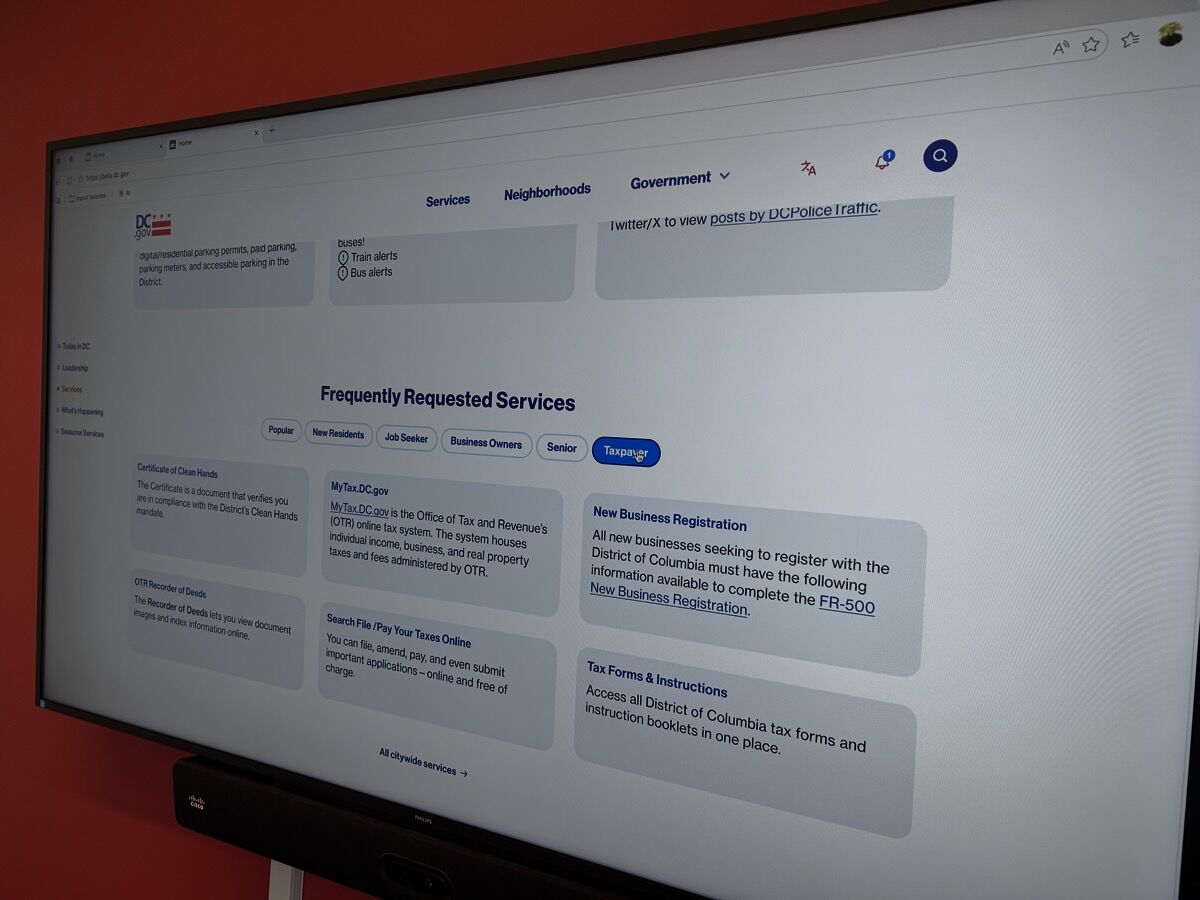
The overhaul is the first in more than a decade and comes in response to feedback that it’s hard to find information on the current site without being efficient at using Google or other search tools.
The D.C. government’s website is getting a complete revamp, a step city leaders hope will make it easier for residents, visitors and business owners to access the help they need.
The District unveiled a beta version of the new DC.gov — beta.dc.gov — and plans to have the redesigned site ready to launch before the end of the year.
The website’s overhaul is the first in more than a decade. It comes in response to feedback that it’s hard to find information on the current site without being efficient at using Google or other search tools.
“This website, it’s really going to eliminate the alphabet soup that you have to remember every day,” said Stephen Miller, the District’s chief technology officer. “So, do you need to know that it’s DPW that’s picking up your trash, or you just need to know that it’s dc.gov?”
The site is built on Drupal 11, which the city said has stronger built-in security features. It includes an integrated calendar and sections for seasonal government services.
Popular searches, based on site traffic data, will also be featured prominently on the main page.
“It’s going to show you, here’s popular services today, based on being a resident, based on being a new resident, based on being a job seeker, based on being a business owner, or based on just being a general resident of the city,” Miller said.
The project cost about $500,000 in dedicated funds.
“We’re setting this up so that you can just go in, say, ‘My trash was missed,’ and it’s going to tell you exactly how to fix that problem,” Miller said.
D.C.’s Office of the Chief Technology Officer is collecting feedback. Residents can leave comments on the beta site and at events at Haynes Senior Wellness Center and Eastern Market, among others, in the coming weeks.
An artificial intelligence-powered search tool, built using Google’s AI technology, will be included on the new DC.gov site after its official launch.
The District, Miller said, is “trying to clean up our content, because what we want to make sure is when we put AI into this site, it’s giving you the right information.”
“We see a lot of future use with AI,” Miller said. “I’d love to get to a point where it’s, ‘Hey Siri, renew my driver’s license,’ and we’ve laid out the foundation for something like that to happen in the future.”
Get breaking news and daily headlines delivered to your email inbox by signing up here.
© 2026 WTOP. All Rights Reserved. This website is not intended for users located within the European Economic Area.

A 16-day state fair is among the biggest attractions of the country’s 250th celebration in Washington DC. The Great American State Fair, which features attractions from each of the 50 states, runs from 25 June to 10 July across the National Mall from the US Capitol to the Washington Monument.
The BBC asked visitors why it was important for them to attend the fair.
Video by Meiying Wu
Produced by Madeline Gerber
Washington, D.C
Great American State Fair opens Thursday on National Mall. See hours and security info

The Great American State Fair, celebrating the United States’ 250th birthday, opens Thursday, bringing a Ferris wheel, special exhibits and road closures to the National Mall.
D.C. residents and visitors may have seen a Ferris wheel towering 110 feet over the fairgrounds. It’s free to ride, and it’s the first-ever Ferris wheel to be on the National Mall, a Talley Amusements spokesperson said on social media.
Visitors will also find exhibits representing all 56 states and territories, fair organizers Freedom 250 said, although some states decided not to sponsor programming, several media outlets reported. Metro will showcase its newest and oldest railcars at the fair.
Expect road closures and Metrobus detours into July.
Great American State Fair hours
The Great American State Fair is free and opens to the public at 10 a.m. Thursday. It runs daily through July 10. Each day has a theme, including Make America Health Again (MAHA) Mondays and Military & Veterans Appreciation Day on Sunday, June 28.
Fair hours will be 10 a.m. to 9 p.m. Sunday to Wednesday, 10 a.m. to 11 p.m. Thursday to Saturday.
Fairgrounds will be open 10 a.m. to midnight on July 4, when President Donald Trump promised “the largest pyrotechnics display in the history of the world.”
Great American State Fair security: bag policy and prohibited items
Visitors must go through security at the gates on either 12th or 7th street.
“To enhance security screening and expedite entry into the event venue, all attendees will be required to follow the Clear Bag Policy,” the event’s website says. Bags are subject to inspection.
Bag policy: Each guest may bring one clear, see-through bag that does not exceed 12″ x 6″ x 12″. A small clutch purse not exceeding 10″ x 6″ x 2″ is also permitted. Anyone accompanying a child 6 or under can bring one diaper bag.
Prohibited items: Aerosols (including bug spray and sunscreen), animals, backpacks, food, water bottles, umbrellas, balls, drink tumblers, drones, glass and metal containers, packages, selfie sticks, sign supports, toy guns and weapons of any kind, including firearms, are among prohibited items. See a full list on the event’s website.
Driving and walking anywhere near the National Mall is drastically different as it’s being transformed for the state fair. News4’s Mauricio Casillas reports.
How to get to the Great American State Fair
Organizers recommend you take public transit or ride share. Nearby Metro stations include Federal Triangle and Smithsonian on the Blue, Orange and Silver lines; Archives on the Green and Yellow Lines; and Gallery Places on the Green, Yellow and Red lines.
You can use Metro’s Trip Planner tool or apps like Google Maps to get directions.
“All ride-share services (Uber, Lyft, taxi, etc.) must use the designated Ride-Share Pick-Up & Drop-Off areas. Locations will be updated and communicated at a later time,” the event’s website said on Thursday morning.
President Trump kicked off fair after artists dropped out
Trump formally kicked off the celebrations on Wednesday night with a rally that included a series of flyovers by stealth bombers, military bands and Lee Greenwood singing “God Bless the USA.”
“There has never been anything like the United States of America, and together we are making it bigger and better and stronger and far more exceptional than ever before,” Trump said.
Trump announced he would headline the event after several musicians pulled out of the event’s concert series. Some artists have said they were misled about the event’s theme and want to avoid political controversy.
The event is organized by Freedom 250, a public-private partnership created by Trump that labels itself as a nonpartisan nonprofit organization, NBC News reported.
The fair is just the latest event drawing crowds downtown, prompting extra security and road closures. It follows the UFC fight, problems with the Reflecting Pool and the debut of a FIFA World Cup fan zone.
In August, the Freedom 250 Grand Prix will send cars speeding at 190 mph through D.C.
Subscribe to The Weekend Scene, our free newsletter about events, experiences and adventures for you and for your family around the DMV.
-

 Finance33 seconds ago
S&P Global improves outlook on city of Houston’s finances | Houston Public Media
-

 Fitness6 minutes ago
Can VR Fitness Replace Traditional Exercise? – TechRound
-

 Movie Reviews16 minutes ago
Movie review: Hero of folklore worse off in ‘The Death of Robin Hood’
-

 World28 minutes ago
‘Eddie Cochran: Don’t Forget Me’ Director Kirsty Bell on How Legendary Musician Influenced New Generation of ‘Rock Stars’ Like Yungblud
-
 Lifestyle1 hour ago
‘Supergirl’ has a solid hero but could use a better villain : Pop Culture Happy Hour
-

 Technology1 hour ago
Of course Meta thinks gambling is the future
-

 World1 hour ago
Death toll from Venezuela earthquakes rises to at least 589, with thousands reported missing
-

 Politics1 hour ago
McCarthy says Trump will use ‘everything he can’ to force Senate action on SAVE America Act

