Washington, D.C
Protestors flood DC streets to oppose President Trump’s surge of federal law enforcement


WASHINGTON (7News) — On the third weekend of President Trump’s federal takeover in D.C., hundreds of protestors packed the city streets to voice their opinion.
“This is where we can hear each other,” Rev. Dr. John J. Cox said at the corner of 14th and U Street, NW, where National Guard members and federal agents have set up checkpoints in recent weeks. “This is where we can meet each other.”
RELATED | MPD joins ICE and other federal agencies at DC checkpoint, crowd protests
Cox, the senior pastor at Vermont Avenue Baptist Church, walked alongside dozens of his neighbors to push back against the soldiers’ presence in the District, claiming law enforcement is targeting the community’s most vulnerable.
“We’re watching their rights being trampled upon. We’re seeing children made afraid in their communities,” Cox added. “We stand against that, and we’re here to make our voices heard.”
Demonstrators marched from U Street down to the National Mall, ending in the shadow of the Washington Monument to send a clear message to President Trump.
“The National Guard is most densely concentrated in the downtown. It’s a symbolic gesture,” Merawi Gerina with the D.C. Alliance told 7News’ Lianna Golden. “We are making a statement that this is our city.”
Gerina said they hope to mobilize the community the same time next weekend.
RELATED | Advocates voice frustration over lack of local input in federal policing strategies in DC
Some of the youngest protestors in the crowd weren’t afraid to speak up, either.
“We are all humans, and we all need to be treated with respect,” Cecila Lugo, 13, said. “I hope, in the present, that this doesn’t touch any of the schools.”
“I really believe that people should have a say in what they believe is right,” Evie Marvin, 15, said.
Blocks over at the White House, the Deputy Chief of Staff Stephen Miller defended the President’s authority on Friday.
“As President of the United States, he will not relent, and he will use every authority and tool at his disposal to ensure that the capital city of the United States is safe for all Americans,” Miller said. “We will never waver, and he will never waver from fulfilling that mission.”



Darren Lyn
18 June 2026•Update: 18 June 2026
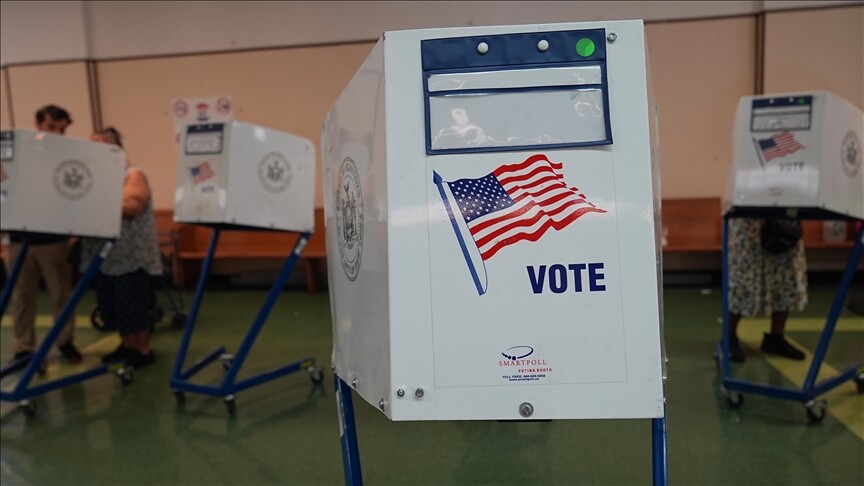
Democratic socialist Janeese Lewis George currently leads the vote tally as of Wednesday versus six other candidates in the Washington, DC Democratic mayoral primary, and if victorious, could be following in the footsteps of the most notable democratic socialist in the United States — New York Mayor Zohran Mamdani.
With 73% of the ballots counted since Tuesday’s primary election in the nation’s capital, the Associated Press (AP) has Lewis George leading with 52.9% of the vote. Her closest challenger is Kenyan McDuffie, who currently holds 36.5%.
The mayor’s office in the District of Columbia has traditionally been a Democratic stronghold, and political experts have said that any Republican challenger is not expected to put up meaningful competition for the mayor’s seat in the general election.
If Lewis George keeps her current lead and wins the majority, she will head to the November election as the favorite to replace three-term Mayor Muriel Bowser, who decided not to run for a fourth term.
A victory for Lewis George would be to the ire of US President Donald Trump, who told reporters that he could attempt a federal takeover of Washington if she won the mayor’s race, according to local media reports.
“We won’t put up with it,” Trump told reporters at a news conference.
Yet Trump has already seen a democratic socialist take power in America’s largest city, with the election of Mamdani as mayor of New York City.
Not to be outdone, the race for the mayor’s office in Los Angeles, California — the second largest city in the US by population — has a democratic socialist, Nithya Raman, in the runoff to vie for the position in November’s general election. Raman will face incumbent Democratic Mayor Karen Bass, who narrowly edged out Raman in the primary 34.3% to 29.0%.
In California’s 14th congressional district, two candidates will head to a runoff election to replace former US Rep. Eric Swalwell, who resigned from Congress in April amid allegations of sexual assault, including rape.
Aisha Wahab secured the first runoff spot on Tuesday with 38.3% of the vote, with the AP on Wednesday calling the second position to go to Melissa Hernandez, who tallied 17.2%.
The runoff election will be held on Aug. 18, with the winner finishing out the rest of Swalwell’s term.

At time of writing, the Associated Press estimates that around 64% of votes have been counted. Races where no candidate wins a majority of first choices will proceed to a ranked choice voting count – most likely the at-large Council and Ward 1 Democratic primaries. With RCV, all nominees will have support from a majority of their party – as will the winner in an at-large Council special election.
Mayor
In the closely watched mayoral race, Councilmember Janeese Lewis George leads with 52.8% of voters’ first choices, followed by former Councilmember Kenyan McDuffie at 36.6%. If Lewis George remains above 50% as the remaining votes are counted, a ranked choice tabulation will not be necessary to determine the winner.
Congressional delegate
Five candidates ran in the Democratic primary to succeed retiring Delegate Eleanor Holmes Norton. Councilmember Robert White won that election with 63.2% of first choices. Councilmember Brooke Pinto came in second with 21.5% of first choices.
At-large Council Democratic primary
Nine candidates ran for the Democratic nomination to succeed at-large Councilmember Anita Bonds. No candidate has won a majority of first choices. Oye Owolewa leads with 33.8%, followed by Lisa Raymond at 15.2% and Kevin Chavous at 13.8%. The result will likely be determined by a ranked choice voting count.
| Candidate | Share of first choices |
| Oye Owolewa | 33.8% |
| Lisa Raymond | 15.2% |
| Kevin B Chavous | 13.8% |
| Greg Jackson | 11.0% |
| Candace Tiana Nelson | 7.7% |
| Dwight Davis | 6.0% |
| Fred Hill | 5.4% |
| Dyana N. M. Forester | 3.7% |
| Leniqua’dominique Jenkins | 3.0% |
| Write-in | 0.4% |
In a choose-one election, Owolewa would have won the nomination despite 66% of voters voting for another candidate. In 2022, for instance, Councilmember Anita Bonds won the Democratic primary for this seat with only 36% of first choices. Now, ranked choice voting will ensure the nominee – whether Owolewa or someone else – has majority support.
At-large Council special election
In the special election for at-large Council, former Councilmember Elissa Silverman is leading with 54.8% of first choices, followed by appointed Councilmember Doni Crawford and Board of Education President Jacque Patterson, with 25% and 19% respectively. If Silverman maintains a majority of first choices, there will be no ranked choice tabulation.
Ward 1
In the competitive Democratic primary for Ward 1 councilmember, Aparna Raj leads with 47% of first choices. Depending on remaining ballots, Raj may win with a majority of first choices, or the winner may be determined by a ranked choice voting count.
Candidate
Share of first choices
Aparna Raj
46.7%
Michael Trindade Deramo
20.3%
Rashida Brown
17.2%
Jackie Reyes Yanes
10.0%
Terry Lynch
5.8%
Write-in
0.1%
Notably, in three Council races – the at-large Council Democratic primary, at-large Council special election, and Ward 1 Democratic primary – candidates cross-endorsed each other, asking voters to rank each other on their ballots. Past elections show that voters often listen to cross-endorsements by candidates they support, so it’s possible candidates who cross-endorsed will benefit when their races go to RCV tallies.
DC’s ranked choice voting elections offer a sharp contrast with the District’s recent past, in which candidates regularly won key primaries without majority support. Since 2012, every districtwide office and six of the eight wards have seen Democratic primaries won with less than 50% of the vote. Since 2020, Ward 2 and Ward 7 have had Democratic Council primaries won with less than 30% of the vote.
FairVote will post more analysis of the DC election over the coming week. In the meantime, visit Grow Democracy DC to learn more about RCV in DC.

-

 Sports5 minutes ago
Deion Sanders wanted more from his son, Shedeur Sanders, but backs development plan after Myles Garrett trade
-

 Technology8 minutes ago
UK to ban TikTok, YouTube, other social media apps for children under 16, Starmer says
-
 Business13 minutes ago
Commentary: A porn firm that a judge called a ‘copyright troll’ now has Meta in its sights — and it could win
-
 Entertainment20 minutes ago
Las Culturistas Culture Awards: 6 best moments from the show
-
 Politics28 minutes ago
Bill to limit prison off-ramp for the mentally ill could soon head to Newsom
-
 Sports38 minutes ago
Mexico hopes to put nerves behind it against South Korea in key World Cup match
-

 World50 minutes ago
Taiwan hopes US arms sale package can be approved soon, president says
-
 News1 hour ago
As America turns 250, one museum makes history possible to touch

