Politics
Commentary: Gerrymanders, judges and an alley-oop: A look at the midterm fight for control of Congress


Today, we discuss political jockeying, litigation and Hail Mary passes.
There’s so much going on these days …
Indeed.
Between the war with Iran, the World Cup and President Trump slapping his filigreed (emphasis greed) name on everything in sight, I’ve completely lost track of the fight for control of Congress.
Well, now that the California gubernatorial primary is in the rear view, let’s catch up. The midterm election is not until November, of course. But a fierce political competition, aimed at skewing the result, has been underway since last summer.
-
Share via
It started in Texas, where Trump strong-armed Republican lawmakers into redrawing their congressional map in hopes of boosting the GOP’s chances of keeping control of the House. That led California voters to pass an eye-for-an-eye measure aimed at boosting Democratic prospects.
Other states joined the skirmishing, capped by Virginia, where voters in April approved new political lines aimed at netting Democrats as many as four additional seats.
For a short time, it looked as though Trump’s move had backfired and Democrats might actually come out ahead, at least on paper, by a seat or two.
And then?
And then the courts stepped in.
In a 4-3 decision in May, the Virginia Supreme Court struck down the state’s new congressional map, ruling that the Democratic-run legislature had violated procedural requirements when it placed the constitutional measure on the ballot.
But the more significant legal decision came a week prior, when the U.S. Supreme Court nullified a major part of the federal Voting Rights Act, freeing several Southern states to hastily redraw a number of congressional districts to Republicans’ advantage.
What’s the bottom line?
It looks as though the GOP has come out ahead, but not by more than a handful of seats, give or take. It’s important to note that all that cartographic competition offers no guarantee of success.
“Cartographic competition?”
Those gerrymandered maps were drawn for the express purpose of helping out one party or the other, but the partisan manipulation doesn’t make all those redrawn districts a lock come November.

California Gov. Gavin Newsom signs legislation calling for a special election to redraw the state’s congressional map
(Godofredo A. Vasquez / Associated Press)
In California, for instance, the Central Valley seat held by Republican David Valadao — a perennial Democratic target — remains highly competitive. In Texas, GOP lawmakers redrew their map assuming the substantial Latino support that Trump enjoyed in 2024 would carry over to Republican candidates in this year’s midterm election. That seems increasingly less likely, given shifting Latino attitudes, which means at least two of those redrawn Texas seats are more competitive than Republicans would like.
Bottom line, where does that leave things in the fight for control of the House?
There are no certainties …
… Beyond death and taxes. Understood.
It still seems more likely than not that Democrats will win the House in November.
They just need to gain three seats. Going back more than half a century, the out party (which is to say the one not in the White House) has gained an average of more than two dozen House seats in the midterm election. So Democrats have that going for them.

President Trump kicked off a redistricting battle by strong-arming Texas into redrawing its congressional map.
(Alex Brandon / Associated Press)
Also, more significantly, Trump’s approval ratings — in a word — stink. There’s a very strong correlation between a president’s standing in polls and his party’s performance, given midterm elections are almost always a referendum on the party in the White House. Since disgruntled voters are more likely to turn out, that means the out party typically gains seats.
“It would be one thing if Republicans were trying to buck a historical trend and they were doing so strengthened by a popular Republican president,” said Jacob Rubashkin, an analyst with the authoritative nonpartisan political guide Inside Elections. “But that’s simply not the case. … [Trump] is less popular than any president heading into a midterm election in a very long time.”
What about control of the Senate?
Advantage Republicans.
How so?
Part of it is straight-up math. Democrats need to flip four seats. There are 35 Senate races being decided this fall, but only 10 or so are even remotely competitive. Nearly all are in states that Trump carried.
That said, things are looking up considerably for Democrats from where they were a few months ago.
Oh?
There’s much less correlation between presidential approval and the outcome of Senate races. Still, Trump is putting up some pretty strong headwinds that Republicans will have to overcome this fall, including in battleground states such as Georgia, Michigan and North Carolina. (His gaseous effusions — “I love the inflation,” “Affordability is a con job” — are not helpful, to put it mildly, when gasoline and hamburger are costing hard-pressed voters an arm and a leg, respectively.)
And Democrats have done about as well as they could have hoped in landing their preferred candidates in the Republican-leaning states of Alaska, Ohio and Iowa, making those contests far more competitive than they would have been.
What about Maine?
That started out as Democrats’ top target this election cycle. Five-term incumbent Susan Collins has the distinction of being the only Republican senator running in a state that Kamala Harris won. The race is still considered a toss-up.
But the nomination of Graham Platner, an oyster farmer and Marine Corps veteran with a history that is, um, problematic — a tattoo resembling a Nazi SS symbol he did or did not apprehend; extramarital sexting; coarse online commentary — could turn the race into more of a referendum on the Democrat than either Trump or Collins.
And Texas?
You mean the boneyard of Democratic dreams?
It’s been decades since the party won a statewide race in Texas, despite all manner of attempts. (The “dream team” of a white/Black/Latino slate; the streaking-comet candidacies of Beto O’Rourke and Wendy Davis, who both flamed out short of victory.)
Democrats are giddy again, this time over 37-year-old state Sen. James Talarico, who’s built a national following with his telegenic, Christian-infused progressive platform. More pertinent, he’s running against a singularly flawed Republican nominee, state Atty. Gen. Ken Paxton, whose dubious resume is muddied with a felony indictment, impeachment by the GOP-run Texas House and allegations of repeated adultery.
Still, it’s Texas. Electing Talarico would be like connecting on one of those last-second, desperation, alley-oop passes in the end zone. Not impossible.
But don’t bet the ranch.



NEWYou can now listen to Fox News articles!
President Donald Trump said Tuesday he plans to lift U.S. sanctions on Turkey and signaled he is prepared to move forward with the long-stalled sale of F-35 stealth fighter jets, marking a dramatic reversal in U.S. policy toward the NATO ally years after Ankara was expelled from the program for its purchase of a Russian missile defense system.
Speaking alongside Turkish President Recep Tayyip Erdoğan during a bilateral meeting at the NATO summit in Ankara, Turkey, Tuesday, Trump said his administration would remove sanctions imposed on Turkey’s defense sector.
“I can tell you we’re going to be taking the sanctions off, OK?” Trump said. “I don’t want him to waste his time answering that question. It’s time. We don’t sanction friends.”
TRUMP BETS ON FORMER NATO TROUBLEMAKER AS TURKEY’S STRATEGIC VALUE SURGES
Turkish President Recep Tayyip Erdogan welcomes US President Donald Trump at Ankara Airport, who is paying an official visit to Turkey ahead of the 36th NATO Heads of State and Government Summit in Ankara, Turkey, on July 07, 2026. (Dogukan Keskinkilic/Pool via REUTERS)
Asked whether he would sell F-35 fighter jets to Turkey despite existing legal restrictions tied to Ankara’s purchase of the Russian-made S-400 air defense system, Trump indicated he was open to doing so.
“Many people, including the people sitting right here thinks why wouldn’t we do that?” Trump said. “Turkey has been in many ways much more loyal than other countries that we think would be loyal.”
Pressed on concerns about Turkey’s continued possession of the S-400, Trump dismissed them.
“I have no concerns about anything.”
The remarks represent Trump’s clearest indication yet that he intends to restore defense ties with Turkey, building on months of efforts to revive military cooperation with one of NATO’s largest armed forces after years of strained relations.
Turkey was removed from the multinational F-35 program in 2019 after taking delivery of the Russian-made S-400 air defense system, prompting Washington to argue that operating the Kremlin-built system alongside America’s most advanced stealth fighter could expose sensitive U.S. technology. Congress subsequently imposed sanctions under the Countering America’s Adversaries Through Sanctions Act, or CAATSA.
‘WRITTEN IN OUR DNA’: POLISH PILOTS WHO REMEMBER SOVIET RULE PREPARE FOR AMERICA’S MOST LETHAL FIGHTER JET
Congress long has been one of the biggest obstacles to restoring Turkey’s access to the F-35, with bipartisan lawmakers arguing that Ankara should not receive America’s most advanced fighter aircraft while it continues to possess the Russian-made S-400 air defense system and pursues policies they say run counter to U.S. interests.
A U.S. airmen watches an Air Force F-35 Lightning II joint strike fighter aircraft approach for the first time on July 14, 2011 at Eglin Air Force Base in Florida. (Samuel King Jr./U.S. Air Force)
Beyond political opposition, the Trump administration also faces legal hurdles.
While the president has authority over sanctions policy, Congress enacted additional restrictions after Turkey’s purchase of the S-400. Section 1245 of the fiscal year 2020 National Defense Authorization Act bars the transfer of F-35 aircraft to Turkey unless the executive branch certifies that Ankara has met statutory requirements related to the Russian missile system.
In recent days, a bipartisan group of House lawmakers urged Trump not to move forward with an F-35 sale, arguing that doing so without satisfying those legal requirements would violate U.S. law and undermine national security.
Lawmakers also have warned that Turkey’s continued possession of the S-400, support for Hamas and tensions with fellow NATO allies Greece and Cyprus raise broader concerns about restoring Ankara’s access to the stealth fighter.
Russian S-400 missile air defence systems are seen before the military parade to commemorate the 75th anniversary of the battle of Stalingrad in World War Two, in the city of Volgograd, Russia February 2, 2018. REUTERS/Tatyana Maleyeva – UP1EE220T3A2B
CLICK HERE TO DOWNLOAD THE FOX NEWS APP
The Pentagon has maintained that the S-400’s sophisticated radar could collect data on the F-35’s radar signature and electronic profile during routine operations, potentially allowing Russia to better detect and defeat the aircraft in a future conflict if that information were shared with Moscow.
When the Trump administration removed Turkey from the F-35 program in 2019, the White House said “the F-35 cannot coexist with a Russian intelligence collection platform that will be used to learn about its advanced capabilities.”
Pentagon acquisition chief Ellen Lord similarly warned at the time that allowing Turkey to operate both systems would jeopardize the long-term security of the F-35 program because “much of the F-35’s strength lies in its stealth capabilities.”
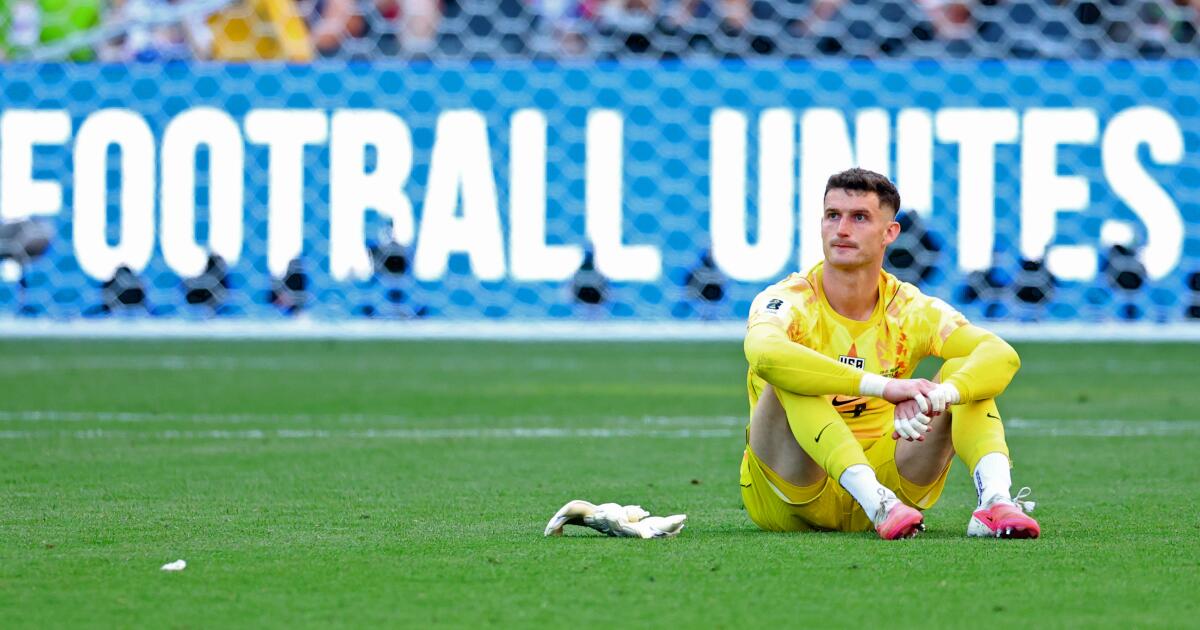
SEATTLE — Is everybody happy now? You good, Mr. President?
Put our boys in a blender, President Trump did, with those phone calls to FIFA President Gianni Infantino. Messed with their mojo by politicking to get American striker Folarin Balogun’s red card rescinded.
We’ll have to check VAR, but it might be the first time Trump succeeded at having a decision overturned.
Probably because this time what he sought to overturn — discipline stemming from Balogun’s accidental contact in the United States’ victory over Bosnia and Herzegovina — actually was unjust. Balogun should not have received a red card.
The problem is, having our President butt in here was a joke. Unfunny and out of bounds, offsides, an own goal — all of the things.
It put the U.S. team at the center of a geopolitical maelstrom, which is exactly what they did not need in the hours before the biggest match of their lives and the biggest match in the history of the U.S. men’s soccer program.
Some 40 or 50 million viewers were expected to tune in; how many of them watched for the first time? And what sort of impression did Monday’s 4-1 blunder-filled meltdown against Belgium make? That we stink at soccer — still?
If you were one of them, please, believe your soccer-fan friends when they tell you the Americans played much better in previous matches.
But so much for a magical run. On their home turf, the Americans pulled up lame before the finish line (aka, for the U.S. team’s purposes, its first quarterfinals since 2002).
To their credit, after the debacle, members of the U.S. team didn’t complain about anything being rigged. They didn’t use the distraction as an excuse. And they didn’t point fingers at anyone — anyone at all.
U.S. striker Folarin Balogun (20) walks to the locker room at halftime against Belgium in the World Cup on Monday at Lumen Field in Seattle.
(Allen J. Schaben / Los Angeles Times)
“We’re playing on home soil,” defender Chris Richards said. “So the only pressure we put on ourselves is to perform for our country, and ultimately didn’t feel the way we wanted to today. But I don’t think the antics of the last 24 hours had anything to do with it.”
No, they said the “debate,” or “outside noise” or “political manipulation” — as Tim Ream, Alex Freeman and coach Mauricio Pochettino described what others are calling “Balogate” — were not to blame for the gut-punch that answered the question: Why not us?
Because the U.S. is not yet good enough to beat the world’s great teams. Especially not when their pregame preparation includes having to try to block out an international uproar.
To have any hope against the Belgians in the round of 16 — a matchup between FIFA’s Nos. 9- and 17-ranked sides — the Americans needed to be going full-tilt, to be focused and ferocious and probably also a little bit lucky.
Instead, they looked shook, rattled. And they got rolled.
They were the worst version of themselves at the worst time, which was so weird from a team that had been on its front foot from the first whistle against Paraguay.
Not Monday. Against Belgium, they were on their heels from the outset. Heavy touches, slow afoot, playing like they had the weight of the World Cup on their shoulders.
And all that White House maddening meddling — for what?
Balogun started and played most of the match, but it could just as well have been reserve striker Ricardo Pepi. Or you or me, Balogun was that ineffective.
His play of the day came postmatch, when he approached Belgian coach Rudi Garcia and the two had a respectful exchange. A real diplomat, that Brooklyn-born, Britain-raised American by birthright.

This loss was a real team effort, of course. Christian Pulisic came off in the 59th minute after twisting his right ankle — leaving this World Cup without a goal in the four matches he appeared.
Matt Freese, the Harvard-educated starting goalkeeper, had a brain cramp of epic proportions when he stepped outside of the box and failed to corral a ball. Belgium’s Charles De Ketelaere kicked it loose and set up Hans Vanaken, whose shot traveled behind Ream for an easy score that made it 3-1 in the 57th minute.
There was a lot of poor decision-making with this match, on and off the pitch.
In the end, Trump’s appeal to Infantino did more harm than good. But what if some good could come from it?
Hey, FIFA, what about giving teams a process to appeal cards, like our American athletes in the NBA, NFL and MLB have?
Offering a suggestion box wouldn’t be opening Pandora’s box, not if it were a transparent and regular part of the game that would, hopefully, offer increasingly fair outcomes in a tournament where every match is so monumental — as our President recognized, much too enthusiastically.

U.S. coach Mauricio Pochettino waves to the crown after a 4-1 loss to Belgium at the World Cup on Monday.
(Allen J. Schaben / Los Angeles Times)
Prosecutors on Monday began laying out their case against the man accused of murdering Charlie Kirk. It was the first day of a weeklong preliminary hearing that will determine whether or not there is enough evidence against the accused killer to stand trial.
-

 Pennsylvania2 minutes ago
The 11 Most Picturesque Small Towns in Pennsylvania
-

 Rhode Island5 minutes ago
The Must C’s of Rhode Island
-

 South-Carolina10 minutes ago
When is South Carolina’s tax free weekend? Here’s what to know
-

 South Dakota17 minutes ago
150-mile power line to connect substation near Fargo to northeast South Dakota
-

 Tennessee20 minutes ago
When is Tennessee’s tax-free weekend in 2026? Here’s what you need to know
-
Texas25 minutes ago
Trump takes credit for Toyota moving some truck production from Mexico to Texas: ‘That’s what tariffs do’
-

 Utah32 minutes ago
Utah Shutters Boarding School Paris Hilton Says Abused Her
-

 Vermont35 minutes ago
Letter to the Editor | Judy Murphy: In support of Molly Gray

