Washington, D.C
11 Fun Ways to Get on the Water This Summer


Whitlow’s on Water is the biggest boat in Sea Suite Cruises’ fleet. Photograph by Jack Walten.
All aboard! A great way to take in the views of DC’s majestic monuments and landmarks is on a boat adventure. Here’s a list of fun water trips to add to your summer plans:
Go hydro biking
Potomac Ave., SE and 710 Wharf St., SW
Boating in DC offers a unique experience: biking on the water while balancing on two floating rafts. The “hydro bikes” are stable pontoon bikes that can be rented at the Wharf Boathouse, and, starting on May 18, at Ballpark Boathouse in Navy Yard (Fri-Sun through October, $26+).
Picnic on a boat
970 Wharf St., SW

Sail across the Washington Channel—no boating license necessary—in a GoBoat you can rent at the Wharf. The electric boats travel at a speed of about three to four miles an hour, so you can do a leisurely cruise while sightseeing with friends. GoBoats carry up to eight passengers—including pets, for an additional fee. On this ride you are the captain, and are welcome to bring food and drinks (daily, $168+).
Explore on a paddleboard
Multiple locations in DC and Virginia
Test your balance and paddling skills on a standup paddleboard; you can find rentals throughout the area. Just south of Alexandria, paddlers can explore Dyke Marsh Wildlife Preserve, the largest freshwater tidal wetlands near DC, with paddleboards rented from Belle Haven Marina. Boating in DC also rents boards in Georgetown, the Wharf, Alexandria, and Fletcher’s Cove (daily, $16+ for Boating in DC rentals, $30+ for Belle Haven Marina).
Sail on a historic ship
201 N. Union St., Alexandria
Travel back in time to the 18th century aboard the Tall Ship Providence, docked in Alexandria. History guides dressed in period garb talk about the life of sailors in the Revolutionary War. The floating classroom offers dockside tours, sunset cruises, and tasting journeys on the water ($55+ for daily sunset cruises, Wed-Mon; $24 for dockside tours; $76 select dates for tasting journeys).
Party with friends
Multiple locations in DC


Choose a starting point—DC’s Wharf, Georgetown, or Navy Yard—and invite some friends to pedal across DC waters on a Potomac Paddle Club pontoon. There are 10 cycling stations for guests to get active while passing by sites such as the Frederick Douglass Memorial Bridge and Pentagon. Boats can accommodate between 16 to 20 people, and are equipped with coolers, USB charging stations, Bluetooth speakers, and a motor if you prefer not to pedal; you can bring your own beverages aboard, too (daily, $35+).
Go on a Classic DC Outing
1501 Maine Ave., SW
Prepare to move your feet on the Tidal Basin’s pedal-powered, four-passenger boats. Boating in DC offers one-hour rentals for this classic DC experience (daily, $38 on weekdays, $40 on weekends and holidays).
Take a culinary cruise
970 Wharf St., SW
Upgrade your boating experience this summer on a yacht. Nautiste— a woman-owned yacht-charter company—launched last year. It offers three options for a luxe water journey: two motor yachts, the 72-foot Patriot and the more intimate 42-foot Independence, as well as the Cru Classé, a 47-foot French sailing yacht. The fleet ports at the Wharf. There are options to add dining experiences such as champagne and oyster tastings, or charcuterie spreads, for an additional price (private bookings, prices vary).
Throw a tiki party
3100 K St., NW and 355 Water St., SE

If you’re looking for a booze cruise, Potomac Tiki Club has you covered. These Potomac River explorations feature a tiki bar where guests can purchase drinks; guests can also sip beverages they packed from home. There are two boats to choose from: a smaller boat that fits up to six people and leaves from Navy Yard, and a larger boat departing from Georgetown that fits eight to 18 people (daily, $45+ for Georgetown cruises, $350+ for Navy Yard).
Visit a local bar on a boat
3100 K St., NW and 1492 4th St., SE
The local bar Whitlow’s recently launched a 48-passenger tiki boat cruise in collaboration with Sea Suite Cruises. Whitlow’s on Water— which has televisions, music, and an open-air bar mixing up summery drinks—sails the Potomac River. The boat is also available for private charters (daily, $40+, Georgetown, Navy Yard). (Here’s more.)
Paddle the Anacostia River
4601 Annapolis Rd., Bladensburg
Spend some time exploring a quiet stretch of the Anacostia River by yourself in a single kayak, or take a serene canoe trip. Rentals can be booked from Bladensburg Waterfront Park through October (daily, $25+ for Prince George’s and Montgomery County residents, $33+ for non-residents).
Enjoy sunset views
3000 K St., NW and 580 Water St., SW
Capitol River Cruises and City Cruises are great boat options for sunset tours, date-night dining, and monument sightseeing around DC. On City Cruises, you can have a three-course meal and dance to a live DJ while overlooking the Potomac; on special occasions there are firework shows, too. Capitol River Cruises ship out around 8 PM for 45-minute journeys past the Kennedy Center, the Jefferson Memorial, the Capitol, and the Lincoln Memorial (daily, $25+ for Capitol River Cruises; daily, $52+ for City Cruises).
Voyage to Mount Vernon
145 National Plaza, National Harbor; 0 Cameron St., Alexandria
Tickets will be available soon for this experience that includes spending time at historic Mount Vernon. First, patrons cruise to George Washington’s former estate by way of a water taxi, which departs from Alexandria and National Harbor. On-board guides provide narration as guests pass sites such as Fort Washington. After the boat ride, passengers have three hours to tour Mount Vernon before the boat ride back (schedule TBA, $56+).

Briana A. Thomas is a local journalist, historian, and tour guide who specializes in the research of D.C. history and culture. She is the author of the Black history book, Black Broadway in Washington, D.C., a story that was first published in Washingtonian in 2016.



One family, four generations with DC Metro
As Metro celebrates 50 years of service, one D.C. family is marking the milestone with a legacy of their own — four generations who have all worked on the system, helping keep the region moving for decades.
WASHINGTON – D.C. residents got on their first Metro train 50 years ago on March 27, 1976. Here’s a look back at the beginning.
Connecticut Avenue; NW; looking south. evening traffic-jams are aggravated by metro subway construction in Washington D.C. ca. 1973 (Photo by: HUM Images/Universal Images Group via Getty Images)
View of the Metro Center subway station (at 13th and G Streets NW) during its construction, Washington DC, November 16, 1973. (Photo by Warren K Leffler/PhotoQuest/Getty Images)
Standing in the cavernous tunnel, planners wearing hard hats discuss the construction progress of the Metro Center subway station at the intersection of 13th and G Streets in Washington, DC, November 16, 1973. (Photo by Leffler/Library of Congress/In
WASHINGTON, DC – NOVEMBER 07: FILE, Metro construction miners and blasters on a jumbo drill outside the hole they are working on at Rock Creek Parkway and Cathedral Ave NW in Washington, DC on November 7, 1973. (Photo by James K.W Atherton/The Washin
WASHINGTON, DC – MARCH 4: FILE, View of the Post Office at North Capital and Mass Avenue NE, and 1st NE where subway tunnels were being constructed in Washington, DC on March 4, 1974. (Photo by Joe Heiberger/The Washington Post via Getty Images)
WASHINGTON, DC – AUGUST 29: FILE, Workers rig a pipe at the entrance to the Rosslyn Metro Station in Washington DC on August 29, 1974 (Photo by Larry Morris/The Washington Post via Getty Images)
WASHINGTON, DC – MARCH 27: FILE, The crowd at Rhode Island Station on opening day of the Washington Metro on March 27, 1976. (Photo by James A. Parcell/The Washington Post via Getty Images)
WASHINGTON, DC – MARCH 28: FILE, Reverend Leslie E. Smith of the Episcopal Church, right, and George Docherty of New York Avenue Presbyterian church hold a joint service at the new Metro Center station in Washington, DC on March 28, 1976. (Photo by D
WASHINGTON, DC – JULY 1: FILE, An aerial view of metro construction where it crosses the Washington Channel. The Potomac River, the Pentagon and Northern Virginia can be seen in the distance. (Photo by Ken Feil/The Washington Post via Getty Images)
WASHINGTON, DC – JANUARY 27: FILE, A packed train of commuters on the Silver Spring metro on the Red Line on January 27, 1987. (Photo by Dudley M. Brooks/The Washington Post via Getty Images)
WASHINGTON, DC – JULY 4: FILE, Thousands of people press their way into the Smithsonian Subway station after the Independence Day fireworks in Washington, DC on July 4, 1979. (Photo by Lucian Perkins/The Washington Post via Getty Images)

Among the liquor store, barber shop and dry cleaners at the Watergate Complex’s retail plaza, there is a new pop-up museum dedicated to the scene of the crime that toppled Richard Nixon’s presidency.
Among the liquor store, barber shop and dry cleaners at the Watergate Complex’s retail plaza, there is a new pop-up museum dedicated to the scene of the crime that toppled Richard Nixon’s presidency.
The temporary exhibit features the work of artist Laurie Munn — portraits of members of the Nixon administration and those connected to the Watergate break-in. The exhibit features members of Congress, the media and some who were on Nixon’s enemies list.
Keith Krom, chair of the Board of Directors of the Watergate Museum, told WTOP the exhibit was first featured in the gallery in 2012 for the 40th anniversary of the break-in at the Democratic National Committee.
“When she (Munn) learned about our museum effort, she offered to reassemble them as a way for us to expand awareness of the museum,” Krom said.
Krom, who lives in the Watergate, said his favorite portrait is of one of the special prosecutors, whose firing sparked the “Saturday Night Massacre” in 1973.
“I had the pleasure of being a student of Archibald Cox,” Krom said. “He served as my mentor for my third-year writing project.”
Krom said during this time, at the Boston University School of Law, he spent a great deal of time with him.
“I didn’t realize how much he must have gone through. Here he was, this one man, who was challenging the president of the United States over something pretty serious,” Krom said.
The pop-up opened in October and was recently extended to stay open until April 25. Krom said the hope is to find it a permanent location within the Watergate Complex, where they can “present the history of Watergate, but with two perspectives.”
The first would be on the building’s “architectural significance to D.C.,” he said.
“You may not like the design, you actually may hate it,” Krom said. “But you cannot deny that it changed D.C.’s skyline.”
The secondary focus would, of course, be on the mother of all presidential scandals that changed the course of American history.
“That’s where that suffix ‘-gate’ started and continues to be used for almost every scandal that comes out today,” Krom said.
The inspiration for the museum spawned from an interaction from a tourist outside the Watergate.
“He says, ‘This is the Watergate, right?’ And I was like, ‘Yeah, it’s one of the buildings,’” Krom recalled.
The tourist then asked Krom, “So where’s the museum?”
“I was like, ‘Oh, we don’t have a museum.’ And he literally just looked at me and said, ‘That’s so sad.’ And he got on his bike and rode away,” Krom said.
While the self-proclaimed political history nerd said he “still gets goose bumps” when he drives by the Capitol at night, Krom hopes that when people leave the museum, “they’ll walk away with a new appreciation for how our government works, the guardrails that are in place.”
“Maybe an understanding that those guardrails themselves are kind of frail, and they probably need our collective help in making sure they last — that’s what we hope to accomplish,” Krom said.
Get breaking news and daily headlines delivered to your email inbox by signing up here.
© 2026 WTOP. All Rights Reserved. This website is not intended for users located within the European Economic Area.

According to the National Park Service at the National Mall, famous cherry blossoms around the nation’s capital have hit peak bloom conditions. The National Park Service X account for the National Mall proclaimed this morning, “PEAK BLOOM! PEAK BLOOM! PEAK BLOOM!”
It became apparent yesterday that the bloom would be at peak today. “Despite a sunny afternoon and patches of blue sky, the cherry blossoms remain at Stage 5: Puffy White,” the Park Service wrote on X yesterday. Stage 5, “Puffy White”, is the final stage blossoms go through before being in full bloom. They start at Stage 1 as a “Green Bud”, grow into Stage 2 with “Florets Visible”, and then florets become extended at Stage 3. In Stage 4, there is “Peduncle Elongation” which sets the stage for the puffy blossoms to appear in Stage 5. Puffy White and Peak Bloom are defined as when 70% of the blossoms on the trees reach that stage.

Peak bloom varies annually depending on weather conditions; the most likely time to reach peak bloom is between the last week of March and the first week of April. According to the Park Service, extraordinary warm or cool temperatures have resulted in peak bloom as early as March 15 in 1990 and as late as April 18 in 1958.
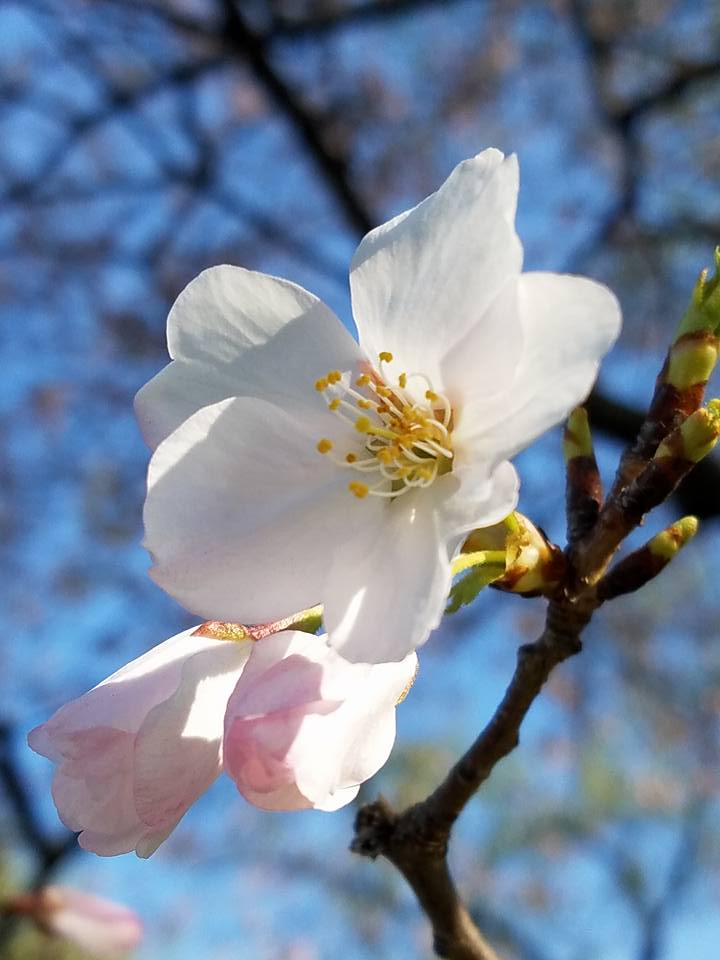
The planting of cherry trees in Washington DC originated in 1912 as a gift of friendship to the People of the United States from the People of Japan. In Japan, the flowering cherry tree, or “Sakura,” is an important flowering plant. The beauty of the cherry blossom is a symbol with rich meaning in Japanese culture.
Dr. David Fairchild, plant explorer and U.S. Department of Agriculture official, imported seventy-five flowering cherry trees and twenty-five single-flowered weeping types from the Yokohama Nursery Company in Japan. After experimenting with growing them on his own property in Maryland, he deemed that the cherry tree would be perfect to plant around the Washington DC area. This triggered an interest by a variety of individuals to plant the tree around Washington. In 1909 the Mayor of Tokyo, Yukio Ozaki, donated 2,000 trees to the United States on behalf of his city. When the trees arrived, they were riddled with disease and insects and to protect other agriculture, they were burned. The Tokyo Mayor made a second donation of trees in 1910, this time amounting to 3,020 trees. This started the forest of cherry trees that now line the Potomac basin around Washington DC. In a gesture of gratitude back to Japan, President Taft sent a gift in 1915 of flowering dogwood trees to the people of Japan. Thousands of trees have been added since, including another gift of 3,800 trees from Japan in 1965.


Trump floats sending federal agents to San Francisco to tackle crime

Dallas ISD will offer free pre-K starting next school year

Norwegian Cruise Line offers a first look at Luna, new cruise ship setting sail from PortMiami – WSVN 7News | Miami News, Weather, Sports | Fort Lauderdale

Boston ‘No Kings’ rally expected to draw 100,000; others planned across Mass.

Jazz List 8 Players on Injury Report vs. Nuggets

Florida High School Football Rankings: Top 25 teams – Oct. 21

How old is Bo Nix? What to know about Oregon quarterback ahead of 2024 NFL Draft

Cleary's 21 help Le Moyne down Central Connecticut State 69-64 in OT

99th annual Pony Swim held in Virginia

Indiana Members Credit Union announced as new anchor tenant at Bottleworks District

Video: Will ICE Change Under Its New Leader?

DHS shutdown breakthrough comes at cost for Republicans as funding fights nears end

Rubio joins crucial G7 talks as Iran war set to dominate second day

A surprise resignation could open the door for an independent to win a Montana Senate seat

Video: Savannah Guthrie Says She Believes Her Mother Was Taken for Ransom
-

 Detroit, MI1 week ago
Drummer Brian Pastoria, longtime Detroit music advocate, dies at 68
-

 Science1 week ago
How a Melting Glacier in Antarctica Could Affect Tens of Millions Around the Globe
-
 Science1 week ago
I had to man up and get a mammogram
-

 Movie Reviews1 week ago
‘Youth’ Twitter review: Ken Karunaas impresses audiences; Suraj Venjaramoodu adds charm; music wins praise | – The Times of India
-

 Sports6 days ago
IOC addresses execution of 19-year-old Iranian wrestler Saleh Mohammadi
-

 New Mexico5 days ago
Clovis shooting leaves one dead, four injured
-
 Business1 week ago
Disney’s new CEO says his focus is on storytelling and creativity
-

 Technology5 days ago
YouTube job scam text: How to spot it fast