Virginia
Virginia’s new legislative session kicks off Wednesday


Incoming House Speaker Don Scott is ready to get to work.
“I think there are a lot of things that we can agree on with the governor,” said Scott, D-Portsmouth. “I think there will be a lot of bipartisan legislation coming out.”
After a heated election season marked by tight races and record spending, leaders are cooling the rhetoric as they ready for the legislature to reconvene Wednesday for its annual session. Democrats recently held the Senate and took back the House of Delegates, but with Republican Gov. Glenn Youngkin wielding power from the executive branch, neither party will have total control.
“We all have to come together in order to progress legislation,” Youngkin said at a news conference after the elections. “We’re going to have to find a way to get things done. I’m optimistic that we can.”
___
Middle ground
Scott said he believes both parties are largely on the same page when it comes to the need for more funding to help with addiction and mental health.
A recent report from a panel that conducts research for the General Assembly concluded that staff and patient safety is lacking at state psychiatric hospitals. The report, issued by the Joint Legislative Audit and Review Commission, found many facilities struggle with overcrowding, staffing shortages and structural hazards.
“I think we can all agree that the mental health system needs more upgrading and more work and investments,” Scott said.
He also expects both parties will work together on plans to bring new professional sport teams to Virginia.
Youngkin reached a tentative deal last month with the parent company of the NBA’s Washington Wizards and NHL’s Washington Capitals to move those teams to Alexandria. But it needs the legislature’s approval.
“Bringing the teams to that region could benefit the entire commonwealth by bringing in some revenue to help deal with transportation,” Scott said.
Editorial: Let this legislative session advance the cause of government transparency
Although gun safety legislation is trickier, Scott is holding out hope for some middle-of-the-road solutions.
A bill last year allowing a $300 income tax credit for the purchase of safety equipment, such as gun storage safes or trigger locks, was signed into law by the governor after passing the legislature with nearly unanimous support.
The measure is intended to incentivize responsible gun ownership and help prevent children from accessing firearms. Guns are the leading cause of death for children and teens in the United States since surpassing car accidents in 2020.
“I think there is some hope in getting another bill like that out, and I think there is some hope in getting the governor to sign it,” Scott said.
The speaker-elect said one possible measure would involve strengthening the rules and penalties for leaving a firearm in a vehicle.
“The chief of police in my city says a lot of these guns (used in crimes) are getting out because irresponsible gun owners are leaving them in unlocked cars and people are stealing them,” he said.
___
Budget
The state budget is another area that will require compromise. The General Assembly is tasked this year with crafting a two-year plan for the state.
“I would ask us to commit ourselves to deliver a budget on time when you adjourn sine die in March,” Youngkin told legislators at a joint committee hearing last month. “Virginians deserve it, and I know we can do it.”
Legislators last year debated a series of amendments to the 2022 budget. Negotiations went into overtime after the Senate and House clashed over tax cuts. A consensus wasn’t reached until late August.
Youngkin’s budget proposal — unveiled last month — will serve as a starting point for this year’s negotiations. His plan would cut income taxes by 12% across all income brackets and raise the state sales tax from 4.3% to 5.2%. It would also expand the sales and use tax base to include digital goods.
This year’s negotiations will be spearheaded by House Appropriations Committee Chair Barry Knight and Sen. Louise Lucas, the newly-elected chair for the Senate Finance and Appropriations Committee.
Lucas, a Portsmouth Democrat, has signaled she’s less than impressed with the governor’s proposal.
“I will not support a budget that further erodes Virginia’s long-term revenues or uses worn out gimmicks in a budget when a predicted recession has not yet materialized,” Lucas wrote on X, the social media platform formerly known as Twitter.
More surprisingly, the proposal also faced criticism from at least one Republican. Sen. Bill Stanley of Franklin County recently told Cardinal News the governor’s plan is “tone deaf” and said he believes increasing sales tax will disproportionately hurt rural and inner-city residents.
Meanwhile, Knight, a Virginia Beach Republican, said it was a good starting point.
“Like any proposal, it’s a proposal,” he previously told The Virginian-Pilot. “Every governor’s budget is put out there, and then we take it and go through it from there.”
___
Constitutional amendments
While there may be some middle ground to be found, Democrats and Youngkin aren’t likely to see eye-to-eye on longstanding culture war issues. And with narrow majorities in both chambers, Democrats won’t have the votes to override a veto from the governor.
Constitutional amendments, however, allow legislators to circumvent the executive branch. A constitutional amendment must pass the General Assembly during two legislative sessions with an election in between. The amendment then only needs approval from Virginia voters to take effect.
Scott said Democrats have already begun prefiling amendments.
Five legislators introduced a measure that would protect reproductive rights, including Lucas and Sen. Mamie Locke of Hampton.
“Every individual has the fundamental right to reproductive freedom,” it states. “This right to make and effectuate one’s own decisions about all matters related to one’s pregnancy shall not be denied, burdened, or infringed upon, unless justified by a compelling state interest.”
Abortion rights have become a focus in Virginia since the U.S. Supreme Court overturned the landmark Roe v. Wade ruling in 2022.
Locke further introduced an amendment that would automatically restore voting rights to residents who’ve served their time for a felony conviction. Those with a felony conviction lose the right to vote in Virginia, and the only way to get it back is to receive approval from the governor.
Meanwhile, Sen. Adam Ebbin, D-Alexandria, prefiled an amendment that would remove language in the state constitution defining marriage as a union between one man and one woman. Since Roe fell, same-sex marriage advocates have become concerned that the Supreme Court might also overturn Obergefell v. Hodges, the ruling that legalized same-sex marriage nationwide.
Given the state’s election schedule, any potential new amendments wouldn’t go before the state’s voters for approval until 2026.
Katie King, katie.king@virginiamedia.com


RICHMOND, Va. — Jerrod Buford first picked up a paintbrush as a kid, never imagining that same creative outlet would carry him through his darkest days in prison.
Buford, who grew up in Williamsburg, was convicted and arrested as a young man and spent almost a decade behind bars. During that time, he struggled deeply.
“Turning to drugs and alcohol to kind of shadow over emotions,” Buford said. “Looking for acceptance, approval. Not just from my parents, but from friends, from, you name it. I mean, I tried to commit suicide, I don’t even know how many times,” Buford said.
WTVR
It was inside prison walls that art became more than a hobby.
“Throughout my prison time, I learned, the freedom that I desired, I’ve always had it. I got, I found it, in a box,” Buford said.
More than three years after his release, Buford continues to advocate for art as a tool for healing. He describes his work as a gift he feels called to share.
“I received a blessing from God that just allowed me to display what he’s given me,” Buford said.
For Buford, creating art is also a way of processing his past.
“That’s what art has done for me. It’s given me the ability to look at parts of my life, all parts of my life, and find the good and the negative, learn from the negative,” Buford said.
He shares his story and artwork with a wide audience through social media, including live sessions on TikTok, and holds art classes with new communities.
The Story Cafe
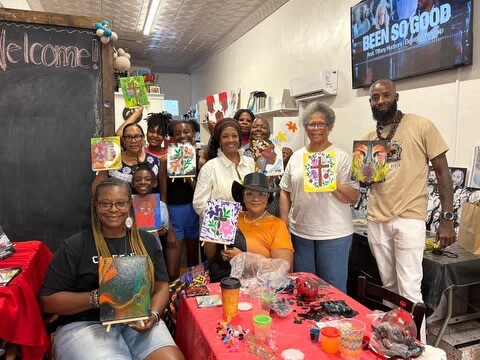
Buford said his mission is to help others find their own path toward healing — whatever form that takes.
“What I strive to do is guide this person to just create, man. Don’t care what people think about your creation, you just need to get it out,” Buford said. “Whether it’s with art, addressing your mental health, getting your life right — just do it.”
CBS 6 is committed to sharing community voices on this important topic. Email your thoughts to the CBS 6 Newsroom.
📲: CONNECT WITH US
Blue Sky | Facebook | Instagram | X | Threads | TikTok | YouTube

This story was initially reported by a journalist and has been converted to this platform with the assistance of AI. Our editorial team verifies all reporting on all platforms for fairness and accuracy. To learn more about how we use AI in our newsroom, click here.

Lovingston, VA (7News) — Good Morning Washington interviews Amanda Beckwith of Virginia Distillery Company- one of the contributing distilleries to the Virginia Spirits Board’s 250th Celebration Trio Pack, a special, exclusive release created to commemorate America’s upcoming 250th anniversary. This limited-edition package features a curated collection of a rum, a gin, and a whiskey, all crafted from scratch by distillers in Virginia to celebrate the rich history and current state of distilling within the Commonwealth.
Beckwith elaborates on VA Distillery Company’s role in the project, noting her focus on Virginia-grown grain to make the bottle of unique whiskey that is included in the Trio Pack. It is also worth noting that the Trio Packs themselves were bottled and produced right here at Virginia Distilling Company!
American single malts are the newest official category of American whiskey, distilled from one grain and from a single distillery. Virginia Distillery Co specializes in this new category of whiskey and crafted their contribution to the Trio Pack with this very specialty. Given the limited remaining availability of the Trio Pack, its historical value and collectible nature, the message it loud and clear encouraging viewers to grab a pack before they are all gone!
BE THE FIRST TO COMMENT
21+ Please drink responsibly, this content is sponsored by Virginia Distillery Company.


Powerball, Mega Millions jackpots: What to know in case you win
Here’s what to know in case you win the Powerball or Mega Millions jackpot.
Just the FAQs, USA TODAY
The Virginia Lottery offers multiple draw games for those aiming to win big.
Here’s a look at June 24, 2026, results for each game:
Powerball
Powerball drawings are held Monday, Wednesday and Saturday at 11 p.m.
13-14-16-21-38, Powerball: 14, Power Play: 2
Check Powerball payouts and previous drawings here.
Saturday, June 27, 2026
Pick 3
DAY drawing at 1:59 p.m. NIGHT drawing at 11 p.m. each day.
Night: 3-1-5, FB: 8
Day: 7-8-8, FB: 4
Check Pick 3 payouts and previous drawings here.
Pick 4
DAY drawing at 1:59 p.m. NIGHT drawing at 11 p.m. each day.
Night: 4-7-2-1, FB: 7
Day: 7-3-4-6, FB: 3
Check Pick 4 payouts and previous drawings here.
Pick 5
DAY drawing at 1:59 p.m. NIGHT drawing at 11 p.m. each day.
Night: 7-5-2-6-9, FB: 0
Day: 6-9-4-0-7, FB: 0
Check Pick 5 payouts and previous drawings here.
Cash Pop
Drawing times: Coffee Break 9 a.m.; Lunch Break 12 p.m.; Rush Hour 5 p.m.; Prime Time 9 p.m.; After Hours 11:59 p.m.
Coffee Break: 12
After Hours: 08
Prime Time: 13
Rush Hour: 01
Lunch Break: 14
Check Cash Pop payouts and previous drawings here.
Cash 5
Drawing every day at 11 p.m.
09-12-15-24-43
Check Cash 5 payouts and previous drawings here.
Bank a Million
Bank a Million draws are held every Wednesday and Saturday at 11 p.m.
18-21-25-33-36-39, Bonus: 13
Check Bank a Million payouts and previous drawings here.
Millionaire for Life
Drawing everyday at 11:15 p.m.
03-04-10-36-37, Bonus: 05
Check Millionaire for Life payouts and previous drawings here.
Feeling lucky? Explore the latest lottery news & results
This results page was generated automatically using information from TinBu and a template written and reviewed by a Center for Community Journalism (CCJ) editor. You can send feedback using this form.
-
Virginia5 minutes ago
Virginia man uses art to heal after years in prison, mental health battle
-

 Washington8 minutes ago
AJ Dybantsa arrives in Washington, ready to work on turning Wizards around
-

 Wisconsin13 minutes ago
What’s the Wisconsin wolf population? DNR issues latest estimate.
-

 West Virginia20 minutes ago
Register now: West Virginia’s largest yard sale grows with more Webster County sellers for 2026
-

 Wyoming23 minutes ago
Dan Speas Fish Hatchery temporarily closed to visitors as construction begins on new cool-/warm-water expansion
-

 Crypto28 minutes ago
Crypto Insiders Say Daily Senate Meetings Keep CLARITY Act Alive | PYMNTS.com
-

 Finance35 minutes ago
How digital payments are reshaping a fast-growing digital banking market
-

 Fitness38 minutes ago
Exercise Tips From Dr. Schwartz for Summer Fitness – MyRye.com

